wayground logo

Free Printable Worksheets

NEW

Font size

S
M
L
XL
Worksheets

Ap government Unit 1

Total questions: 63

Worksheet time: 1hrs 15mins
Name
Class
Date
1.
Which of the following are identified in the quote?"We hold these truths to be self-evident, that all men are created equal, that they are endowed by their Creator with ... Life, Liberty and the pursuit of Happiness..."
a)
economic rights
b)
unalienable rights
c)
legal rights
d)
states' rights
2.
According to the Declaration of Independence, the main purpose of a government is to-
a)
ensure the stability of the economy
b)
protect the rights of the individual
c)
provide strong military leadership
d)
protect a nation from foreign invasions
3.
According to the Declaration of Independence, from where does government get the power to achieve its purpose?
a)
it is endowed by nature
b)
from the permission of the king
c)
from the authority of parliament
d)
from the consent of the governed
4.
What is Popular Sovereignty?
a)
Being popular in the world
b)
People voting and having a say in the governments decisions
c)
People voting
d)
The act of the 20th admendment and it’s rules.
5.

Federalists believed that the Articles of Confederation were a ________ and set up a ________ National Government.

a)

Success, Strong.

b)

Success, Weak.

c)

Failure, Weak.

d)

Failure, Strong.

6.

In Federalist Paper #10, what is a faction?

a)

a majority tyranny

b)

the extended sphere

c)

special interest groups

d)

the new Constitution

7.

"Liberty is to faction what air is to fire", James Madison wrote.

a)

True

b)

False

8.

How did James Madison view the existence of “faction” in America?

a)

He feared faction and felt that there was no way to control it.

b)

He liked faction and wanted the strongest faction to dominate

c)

He refused to acknowledge that any factions existed in the new nation.

d)

He feared faction but thought its effects could be managed by the existence of many competing factions.

9.

The Anti-Federalists in Brutus #1 argue that the proposed constitution would create too _________ a republic, a system of government that has never successfully existed in history.

a)

small

b)

large

c)

weak

d)

divided

10.

Brutus #1 argues that the proposed Constitution would create a republic so large that representation would be "so numerous as to be incapable of transacting public business." This is an argument against a _________ system.

a)

elitist

b)

pluralist

c)

communist

d)

fascist

11.
Under the Articles of Confederation, which government had the MOST power?
a)
Legislative branch
b)
the president
c)
the state governments
d)
national government
12.
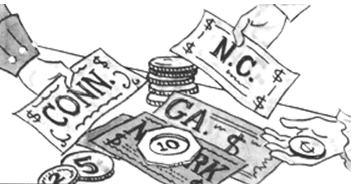
Which of the following weaknesses  in the Articles of Confederation does  this picture represent?
a)
no common currency (money)
b)
no executive branch
c)
no power to tax
d)
one vote for each state
13.
Which of the following is an example of a weakness in the Articles of Confederation?
a)
Congress couldn't collect taxes
b)
Weak national government
c)
Provided no common currency/money for all 13 states
d)
All of the  above
14.

Under the Articles of Confederation, the national government consisted of _______________ branch of government.

a)

3

b)

2

c)

1

d)

4

15.
In order to change (amend) the Articles of Confederation,  __________ out of 13 states had to agree. 
a)
9
b)
10
c)
13
d)
15
16.
Under the Articles of Confederation, each state got __________ vote. 
a)
b)
2
c)
1
d)
5
17.
What did Shays' Rebellion help Americans realize they needed?
a)
A strong national government
b)
A stronger militia
c)
A common currency
d)
The ability to sign peace treaties
18.
The Great Compromise was a compromise between--
a)
Mass. Plan and New Jersey Plan
b)
Virginia Plan and New Jersey Plan
c)
Virginia Plan and New York Plan
d)
Virginia Plan and Delaware Plan
19.
The Virginia Plan wanted representation based on--
a)
population
b)
equality for every state
c)
state size
d)
money
20.
The New Jersey Plan wanted representation in government based on--
a)
population
b)
equality for every state
c)
state size
d)
money
21.
The 3/5 Compromise settled the argument of--
a)
Representation in the Senate
b)
How slaves should be counted for representation
c)
How states should be represented
d)
Borders of states
22.
Congress is made up of two houses, which one has equal representation of 2 representatives per state?
a)
House of Burgesses
b)
Senate
c)
House of Representatives
d)
Continental Congress
23.

What does Article I (1) establish?

a)

Legislative Branch

b)

Judicial Branch

c)

Executive Branch

d)

Supremacy of the Constitution

24.

What does Article II (2) establish?

a)

Legislative Branch

b)

Judicial Branch

c)

Executive Branch

d)

Supremacy of the Constitution

25.

What does Article III (3) establish?

a)

Legislative Branch

b)

Judicial Branch

c)

Executive Branch

d)

Supremacy of the Constitution

26.

What does Article IV (4) establish?

a)

The Constitution is Supreme

b)

How to amend the Constitution

c)

How to ratify the Constitution

d)

Relationships between the states

27.
What does Article V (5) establish?
a)
The Constitution is Supreme
b)
How to amend the Constitution
c)
How to ratify the Constitution
d)
Relationships between the states
28.
What does Article VI (6) establish?
a)
The Constitution is Supreme
b)
How to amend the Constitution
c)
How to ratify the Constitution
d)
Relationships between the states
29.
What does Article VII (7) establish?
a)
The Constitution is Supreme
b)
How to amend the Constitution
c)
How to ratify the Constitution
d)
Relationships between the states
30.
What does amend mean?
a)
change
b)
approve
c)
not approve
d)
carry out
31.
What does ratify mean?
a)
change
b)
approve
c)
not approve
d)
carry out
32.
Which Article includes Congress?
a)
Article I
b)
Article II
c)
Article III
33.
What is another name for the Legislative Branch?
a)
Supreme Court
b)
Congress
c)
President
34.
What is another name for the Executive Branch?
a)
Supreme Court
b)
Congress
c)
President
35.
What is another name for the Judicial Branch?
a)
Supreme Court
b)
Congress
c)
President
36.
How many houses are in Congress?
a)
1
b)
2
c)
3
d)
4
37.

According to Federalist No. 51, "If men were angels, no _____________ would be necessary."

a)

courts

b)

congress

c)

states

d)

government

38.

Federalist No. 51 argues for the following principles of government in order to limit the power of government?

a)

Separation of Powers and Checks and Balances

b)

Elitism and Pluralism

c)

Hyperpluralism and Federalism

d)

Federalism and Elitism

39.

In Federalist #51, Madison argues that it would be too difficult for the officers of all 3 branches of government to be chosen ______.

a)

by one another

b)

directly by the people

c)

by the state legislatures

d)

by the new President

40.

This branch can override a presidential veto.

a)

Legislative

b)

Executive

c)

Judicial

41.

This branch can appoint Supreme Court Justices.

a)

Legislative

b)

Executive

c)

Judicial

42.

This branch can impeach a president or judge.

a)

Legislative

b)

Executive

c)

Judicial

43.

This branch confirms all appointments to the Supreme Court.

a)

Legislative

b)

Executive

c)

Judicial

44.

This branch can declare legislation unconstitutional.

a)

Legislative

b)

Executive

c)

Judicial

45.

This president of the Senate is a member of this branch. He or she can break a tie vote in the Senate.

a)

Legislative

b)

Executive

c)

Judicial

46.

This branch approves treaties.

a)

Legislative

b)

Executive

c)

Judicial

47.

This branch approves all Cabinet appointments.

a)

Legislative

b)

Executive

c)

Judicial

48.

This branch can veto legislation.

a)

Legislative

b)

Executive

c)

Judicial

49.

This branch includes 15 executive departments, whose department heads are approved by the Senate.

a)

Legislative

b)

Executive

c)

Judicial

50.

What does impeachment mean?

a)

removal from office

b)

conviction of a crime

c)

formal accusation of wrongdoing

51.

Who can formally initiate the impeachment process?

a)

the House of Representatives

b)

any citizen of the United States

c)

the President

52.

Which of the following presidents was NOT formally impeached?

a)

Andrew Johnson

b)

Richard Nixon

c)

Bill Clinton

53.
Which of the following ideas is found in the Declaration of Independence?
a)
government grants your natural rights
b)
freedom requires suffrage
c)
all men are created equal
d)
you must give your rights to the monarch
54.
The Supremacy Clause is found in
a)
Article IV
b)
Article V
c)
Article VI
55.
In the United States political system, the term Federalism refers to
a)
limits on the powers of the state governments
b)
limits on the powers of the national government
c)
the division of powers between the levels of government
d)
the legal authority of the courts to hear cases
56.
The central government of the United States is called the 
a)
federal government
b)
executive branch
c)
constitution
d)
congress
57.
The Supremacy Clause states that 
a)
state laws are superior to federal laws
b)
federal laws are superior to state laws
c)
expressed powers are superior to implied powers
d)
Alabama is superior to Auburn
58.
Powers of Congress that are stated in the Constitution
a)
expressed
b)
reserved
c)
implied
d)
concurrent
59.
Which amendment protects the powers and rights of State Governments?
a)
1st Amendment
b)
2nd Amendment
c)
9th Amendment
d)
10th Amendment
60.

The courts ruled that the states could not tax the federal government, i.e. the Bank of the United States; the phrase "the power to tax is the power to destroy"; federal government is supreme to the states (supremacy clause); confirmed the constitutionality of the Bank of the United States (elastic clause).

a)

Gideon v Wainwright

b)

Wisconsin v Yoder

c)

McCulloch v Maryland

d)

Baker v Carr

61.

In a 5-4 decision, the Supreme Court affirmed the decision of the Court of Appeals. It held that while Congress had broad lawmaking authority under the Commerce Clause, the power was limited, and did not extend so far from "commerce" as to authorize the regulation of the carrying of handguns, especially when there was no evidence that carrying them affected the economy on a massive scale

a)

Citizens United v FEC

b)

Roe v Wade

c)

US v Lopez

d)

McDonald v Chicago

62.

Which case deals with the supremacy clause?

a)

Marbury v. Madison

b)

McCulloch v. Maryland

c)

US v. Lopez

d)

Schenck v. US

63.

Which case deals with the commerce clause?

a)

Marbury v. Madison

b)

McCulloch v. Maryland

c)

US v. Lopez

d)

Schenck v. US