
 Worksheets
Energy & Waves HONORS Review
Total questions: 38
Worksheet time: 1hrs 15mins

Specific heat is the amount of energy needed to change the temperature of 1 kilogram (kg) of a substance by 1 °C. The unit of energy for this change is called the joule (J). The table below lists the specific heat in J/kg•°C of four different substances. Which of the following shows the correct order of substances from least to most energy required to change the temperature of the substances listed in the table above?
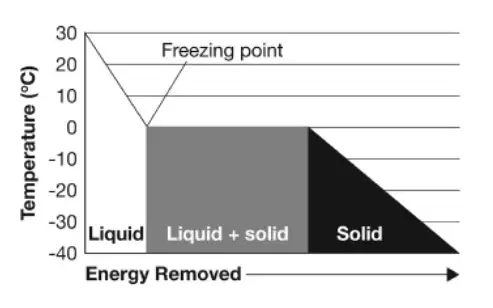
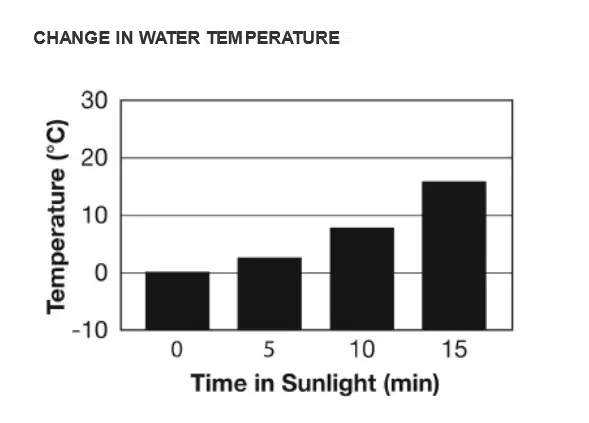
Energy can be created or destroyed but not transformed
In the electromagnetic spectrum, which of the following is true of waves with long wavelengths? (SC.7.P.10.1)
They have high frequencies.
They have low frequencies.
They have moderate frequencies.
They have inconsistent frequencies.
The electromagnetic spectrum is made up different types of electromagnetic energy with different _____ (SC.8.E.5.11)
Speeds
Frequencies
Reflections
Mediums
All of the waves listed below are a part of the electromagnetic spectrum except (SC.8.E.5.11)
Sound Waves
X Rays
gamma rays
light waves

The diagram below shows the electromagnetic spectrum. Which letters represent radio and gamma waves? (SC.8.E.5.11)
A, F
F, C
A, G
C, G
What part of the electromagnetic spectrum can be seen by humans? (SC.7.P.10.1)
Visible Light
Microwaves
Ultraviolet Waves
Infrared Rays

Which wave has a higher frequency? (SC.8.E.5.11)
Wave N
Wave O
The waves have the same frequency.
What does a wave carry from place to place?
energy
matter
people
The number of waves that pass somewhere in a second is:
amplitude
frequency
wavelength
Waves that require a medium to travel though are called
electromagnetic waves
mechanical waves
ocean waves
transverse waves
I do not know and do not wish to answer.
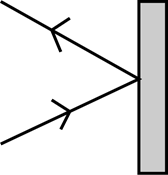
The illustration shows a light ray striking an object.
In the illustration, the light ray striking the object is _________________.
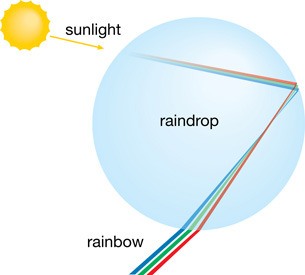
Organize the speed of electromagnetic energy from fastest to slowest.
Solids
Slow
Liquids
Medium
Gases
Fast
Vacuum
Fastest
Organize the speed of mechanical energy from fastest to slowest.
Solids
Fastest
Liquids
Medium
Gases
Slow
Vacuum
Zero (Cannot travel)
How do the sound waves of the higher pitch notes compare to the sound waves of the lower pitch notes?
The sound waves of notes with higher pitches have higher amplitudes.
The sound waves of notes with higher pitches travel at higher speed.
The sound waves of notes with higher pitches have higher wavelengths.
The sound waves of notes with higher pitches have figher frequencies.

The diagram above shows light as it travels toward matter. Based on the arrows, which of the following BEST describes the way that light interacts with the matter?
light is absorbed
light is transmitted
light is reflected
light is scattered
Select all that are TRUE about Transmission.
Transparent substances allow most light to pass
Opaque substances block most light
Transparent substances block most light
Opaque substances allow most light to pass
Match the following terms of Light Properties.

Diffuse Reflection

Reflection of (1) visible light wave

Reflection of all visible light

Absorption of all visible light
Match the following terms of Light Properties.

Refraction

Reflection

Transmission

Absorption & Reflection

No absorption
Reorder the following from most to least Transmission.


Which vocabulary term is used to identify the distance between points C & E?
Amplitude
Crest
Frequency
Wavelength

Which is an example of a longitudinal wave?
x ray
microwave
sound wave
water wave

Sound waves travel as _________ waves.
transverse
electromagnetic
longitudinal
surface

In a longitudinal wave, the parts where the coils are close together (A) are called what?
longitudes
rarefactions
compressions
wavelengths

The distance from the beginning of one compression to the beginning of the next compression is called a -----
Rarefaction
Frequency
Wavelength
Compression
If a sound wave has a high pitch, it has a ___.
high frequency
low frequency
We see a blue shirt because...
The musical note A above middle C has a frequency of 440 Hz. If the wavelength is measured to be 0.80m, what is the speed of the wave?
343 m/s
350 m/s
550 m/s
352 m/s
As the frequency of a wave increases, its wavelength
gets larger
gets smaller
remains the same
goes to zero
What is the wavelength of a wave with a speed of 25 m/s and a frequency of 50 Hz?
6250 m
.5 m
75 Hz
75 m

