wayground logo

Free Printable Worksheets

Font size

S
M
L
XL
Worksheets

Geometry Semester 1 Exam Review

Total questions: 125

Worksheet time: 9hrs 9mins

Name
Class
Date
1.
Part of a line. Has two endpoints and includes all of the points in between.
a)
Point
b)
Angle
c)
Line
d)
Line Segment
2.
Part of a line. Has one endpoint and continues on forever in one direction.
a)
Line Segment
b)
Line
c)
Ray
d)
Point
3.
Name the Image
a)
Angle
b)
Line
c)
Line Segment
d)
Ray
4.
Name the Image. 
a)
Ray
b)
Point
c)
Line
d)
Line segment
5.

When naming a plane, we should use ________

a)

2 points

b)

a lower case cursive letter

c)

3 points on the same line

d)

3 points not on the same line

6.
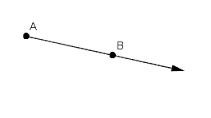
What is the name of this ray?
a)
Ray AB
b)
Ray BA
c)
Ray ABC
d)
Ray AC
7.
Parallel lines ...
a)
will never intersect
b)
intersect to form right angles
c)
are curved lines
8.
What is the midpoint between (-4,4) and (-2,2)?
a)
(3,2)
b)
(-3,3)
c)
(4,5)
d)
(6,7)
9.
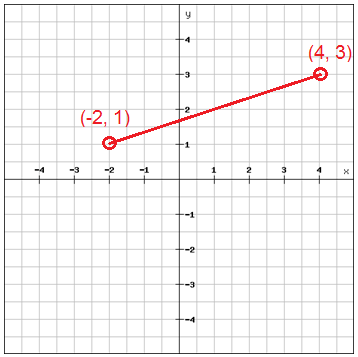
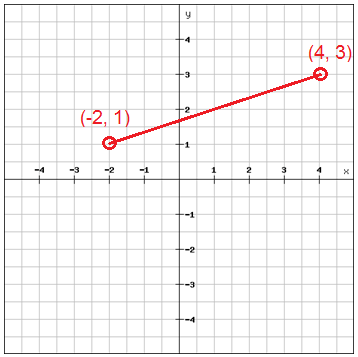
Find the y-coordinate of the midpoint of the line
a)
1
b)
2
c)
-2
d)
3
10.
What is the distance between the two points?
a)
6.3
b)
6.5
c)
6.7
d)
16
11.

Calculate the distance between the two points: (2, -1) and (2, 5). Round your answer to the nearest tenth.

a)

0

b)

8.3

c)

6

d)

5.5

12.

What type of angle is this?

a)

right angle

b)

acute angle

c)

obtuse angle

13.

What type of angle is this?

a)

right angle

b)

acute angle

c)

obtuse angle

14.

What type of angle is this?

a)

right angle

b)

acute angle

c)

obtuse angle

15.
Two angles added together to produce 90 degrees
a)
Supplementary
b)
Complementary
c)
Right
d)
Vertical
16.
What kind of angles are shown?(45 + 135 = 180)
a)
complementary
b)
supplementary
c)
adjacent
d)
corresponding
17.

Name the relationship between a and b: complementary, supplementary, or neither.

a)
Complementary
b)
Supplementary
c)

Neither

18.
a)
x = 56
b)
x = 66
c)
x = 156
d)
x = 166
19.

Solve for x

a)

20

b)

25

c)

120

d)

180

20.
Find the measure of angle 1.
a)
28o
b)
136o
c)
44o
d)
6o
21.

Solve for x

a)

32

b)

-32

c)

-20

d)

20

22.
What is the value of y?
a)
29
b)
119
c)
58
23.

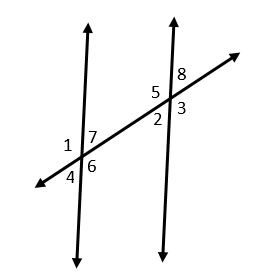
2) Given the following two parallel lines cut by a transversal.


Which pair of angles represents corresponding angles?

a)

1\angle1  and  6\angle6  

b)

6\angle6  and 5\angle5  

c)

7\angle7  and 8\angle8  

d)

4\angle4  and 8\angle8  

24.

3) Given the following two parallel lines cut by a transversal.


Which pair of angles represents alternate interior angles?

a)

3\angle3  and 8\angle8  

b)

7\angle7  and 2\angle2  

c)

7\angle7  and 8\angle8  

d)

4\angle4  and 8\angle8  

25.
WHAT IS THE CORRECT EQUATION TO FIND THE VALUE OF X?
a)
X=12
b)
8X - 17 + 5X +19 = 180
c)
8X - 17 = 5X +19
d)
X= -12
26.

What is the relationship between angle 3 and angle 6?

a)

Same Side Interior Angles Postulate

b)

Alternate Exterior Angles Theorem

c)

Alternate Interior Angles Theorem

d)

Linear Pair Theorem

e)

Corresponding Angles Theorem

27.

A line that passes through parallel lines is called a ______________.

a)

Perpendicular Bisector

b)

Midpoint

c)

Transversal

d)

Angle Bisector

28.

Name a line skew to FG\overleftarrow{F}\overrightarrow{G}

a)

EH\overleftarrow{E}\overrightarrow{H}

b)

FB\overleftarrow{F}\overrightarrow{B}

c)

DC\overleftarrow{D}\overrightarrow{C}

d)

AD\overleftarrow{A}\overrightarrow{D}

29.

Name a line parallel to AD\overleftarrow{A}\overrightarrow{D}

a)

EH\overleftarrow{E}\overrightarrow{H}

b)

AB\overleftarrow{A}\overrightarrow{B}

c)

DC\overleftarrow{D}\overrightarrow{C}

d)

HG\overleftarrow{H}\overrightarrow{G}

30.

The figure shown is a right rectangular prism. Name a line perpendicular to AD\overleftarrow{A}\overrightarrow{D} .

a)

EH\overleftarrow{E}\overrightarrow{H}

b)

AB\overleftarrow{A}\overrightarrow{B}

c)

CG\overleftarrow{C}\overrightarrow{G}

d)

HG\overleftarrow{H}\overrightarrow{G}

31.
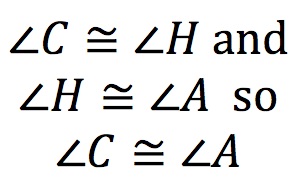
What is the justification?
a)
Symmetric Prop.
b)
Angle addition postulate
c)
Reflexive Prop
d)
Transitive Prop.
32.
AB = AB
a)
Reflexive POE
b)
Transitive POE
c)
Symmetric POE
d)
Distributive POE
33.
What is the reason?
a)
Definition of congrucent
b)
Definition of midpoint
c)
Definition of segment
d)
Segment Addition 
34.
What is the reason?
a)
Transitive 
b)
Substitution
c)
Middle Man
d)
Replacing 
35.
What is the reason?
a)
Definition of Complementary
b)
Definition of 180 
c)
Definition of supplementary
d)
Angle Addition
36.
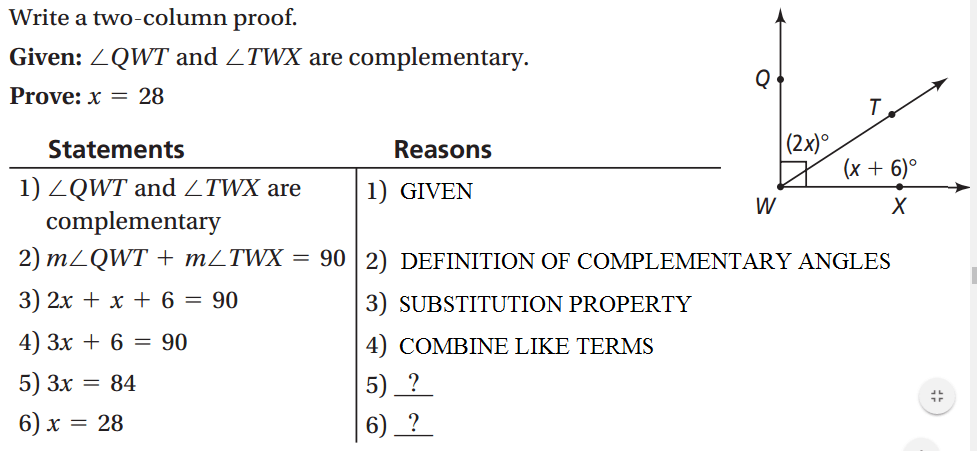
What is the REASON for Statement #5?
a)
Addition Property of Equality
b)
Subtraction Property of Equality
c)
Multiplication Property of Equality
d)
Division Property of Equality
37.
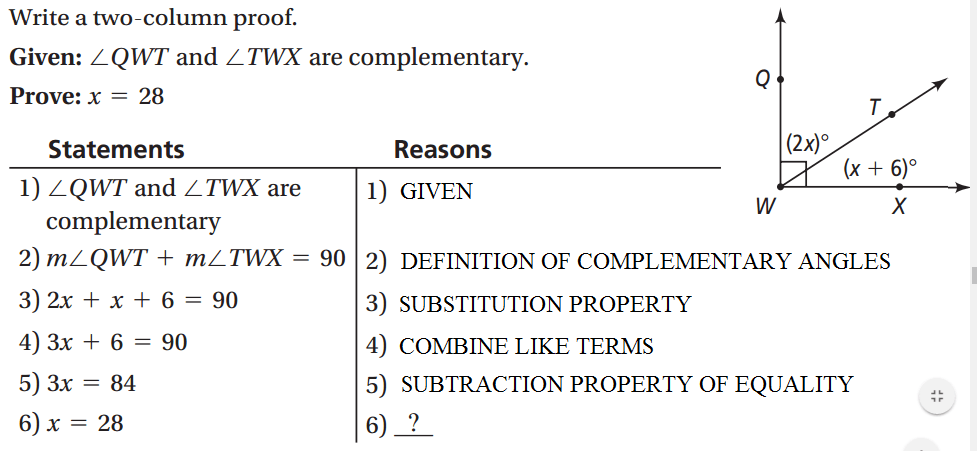
What is the REASON for Statement #6?
a)
Addition Property of Equality
b)
Subtraction Property of Equality
c)
Multiplication Property of Equality
d)
Division Property of Equality
38.
AB = AB
a)

Reflexive Property

b)

Transitive Property

c)

Symmetric Property

d)

Distributive Property

39.
Which of these represents point-slope form of a linear equation?
a)
y - y1 = m(x - x1)
b)
Ax + By = C
c)
y = mx + b
40.
For the equation
y - 3 = 2(x + 4),
the line has a slope of 2 and contains what point?
a)
(-4, 3)
b)
(3, -4)
c)
(-3, -4)
d)
(-4, -3)
41.
For the equation
y + 1 = -3(x - 5),
the line contains the point (5, -1) and has a slope of?
a)
-1
b)
1
c)
-3
d)
5
42.
What is the slope in the equation y=2x + 3?
a)
2
b)
3
c)
5
d)
Cannot be Determined 
43.
If m=3 and b=6, what is the correct slope intercept equation?
a)
y=3-6
b)
y=3x-6
c)
y=3x+6
d)
y=6x+3
44.
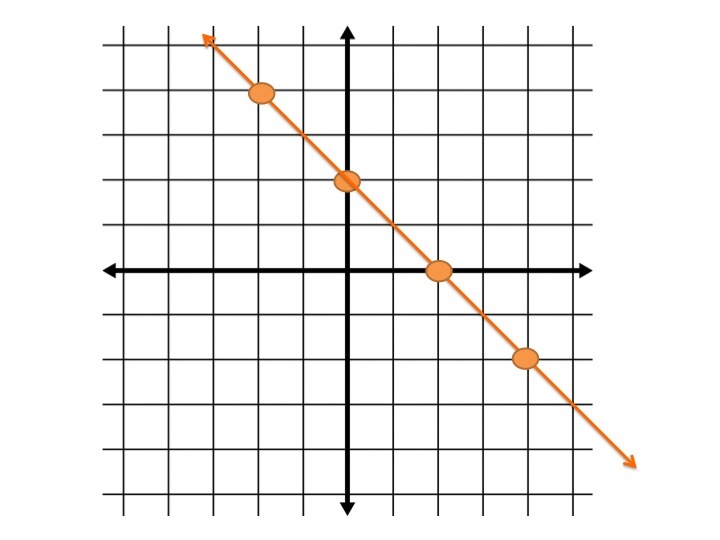
What is the equation of this line?
a)
y = 2x +2
b)
y = 2x -2
c)
y = -x + 2
d)
Cannot be Determined
45.
What does 'b" represent in y=mx=b
a)
y-intercept
b)
beans
c)
nothing
d)
slope
46.
Slopes of parallel lines are...
a)
opposite reciprocals.
b)
opposites.
c)
identical.
d)
always 7.
47.
Slopes of perpendicular lines are...
a)
opposite reciprocals.
b)
opposites.
c)
identical.
d)
always 7.
48.
y = 3x +2
y = 3x - 3
These lines are...
a)
Parallel
b)
Perpendicular
c)
Neither
d)
The same line
49.
y = -2/3x + 2
y = 3/2x + 9
These lines are...
a)
Parallel
b)
Perpendicular
c)
Neither
50.
A slide is also called a _________.
a)
Translation
b)
Reflection
c)
Rotation
d)
Transformation
51.
A turn is also called a ___________.
a)
Translation
b)
Reflection
c)
Rotation
d)
Transformation
52.

A flip is also called ___________.

a)

Translation

b)

Reflection

c)

Rotation

d)

Transformation

53.
The image shows what type of transformation
a)
Rotation
b)
Translation
c)
Reflection
54.
a transformation that changes the size of a figure, but not the shape
a)
translation
b)
rotation
c)
reflection
d)
dilation
55.
What Transformation is visible?
a)
Reflection
b)
Translation
c)
Dilation
d)
Rotation
56.

Is the picture being reflected across the y-axis or the x-axis?

a)

y-axis

b)

x-axis

57.

Describe the Transformation

a)

Dilation

b)

Reflection

c)

Translation

d)

Rotation

58.

What is this picture an example of?

a)

Reflection

b)

Translation

c)

Rotation

d)

Dilation

59.
Point (-5,2) is reflected over the y axis.  Where is the new point located?
a)
(5,2)
b)
(-5,-2)
c)
(-5,2)
d)
(5,-2)
60.
The point that is to be transformed is called the:
a)
Pre-Image
b)
Image
c)
Post-Image
d)
Transformation
61.
After being transformed the new point is called a(n):
a)
Pre-Image
b)
Post Image
c)
Transformed
d)
Image
62.
Write a rule for the translation.
a)
 (x -1, y  + 2)
b)
 (x -2, y  + 1)
c)
 (x +2, y  - 1)
d)
(x +1, y  -  2)
63.
What is the sequence of transformations?
a)
Reflect over the y then reflect over the x
b)
Reflect over the x then reflect over the y
c)
Translate 4 units then rotate 90˚
d)
Rotate 90˚ then reflect over the x
64.

Determine the image of C after it's first translated by the rule

(x, y) → (x − 2, y + 5)

and is then reflected over the y-axis.

a)

(-1, 4)

b)

(1, 4)

c)

(6, -3)

d)

(-3, 6)

65.
a)

is symmetrical

b)

not symmetrical

66.
a)

Is symmetrical

b)

not symmetrical

67.
How many lines of symmetry does this shape have?
a)
1
b)
2
c)
4
d)
8
68.
How many lines of symmetry does this shape have?
a)
0
b)
1
c)
2
d)
4
69.
Is this a line of symmetry?
a)
Yes
b)
No
70.

How many lines of symmetry are there on an equilateral triangle?

a)

0

b)

1

c)

2

d)

3

71.
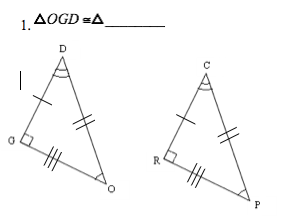
Complete the congruence statement.
a)
CRP
b)
PCR
c)
RPC
d)
PRC
72.
Use the congruency statement to answer the following: 
<F = ___
a)
<H
b)
<I
c)
<G
d)
not congruent to another angle
73.
a)
A
b)
B
c)
C
d)
D
74.
∠E ≅ ∠ __
a)
A
b)
B
c)
C
d)
D
75.
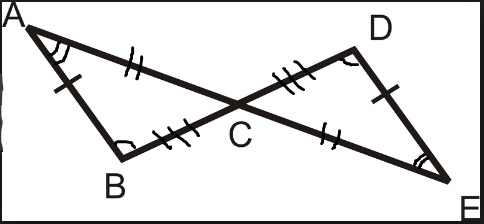
Name the corresponding angle or side.
a)
A
b)
B
c)
C
d)
D
76.
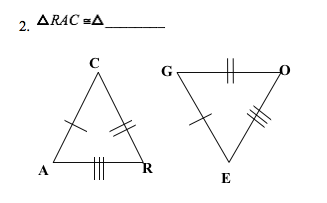
Complete the congruence statement.
a)
OEG
b)
OGE
c)
EGO
d)
GOE
77.

△BAC ≅ △QPR. If ∠B = 2x and ∠Q = 10, find the value of x.

a)

2

b)

4

c)

5

d)

-5

78.
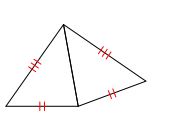
What shortcut would you use to prove the triangles congruent?
a)
SSS
b)
SAS
c)
ASA
d)
AAS
79.
What shortcut would you use to prove the triangles congruent?
a)
SSS
b)
SAS
c)
ASA
d)
AAS
80.
What shortcut would you use to prove the triangles congruent?
a)
SSS
b)
SAS
c)
ASA
d)
AAS
81.
What shortcut would you use to prove the triangles congruent?
a)
SSS
b)
SAS
c)
ASA
d)
AAS
82.
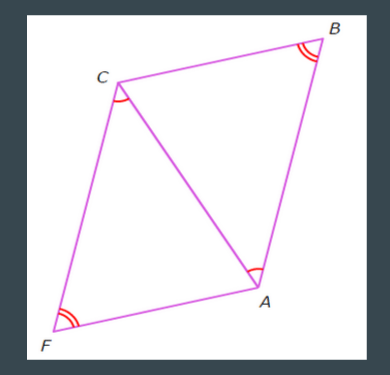
State if the two triangles are congruent.  If they are, state which theorem you would use.
a)
Yes, SAS
b)
Yes, SSS
c)
Yes, HL
d)
Not enough information
83.
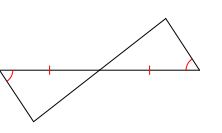
How are these two triangles congruent?
a)
AAS
b)
ASA
c)
Not enough information
d)
SAS
84.
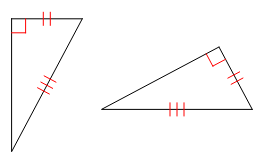
How are these triangles congruent?
a)
AAA
b)
Not enough information
c)
ASA
d)
HL
85.
What is the measure of angle b?
a)
36o
b)
56o
c)
63o
d)
117o
86.
Find the measure of the indicated angle. 
a)
95
b)
85
c)
35
d)
45
87.
Find the missing angle.
a)
29° 
b)
39° 
c)
49° 
d)
59° 
88.

Point P is the centroid of ∆ABC.

 If BL = 42, what is the length of BP?

a)

28

b)

14

c)

21

d)

84

89.

Find the coordinates of the centroid of the triangle with the given vertices.

a)

(3,1)

b)

(9,3)

c)

(133,3)\left(\frac{13}{3},3\right)  

d)

(6,1)

90.

The circumcenter is the point at which all the ______ of a triangle meet.

a)

perpendicular bisectors

b)

angle bisectors

c)

medians

d)

altitudes

91.

The example from the video is shown. What is the measure of EC?

a)

6

b)

12

c)

15

d)

20

92.

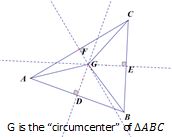
If G is the circumcenter, what type of segments are show as dotted lines?

a)

perpendicular bisectors

b)

angle bisectors

c)

altitudes

d)

centroids

93.
1.  Point Z is the circumcenter of ΔRST. What is TZ?
a)
3
b)
5
c)
4
d)
6
94.

Name this center:

a)

Circumcenter

b)

Incenter

c)

Centroid

d)

Orthocenter

95.

A Incenter is the point at which three _____________ intersect in a triangle.

a)

Medians

b)

Altitudes

c)

Perpendicular Bisectors

d)

Angle Bisectors

96.

If D and E are Midpoints, then 

DE\overline{DE}  is _______________. 

a)

an angle bisector

b)

a perpendicular segment

c)

a median

d)

a midsegment 

97.
The three altitudes of a triangle intersect at the___________________.
a)
orthocenter
b)
median
c)
centroid
d)
circumcenter
98.
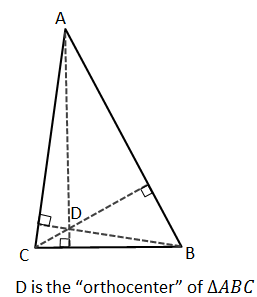
If D is the orthocenter, what type of segments are drawn?
a)
medians
b)
altitudes
c)
angle bisectors
d)
perpendicular bisectors
99.

Which center of a triangle is shown in the picture below?

a)

Circumcenter

b)

Orthocenter

c)

Incenter

d)

Centroid

100.

The three perpendicular bisectors of a triangle intersect at the ________________.

a)

circumcenter

b)

incenter

c)

centroid

d)

orthocenter

101.

What point of concurrency is shown?

a)

incenter

b)

centroid

c)

circumcenter

d)

orthocenter

102.

Which center of a triangle is shown in the picture below?

a)

Circumcenter

b)

Orthocenter

c)

Incenter

d)

Centroid

103.
What is the order and angle of rotation of the flower?
a)
Order 6, 60 degrees
b)
Order 4, 90 degrees
c)
Order 3, 120 degrees
d)
Order 6, 254 Degrees
104.
How many lines of Symmetry does this hexagon have?
a)
3
b)
6
c)
9
d)
12
105.
What are the angles of rotation for a square?
a)
multiples of 30
b)
multiples of 45
c)
multiples of 90
d)
multiples of 180
106.
How many lines of symmetry does this shape have?
a)
1
b)
2
c)
3
d)
4
107.
Identify the smallest angle of rotation that maps the image to itself.
a)
60°
b)
None
c)
51.4°
d)
45°
108.

The image of (2,5) after a reflection in the x-axis

(a)  

109.

The image of (x,y) after a reflection in the line y=x

(a)  

110.

The image of ( -3,-2) after a reflection in the line x=3

(a)  

111.

The image (0,5) after a rotation of 90°90\degree  


(a)  

112.

The image (-1,3) after a rotation of 180°180\degree  


(a)  

113.

The image (x,y) after a rotation of 270°270\degree  


(a)  

114.

The image ( 2,3) after T2,1

(a)  

115.

The image ( -1,5) after T-3,-2

(a)  

116.

If <1 is a right angle, than m<1 = 90o90^o  

a)

Definition of right angle

b)

Definition of supplementary angles

c)

Definition of angle bisector

d)

Definition of midpoint

117.

If m<1 + m<2 = 50 and m<2 = 10, then m<1 + 10 = 50

a)

Transitive property

b)

Substitution Property

c)

Definition of angle bisector

d)

Subtraction Property

118.

m<AMX + m<XMB = m<AMB

a)

Segment addition postulate

b)

Angle addition postulate

c)

Definition of supplementary angles

d)

Definition of angle bisector

119.

If A = B, then 8A = 8B Which of the following "reasons" fits for the statement?

a)

Multiplication Property

b)

Division Property

c)

Reflexive Property

d)

Addition Property

120.
If X = Y, then X + 5 = Y + 5
a)

Addition Property

b)

Subtraction Property

c)

Reflexive Property

d)

Transitive Property

121.
Name the property of equality or congruence that justifies going from the first statement to the second statement.
a)
Associative Property
b)
Commutative Property
c)
Distributive Property
d)
Combine Like Terms
122.

What is the justification?

a)

Definition of congruence

b)

Reflexive Property of Congruence

c)

Segment Addition Postulate

d)

Definition of Midpoint

123.

What is the justification?

a)

Definition of Supplementary Angles

b)

Vertical Angles Theorem

c)

Definition of an Angle Bisector

d)

Angle Addition Postulate

124.

What is the justification?

a)

Definition of an Angle Bisector

b)

Complementary Angles Theorem

c)

Definition of a Right Angle

d)

Angle Addition Postulate

125.

8) What is the reason for Statement 4 to complete the proof?

a)

Converse of Corresponding Angles Postulate

b)

Transitive Property of Congruence

c)

Substitution

d)

Algebra