
Font size
 Worksheets
Physical Science Chapter 18 Practice Questions
Total questions: 89
Worksheet time: 45mins
Which statement best defines an electromagnetic wave?
A ripple made solely by magnetic forces
A vibration requiring particles to collide
A wave moving only through solid matter
A disturbance of changing electric and magnetic fields
How are electromagnetic waves produced?
By pushing air to make pressure changes
By heating a material until it glows
When magnets are placed next to each other
When an electric charge vibrates or accelerates
Which property allows electromagnetic waves to travel through space?
They require dense particles to move
They do not need a material medium
They flow only with moving air
They bounce only off metal surfaces
What is the speed of light in a vacuum, c?
3.00 × 10^6 m/s
3.00 × 10^7 m/s
3.00×10⁸ m/s
3.00 × 10^9 m/s
Electromagnetic waves are transverse. What does this mean about the fields?
Fields rotate only around sources
Fields oscillate at right angles to motion
Fields remain constant over distance
Fields change along the travel direction
A radio wave moves in a vacuum. Its wavelength increases. What happens to its frequency?
Frequency stays exactly the same
Frequency increases proportionally
Frequency decreases inversely
Frequency becomes zero instantly
Which process explains how EM waves keep moving through space without a medium?
Gravity pulls the wave along
Particles transfer kinetic energy
Air currents carry energy forward
Electric fields create magnetic fields and vice versa
A radio wave in a vacuum has wavelength 3.0 m. Using c = 3.00 × 10^8 m/s, what is its frequency?
3.0 × 10^7 Hz
1.0 × 10^7 Hz
1.0 × 10^8 Hz
3.0 × 10^8 Hz
A radio wave has a wavelength of 19 cm. Convert the wavelength to meters and calculate the frequency using wave speed 3.0 × 10^8 m/s.
3.0 × 10^7 Hz
1.0 × 10⁸ Hz
1.6 × 10⁸ Hz
1.6×10⁹Hz
The radio waves of a station vibrate 680,000 times per second. Using v=3.0×10⁸m/s , what is the wavelength?
2.2 × 10^3 m
6.8 × 10^5 m
3.0 × 10^8 m
4.4 \times 10^2 m
If radio waves travel on the same train lines at 3.0 × 10^8 m/s, what happens to wavelength when frequency is halved?
Wavelength increases slightly
Wavelength stays same
Wavelength halves
Wavelength doubles
Which statement best describes the dual nature of electromagnetic radiation?
It behaves only like particles in all cases
It behaves only like a wave in all cases
It behaves like a wave and like particles
It behaves neither like waves nor particles
What pattern on a screen indicates light behaving as a wave when it passes through a double slit?
Single bright spot centered on the screen
Uniform brightness across the entire screen
Alternating bright and dark bands
Random scattered dots with no structure
Which situation shows constructive interference for light?
Electrons are emitted from a metal plate
Waves overlap to produce brighter bands
Waves cancel to produce darker bands
Light is absorbed by a metal surface
In the photoelectric effect, what causes electrons to be emitted from a metal surface?
Photons with enough energy striking the metal
High light intensity regardless of color
Heat from the lamp warming the metal
Any light frequency lower than red
Which color of light typically has photons with higher energy?
Red light with lower frequency
Blue light with higher frequency
Green light with medium frequency
Yellow light with lower wavelength
A dim blue light ejects electrons from cesium, while a bright red light does not. What conclusion fits this observation?
Metal surfaces reflect all red light always
Frequency determines photon energy and emission
Electron emission depends only on brightness
Energy depends only on the number of photons
Which evidence supports the particle model of light?
Uniform spreading of light through a slit
Shadows cast by opaque objects in sunlight
Interference bands formed by overlapping waves
Emission of electrons due to the photoelectric effect
Which statement best describes why light appears dimmer as you move away from a lamp?
Photons spread out over a larger area
Air absorbs all light at long distances
Photons slow down and lose their speed
The lamp makes fewer photons per second
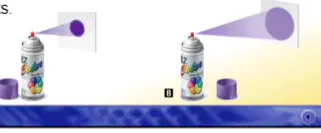
A spray can covers a smaller, darker spot when held close and a larger, lighter area when held farther. What concept does this illustrate for light intensity?
Near sources change light color
Farther distance lowers frequency
Closer distance increases wavelength
Energy spread reduces intensity
Which choice explains a key difference between electromagnetic waves and mechanical waves?
Electromagnetic waves can travel through a vacuum
Electromagnetic waves carry no energy
Mechanical waves are always invisible
Electromagnetic waves must be longitudinal
The photoelectric effect supports which idea about how light behaves?
Both a wave and a particle
Only a particle
Only a wave
Neither a wave nor a particle
Which list correctly names major parts of the electromagnetic spectrum from lowest to highest typical frequency?
Radio, infrared, visible, ultraviolet, X-rays, gamma
Gamma, X-rays, ultraviolet, visible, infrared, radio
Visible, radio, infrared, ultraviolet, X-rays, gamma
Infrared, radio, visible, ultraviolet, gamma, X-rays
Radio waves are described by which pair of properties compared to other electromagnetic waves?
Variable wavelengths and constant frequencies
Medium wavelengths and medium frequencies
Shortest wavelengths and highest frequencies
Longest wavelengths and lowest frequencies
Which is a common use of radio waves in everyday technology?
Detecting ultraviolet light for sunscreen tests
Communication signals in radio and television
Producing medical X-ray images of bones
Heating food by infrared lamps
Which statement best describes amplitude modulation (AM) in radio broadcasting?
The frequency varies while amplitude stays the same
Neither amplitude nor frequency changes during transmission
The amplitude varies while frequency stays the same
Both amplitude and frequency vary at the same time
Which statement best describes frequency modulation (FM) in radio broadcasting?
The frequency varies while amplitude stays the same
The amplitude varies while frequency stays the same
Amplitude and frequency remain constant together
Both amplitude and frequency vary equally
Why do FM radio signals typically not travel as far as AM signals along Earth’s surface?
FM stations transmit with lower power than AM stations
AM receivers are more sensitive than FM receivers
Lower-frequency waves lose energy faster near the ground
Higher-frequency waves reflect less in the upper atmosphere
In satellite TV transmission, what is the correct sequence of how signals reach homes?
Sent from homes to satellites, broadcast to TV stations, returned
Recorded by satellites, sent to radio towers, decoded by phones
Broadcast to Earth towers, reflected to satellites, sent to homes
Broadcast to satellite, retransmitted to Earth, received by dishes
FM broadcast frequencies commonly range between which approximate values?
88 megahertz to 108 megahertz
535 kilohertz to 1605 kilohertz
8 gigahertz to 12 gigahertz
30 hertz to 300 hertz
Microwaves are radio waves with the shortest wavelengths. Which range best matches typical microwave frequencies?
About 300 kHz to 3,000 kHz
About 30 Hz to 300 Hz
About 3 MHz to 30 MHz
About 300 MHz to 300,000 MHz
Which statement best describes how infrared rays are commonly used?
For sterilizing medical tools using radiation
For producing vitamin D in human skin
To carry radio broadcasts over long distances
As a source of heat and temperature sensing
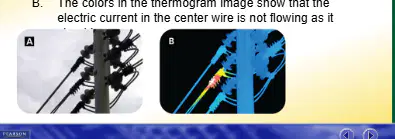
Thermograms are color-coded images created with infrared sensors. In a utility line inspection, what does a bright hot spot most likely indicate?
Visible light reflection from metal parts
An area with abnormal heat suggesting a fault
Uniform temperature showing normal operation
Ultraviolet exposure causing sunburn
Each color in visible light corresponds to a specific wavelength and frequency. What does this mean for the colors you see?
All colors share identical wavelengths
Different colors have different wavelengths
Colors depend only on object temperature
Colors are determined by infrared sensors
Ultraviolet rays have applications in health and agriculture. Which is a correct use?
Creating thermograms for utilities
Heating food with infrared lamps
Transmitting visible colors to cameras
Helping skin produce vitamin D
Too much ultraviolet exposure can cause harm. Which effect is most directly linked to excessive UV?
Sunburn and increased skin cancer risk
Reduced absorption of radio signals
Lower temperature in warm objects
Improved night vision and warmth
Compare infrared and ultraviolet radiation in everyday contexts. Which statement is most accurate?
Both are visible to the human eye as bright colors
Ultraviolet warms food; infrared causes sunburn
Infrared creates vitamin D; ultraviolet senses heat
Infrared warms objects; ultraviolet can sterilize and harm
Which statement best compares wavelengths and frequencies of X-rays and gamma rays?
X-rays longer wavelength, lower frequency than gamma rays
X-rays shorter wavelength, higher frequency than gamma rays
Gamma rays longer wavelength, lower frequency than X-rays
Gamma rays same wavelength and frequency as X-rays
What is a common medical use of X-rays?
Producing images of bones inside the body
Treating viral infections in the bloodstream
Measuring muscle strength during exercise
Detecting sound waves in the inner ear
A hospital plans to target cancer cells without harming nearby healthy cells. Which electromagnetic waves are most appropriate and why?
Radio waves, low frequency precisely focuses on tumors
Infrared rays, long wavelength easily passes through tissue
X-rays, low energy gently heats and removes tumors
Gamma rays, high energy penetrates and kills cancer cells
Order these waves from longest wavelength to shortest: visible light, radio waves, ultraviolet rays.
Radio waves, visible light, ultraviolet rays
Visible light, radio waves, ultraviolet rays
Ultraviolet rays, visible light, radio waves
Radio waves, ultraviolet rays, visible light
Which term describes a material that allows most light to pass straight through so objects appear clear and distinct?
Opaque material that blocks all light
Transparent material that transmits most light
Reflective material that absorbs all light
Translucent material that scatters all light
You are looking at a reef through water but cannot see through the bottom of a boat. What is the best explanation?
Water is transparent while the boat is opaque
Water is translucent while the boat is transparent
Water is opaque while the boat is translucent
Both water and the boat are transparent
Which situation best illustrates a translucent material?
Frosted glass door showing fuzzy shapes
Clear window showing sharp street details
Metal door blocking all silhouettes
Mirror giving a perfect reflection
What happens to light interacting with an opaque material?
Mostly transmitted through the material
Partly scattered but still passes
Either absorbed or reflected back
Refracted to form clear images
A bus window lets you see buildings and trees clearly while riding. How should this window be classified?
Opaque because light cannot pass
Translucent because shapes look fuzzy
Reflective because it mirrors images
Transparent because light transmits
Which statement best describes regular reflection?
Parallel light waves reflect in one direction
Light rays scatter randomly in all directions
Light bends when entering a new medium
Light energy is absorbed by a rough surface
What causes diffuse reflection on a surface?
Light is polarized by a filter
Light enters a denser medium
Parallel waves hit a smooth surface
Parallel waves hit a rough surface
When a light wave passes at an angle from air into water, what most likely occurs?
Reflection keeps the path straight
Polarization changes light color
Refraction bends the light path
Absorption stops the wave entirely
Which situation explains why underwater objects appear closer than they are?
Polarization removes scattered glare
Diffuse reflection spreads the image
Regular reflection increases brightness
Refraction magnifies apparent distance
A mirage on a hot road is mainly caused by what?
Refraction in layers of air
Polarization by sunlight
Diffuse reflection from asphalt
Absorption of blue wavelengths
Which statement about polarized light is accurate?
Occurs only with smooth mirrors
Always travels in curved paths
Vibrates in only one plane
Is absorbed by all water surfaces
Sunglasses with vertically polarized filters help most by doing what?
Blocking horizontally polarized glare
Absorbing all incoming wavelengths
Enhancing diffuse reflections from sand
Increasing refraction at the lens

In scattering, why does the sky often appear blue during the day?
Blue light scatters more than other colors
Red light absorbs all other wavelengths
Green light reflects off the ground strongly
Yellow light passes through air without scattering

Why does the sun look red near sunset?
Clouds absorb all red wavelengths at dusk
Shorter path adds blue wavelengths to sunlight
Air removes green wavelengths only at sunset
Longer path scatters shorter wavelengths away
How do polarized sunglasses reduce glare from horizontal surfaces?
By reflecting light back to the source
By absorbing every wavelength equally
By scattering light inside the lenses
By blocking horizontally polarized light
A material lets light pass but scatters it so objects look unclear. What is this material called?
Reflective
Transparent
Opaque
Translucent
Which process causes white light to separate into different colors when passing through a prism or raindrop?
Polarization by aligned molecules
Interference from overlapping waves
Diffusion of light in the medium
Dispersion due to wavelength refraction
When white light enters a glass prism, which wavelengths bend the most?
All wavelengths bend equally
Shorter wavelengths like violet
Medium wavelengths like green
Longer wavelengths like red
Which statement best describes how object color is determined?
By the color your eyes prefer to see
By the color of light the object reflects
By the temperature of the surrounding air
By the color the object emits naturally
A red car appears red in sunlight primarily because it does which of the following?
Reflects mostly red and absorbs other colors
Emits red light from its engine heat
Transmits all colors through its surface
Reflects green while absorbing red
Two identical pots look different colors under different lights. What explains this change?
Human vision resets in dim rooms
Objects change pigment with temperature
Object color depends on reflected light
Light intensity removes all colors
Which set lists the primary colors of light?
red, green, blue
red, yellow, blue
cyan, magenta, yellow
yellow, green, magenta
When two primary colors of light combine, what is formed?
a secondary color of light
a complementary pigment
a shade of black light
a tertiary color of pigment
Which pair of light colors is complementary because they combine to make white light?
blue and yellow
green and magenta
red and cyan
cyan and magenta
What are the secondary colors of light?
red, green, blue
cyan, magenta, black
cyan, yellow, magenta
orange, purple, green
Which set lists the primary colors of pigments used in printers?
blue, green, yellow
red, yellow, blue
red, green, blue
cyan, magenta, yellow
How does mixing pigments affect the light reflected from a surface?
More colors are absorbed
More colors are reflected
White light is produced
All wavelengths are increased
If a surface reflects more than one color of light, what happens to the perceived color?
Brightness decreases without hue change
Pigments subtract to make white
Colors add to form a new color
Only one primary remains visible
A prism separates white light into the visible spectrum because
shorter wavelengths reflect more than longer wavelengths.
shorter wavelengths refract more than longer wavelengths.
longer wavelengths are absorbed more than shorter wavelengths.
The color of an object depends on what the object is made of and on
the speed of the light that strikes the object.
the direction of the light that strikes the object.
the color of light that strikes the object.
the intensity of light that strikes the object.
Which of these colors is one of the primary colors of light?
magenta
white
yellow
green
Which statement best describes a luminous object?
It reflects light from other sources
It blocks light and makes shadows
It produces its own light energy
It absorbs light and warms up
What primarily causes an incandescent bulb to emit light?
Chemical reactions in the glass
Electricity in a phosphor
Heat from a hot filament
Ultraviolet rays from mercury
Which material commonly forms the filament inside an incandescent bulb?
Carbon fiber
Aluminum strip
Tungsten metal
Copper wire coil
Why are incandescent bulbs considered inefficient compared to fluorescent bulbs?
They are heavier to install
They flicker during operation
They need high voltage to start
They emit most energy as heat
In a fluorescent bulb, what role do phosphors play?
They reflect ambient daylight
They steady emit visible photons
They convert heat into sound
They heat the filament to glow
Which sequence correctly explains light production in a fluorescent tube?
Sunlight enters tube; glass focuses light
Electrons excite mercury; UV hits phosphor
Heat melts tungsten; vapor emits light
Electrons heat filament; filament glows
Which setting most commonly uses fluorescent lighting due to efficiency?
Office buildings and schools
Outdoor stadium bleachers
Home fireplaces and hearths
Underwater swimming pools
What makes laser light coherent compared to ordinary light?
Waves share wavelength and align crests
Waves have random wavelengths and phases
Waves mix many colors at once
Waves travel in curved paths through air
Which statement best describes how a laser produces light?
A battery sparks random light pulses
A bulb glows from heated filament
A device emits a narrow coherent beam
A prism spreads white light broadly
Why can a laser beam be focused on a small spot without spreading much?
Its waves travel parallel in one phase
Its waves bounce randomly in air
Its beam contains many mixed colors
Its source heats a filament strongly
Which is a practical application of lasers?
Cutting metals and making chips
Heating rooms and cooking food
Filtering smoke in chimneys
Producing radio signals in cars
In neon lights, what causes light emission inside the glass tube?
Filament heating by electric current
Chemical reaction forming new solids
Electrons moving through ionized gas
Sunlight reflecting off metal foil
Which gas-color pairing is correct for glowing signs?
Helium gives off pink light
Krypton produces bright red
Argon alone makes violet-blue
Mercury vapor creates orange
How do sodium-vapor lights generate their characteristic light?
Lens focuses sunlight into a beam
Phosphors convert UV to visible
Filament emits blackbody radiation
Electrons excited in sodium emit photons
How does a tungsten-halogen bulb generate light?
Electrons heat a tungsten filament
Gas plasma excites neon atoms
Chemical reaction inside the glass
Magnetic fields spin the filament
In a tungsten-halogen bulb, what is the role of the halogen gas?
Creates coherent laser light
Makes the bulb glow brighter
Stops electrons from moving
Reduces filament wear over time
Which light source is most efficient for lighting rooms in a building?
Tungsten-halogen bulbs
Sodium-vapor street lights
Fluorescent light sources
Incandescent light sources

