
Font size
 Worksheets
Submaximal Aerobic Training Systems and Adaptations Quiz
Total questions: 88
Worksheet time: 44mins
Which of the following systems is NOT listed as one of the systems covered in the lecture on submaximal aerobic training?
Metabolic
Muscular
Cardiovascular
Digestive
Recall the four systems discussed in the context of training adaptations. Which system is responsible for the exchange of gases such as oxygen and carbon dioxide?
Metabolic
Muscular
Cardiovascular
Respiratory
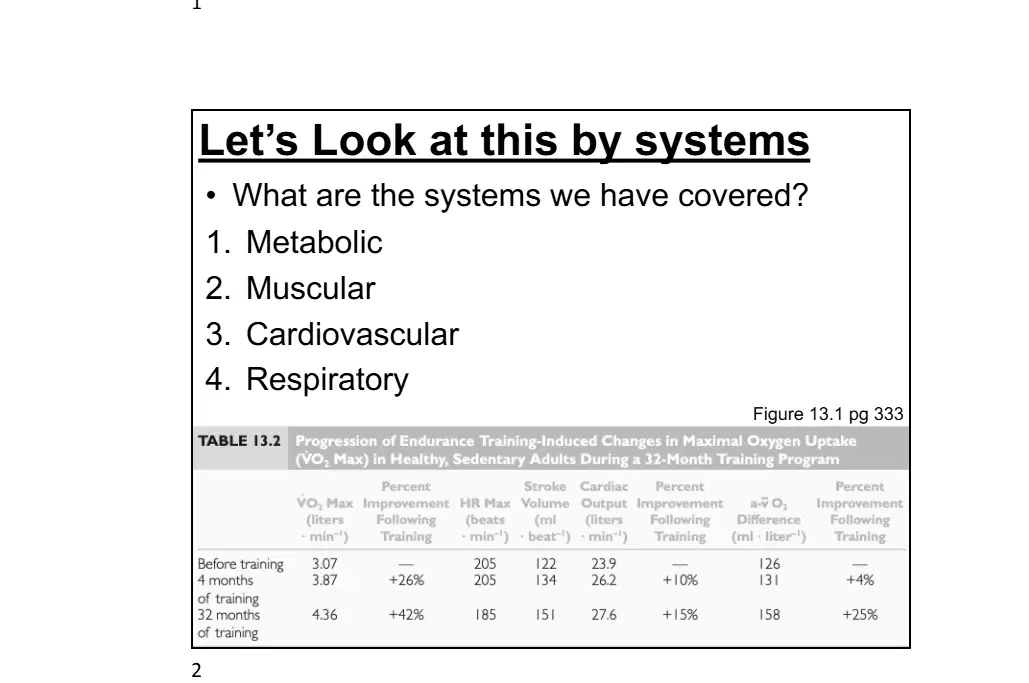
Based on the table shown, which variable is most likely to increase as a result of endurance training over 32 months in healthy, sedentary adults?
VO₂ Max
HR Max
Stroke Volume
All of the above
If a sedentary adult undergoes endurance training for 32 months, which system would primarily be responsible for improvements in oxygen delivery to muscles?
Metabolic
Muscular
Cardiovascular
Respiratory
Strategically, why might it be important to consider multiple physiological systems (metabolic, muscular, cardiovascular, respiratory) when designing a submaximal aerobic training program?
Because each system adapts independently and does not affect overall performance
Because improvements in one system can enhance the function of others, leading to better overall training outcomes
Because only the cardiovascular system is relevant to aerobic training
Because respiratory adaptations are the only ones that matter for endurance
Which of the following is a key metabolic change associated with endurance training (ET)?
Increased capacity
Decreased fuel storage
Reduced muscle adaptation
Lower energy provision by muscles
What does "sparing of CHO" refer to in the context of metabolic changes with endurance training?
Reduced use of carbohydrates as fuel
Increased breakdown of proteins
Enhanced fat storage
Decreased oxygen consumption
According to the data, which aerobic enzyme shows the greatest increase in activity in aerobically trained individuals compared to untrained individuals?
Citrate synthase
Succinate dehydrogenase
MDH
CPT
How does muscle adapt as a result of endurance training?
It becomes a more effective energy provider
It stores less fuel
It decreases enzyme activity
It reduces oxygen uptake
Based on the enzyme activity table, which enzyme activity is significantly higher in aerobically trained individuals compared to untrained individuals?
SDH, MDH, and CPT
SDH and MDH only
MDH and CPT only
SDH, MDH, and Citrate synthase
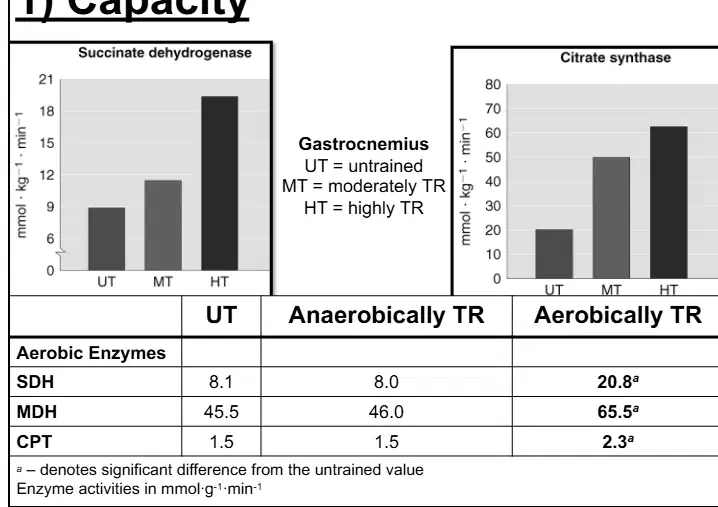
What do the bar graphs of succinate dehydrogenase and citrate synthase activities suggest about the effect of training on these enzymes?
Aerobic training increases the activity of both enzymes
Anaerobic training decreases the activity of both enzymes
Training has no effect on enzyme activity
Aerobic training decreases the activity of both enzymes
Why is it important for muscles to adapt to become more effective energy providers during endurance training?
To improve performance and delay fatigue
To reduce muscle mass
To increase carbohydrate breakdown only
To decrease oxygen delivery to tissues
Where are subsarcolemmal mitochondria located in the muscle?
Below the sarcolemma
Inside the nucleus
Around contractile proteins
In the cytoplasm
What percentage of all mitochondria are found in the intermyofibrillar pool?
80%
20%
50%
100%
Which factor does NOT directly affect the rapid increase in mitochondrial content in muscle?
Type of diet
Intensity of training
Duration of training
Both intensity and duration of training
How much can mitochondrial content increase within the first 6 weeks of training?
50–100%
10–20%
5–10%
150–200%
Why does endurance performance improve with increased mitochondrial content?
Due to changes in muscle metabolism
Due to increased bone density
Due to improved lung capacity
Due to faster heart rate
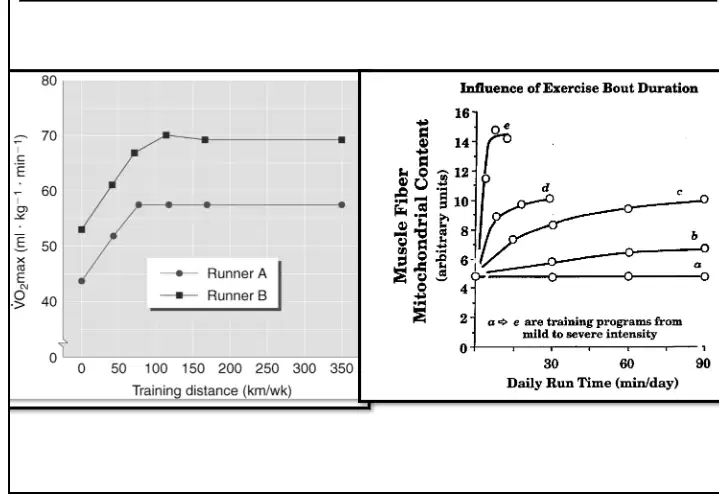
Based on the graphs shown, which training variable is most critical for increasing muscle fiber mitochondrial content?
Intensity of exercise
Type of shoes worn
Amount of water consumed
Time of day exercise is performed
If a runner increases both the intensity and duration of their training, what is the expected effect on their muscle mitochondrial content?
It will increase rapidly
It will decrease
It will remain unchanged
It will fluctuate randomly
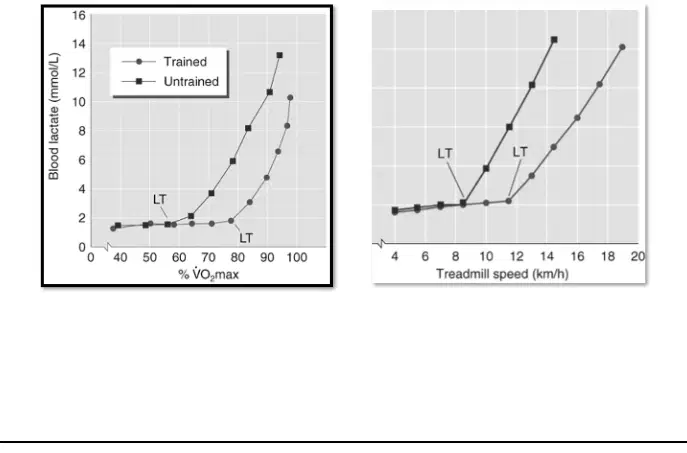
Which of the following is a result of training on lactate threshold (LT)?
LT occurs at a higher %VO2max in trained individuals
LT occurs at a lower %VO2max in trained individuals
LT is unaffected by training
LT occurs at the same %VO2max for all individuals
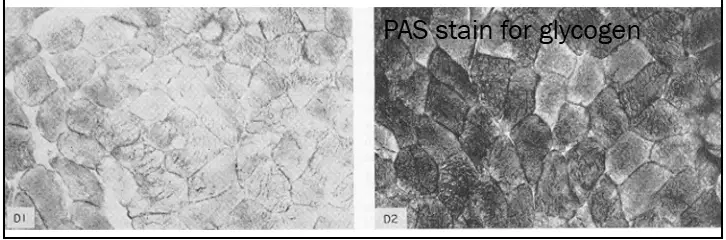
What is one effect of training on muscle glycogen content?
Muscle glycogen content may increase by up to 2 times
Muscle glycogen content decreases by half
Muscle glycogen content remains unchanged
Muscle glycogen content is eliminated
Which fuel source increases as a result of training?
Fats
Proteins
Water
Vitamins
What is the result of increased IMTG stores and fats as a fuel source due to training?
Glycogen sparing
Glycogen depletion
Increased protein breakdown
Reduced muscle mass
Explain how training affects the lactate threshold (LT) and why this is beneficial for endurance athletes.
Training raises the LT, allowing athletes to exercise at higher intensities before lactate accumulates, which improves endurance performance.
Training lowers the LT, causing athletes to fatigue more quickly.
Training has no effect on LT, so endurance performance remains unchanged.
Training eliminates the LT, making lactate accumulation impossible.
Describe the concept of glycogen sparing and its significance during prolonged exercise.
Glycogen sparing means the body uses more fats and IMTG stores, preserving muscle glycogen for later use, which delays fatigue.
Glycogen sparing means the body uses more protein, leading to muscle breakdown.
Glycogen sparing means the body eliminates glycogen completely.
Glycogen sparing means the body stores less glycogen, increasing fatigue.
What is the primary effect of providing extra carbohydrates (CHO) to muscles before exercise?
Increase initial muscle glycogen and reliance on glycolysis
Decrease initial muscle glycogen and reliance on glycolysis
Increase fat oxidation and decrease glycolysis
Decrease muscle glycogen and increase fat oxidation
According to the material, at approximately what percentage of VO₂max is the greatest sparing of muscle glycogen observed?
60%
20%
85%
100%
Which of the following statements best describes the effect of a high-carbohydrate diet on time to exhaustion during exercise?
It increases the time to exhaustion compared to a low-carbohydrate diet.
It decreases the time to exhaustion compared to a low-carbohydrate diet.
It has no effect on time to exhaustion.
It only affects time to exhaustion at low exercise intensities.
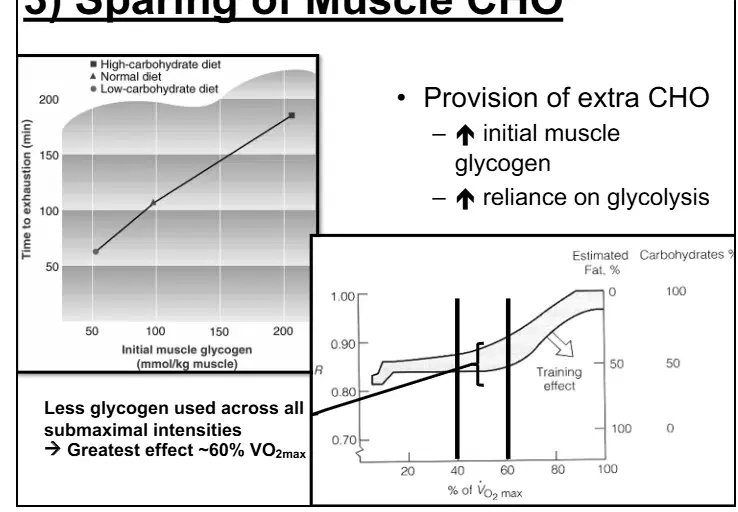
Based on the graph, which diet results in the highest time to exhaustion?
High-carbohydrate diet
Normal diet
Low-carbohydrate diet
Protein-rich diet
After endurance training, which fuel source is utilized less during submaximal exercise?
Muscle glycogen
Muscle triglycerides
Plasma free fatty acids (FFA)
Plasma glucose
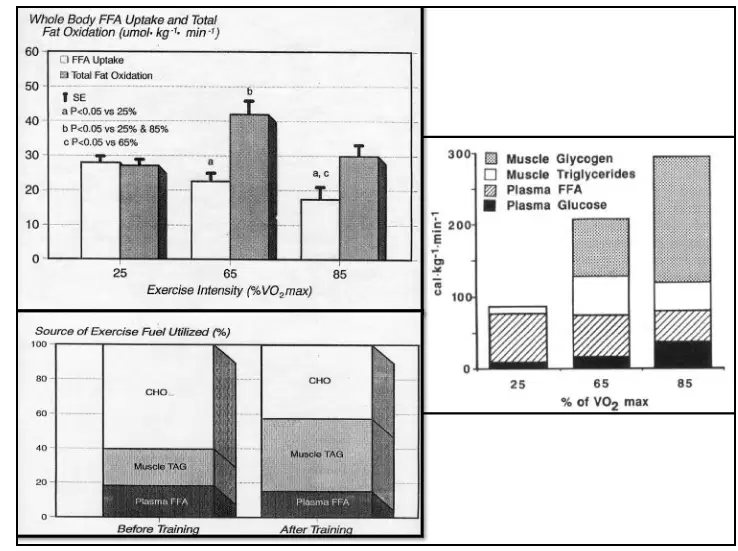
At which exercise intensity is total fat oxidation the highest according to the graph?
65% VO₂max
25% VO₂max
85% VO₂max
100% VO₂max
How does endurance training affect the source of exercise fuel utilized at submaximal intensities?
It increases the use of fat and decreases the use of carbohydrate.
It increases the use of carbohydrate and decreases the use of fat.
It has no effect on fuel utilization.
It increases the use of protein as a fuel source.
Which of the following is NOT a result of providing extra CHO before exercise?
Decrease in initial muscle glycogen
Increase in initial muscle glycogen
Increase in reliance on glycolysis
Sparing of muscle CHO
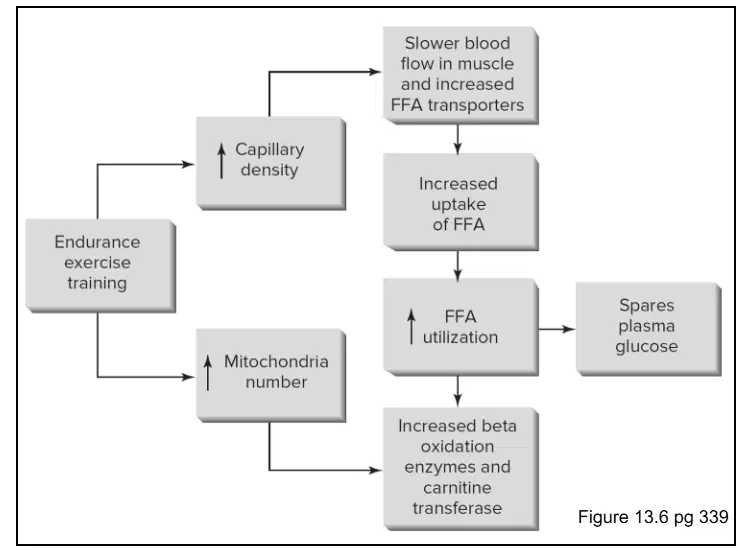
Which physiological adaptation is directly increased by endurance exercise training?
Capillary density
Blood pressure
Heart rate
Bone density
What is the effect of increased mitochondria number in muscle cells due to endurance exercise training?
Increased beta oxidation enzymes and carnitine transferase
Decreased oxygen consumption
Reduced muscle mass
Lowered heart rate
According to the Metabolic Adaptation Summary, what happens to carbohydrate (CHO) usage at rest after endurance training?
It decreases
It increases
It stays the same
It fluctuates randomly
How does endurance exercise training help spare plasma glucose during exercise?
By increasing FFA utilization
By decreasing capillary density
By reducing mitochondria number
By lowering total energy expenditure
Why is there not much difference between fit and unfit individuals at rest or during walking, according to the metabolic adaptation summary?
Because there is no challenge to the metabolic system
Because fit individuals have higher heart rates
Because unfit individuals use more fat
Because fit individuals have lower energy needs
During fast running, how do fit individuals differ metabolically from unfit individuals?
Fit individuals use fat longer and also use more carbohydrate at a higher rate
Fit individuals use less fat and more protein
Fit individuals use less carbohydrate and more fat
Fit individuals use the same amount of energy as unfit individuals
Which of the following is NOT a direct result of increased capillary density from endurance exercise training?
Slower blood flow in muscle and increased FFA transporters
Increased uptake of FFA
Increased bone density
Increased FFA utilization
What does the metabolic adaptation summary indicate about total energy expenditure at rest after endurance training?
It remains the same
It increases significantly
It decreases significantly
It fluctuates unpredictably
Which type of muscle fibre does endurance training (ET) primarily shift towards?
Type 1 fibres
Type 2 fibres
Type 3 fibres
Type 4 fibres
What is one benefit of muscle changes with endurance training (ET)?
Increased fatigue
Less fatigue and better ability to handle metabolic disturbances
Decreased ability to handle metabolic disturbances
Reduced muscle strength
During muscle fibre changes with endurance training, what happens to fast myosin levels?
They increase
They remain unchanged
They decrease
They fluctuate randomly
Which factors influence the degree of muscle fibre change during endurance training?
Diet and hydration
Duration of training and genetics
Age and gender
Sleep patterns and stress levels
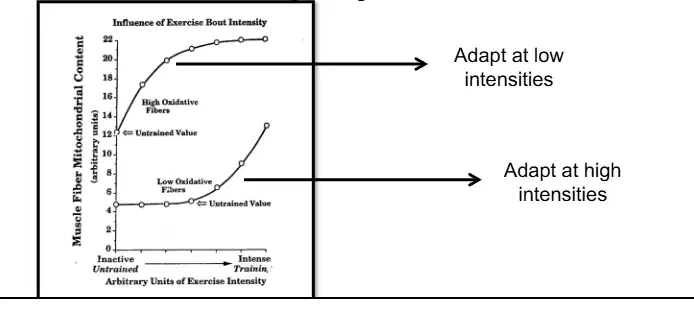
Explain how muscle fibre adaptation differs between low and high exercise intensities, based on the provided information.
Both low and high intensities result in the same adaptation
Low intensities adapt with high oxidative muscle fibres, while high intensities adapt with low oxidative muscle fibres
High intensities adapt with high oxidative muscle fibres, while low intensities adapt with low oxidative muscle fibres
Neither intensity leads to muscle fibre adaptation
Which of the following is a key cardiovascular change with endurance training (ET)?
Decreased heart function
Increased heart function
Decreased a-vO₂ difference
Reduced blood flow redistribution
Endurance training leads to an increase in which of the following?
a-vO₂ difference
Blood pressure
Resting heart rate
Muscle fatigue
What does blood flow redistribution refer to in the context of cardiovascular changes with endurance training?
Blood is distributed away from muscles during exercise
Blood is redistributed to active muscles during exercise
Blood flow remains constant regardless of activity
Blood is redistributed to the digestive system during exercise
Which group has the highest stroke volume at rest according to the table?
Untrained
Trained
Elite
All groups have the same stroke volume
How does the heart adapt to endurance training to improve its function?
The heart becomes smaller
The heart walls hypertrophy and it fills & pumps better
The heart rate decreases dramatically
The heart loses muscle mass
Based on the data, what is the maximum stroke volume (SV max) for elite subjects?
80-110 mL
130-150 mL
160-220+ mL
55-75 mL
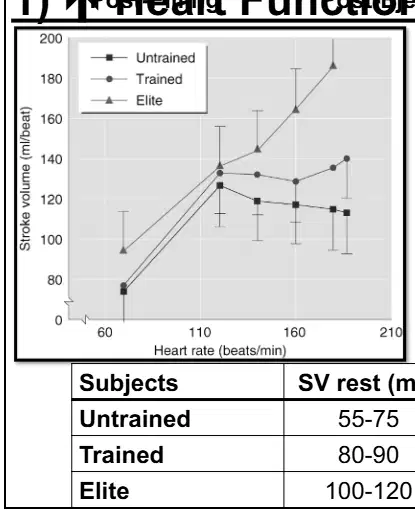
What does the graph suggest about stroke volume in elite athletes compared to untrained individuals as heart rate increases?
Stroke volume decreases more rapidly in elite athletes
Stroke volume remains higher in elite athletes across all heart rates
Stroke volume is the same for all groups at high heart rates
Stroke volume is lower in elite athletes at rest
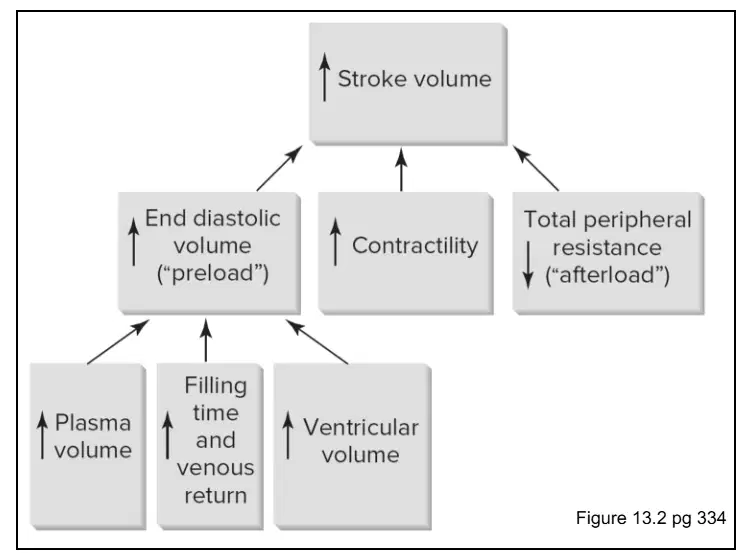
Which of the following factors directly increases stroke volume according to the diagram?
Increased end diastolic volume ("preload")
Decreased plasma volume
Decreased contractility
Increased total peripheral resistance ("afterload")
According to the data, what is the effect of longer duration training (28 months) on VO₂max improvements?
Increases a-vO₂ more than stroke volume
Increases stroke volume more than a-vO₂
Decreases both stroke volume and a-vO₂
Has no effect on VO₂max
What is the approximate contribution of stroke volume (SV) and arteriovenous oxygen difference (a-vO₂) to improvements in VO₂max?
~50% SV and ~50% a-vO₂
~75% SV and ~25% a-vO₂
~25% SV and ~75% a-vO₂
~100% SV and 0% a-vO₂
Based on the graphs, how does cardiac output change after training at a given treadmill speed?
Cardiac output is higher posttraining than pretraining
Cardiac output is lower posttraining than pretraining
Cardiac output remains the same pre- and posttraining
Cardiac output decreases with increased treadmill speed
If total peripheral resistance ("afterload") decreases, what is the expected effect on stroke volume?
Stroke volume increases
Stroke volume decreases
Stroke volume remains unchanged
Stroke volume becomes zero
Which of the following best explains the relationship between plasma volume and end diastolic volume ("preload")?
Increased plasma volume leads to increased end diastolic volume
Increased plasma volume leads to decreased end diastolic volume
Plasma volume has no effect on end diastolic volume
Increased plasma volume decreases contractility
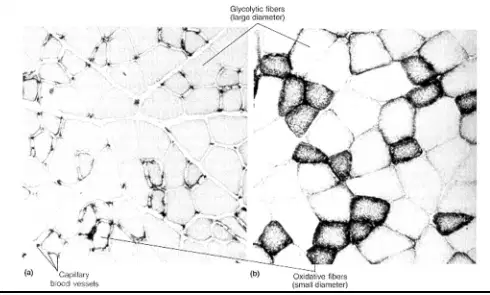
Which of the following is a result of increased muscle blood flow during exercise training?
Increased vasoconstriction
Decreased SNS activity
Decreased capillary density
Decreased mitochondrial number

What adaptation occurs in capillary density as a result of exercise training?
Capillary density decreases
Capillary density remains unchanged
Capillary density increases
Capillary density fluctuates randomly
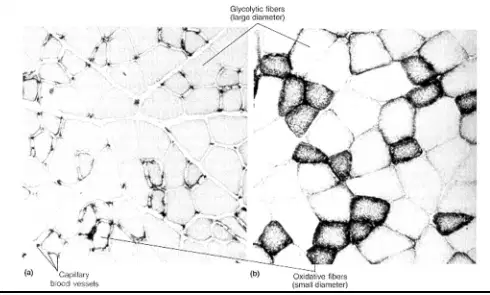
Which factor contributes to less vasoconstriction during exercise training?
Increased SNS activity
Decreased SNS activity
Increased mitochondrial number
Decreased muscle blood flow

How does blood volume change with training?
Blood volume decreases
Blood volume remains the same
Blood volume increases
Blood volume fluctuates randomly
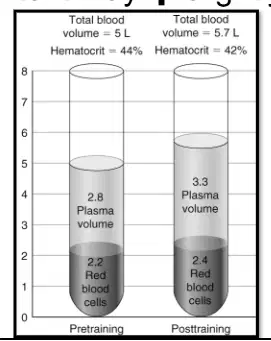
What component of blood volume is primarily responsible for the increase seen with training?
Red blood cell volume
Plasma volume
Platelet count
White blood cell count
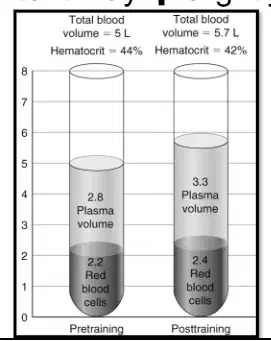
Total hemoglobin (HgB) content may change in what way as a result of training?
Decrease significantly
Remain unchanged
Increase slightly
Fluctuate randomly
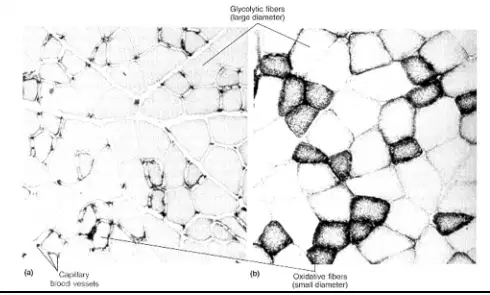
Explain how increased mitochondrial number and capillary density contribute to improved extraction during exercise training.
They reduce oxygen delivery to muscles
They enhance the muscles' ability to extract and utilize oxygen
They decrease muscle endurance
They increase vasoconstriction
Which cardiovascular variable remains the same at rest according to the CV Adaptation Summary?
VO₂
HR
SV
BV
What happens to heart rate (HR) at rest as per the CV Adaptation Summary?
It increases
It decreases
It remains the same
It fluctuates
According to the CV Adaptation Summary, which of the following increases at rest?
Stroke volume (SV)
Heart rate (HR)
Q (Cardiac output)
VO₂
Which adaptation is associated with an increase in capillary density at rest?
CV Adaptation
Respiratory Adaptation
Muscular Adaptation
Neural Adaptation
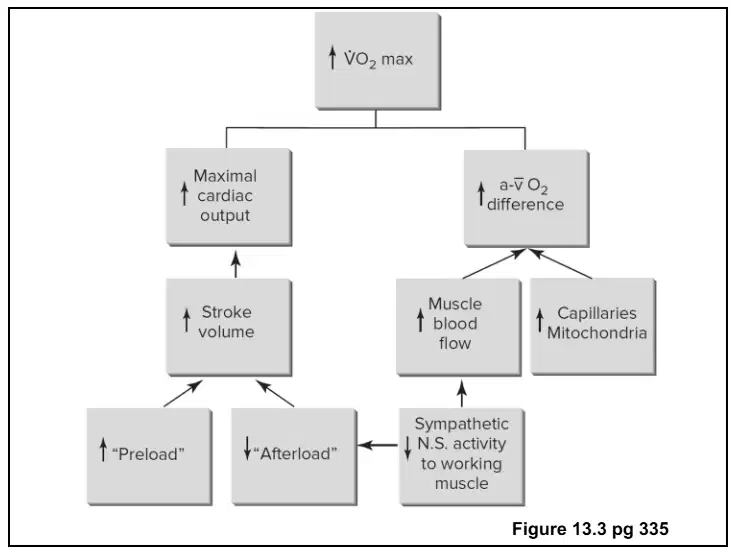
Based on the diagram, which factor directly contributes to an increase in stroke volume?
Increase in "Preload"
Decrease in "Afterload"
Increase in muscle blood flow
Increase in capillaries and mitochondria
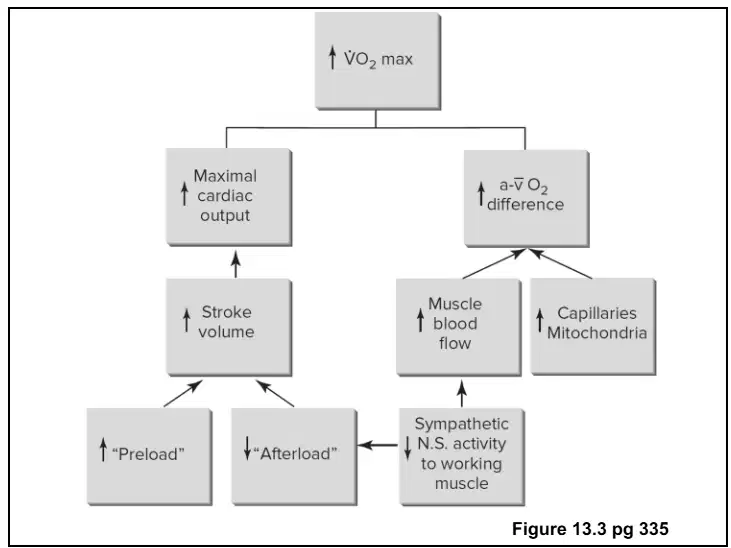
How does an increase in a-vO₂ difference contribute to VO₂ max according to the flowchart?
By increasing muscle blood flow and capillaries/mitochondria
By decreasing stroke volume
By increasing sympathetic nervous system activity
By reducing afterload
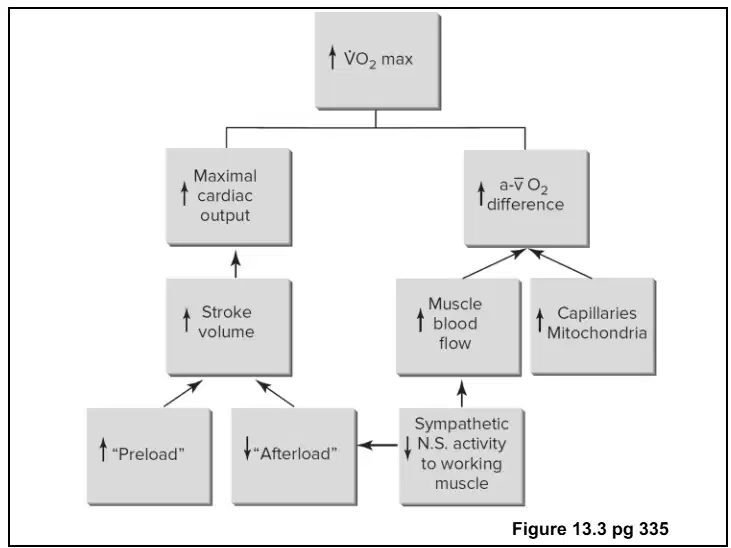
Explain how maximal cardiac output is achieved according to the diagram.
By increasing stroke volume through higher preload and lower afterload
By decreasing muscle blood flow
By increasing capillary density
By reducing sympathetic nervous system activity
Which of the following is a key respiratory change that occurs with endurance training (ET)?
Decreased respiratory muscle fatigue resistance
Increased respiratory muscle fatigue resistance
Decreased gas exchange at lungs
Increased breathing frequency
How does the breathing pattern typically change as a result of endurance training?
Less depth, more frequency
More depth, less frequency
More depth, more frequency
Less depth, less frequency
What happens to gas exchange at the lungs after endurance training?
It decreases
It remains unchanged
It increases
It fluctuates randomly
After endurance training, what happens to ventilation at a given exercise intensity?
It increases
It decreases
It remains the same
It fluctuates unpredictably
Why is ventilation not considered a limiting factor during exercise after endurance training?
Because maximum voluntary ventilation is less than exercise ventilation
Because maximum voluntary ventilation equals exercise ventilation
Because maximum voluntary ventilation is greater than exercise ventilation
Because exercise ventilation is not affected by training
Which statement best explains why there are no structural changes in the respiratory system after endurance training?
The respiratory system adapts only through structural changes
Endurance training causes only functional changes, not structural changes
Structural changes are necessary for improved gas exchange
Endurance training decreases the need for structural changes
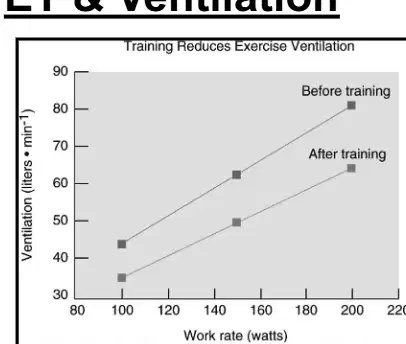
Based on the graph, what is the effect of endurance training on ventilation rates at the same work rate?
Ventilation rates increase after training
Ventilation rates decrease after training
Ventilation rates remain unchanged after training
Ventilation rates fluctuate randomly after training
Which of the following is a respiratory adaptation that occurs with high intensity training?
Increased movement of air
Decreased breathing rate
Reduced number of alveoli
Lower respiratory muscle strength
At rest, how do VE (minute ventilation) and breathing frequency change as a result of respiratory adaptations?
Both increase
Both decrease
Both stay the same
VE increases, frequency decreases
Which adaptation leads to more efficient fuel use in the body?
Metabolic adaptation
Muscle adaptation
Cardiovascular adaptation
Respiratory adaptation
What is a key benefit of cardiovascular adaptations according to the take home points?
More efficient system with higher top end
Less efficient muscle activation
Decreased fuel use
More fatigue in respiratory muscles
Which of the following is NOT listed as a respiratory adaptation from training?
Increased capillarisation in lungs
Increased number of alveoli
Decreased ability of lungs to expand
Increased respiratory muscle strength and endurance
Explain how respiratory adaptations contribute to reduced fatigue during exercise.
They increase the efficiency of oxygen exchange and strengthen respiratory muscles, allowing for sustained activity with less fatigue.
They decrease the number of alveoli, making breathing harder.
They reduce capillarisation, limiting oxygen delivery.
They slow down breathing rate, causing less oxygen intake.
How do muscle adaptations improve performance according to the take home points?
By making muscle activation more efficient
By reducing muscle strength
By increasing muscle fatigue
By decreasing fuel use
Which of the following is a result of increased capillarisation in the lungs?
More blood flow and cross-sectional area for gas exchange
Less oxygen delivered to muscles
Reduced breathing rate
Decreased number of alveoli

