
 Worksheets
Economics and Finance Quiz
Total questions: 48
Worksheet time: 40mins
Scarcity exists because:
Resources are unlimited
Wants are limited
Resources are limited but wants are unlimited
Markets don’t function
Which of the following is a factor of production?
Gravity
Human capital
Temperature
Air pressure
Opportunity cost is:
Money spent on goods
The next best alternative given up
The time it takes to make something
Wasted resources
A traditional economy is based on:
Government decision-making
Consumers’ choices
Customs and traditions
Technology and markets
A point outside the PPC curve represents:
Efficient production
Under-utilization
Unattainable production
Maximum efficiency
According to the law of demand:
Price ↑ → Qd ↑
Price ↑ → Qd ↓
Price ↓ → Qd ↓
Price does not affect Qd
Which of these will shift the demand curve?
Price of the product
Resource cost
Consumer income
Technology
A price ceiling set below equilibrium creates:
A surplus
A shortage
No effect
A new equilibrium above original
A price floor set above equilibrium creates:
Shortage
Surplus
Inflation
Perfect competition
When supply increases, equilibrium price will:
Increase
Decrease
Stay the same
Rise then fall
Which business organization has unlimited liability?
Corporation
Sole proprietorship
Nonprofit
LLC
Perfect competition includes:
One seller
Few sellers
Many sellers with identical products
Many sellers with unique products
Real GDP differs from nominal GDP because real GDP:
Ignores services
Adjusts for inflation
Uses current prices
Excludes imports
The unemployment rate is calculated by:
Labor force ÷ unemployed
Employed ÷ population
Unemployed ÷ labor force
Jobs ÷ workers
Cyclical unemployment happens because of:
Job switching
Recessions
Seasonal jobs
Technology changes
The Federal Reserve controls:
Foreign trade
Taxes
Interest rates & money supply
Government spending
When the Federal Reserve buys bonds, this is:
Expansionary monetary policy
Contractionary monetary policy
Fiscal policy
Budgeting policy
A government budget deficit occurs when:
Revenue > spending
Spending > revenue
Taxes equal spending
GDP is shrinking
Comparative advantage means producing:
The most goods overall
The lowest total cost
The lowest opportunity cost
Goods with most workers
A tariff is a:
Limit on imports
Tax on imports
Complete ban on trade
Subsidy to producers
A strong dollar makes imports:
Cheaper
More expensive
Illegal
Harder to find
Net exports =
Imports – exports
Exports – imports
Imports + exports
GDP – spending
Inflation is defined as:
A drop in GDP
A general rise in prices
Unemployment rising
Money supply decreasing
Net worth =
Assets + liabilities
Assets – liabilities
Income – expenses
Gross pay – taxes
A regressive tax affects low-income earners:
More heavily
Less heavily
Equally
Not at all
A budget helps you:
Increase taxes
Spend more than you make
Manage your money
Eliminate expenses completely
Compound interest grows money:
At the same rate as simple interest
Slower over time
Faster over time
Not at all
Renters insurance covers:
The building structure
The landlord’s property
The tenant’s personal belongings
Vehicles
According to the law of supply:
Price ↑ → Qs ↑
Price ↑ → Qs ↓
Price ↓ → Qs ↑
Price never affects Qs
Specialization leads to:
Lower productivity
Higher productivity
Fewer trade options
Increased costs
Which is NOT a scarce resource?
Labor
Trees
Time
Candy
To lack enough of something
Shortage
Plentifulness
Accountability
Pollution
This is how it is decided who will get goods and services when there are not enough for everyone.
good
scarcity
allocation
services

The 4 Factors of Production (FOP) are
rent for land, wages for labor, profit for capital, interest for entrepreneurship
land, labor, capital, entrepreneurship
land, labor, physical capital, financial capital
land, labor, resources, profits

What type of market structure is described by the information?
Pure Competition
Monopolistic Competition
Oligopoly
Monopoly

Which of the following is described by the characteristics listed in the box?
Monopoly
Oligopoly
Pure competition
Monopolistic competition


The situation graphed here would be called:
Equilibrium price
Shortage
Surplus
Oaken's Trading Post

Which statement reflects the inverse relationship between quantity demanded and price?
As the price goes up, quantity demanded goes up.
As the price goes down, quantity demanded goes up.
As the supply goes up, the price goes up.
As the supply goes up, the demand goes up.
The government takes a hands-off approach to business.
communism
socialism
laissez-faire
invisible hand
A legal barrier that holds a price below the equilibrium price; sets the highest price.
(a)
A legal barrier that holds a price above the equilibrium price; sets the lowest price.
(a)
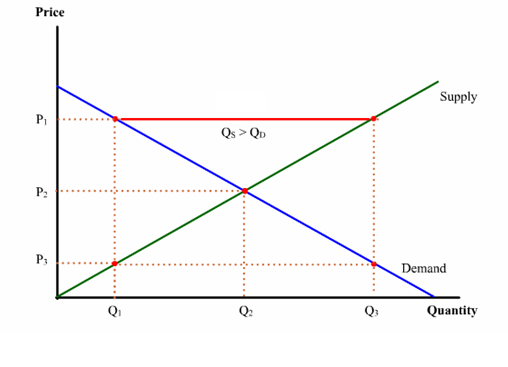
If producers price products above equilibrium, it will cause a
surplus
price ceiling
price floor

