
 Worksheets
The Colonial Era in India
Total questions: 98
Worksheet time: 49mins
Colonialism is:
the policy or practice of acquiring full or partial control over another country, occupying it with settlers, and exploiting it economically
the process of forming alliances between countries for mutual benefit
the act of promoting local culture and traditions in a region
the system of government where power is shared equally among all citizens
What drew European powers to India?
The search for spices and trade opportunities
The desire to spread Christianity
The quest for new lands to colonize
The need for military alliances
India’s economic and geopolitical standing before and during the colonial period was:
One of the world’s leading economies and a major geopolitical power before colonization, but declined significantly during colonial rule.
A minor economic player with little geopolitical influence throughout both periods.
Consistently the most powerful nation in the world during both periods.
Economically stagnant and geopolitically isolated before and during colonial rule.
The British colonial domination of India impacted the country in which of the following ways?
It led to economic exploitation and cultural changes.
It resulted in complete industrialization of India.
It caused India to become a world superpower.
It eliminated all social divisions in India.

In which year did Vasco da Gama arrive at Calicut (Kozhikode)?
1498
1501
1488
1510

When was the Inquisition established at Goa?
1560
1542
1600
1580

The English East India Company established trading posts at Surat, Madras, Bombay, and Calcutta between which years?
1612-1690
1500-1570
1700-1770
1800-1870
Colonialism is:
the policy of acquiring and maintaining colonies by one country over another
the process of industrialization in a country
the development of democratic institutions in a society
the practice of promoting local culture and traditions
According to the passage, colonialism is not a recent occurrence.
True
False

What event took place in 1757 that marked a significant British victory in India?
The defeat of the Dutch at the Battle of Colachel
The British victory in the Battle of Plassey
The Carnatic Wars between the British and the French
The Great Indian Rebellion

Fill in the blank: The British Crown ended the rule of the East India Company and started the British Raj in the year _____?
1858
1757
1947
1833

Which war ended Maratha power in 1818?
Third Anglo-Maratha war
First Anglo-Maratha war
Second Anglo-Maratha war
Battle of Plassey
What does the term 'enslavement' mean as used in the passage?
Turning someone into a slave.
Giving someone freedom.
Teaching someone a skill.
Making someone a leader.
According to the passage, which European countries established colonies across the world during the Age of Colonialism?
Spain, Portugal, Britain, France, and Netherlands
Italy, Germany, Austria, Sweden, and Norway
Russia, Poland, Switzerland, Greece, and Hungary
Denmark, Finland, Belgium, Ireland, and Luxembourg
The conquests during the Age of Colonialism were often achieved through peaceful negotiations.
True
False
What were some of the motivations for European nations to undertake colonial expansion?
Political competition, economic advantages (access to resources, new markets, trade routes), plunder, converting indigenous populations to Christianity, and scientific inquiry.
Avoiding technological advancements and isolation from global trade.
Reducing population growth and limiting cultural exchange.
Focusing solely on domestic agriculture and ignoring overseas opportunities.
What does the term 'Demonise' mean?
To praise someone in a positive light
To falsely portray an individual or a group of people in a very negative light
To ignore someone's actions
To support a group of people

What message does this cartoon convey about British colonisation in Africa?
It criticizes the exploitative nature of British colonisation in Africa.
It celebrates the positive impact of British rule in Africa.
It shows the peaceful coexistence between British colonisers and Africans.
It ignores the effects of colonisation on African societies.
Fill in the blank: While colonisers often claimed they had the 'civilising mission' of bringing 'progress' to the colonised peoples, the reality was very different: loss of independence, exploitation of resources by the colonisers, the destruction of traditional ways of life, and the imposition of ______ cultural values.
foreign
ancient
local
indigenous
The cartoon (Fig. 4.3) is trying to express which idea, considering that the telegraph was a recent invention allowing instant communication? Analyse different elements of the drawing.
The telegraph revolutionized communication by making it instant.
The telegraph was a dangerous and unreliable invention.
The telegraph made travel faster than ever before.
The telegraph was only useful for military purposes.
Who controlled the port town of Ullal in the latter half of the 16th century?
Vasco da Gama
Rani Abbakka I
The British
The Dutch
How did Rani Abbakka II reportedly attack the Portuguese ships?
By using cannons
By creating fireballs out of coconut shells
By poisoning the crew
By sinking them with submarines
Fill in the blank: The Portuguese captured strategic ports, including _____ in 1510, which became the capital of their colony in India.
Goa
Calicut
Bombay
Cochin
What was the system called that the Portuguese implemented, requiring all ships in the Arabian Sea to purchase permits for navigation?
Cartaz
Capitulation
Mandate
Passage License
What was the Inquisition, as established by the Portuguese in Goa in 1560?
A tribunal set up by the Roman Catholic Church to judge heretics (i.e. Christians suspected of holding opinions contrary to the Church's doctrine).
A trade council established to regulate spice exports.
A military alliance formed to defend against local kingdoms.
A school founded to teach European languages.
The Portuguese presence in western India was characterised only by commercial exploitation and not by religious persecution.
True
False
The impact of Portuguese naval dominance on the spice trade between India and Europe was:
It allowed Portugal to control and monopolize the spice trade routes.
It led to the decline of European interest in Indian spices.
It resulted in the complete end of spice trade between India and Europe.
It made the spice trade more accessible to all European nations.

What does the plaque in Kozhikode commemorate?
It marks Vasco da Gama's arrival in Kozhikode in the year 1498.
It marks the founding of the first Indian university.
It commemorates the signing of the Treaty of Kozhikode.
It celebrates the birth of Mahatma Gandhi.
When did the Dutch arrive in India?
The Dutch arrived in India in the early 17th century.
The Dutch arrived in India in the late 18th century.
The Dutch arrived in India in the mid 15th century.
The Dutch arrived in India in the early 20th century.
Which company did the Dutch establish for trading in India?
Dutch East India Company
British East India Company
French East India Company
Portuguese East India Company
What was the main area of Dutch presence in India?
Malabar region of Kerala
Coromandel Coast of Tamil Nadu
Konkan region of Maharashtra
Bengal region

Who did the Dutch forces surrender to after the Battle of Colachel in 1741 CE?
King Marthanda Varma of Travancore
Hyder Ali of Mysore
Robert Clive of the British East India Company
Tipu Sultan of Mysore
Who defeated the Dutch forces at the Battle of Colachel in 1741?
British
Travancore under King Marthanda Varma
French
Portuguese
Fill in the blank: The Dutch presence in India declined significantly after their defeat at the Battle of _______ in 1741.
Colachel
Plassey
Panipat
Buxar
When did the French establish their first trading post in India?
1668
1674
1742
1754
Who served as Governor-General of French India from 1742 to 1754 and pioneered several colonial strategies?
Dupleix
La Bourdonnais
Benoît Dumas
Pierre André de Suffren
The French colonial ambitions in India were checked during the Carnatic Wars (1746–1763), which were conflicts between which two countries?
France and Portugal
Britain and France
France and Spain
Britain and Netherlands
The French colonial powers intervened extensively in Indians’ social and religious life.
True
False

Refer to the map titled 'Plan de la Ville de Pondicheri'. What does the large structure facing the sea at the bottom of the plan represent?
The hospital
The fort
The market
The cemetery
According to the passage 'Enter the British', for how long did Britain dominate the Indian subcontinent? Fill in the blank: Britain dominated the Indian subcontinent for nearly ______ centuries.
two
three
one
four
Based on the passage 'Enter the British', what will the text focus on regarding British colonialism in India?
The impact of British colonialism in India
The history of Indian independence
The cultural diversity of India
The geography of India
The painting on the first page of this chapter was specially ordered for which location?
London headquarters of the East India Company
British Museum
Victoria Memorial
National Gallery
What policy did the British use to benefit from conflicts between regional rulers or succession disputes within ruling houses in India?
Doctrine of Lapse
Divide and Rule
Subsidiary Alliance
Permanent Settlement

Who led the East India Company officials during the Battle of Plassey in 1757?
Mir Jafar
Siraj-ud-daulah
Robert Clive
William Heath
Fill in the blank: The Battle of Plassey took place at Palashi, some 150 kilometres north of present-day _______.
Kolkata
Delhi
Mumbai
Chennai
Mir Jafar's forces assisted the Nawab during the Battle of Plassey, ensuring a British victory.
True
False
What was the Doctrine of Lapse introduced by the British in the 19th century?
A) A policy to divide Indian rulers
B) A policy to annex princely states if the ruler died without a male heir
C) A policy to encourage religious tensions
D) A policy to install new Nawabs
In the Indian context, a princely state was a region that remained under the rule of an Indian prince, maharaja or nawab, but which had accepted British protection and guidance in exchange for maintaining internal autonomy.
True
False
At the time of India’s Independence, there were over ____ princely states, covering about 40 per cent of the Subcontinent.
500
200
1000
50
Which of the following was NOT a large princely state mentioned in the passage?
Hyderabad
Mysore
Travancore
Punjab
The Doctrine of Lapse led to the annexation of numerous states, contributing to the expansion of the territorial control of the British.
True
False
The main purpose of the subsidiary alliance system introduced by the British in India was:
To establish British military control over Indian states
To promote trade between British and Indian states
To encourage cultural exchange between Britain and India
To provide financial aid to Indian rulers
What does 'Paradise' mean in a religious context?
A) A place of suffering
B) Heaven, an ideal, wealthy or perfectly happy place
C) A desert
D) A battlefield
Who described Bengal as 'the paradise of the earth' after the victory at Plassey?
Clive
Warren Hastings
Robert Cornwallis
Mir Jafar
What was one major consequence of the harsh revenue collection targets imposed by the East India Company in Bengal during 1770-1772?
A catastrophic famine which killed nearly one-third of the population or an estimated 10 million people.
Rapid industrialization and economic growth in Bengal.
The establishment of democratic institutions in Bengal.
A significant increase in agricultural productivity and prosperity.
According to W.W. Hunter, what were some of the desperate actions taken by farmers during the famine of 1770?
Farmers sold their cattle, implements of agriculture, seed-grain, sons and daughters, ate leaves of trees and grass of the field, and poured into the great cities.
Farmers migrated to other countries in search of gold.
Farmers started trading spices with European merchants.
Farmers built irrigation canals to prevent famine.
Describe the impact of the Great Famine of 1876-1878 in India.
Up to 8 million Indians perished, mostly in the Deccan plateau.
It led to the abolition of the British Raj.
It resulted in the immediate independence of India.
It caused a major industrial revolution in India.

What does the image show about the situation on Madras beach during the famine of 1876-1878?
People were receiving food relief
Grain bags were ready for export while people were dying of hunger in large numbers
The government was distributing grain to the poor
There was no grain available on the beach

What were people waiting for in Bangalore (today Bengaluru) during the 1877 famine?
Food export
Famine relief
Government jobs
Price rise
According to the passage, about how much rice was exported to Britain per year during the three years of the famine?
One thousand tonnes
One million tonnes
Ten million tonnes
One hundred thousand tonnes
Fill in the blank: The British economic policy of 'free market' during the famine left prices of commodities free to ________, which contributed to the severity of the famines.
fluctuate
stabilize
decrease
remain constant
Lord Lytton, Viceroy of India, issued which order during the 1876-1878 famine regarding government interference in the price of food?
He ordered no government interference in the price of food.
He mandated strict government control over food prices.
He subsidized food prices for the poor.
He imposed price ceilings on all grains.
According to the passage, how many severe famines occurred during the entire British rule in India?
Less than 10
Between 12 and 20
From a dozen to over 20
More than 50
What was the estimated total number of human victims of famines during British rule in India?
10-20 million
50-100 million
200-300 million
Less than 1 million
Fill in the blank: The British administration did open famine relief camps in some cities, but they were far too few and with ______ supplies.
inadequate
abundant
expensive
modern
According to Brooks Adams, what event marked the beginning of the 'industrial revolution' in Britain?
The Battle of Plassey
The end of World War II
The establishment of famine relief camps
The arrival of Bengal plunder in London
Explain how the 'drain of India's wealth' contributed to the Industrial Revolution in Britain.
It provided Britain with capital to invest in industries and infrastructure, fueling the Industrial Revolution.
It led to the decline of British industries due to lack of resources.
It caused Britain to import more goods from India, slowing industrial growth.
It resulted in Britain losing its economic dominance to India.
Dadabhai Naoroji referred to 'un-British rule in India' as:
A system where British interests were prioritized over Indian welfare.
A period when India was ruled by Indian kings.
A time when India was not under any foreign rule.
A rule that promoted equal rights for Indians and British.
Let us return to this painting (Fig. 4.14), but now with some clues to its symbolism. Note how Britannia (a symbolic figure) is depicted in the artwork. What does Britannia symbolize in this painting?
The British nation
A famous artist
A historical event
A type of ship
According to the passage, what does the higher position of Britannia in the painting symbolise?
The wealth of the colonies
The superior power of Britain
The equality between Britain and the colonies
The importance of trade
What do the dark complexion of the Indian figures in the painting reflect, according to the passage?
The climate of India
The belief in the superiority of white people over dark-skinned 'natives'
The wealth of India
The importance of trade
Did the colonies really 'offer' their wealth to Britain, according to the passage?
Yes, the colonies willingly offered their wealth to Britain.
No, the colonies did not willingly offer their wealth to Britain.
The colonies offered only a part of their wealth to Britain.
The passage does not mention anything about the colonies' wealth.
What impact did expanding colonial rule have on Indian life, according to the passage under 'Changing Landscapes'?
It led to significant changes in Indian society and environment.
It resulted in complete independence for Indian people.
It had no effect on Indian traditions or daily life.
It improved the economic status of all Indians.
Do you understand all the terms used above to list and describe Indian textiles? If not, what should you do next?
Form groups and research the terms, then compare findings with your teacher.
Ignore the terms and move on to the next topic.
Ask your teacher to give you all the answers without any research.
Skip the activity and wait for someone else to explain.
What does 'Embossed' mean?
A design stamped on the cloth in such a way that it stands out in relief.
A type of cotton fabric.
A method of weaving silk.
A traditional Indian dyeing technique.
According to Charles Metcalfe, what was the significance of village communities in India during the 1830s?
They were insignificant in Indian society
They acted as little republics, self-sufficient and resilient
They were controlled directly by the British
They contributed little to the preservation of India
Fill in the blank: The British systematically dismantled indigenous governance systems in India, replacing them with a ________ bureaucracy designed primarily to facilitate tax collection and maintain order.
centralised
fragmented
decentralised
traditional
Name any two traditional educational institutions mentioned in the passage that existed in India before British rule.
Gurukuls and Madrasas
Universities and Colleges
Schools and Seminaries
Libraries and Museums
The introduction of British codes of law respected the customary laws and practices that had governed Indian communities for generations.
True
False
What did Macaulay mean when he wrote that 'a single shelf of a good European library was worth the whole native literature of India and Arabia', and why did he want to make Indians 'English in taste, in morals, and in intellect'?
He believed European literature and culture were superior and wanted to promote English values among Indians.
He admired Indian and Arabian literature and wanted to preserve it.
He thought Indian and Arabian literature was equal to European literature.
He wanted Indians to reject English culture and embrace their own traditions.
What does the term 'Orientalist' mean?
A scholar of the Orient, regions from West Asia to the Far East
A British historian
An Indian clerk
A colonial administrator
What was the primary purpose of the railway network built by the British in India?
To help Indians travel easily
To move raw materials for export and distribute British goods
To promote tourism
To connect Indian villages
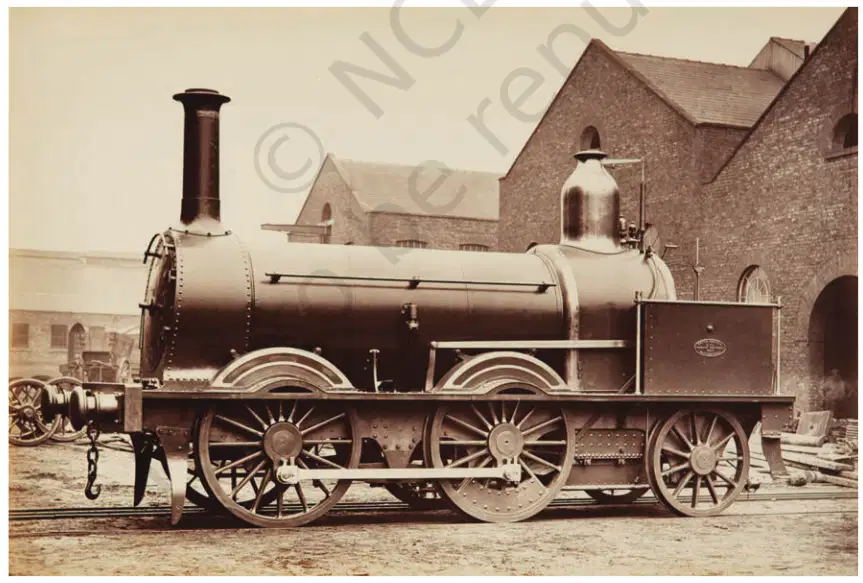
Fill in the blank based on the image caption: A steam locomotive of the ________ Railway (one of the companies operating the rail network in British India) in 1860.
Madras
Bombay
Bengal
Punjab
Based on the passage, the construction of railways in India served the economic interests of the British Empire by:
Facilitating the transport of raw materials to ports for export to Britain
Promoting local Indian industries over British goods
Reducing British control over Indian trade routes
Encouraging Indian self-sufficiency in manufacturing
What is meant by 'the sun never sets on the British Empire'? Do you think this was a correct statement?
It means the British Empire was so vast that at any time, the sun was shining on at least one of its territories.
It means the British Empire only existed in sunny regions.
It means the British Empire controlled the world's weather.
It means the British Empire never experienced nighttime.

Examine the map. What are the main differences with the map of today's India, in terms both of borders and of names?
The borders are different and some regions have different names compared to today's India.
The map shows only the southern part of India with unchanged borders.
There are no differences; the map is identical to today's India.
The map displays only cities and does not show any borders or names.
What was the main reason for the Kol Uprising (1831-1832) in Chota Nagpur?
Introduction of new land policies by the British
Taxation on forest produce
Conversion to Christianity
Replacement of tribal councils
Who led the Santhal Rebellion of 1855-1856?
Bankim Chandra Chattopadhyay
Sidhu and Kanhu Murmu
Munda and Oraon
British officials
Fill in the blank: The British described tribals as '________', restricted their access to forests and forest produce, and imposed cash taxes.
primitive
modern
educated
urban
The Santhal Rebellion was a widespread uprising against moneylenders and landlords who were taking away ancestral lands with British support.
True
False
Which novel by Bankim Chandra Chattopadhyay was inspired by the rebellion of the sanyasis and fakirs and contained the song 'Vande Mataram'?
Anandamath
Durgeshnandini
Kapalkundala
Rajmohan's Wife
Indigo is a natural deep blue pigment used in dyeing. Which of the following is another natural substance traditionally used in India to dye cloth?
Turmeric
Charcoal
Salt
Plastic
The term 'Sepoy Mutiny' was rejected after Indian Independence because:
it was seen as a colonial term that undermined the Indian perspective of the uprising
it was considered too long and complicated
it was not recognized by the British government
it referred only to a small group of soldiers
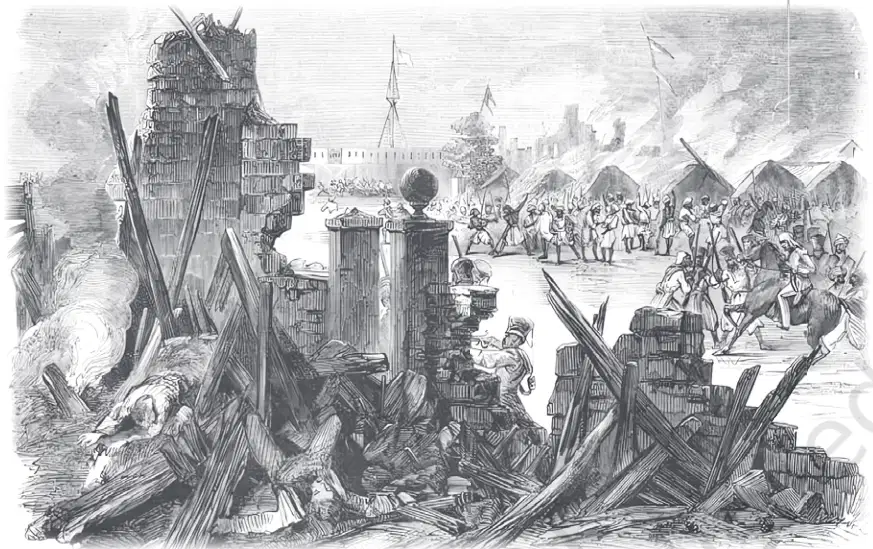
What was the main reason for the Vellore Mutiny of 1806 among the sepoys?
High taxes
New uniform regulations violating religious practices
Lack of food supplies
Poor living conditions
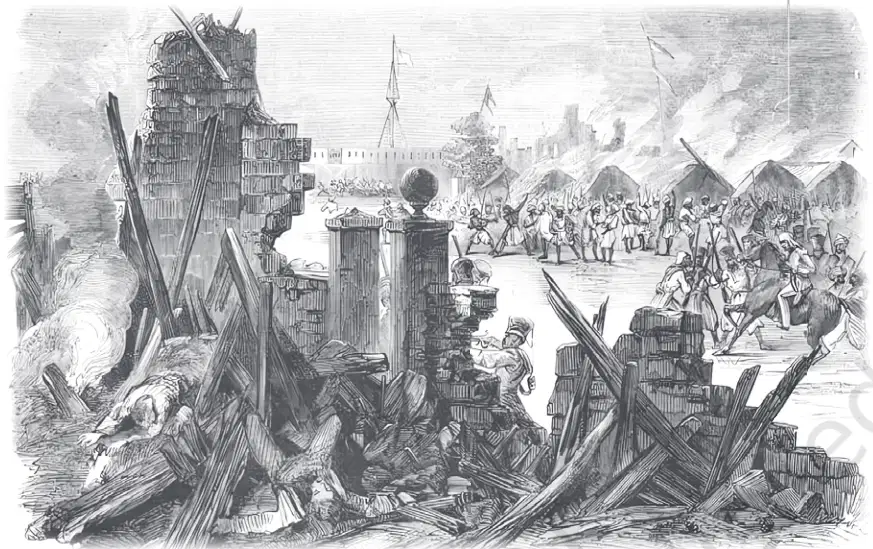
Read the passage and answer: The sepoys seized the Vellore fort and killed many British officers and troops. What was the British response?
They negotiated with the sepoys
They crushed the revolt, killing or executing hundreds of sepoys
They left the fort
They changed the uniform regulations
Fill in the blank: In 1857, rumours spread across northern and central India that rifle cartridges were greased with ______ and pig fat, offending the Hindu and Muslim sepoys’ religious sensibilities.
cow
goat
buffalo
sheep
Who attacked British officers at Barrackpore, leading to further discontent among the sepoys?
Mangal Pandey
Bahadur Shah
Nana Sahib
Rani Lakshmibai
Who was proclaimed as the leader by the sepoys when they marched to Delhi during the revolt of 1857?
Bahadur Shah Zafar
Rani Lakshmibai
Tantia Tope
Nana Sahib

