
Font size
 Worksheets
Financial Statements Quiz
Total questions: 98
Worksheet time: 49mins
What is the primary purpose of an income statement?
To show a company's financial position at a specific point in time
To summarize a company's revenues and expenses over a period
To list all assets and liabilities of a company
To record daily transactions of a business
Which financial document typically includes information about revenues, expenses, and net income?
Balance sheet
Cash flow statement
Income statement
Bank statement
Suppose a company wants to analyze its performance for the year. Which statement would be most useful for understanding its profitability?
Income statement
Statement of retained earnings
Balance sheet
Statement of cash flows
Which of the following best defines what accounts are in a business context?
Records of financial transactions and balances
Lists of employees and their roles
Inventories of products in stock
Schedules of meetings and appointments
Why is it important for businesses to keep their accounts accurate?
To ensure proper financial management and decision-making
To increase the number of employees
To reduce the amount of paperwork
To avoid having to pay taxes
Which formula would you use to calculate Gross Profit?
Sales Revenue minus Cost of Goods Sold
Net Profit minus Expenses
Total Assets minus Total Liabilities
Cash minus Accounts Receivable
What is the critical difference between Profit and Cash in a business?
Profit is paper money, while Cash is real money
Profit is earned from investments, while Cash is borrowed
Profit is only available at the end of the year, while Cash is available daily
Profit is used for marketing, while Cash is used for salaries
When analyzing an Income Statement, what is the main purpose?
To understand a company's financial health
To determine the number of employees
To calculate the amount of inventory
To schedule business meetings
How can forecasted financial data be used in business decision-making?
To evaluate future business decisions
To hire new employees
To design company logos
To organize company events
Which of the following best defines "accounts" in a business context?
The list of employees in a company
The financial records of a business
The marketing strategies of a business
The inventory of products in a business
What is the main goal of maintaining accounts in a business?
To track employee attendance
To monitor every penny coming in and going out
To record customer feedback
To manage product quality
Who is typically responsible for managing the accounts in a business?
The Human Resources Department
The Marketing Department
The Finance Department (Accountants)
The Sales Department
According to the golden rule of accounts, what two qualities must financial records have?
Confidential and creative
Up-to-date and 100% accurate
Flexible and negotiable
Simple and brief
Imagine a business fails to keep its accounts up-to-date and 100% accurate. What could be a possible consequence?
Improved customer satisfaction
Financial errors and poor decision-making
Increased product sales
Better employee morale
When are the "Final Accounts" produced?
At the end of the financial year.
At the beginning of the financial year.
Every month.
Every week.
What is the main purpose of the "Final Accounts"?
To summarize everything that happened during the year.
To record daily transactions.
To plan for the next year.
To calculate employee salaries.
Which of the following is NOT shown by the "Final Accounts"?
Future business strategies.
How the business performed (profit or loss).
What the business is currently worth (Assets vs. Debts).
A summary of the year's activities.
Suppose a business wants to know if it made a profit during the year. Which part of the "Final Accounts" would provide this information?
Results
Value
Assets
Debts
If a company wants to compare its assets and debts at the end of the year, which aspect of the "Final Accounts" should it look at?
Value
Results
Revenue
Expenses
Which type of business must publish their accounts by law?
Limited Companies
Sole Traders
Partnerships
Non-profit Organizations
What is a key difference between the financial records of limited companies and those of sole traders & partnerships?
Limited companies must keep records private, while sole traders must publish them.
Limited companies must publish detailed accounts, while sole traders & partnerships can keep simpler, private records.
Sole traders & partnerships must publish detailed accounts, while limited companies can keep records private.
Both must publish their accounts publicly.
Limited companies are required to publish very detailed accounts because:
Limited companies are regulated by law to ensure transparency for stakeholders, while sole traders and partnerships have fewer legal requirements and can keep records private.
Sole traders and partnerships have more stakeholders, so they must publish detailed accounts.
Limited companies have no legal obligations regarding their accounts.
Both limited companies and sole traders must publish accounts for tax purposes only.
What is one challenge businesses face when dealing with a large volume of transactions?
It is incredibly time-consuming to record everything by hand.
It is easy to update records.
Information is always easy to find.
Transactions are always few in number.
According to the old way described, how did businesses record their transactions?
By hand in physical books.
Using advanced computer software.
By sending emails.
By making phone calls.
Why is recording transactions by hand in physical books considered inefficient for businesses?
It is slow to update and hard to find specific information quickly.
It is the most modern method available.
It guarantees accuracy.
It requires no effort.
Imagine you are managing a business that records thousands of transactions every year using physical books. What strategic change could you propose to address the issues mentioned in the material?
Implement a digital record-keeping system to save time and improve information retrieval.
Continue using physical books but hire more staff.
Ignore the need for updates.
Reduce the number of transactions.
Which of the following is a benefit of using computers for recording sales and purchases?
Computers require manual entry for every transaction
Computers handle the heavy lifting of recording sales and purchases instantly
Computers take up more physical space than paper files
Computers make reporting more difficult
How do digital files compare to paper files in terms of physical storage space?
Digital files take up more space than paper files
Digital files take up zero physical space compared to rooms full of paper
Digital files require special rooms for storage
Digital files are harder to organize than paper files
If you need to find a receipt from 6 months ago, how does using a computer differ from manual searching?
Manual searching is faster than using a computer
Computers require hours of searching
Computers can find receipts in seconds with a search bar
Manual searching uses a search bar
Which feature of digital solutions allows you to print summaries or graphs easily?
Efficiency
Storage
Retrieval
Reporting
Explain how the retrieval process for finding old receipts differs between manual and computer methods.
Manual methods require hours of searching, while computers can find receipts in seconds using a search bar.
Both manual and computer methods require the same amount of time.
Manual methods use a search bar, while computers do not.
Computers require more effort than manual methods.
A business wants to reduce the physical space used for storing records. Which digital solution feature should they focus on, and why?
Efficiency, because it speeds up transactions
Reporting, because it allows printing graphs
Storage, because digital files take up zero physical space
Retrieval, because it helps find receipts quickly
A company is considering switching from manual to digital reporting. What strategic advantage does digital reporting offer?
It increases the risk of losing data
It allows instant printing of summaries or graphs at the click of a button, improving decision-making
It makes printing summaries and graphs more time-consuming
It requires more staff to operate
Evaluate the impact of digital retrieval on business efficiency compared to manual methods.
Digital retrieval slows down business operations
Digital retrieval allows quick access to information, saving time and increasing efficiency compared to manual methods
Manual methods are more efficient than digital retrieval
Digital retrieval has no impact on efficiency
What is the main aim for most businesses according to the provided material?
To make a profit
To increase costs
To reduce revenue
To hire more employees
Which formula is used to calculate profit?
Profit = Revenue + Costs
Profit = Revenue - Costs
Profit = Costs - Revenue
Profit = Revenue × Costs
What does 'revenue' refer to in the context of calculating profit?
Money going out to make the product
Money coming in from sales
Money spent on rent and wages
Money saved from expenses
Which of the following best describes 'costs' in the profit calculation?
Money coming in from sales
Money going out to make the product
Money earned from investments
Money received from customers
A company has a revenue of $10,000 and costs of $7,000. What is its profit?
$3,000
$17,000
$7,000
$10,000
Which of the following best defines a surplus (profit) in a business?
The money left over after all bills are paid
The total amount of money earned before expenses
The amount of money spent on advertising
The money borrowed from a bank
Under which condition does a business experience a loss?
Revenue > Costs
Costs > Revenue
Revenue = Costs
Revenue < Costs but profit is made
Why is it important for a business not to constantly make a loss?
Because it will eventually run out of money and cannot survive
Because it will have more employees
Because it will increase its revenue
Because it will pay fewer taxes
A company earns $10,000 in revenue and has $8,000 in costs. What is the financial outcome for the company?
Loss of $2,000
Surplus (Profit) of $2,000
Break-even
Loss of $8,000
If a business continues to spend more than it earns, what is likely to happen in the long term?
The business will grow rapidly
The business will survive forever
The business will eventually fail
The business will make a profit
Which of the following is a way for a business to increase its surplus?
Increase revenue
Increase costs
Reduce sales
Lower prices without selling more
What does "reduce costs" mean in the context of making more money for a business?
Sell more items
Find cheaper materials or cut waste
Raise the price of products
Increase advertising expenses
If a business wants to maximize its surplus, which strategy combines both main approaches?
Only increase revenue
Only reduce costs
Increase revenue and reduce costs at the same time
Increase costs and reduce revenue
A company decides to sell more items and also finds cheaper suppliers for its materials. Which lever(s) are they pulling to make more money?
Only increase revenue
Only reduce costs
Both increase revenue and reduce costs
Neither increase revenue nor reduce costs
A business might choose to both increase revenue and reduce costs because combining both strategies maximizes surplus more effectively than using just one. Which of the following best explains this reasoning?
Combining both strategies maximizes surplus more effectively than using just one
Selling fewer items increases surplus
Increasing costs is better than reducing them
Focusing on one lever is always more profitable
Which of the following is NOT one of the four pillars of profit for private businesses?
Reward for Enterprise
Reward for Risk
Source of Finance
Market Share Growth
What does the "Reward for Enterprise" pillar refer to in the context of profit?
The paycheck for the entrepreneur’s hard work and ideas
Money kept in the company for expansion
A signal to the world that the business model works
Payment to investors for risking their capital
How does profit act as a "Source of Finance" for a business?
By providing money to pay for growth and expansion
By rewarding investors for their risk
By signaling success to the world
By increasing the company’s market share
Profit serves as an "Indicator of Success" for a business because:
It rewards entrepreneurs for their ideas
It provides money for expansion
It pays investors for their risk
It shows that the business model is effective and sustainable
What is the prize for entrepreneurs' effort according to the incentive to invest?
Salary
Profit
Dividends
Interest
Which of the following is provided by investors as a reward for risk?
Labor
Capital
Land
Technology
If a business fails, what happens to the capital provided by investors?
It is returned to investors
Investors lose that money
It is given to the government
It is used for charity
Why are dividends paid to shareholders?
To pay taxes
To encourage them to keep investing
To cover business losses
To reward employees
The concept of "reward for risk" motivates investors to provide capital to businesses because:
Investors are guaranteed profits regardless of business performance.
Investors provide capital because they may receive dividends if the business succeeds, but risk losing their money if it fails.
Investors are only interested in the skills of entrepreneurs.
Investors do not consider risk when providing capital.
Which of the following best describes retained profit as a source of finance?
All profit is paid out to owners.
Some profit is kept to buy new machinery or open new stores.
Retained profit is the most expensive way to fund expansion.
Retained profit requires paying interest.
Why is retained profit considered the cheapest way to fund expansion?
It requires no interest payments.
It involves borrowing from banks.
It increases the company’s debt.
It is paid out to shareholders.
What does a high profit signal to others in the market?
To stay away from the market.
To enter the market because it is booming.
To reduce prices.
To close their businesses.
If a company reports a loss, what does this indicate to others?
The market is booming.
Others should enter the market.
Others should stay away from the market.
Profits are being retained.
A business wants to expand without paying interest. Which source of finance should it consider based on the information provided?
Bank loan
Retained profit
Issuing shares
Government grant
Retained profit can influence a company’s decision to expand by:
allowing the company to expand by using its own earnings, avoiding interest payments, and funding new machinery or stores.
forcing the company to borrow money from banks.
increasing the company’s liabilities.
being used only to pay dividends to owners.
Which of the following is a primary reason why governments might set profit targets for state-owned enterprises?
To maximize shareholder returns
To ensure efficiency
To increase exports
To reduce competition
What typically happens to surplus money generated by public sector organizations?
It is distributed to private investors
It is used for advertising
It is reinvested to improve public services
It is saved in foreign banks
What is the main goal of social enterprises?
To maximize profit
To help people or the environment
To compete with private businesses
To reduce government spending
How do social enterprises balance their objectives?
By focusing only on making money
By ignoring profit and only doing good
By juggling making money with doing good
By outsourcing their operations
Profit is important for social enterprises, but not their only goal. Which statement best explains this?
Profit is needed for survival, but their main aim is to help people or the environment.
Profit is their only goal, and they do not focus on social impact.
Profit is irrelevant to social enterprises.
Profit is used only for advertising purposes.

Is profit the same thing as cash?
Yes
No
Sometimes
Only in large companies

What is the main danger of making a huge profit on paper but having no cash?
You will pay more taxes
You can still go bankrupt
You will have more employees
You will get a loan easily

Which statement best explains the key lesson from the material?
Profit is what you have in the bank right now
Cash is a calculation; profit is what you have in the bank
Profit is a calculation; cash is what you have in the bank right now
Profit and cash are always the same

Imagine a business reports a large profit for the year but has very little cash in the bank. What risk does this business face?
The risk of paying too much in taxes
The risk of not being able to pay its bills and going bankrupt
The risk of hiring too many employees
The risk of expanding too quickly
What is the main reason why profit does not always mean you have cash available?
Profit is always paid in cash immediately
Customers may pay on credit, so cash is received later
Profit and cash are always the same
Cash is only needed for buying inventory
In the scenario described, what happens to your profit when you sell a car for $20,000 and record the sale immediately?
Profit is low on paper
Profit is high on paper
Profit is zero until cash is received
Profit is negative
If your customer pays you in 30 days, what is your cash position immediately after the sale?
High cash
Zero cash
Negative cash
Double cash
Why might you be unable to pay your electricity bill tomorrow after selling a car for $20,000 on credit?
You have already spent the profit
You have not received the cash yet
The electricity company does not accept cash
The profit is too low
Explain the risk involved when profit is recorded but cash has not yet been received. Use the scenario of selling a car for $20,000 on credit to support your answer.
There is no risk because profit guarantees cash
The risk is that you may not be able to pay immediate expenses, like an electricity bill, because you do not have the cash yet
The risk is that the customer will pay more than the sale price
The risk is that you will have too much cash
Which of the following is an example of a cash drain that does NOT immediately reduce profit?
Buying assets
Paying employee salaries
Paying utility bills
Advertising expenses
Why does repaying loans not count as an "operating cost" even though it uses cash?
Because it is not related to daily business operations
Because it increases profit immediately
Because it is a form of revenue
Because it is a tax expense
If a business buys too much inventory, what is the main impact on its cash flow?
Cash is tied up in unsold inventory
Profit is immediately wiped out
Cash increases due to sales
Operating costs decrease
A company is profitable but notices its cash reserves are decreasing. Using strategic thinking, which of the following could be a possible reason based on the information provided?
The company is buying new assets, repaying loans, or stockpiling inventory.
The company is not making any sales.
The company is increasing its advertising budget.
The company is reducing its workforce.
What is the profit from selling 5000 items for cash at $2 each, if each item cost the business $1.50?
$2500
$5000
$7500
$3500
If a business sells 25,000 items on credit at $3 each and pays cash to suppliers at $2 per item, what is the impact on cash?
Outflow of $50,000
Inflow of $75,000
No impact on cash
Outflow of $25,000
What is the profit from selling 8000 items for cash at $4 each, if suppliers are paid in cash at $2 per item?
$16,000
$32,000
$8,000
$24,000
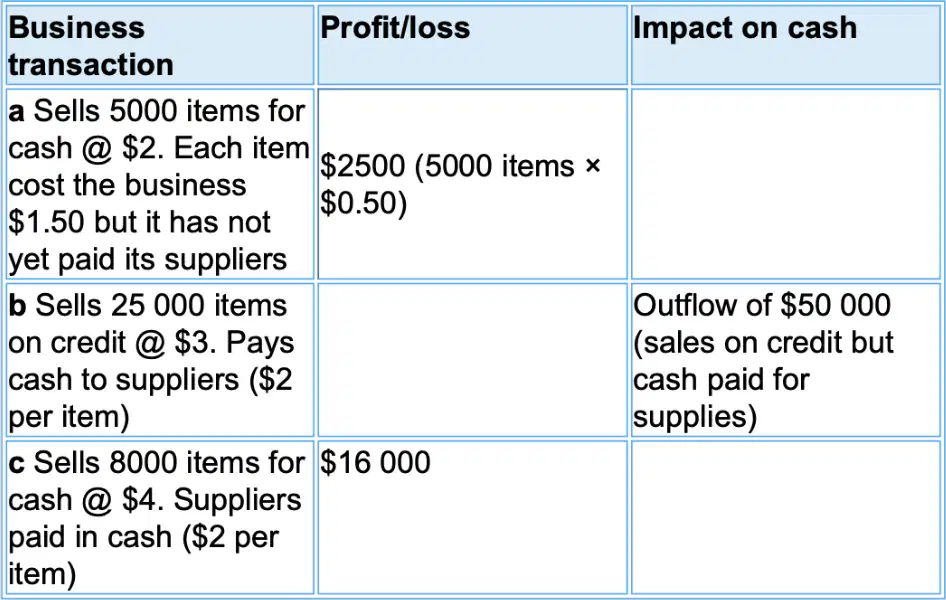
A business sells 5000 items for cash at $2 each, with each item costing $1.50, but has not yet paid its suppliers. What is the impact of this transaction on the business’s cash flow and profit?
Profit is $2500, but there is no immediate impact on cash flow since suppliers are not yet paid.
Profit is $2500, and there is an immediate outflow of $7500.
Profit is $5000, and there is an immediate inflow of $2500.
Profit is $2500, and there is an immediate outflow of $2500.
What does an income statement show about a business?
Whether a business made a profit or loss over a specific time
The total assets owned by a business
The number of employees in a business
The marketing strategies used by a business
Why do managers care about the income statement?
To play 'Detective' and analyze business performance
To hire new employees
To design company logos
To plan office parties
Which of the following is NOT a reason managers use the income statement?
To compare performance over time
To compare profits with competitors
To develop strategies if losing money
To calculate employee salaries
If a manager wants to know if the business is doing better or worse than last year, which aspect of the income statement are they using?
Time Comparison
Competitor Comparison
Strategy
Asset Evaluation
Suppose a company finds from its income statement that it is making less money than its rivals. What type of analysis is this?
Competitor Comparison
Time Comparison
Strategy
Market Expansion
A manager sees a loss in the income statement and asks, 'Is it a temporary problem or a disaster?' What are they considering?
Strategy
Time Comparison
Competitor Comparison
Product Quality
What is the definition of revenue?
The total money received from selling goods or services.
The total profit after expenses are deducted.
The amount of money spent on advertising.
The number of products sold in a year.
Which formula is used to calculate revenue?
Revenue = Price X Quantity Sold
Revenue = Cost X Quantity Sold
Revenue = Price + Quantity Sold
Revenue = Price - Quantity Sold
If a company sells 1,000 products at $10 each, what is the total revenue?
$10,000
$1,000
$100,000
$100
Which of the following is NOT a way to increase revenue?
Lower the price and sell less
Raise the price
Advertise more to sell more
Sell more products
A business wants to increase its revenue. Which strategy would be most effective if the quantity sold remains the same?
Increase the price of the product
Reduce advertising
Lower the price of the product
Sell fewer products
Suppose a company sells 500 products at $20 each. Using the revenue formula, calculate the total revenue.
$10,000
$1,000
$20,000
$5,000

