
 Worksheets
Employer/Employee Duties
Total questions: 30
Worksheet time: 15mins
Under the Health and Safety Act 2005, which action best represents an employer’s primary duty in a construction workplace?
Purchase PPE only after an incident occurs
Rely on workers’ experience to avoid hazards
Delegate all safety tasks to subcontractors
Provide safe systems of work and supervision
Which statement best describes the role of the Health and Safety Authority in Ireland?
Sets global building codes for all EU construction
Enforces workplace safety law and promotes compliance
Manages hospital care and clinical safety nationwide
Provides private insurance to Irish construction firms
Which Act sets out the main provisions for securing and improving health and safety at work in Ireland?
Safety, Health and Welfare at Work Act 2005
National Workplace Wellbeing and Safety Act 2015
European Construction Directives Act 2010
Irish Labour Relations and Safety Act 1998

Which method best ensures safety information is communicated effectively across a construction site?
Emailing supervisors without follow-up actions
Posting notices on a single breakroom board
Verbal briefings at daily toolbox talks
Relying on workers to share messages informally

When should safety training be carried out for construction workers?
During onboarding and before task changes
At the end of each fiscal year only
Only after a serious incident occurs
When requested by individual workers

On a construction site, who should be able to access the Safety Statement at all times?
Only site managers and supervisors
Visitors and delivery drivers
External auditors on request
All employees and contractors
Which statement best defines a hazard in construction work?
A source with potential to cause harm
The chance that harm will occur
A procedure for evaluating dangers
A control that removes a danger
Which statement best defines risk in a workplace context?
A document listing all hazards
A step used to eliminate hazards
Any object that could cause harm
The likelihood and severity of harm

Which option lists the correct order at the top of the risk control hierarchy?
Elimination, substitution, engineering
PPE, training, supervision
Administration, PPE, elimination
Inspection, reporting, PPE
During a risk assessment, what is the first essential step after identifying tasks?
Write the final risk assessment report
Issue personal protective equipment
Identify hazards involved in the tasks
Schedule toolbox talk for the crew
Which three elements form the Fire Triangle required for a fire to sustain?
Heat, smoke, oxygen
Fuel, water, heat
Fuel, ignition, water
Fuel, oxygen, heat
If one element of the Fire Triangle is removed, what is the immediate effect on the fire?
The fire changes class
The fire is extinguished
The fire produces more smoke
The fire intensifies rapidly
Which extinguisher type is most appropriate for an electrical fire?
Foam extinguisher
Water extinguisher
Wet chemical extinguisher
CO2 extinguisher
What key information should an emergency plan include for a construction site?
Evacuation routes and assembly points
Employee lunch schedules and menus
Daily productivity targets and budgets
Tool inventory and supplier contacts
Apply the PASS guideline to using a fire extinguisher. Which step comes first?
Pull the safety pin
Squeeze the discharge lever
Aim at the base of flames
Sweep side to side evenly
Which principle best describes effective fire extinguishing on a fuel spill?
Add water to dilute the fuel
Cool the fuel to remove heat
Heat the area to vaporize fuel
Increase airflow to remove smoke

Which statement best defines PPE in construction safety?
Tools used to eliminate hazards at the source
Training modules that document risk assessments
Equipment worn to reduce exposure to hazards
Policies that replace engineering controls entirely

An employer should decide what PPE to select primarily by which approach?
Assess hazards and match PPE specifications
Choose popular brands for worker acceptance
Select the most expensive items available
Use the same PPE for all site tasks

Which pair correctly describes duties regarding PPE for employer and employee?
Employer sets rules; employee may ignore when uncomfortable
Employer chooses cheapest options; employee shares equipment
Employer trains workers only; employee buys personal gear
Employer provides and maintains; employee uses and reports

Why is PPE considered a last resort to control a hazard?
It is always more comfortable and efficient
It permanently removes hazards from the site
It eliminates the need for supervision entirely
It relies on user behavior and can fail
Which option best defines manual handling in a construction context?
Operating cranes to lift structural steel components
Planning site logistics with digital scheduling tools
Transporting materials only with powered equipment
Moving loads using bodily force without machinery
In the TILE acronym used for safe lifting, what does the letter L represent?
Location of the worksite relative to exits
Leg posture maintained during team lifting
Leverage applied through mechanical aids
Load characteristics such as weight and stability

Which option best defines stress in a workplace context for construction crews?
A physical or psychological response to demands
A feeling that only occurs during off-site travel
A permanent medical diagnosis for all workers
A minor inconvenience that always resolves itself
Which statement best describes a balanced diet for a construction worker during a typical week?
Includes varied foods across all pyramid groups
Focuses mainly on high-protein meat servings
Eliminates carbohydrates except on rest days
Relies on supplements instead of whole foods
Which practice most directly reduces safety risks when intoxicants are present on site?
Apply strict zero-tolerance impairment policy
Allow moderate drinking during lunch breaks
Permit alcohol if below weekly guideline limits
Rely on self-assessment before operating tools

Which option best describes common routes of infection relevant on construction sites?
Airborne droplets from coughing and sneezing
Noise exposure from heavy machinery
UV radiation from sunlight and welding arcs
Static electricity build-up on plastic surfaces
What are the 3 P’s in First Aid used to guide priorities?
Provide comfort, Prepare transport, Pay attention
Practice drills, Prevent accidents, Promote attendance
Preserve life, Prevent worsening, Promote recovery
Plan response, Prioritize paperwork, Protect equipment
When reading a hazard label, which information is typically required for safe handling decisions?
Purchase order and invoice number
Batch number and shipping route
Supplier logo and barcode
Product identifier and signal word
Which statement best describes the primary function of safety signage on a construction site?
Communicate hazards clearly to prevent incidents
Provide decorative visuals to improve site aesthetics
List equipment inventory to aid daily logistics
Display company branding to promote recognition
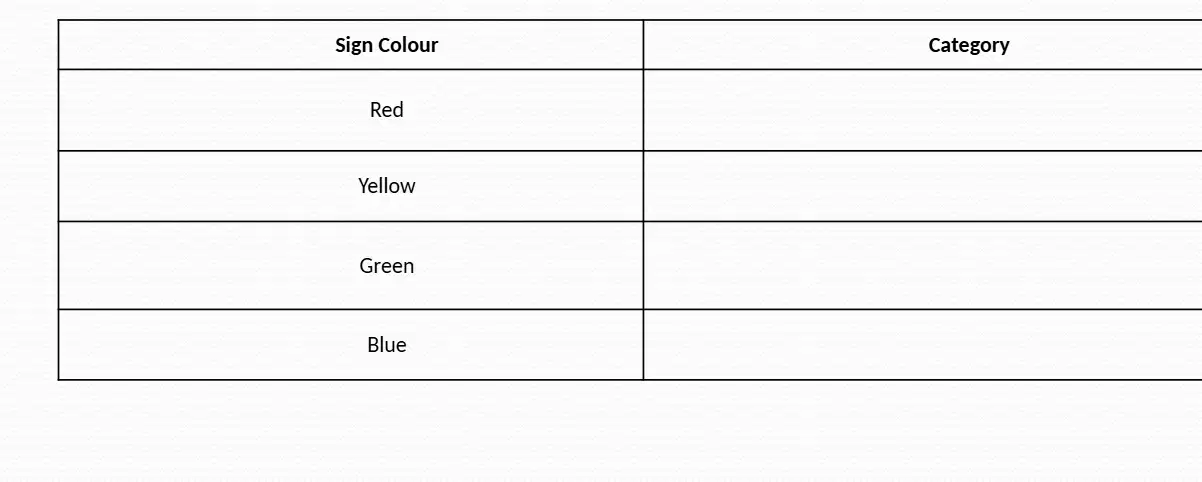
Match each safety sign color to its typical category used on construction sites.
Red — prohibition and fire equipment
Yellow — caution and hazard warning
Green — safe condition and first aid
Blue — mandatory actions and instructions

