
 Worksheets
Engineering Review Game
Total questions: 45
Worksheet time: 23mins
Why is it important for engineers to maintain an engineering notebook? Fill in the blank: An engineering notebook provides a __________ __________ of the project, allowing engineers to track progress, record ideas, and protect intellectual property.
detailed record
simple outline
rough estimate
quick summary
Fill in the blanks: Engineering notebooks are one of the most critical aspects of the __________ process. It is considered a __________ document used for __________. The engineering notebook will prove that the __________ was created, that a working model or the dates of attempts were documented. It also needs to include __________ signatures.
patent, legal, evidence, idea, witness
design, personal, storage, project, team
manufacturing, official, reference, prototype, manager
testing, informal, record, solution, supervisor
Fill in the blanks: __________ is the PROCESS by which __________ and __________ are applied to create objects and solutions that solve problems that can improve people's lives.
Engineering, science, mathematics
Mathematics, engineering, science
Science, mathematics, engineering
Technology, mathematics, science
Engineering is different from science because:
Engineering applies scientific principles to solve practical problems, while science focuses on understanding natural phenomena.
Engineering and science both focus only on theoretical knowledge.
Science is about building machines, while engineering is about studying nature.
Engineering and science are exactly the same in their approach.
Charlotte is working in a lab where she needs to check the quality of metal beams used in construction, but she cannot damage or alter them in any way. Fill in the blank: __________ __________ — a branch of engineering that involves evaluating materials without damaging them.
Nondestructive testing
Destructive analysis
Material fabrication
Structural failure
Which testing method involves breaking or damaging a sample to study its structural limits and performance? Choose the correct term:
Destructive testing
Non-destructive testing
Fatigue analysis
Thermal cycling
Which term describes a part of a system whose failure would result in the entire system becoming unavailable?
Single point of failure
Multiple redundancy
Load balancing
Failover cluster
Name 5 engineering/manufacturing careers, and what they do.
Mechanical Engineer, Electrical Engineer, Civil Engineer, Industrial Engineer, Manufacturing Technician
Doctor, Lawyer, Teacher, Chef, Artist
Pilot, Writer, Musician, Actor, Dancer
Biologist, Chemist, Physicist, Mathematician, Historian
Mechanical Engineer — ________ mechanical systems and machines.
designs
destroys
ignores
abandons
Electrical Engineer — ________ electrical circuits and systems.
designs
destroys
ignores
forgets
Civil Engineer — plans and designs infrastructure like ________ and roads.
bridges
computers
books
paintings
Industrial Engineer — ________ manufacturing processes and systems.
optimizes
destroys
ignores
complicates
Manufacturing Technician — operates and maintains ________ equipment.
production
medical
office
kitchen
CNC stands for: ________ Numerical Control, machining using computers to control and manipulate machines and cutting tools.
Computer
Central
Control
Creative
CADD stands for ________-Aided Design and Drafting, a technology for design and technical documentation.
Computer
Creative
Central
Common
What is the name of this process?
Engineering Design Process
Photosynthesis
Water Cycle
Cell Division
What is the first step in the engineering design process?
Define Problem
Brainstorm Solutions
Build Prototype
Test Solution
Which two actions are typically performed during STEP #2 'Generate Concepts and Ideas' in the engineering design process?
Research and Brainstorm
Test and Evaluate
Present and Construct
Prototype and Design
What is STEP #3 in the engineering design process?
Develop a solution
Identify the problem
Test the prototype
Communicate the results
What is a prototype?
An early sample, model, or release of a product created to test a concept or process.
A final version of a product ready for mass production.
A marketing strategy used to promote a product.
A type of software used for designing graphics.
What do you do when you test a prototype?
Test the prototype to see if it solves the problem, assess improvement needs, and test it many times.
Ignore the results and move on to the next step.
Only test it once and never make changes.
Skip testing and launch the final product immediately.
What does it mean when the steps are iterative?
They involve doing something repeatedly, usually to improve it.
They are always completed in a single attempt.
They never require any changes.
They are performed only once and never revisited.
What is an engineering drawing?
A type of technical drawing used to convey information about an object; specifies geometry required to construct a component (detail drawing).
A form of artistic sketch used for decoration.
A written report describing engineering processes.
A mathematical equation used in engineering analysis.
What is producing engineering drawings often called?
Drafting or technical drawing.
Modeling or sculpting.
Painting or sketching.
Programming or coding.
Welding or soldering.
Which of the following best describes the importance of Engineering Design Drawings?
They provide a visual representation of ideas, facilitate communication among team members, serve as a reference for manufacturing, and help ensure accuracy in construction.
They are only used for artistic purposes and do not impact the engineering process.
They are optional documents that can be ignored during the design phase.
They are mainly used to decorate engineering offices and have no practical use.
What do engineering drawings communicate for manufacturing?
They communicate exact geometry and dimensions for manufacturing.
They communicate only the color of the product.
They communicate the marketing strategy for the product.
They communicate the packaging design for the product.
What do engineering drawings provide for construction and assembly?
They provide standardized instructions for construction and assembly.
They provide decorative designs for aesthetic purposes.
They provide financial estimates for project budgeting.
They provide legal documents for property ownership.
What role do engineering drawings serve in production and quality control?
They serve as legal and contractual documents for production and quality control.
They are used only for artistic reference in production.
They are primarily for marketing purposes.
They are used exclusively for employee training.
How do engineering drawings ensure proper function and safety?
They document tolerances and materials to ensure proper function and safety.
They only provide artistic representations of products.
They ignore material specifications and tolerances.
They focus solely on the aesthetics of the design.
A multiview projection is an orthographic projection that shows an object as it appears from which views?
Front, right, left, top, bottom, or back.
Top, bottom, left, and right only.
Front and back only.
Left, right, and top only.
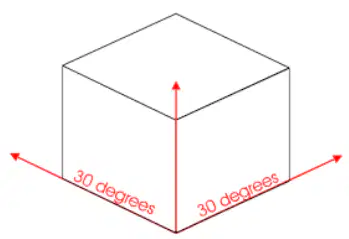
An isometric drawing corresponds to a ___-degree rotation of the object about the vertical axis.
30
45
60
90

Which type of projection is shown in the diagram below?
Perspective projection
Orthographic projection
Oblique projection
Isometric projection
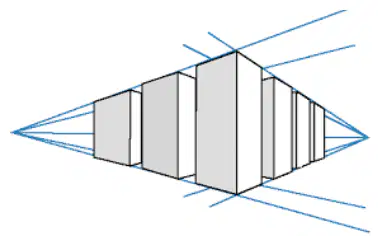
What are the two most characteristic features of a perspective drawing?
A. Objects appear larger as their distance from the observer increases; Foreshortening: the size of an object's dimensions along the line of sight is relatively longer than the dimensions across the line of sight.
B. Objects appear smaller as their distance from the observer increases; Foreshortening: the size of an object's dimensions along the line of sight is relatively shorter than the dimensions across the line of sight.
C. Objects appear the same size regardless of distance; No foreshortening occurs.
D. Objects appear smaller as their distance from the observer increases; Foreshortening: the size of an object's dimensions along the line of sight is relatively longer than the dimensions across the line of sight.
A perspective drawing is an approximate representation, on a flat surface, of how an image appears to the eye.
True
False
Ensure you know how to read from a ruler and convert units when provided with a conversion unit. What skill is being described?
Reading measurements and converting units using a ruler and conversion unit.
Drawing straight lines with a ruler.
Estimating measurements without any tools.
Memorizing unit conversion tables.
What is a scale in drawing to scale?
A ratio that shows the relationship between the representation of an object and its actual measurement.
A way to measure temperature.
A method to color drawings.
A tool for drawing circles.
A ratio is a way to show the relative sizes of two or more quantities.
True
False
Linear Forces are forces acting along the same line. For a truss to remain static, the sum of the forces acting on it must be _______.
zero
infinite
positive
negative
Stress is the force exerted on a _______ or body.
surface
liquid
atom
gas
One of the most valuable structural forms is the triangle. When a load is applied to a triangle, the upper members are in ________, and the lower is in tension.
compression
tension
shear
torsion
What does the offset tool allow you to do?
It creates a parallel copy of an edge or face at a specified distance (creates an inset or an outset).
It merges two objects into one.
It rotates an object around a specified axis.
It scales an object to a larger or smaller size.
How can you tell where the middle of a line is located?
The midpoint is indicated by inference from endpoint coordinates or by using the inference point/midpoint snap (or measuring half the length using the tape measure).
By guessing the center visually without any measurement.
By always choosing the longer segment as the midpoint.
By marking the midpoint at random intervals along the line.
What does CAD stand for?
Computer-Aided Design
Centralized Access Database
Critical Analysis Device
Controlled Automation Drive
How many toolbars are there in SketchUp?
2
3
5
7
What do we call the blue, green, and red lines found in SketchUp?
The axes (Z is blue, Y is green, X is red).
The grid lines (Z is blue, Y is green, X is red).
The guidelines (Z is blue, Y is green, X is red).
The boundaries (Z is blue, Y is green, X is red).

