Wayground logo

Free Printable Worksheets

Font size

S
M
L
XL
Worksheets

Final Exam Review - Fall 2025

Total questions: 80

Worksheet time: 3hrs 3mins

Name
Class
Date
1.

Evaluate f(-3)

a)

f(-3) = -3

b)

f(-3) = 0

c)

f(-3) = 2

d)

not enough information to give an answer

2.

f(x) = -x + 2; Evaluate g(-5)

a)

g(-5) = 7

b)

g(-5) = -3

c)

g(-5) = 0

d)

g(-5) = 3

3.

Evaluate f(8)

a)

f(8) = -3

b)

f(8) = 1

c)

f(8) = 0

d)

f(8) = -1

4.

Evaluate f(0)f\left(0\right)  .

a)

-3

b)

0

c)

1

d)

3

5.

Based on the image, what is f(3)?

a)

1

b)

2

c)

-3

d)

-4

6.

Find h(5) using the equation.

a)

-25

b)

25

c)

3

d)

7

e)

undefined

7.

Find f(0)

a)

-3

b)

18

c)

4

d)

0

8.

What is g(-2) if:

a)

-7

b)

7

c)

1

d)

-1

9.

Given the graph of f(x), evaluate f(4).

(a)  

10.

Given the graph of f(x), evaluate f(-10).

a)

-10

b)

10

c)

undefined

d)

it cannot be determined from the information given

11.

Given the graph of g(x), find g(-2).

(a)  

12.

Given the graph of g(x), find g(-6).

(a)  

13.

Find f(2).

a)

f(2) = 0

b)

f(2) = 1

c)

f(2) = 3

d)

f(2) = 4

14.

Using the graph, find f(-3).

a)
-3
b)
-1
c)
1
d)
3
15.
All of the x values or inputs are called what?
a)
Domain
b)
Range
c)
Relation
d)
Function
16.
All of the y values or outputs are called what?
a)
Domain
b)
Range
c)
Relation
d)
Function
17.
For the function {(0,1), (1,-3), (2,-4), (-4,1)}, write the domain and range.
a)
D: {1, -3, -4,}
R: {0, 1, 2, -4}
b)
D: {-4, 0, 1, 2}
R:{-4, -3, 1}
c)
D: {0, 1, 2, 3, 4}
R:{1, -3, -4}
d)
D: {0, 1, 2, -4}
R: {1, -3, -4, 1}
18.
a)
Function
b)
Not a Function
19.
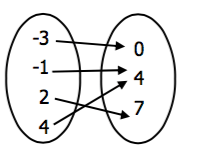
Is this mapping a function or not a function? 
a)
Function
b)
Not a Function
20.
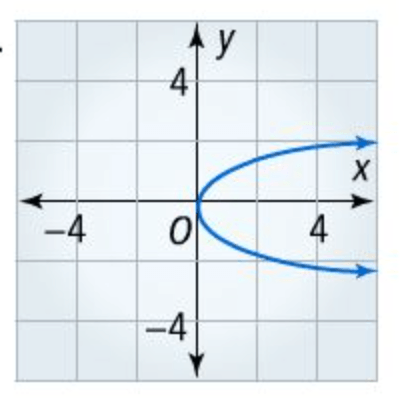
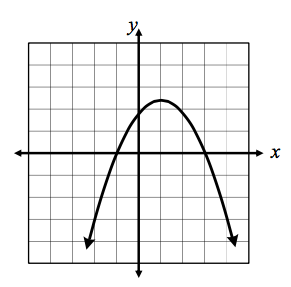
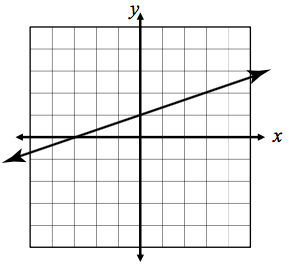
Is this graph a function or not a function? 
a)
Function
b)
Not a Function
21.
Is this mapping a function or not a function? 
a)
Function
b)
Not a Function 
22.
Is this graph a function or not a function? 
a)
Function
b)
Not a Function
23.
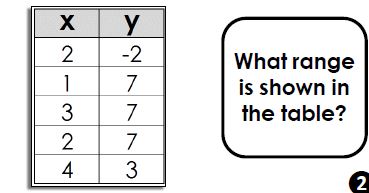
Is this table a function or not a function? 
a)
Function
b)
Not a Function
24.
For the function {(0,1), (1,-3), (2,-4), (-4,1)}, write the domain and range.
a)
D: {1, -3, -4,}
R: {0, 1, 2, -4}
b)
D:{0, 1, 2, -4}
R:{1, -3, -4}
c)
D:{0, 1, 2, 3, 4}
R:{1, -3, -4}
25.
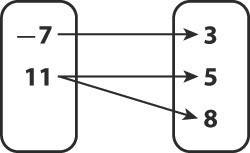
Is the relation a function? Why.
a)
Yes, because the x-value 11 has two y-values pair with it.
b)
Yes, because each x-value has only one y-value paired with it.
c)
No, because the x-value 11 has two y-values pair with it.
d)
No, because each x-value has only one y-value paired with it.
26.
Which set of values is a function?
a)
(9,5) (10,5) (9,-5) (10,-5)
b)
(3,4) (4,-3) (7,4) (3, 8)
c)
(6,-5) (7, -3) (8, -1) (9, 1)
d)
(2, -2) (5, 9) (5, -7) (1, 4)
27.
a)

{-2, 3, 7}

b)

[-2, 7]

c)

{1, 2, 3, 4}

d)

[1, 4]

28.

In the given relation, what domain value corresponds to the range value -2?

{(-1, 2), (-2, 4), (2, 5), (0, -2), (2, 0)}

a)

-2

b)

2

c)

4

d)

0

29.

What is the range?

a)

The set of all x-values

b)

The set of all y-values

c)

The set of all x- and y-values

30.

Simplify: log⁡4(x+4)−log⁡4(x−5)\log_4\left(x+4\right)-\log_4\left(x-5\right)  

a)

log⁡49\log_49  

b)

log⁡4(2x−1)\log_4\left(2x-1\right)  

c)

log⁡4(x2−x−20)\log_4\left(x^2-x-20\right)  

d)

log⁡4(x+4x−5)\log_4\left(\frac{x+4}{x-5}\right)  

31.

Simplify: 2log⁡3(11x)2\log_3\left(11x\right)  

a)

log⁡3(22x)\log_3\left(22x\right)  

b)

log⁡3(121x)\log_3\left(121x\right)  

c)

log⁡3(121x2)\log_3\left(121x^2\right)  

d)

log⁡3(11x2)\log_3\left(11x^2\right)  

32.

Rewrite the following in the form log⁡(c)\log\left(c\right) :

log⁡(5)+log⁡(6)\log\left(5\right)+\log\left(6\right)

(a)  

33.

Match the following:

Rewrite the following in the form log⁡(c)\log\left(c\right)

a)

2log⁡(5)2\log\left(5\right)

1.

log(25)

b)

log⁡(5)+log⁡(4)\log\left(5\right)+\log\left(4\right)

2.

log(20)

c)

log⁡(35)−log⁡(7)\log\left(35\right)-\log\left(7\right)

3.

log(5)

d)

3log⁡(4)3\log\left(4\right)

4.

log(64)

e)

log⁡(4)−log⁡(16)\log\left(4\right)-\log\left(16\right)

5.

log(.25)

34.

Condense: log⁡25+log⁡2x\log_25+\log_2x  

a)

log⁡2x5\log_2x^5  

b)

log⁡2 5x\log_2\ \frac{5}{x}  

c)

log⁡2 x5\log_2\ \frac{x}{5}  

d)

log⁡25x\log_25x  

35.

Condense: log⁡bm−log⁡bn\log_bm-\log_bn  

a)

log⁡bmn\log_bmn  

b)

log⁡b nm\log_b\ \frac{n}{m}  

c)

log⁡b mn\log_b\ \frac{m}{n}  

d)

log⁡bmn\log_bm^n  

36.

Condense: log⁡65−log⁡62\log_65-\log_62  

a)

log⁡610\log_610  

b)

log⁡6 52\log_6\ \frac{5}{2}  

c)

log⁡6 52\log_6\ 5^2  

d)

log⁡6 25\log_6\ \frac{2}{5}  

37.

Condense: 4log⁡5k−log⁡5d4\log_5k-\log_5d

a)

log⁡5k4d\log_5k^4d

b)

log⁡5 4kd\log_5\ 4kd

c)

log⁡5 k4d\log_5\ \frac{k^4}{d}

d)

log⁡5 kd4\log_5\ \frac{k}{d^4}

38.
The common logarithm has what base?
a)
10
b)
0
c)
e
d)
-e
39.
Solve for x:
logx 25 = 2
a)
5
b)
-5
c)
1/5
d)
-1/5
40.

Evaluate the following logarithm:


log327

a)

3

b)

2

c)

-3

d)

1/3

41.
Write in exponential form.
log232 = 5
a)
2-5 = 32
b)
232 = 5
c)
25 = 32
d)
325 = 2
42.

log2(x2 - 6) = log2(2x+2)

a)

4, -2

b)

No Solution

c)

4

d)

-2

43.

Solve:


ln (3x + 2) = ln (5x - 6)

a)

x = 1

b)

x = 4

c)

x = 2

d)

x = 7

44.
g(x)=3x+4
h(x)=3x-1
Find g(h(x))
a)
-9x+11
b)
4x2+4x
c)
9x+1
d)
9x+11
45.
p(x) = 4x - 5
q(x) = 2x2
Find p(q(x))
a)
8x2 + 5
b)
8x2 - 10x
c)
8x2 - 5
d)
None of these.
46.

f(x) = 2x - 5

g(x) = -4x - 2

Find f(g(-2))

a)

25

b)

-25

c)

-7

d)

7

47.

h(x) = -4x + 3

g(x) = 4x - 2

Find h(g(6))

a)

-107

b)

107

c)

-85

d)

85

48.
f(x) = 3x + 10
g(x) = x - 2
Find g(f(-10))
a)
-42
b)
-26
c)
-18
d)
None of these.
49.
f(x) = 3x + 10
g(x) = x - 2
Find g(f(-10))
a)
-42
b)
-26
c)
-18
d)
None of these.
50.
sin π/4
a)
√2∕2
b)
1/2
c)
√3/2
d)
0
51.
cos 5π/6
a)
-1/2
b)
1/2
c)
√3/2
d)
-√3/2
52.
sin 7π/6
a)
1/2
b)
-1/2
c)
√3/2
d)
-√3/2
53.

cos(300°)

a)

0

b)

1/2

c)

√3/2

d)

1

54.

cos 150o

a)

-1/2

b)

1/2

c)

√3/2

d)

-√3/2

55.
What is the radius of a unit circle?
a)
1
b)
2
c)
1/2
d)
0
56.
What are the coordinates of 60° on the unit circle?
a)
(0, 1)
b)
(1/2, √3/2)
c)
(√3/2, 1/2)
d)
(√2/2, 1/2)
57.
sinθ is positive in
a)
the 1st and 2nd quadrants
b)
the 1st and 3rd quadrants
c)
the 1st and 4th quadrants
d)
the 2nd and 3rd quadrants
58.
cosθ is positive in
a)
the 1st and 2nd quadrants
b)
the 1st and 3rd quadrants
c)
the 1st and 4th quadrants
d)
the 2nd and 3rd quadrants
59.

Solve equation for 0≤θ<2π0\le\theta<2\pi  .
4+4tan⁡θ=04+4\tan\theta=0  

a)

θ=π\theta=\pi  

b)

θ=7π4\theta=\frac{7\pi}{4}  

c)

θ=3π4,7π4\theta=\frac{3\pi}{4},\frac{7\pi}{4}  

d)

θ=0,3π4\theta=0,\frac{3\pi}{4}  

60.

Solve equation for 0≤θ<2π0\le\theta<2\pi  .
−2=−5+3sec⁡θ-2=-5+3\sec\theta  

a)

θ=0,π3\theta=0,\frac{\pi}{3}  

b)

θ=0\theta=0  

c)

θ=π3,5π3\theta=\frac{\pi}{3},\frac{5\pi}{3}  

d)

No SolutionNo\ Solution  

61.

Solve equation for 0≤θ<2π0\le\theta<2\pi  .
1=5−8cos⁡θ1=5-8\cos\theta  

a)

θ=π6,π3,11π6\theta=\frac{\pi}{6},\frac{\pi}{3},\frac{11\pi}{6}  

b)

θ=π6,11π6\theta=\frac{\pi}{6},\frac{11\pi}{6}  

c)

θ=π6\theta=\frac{\pi}{6}  

d)

θ=π3,5π3\theta=\frac{\pi}{3},\frac{5\pi}{3}  

62.

Solve equation for 0≤θ<2π0\le\theta<2\pi  .
1+tan⁡2θ=4tan⁡2θ1+\tan^2\theta=4\tan^2\theta  

a)

θ=π6,5π6,7π6,11π6\theta=\frac{\pi}{6},\frac{5\pi}{6},\frac{7\pi}{6},\frac{11\pi}{6}  

b)

θ=π3,2π3,4π3,5π3\theta=\frac{\pi}{3},\frac{2\pi}{3},\frac{4\pi}{3},\frac{5\pi}{3}  

c)

θ=π6,7π6\theta=\frac{\pi}{6},\frac{7\pi}{6}  

d)

θ=π6,5π6,7π6\theta=\frac{\pi}{6},\frac{5\pi}{6},\frac{7\pi}{6}  

63.

Solve equation for 0≤θ<2π0\le\theta<2\pi  .
3sin⁡2θ+4=5+sin⁡2θ3\sin^2\theta+4=5+\sin^2\theta  

a)

θ=π4,5π4,7π4\theta=\frac{\pi}{4},\frac{5\pi}{4},\frac{7\pi}{4}  

b)

θ=π4,7π4\theta=\frac{\pi}{4},\frac{7\pi}{4}  

c)

θ=π4,3π4\theta=\frac{\pi}{4},\frac{3\pi}{4}  

d)

θ=π4,3π4,5π4,7π4\theta=\frac{\pi}{4},\frac{3\pi}{4},\frac{5\pi}{4},\frac{7\pi}{4}  

64.

Solve for x

Hint: Solve using Elimination Method:

a)

1/2

b)

1

c)

-1

d)

-1/2

65.

Solve using Elimination Method:


x - y = 11

2x + y = 19

a)

(10,-1)

b)

(-1,10)

c)

(3,-4)

d)

(6,7)

66.

Solve the system:

x + 6y = 17

-x + 3y = -8

a)

(5, 2)

b)

(11, 1)

c)

(1, 11)

d)

no solution

67.

Solve the following system of equations: 5x - 4y = 3 and 2x + 3y = 8

a)

x = 4, y = 3

b)

x = 2, y = 1

c)

x = 3, y = 2

d)

x = 1, y = 5

68.

7. Solve the system of linear equations: 2x + 5y = 13 and 3x - 2y = 4

a)

x = 4, y = 4

b)

x = 3, y = 1

c)

x = 2, y = 3

d)

x = 5, y = 2

69.

Solve the system using any method:

3x + 2y = 16

7x + y = 19

Answer is (​ (a)   ,​ (b)   )

Choose from the below words

2

5

1

3

4

7

16

19

0

No solution

70.
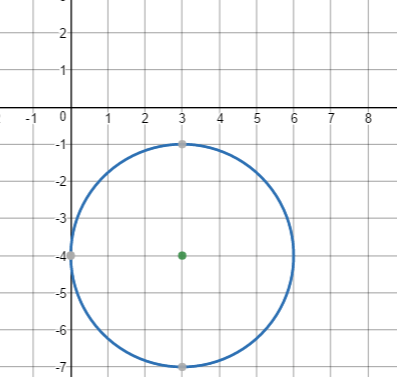
What is the equation of the circle. 
a)
(x - 3)2  + (y + 4)2 = 9
b)
(x - 3)2  + (y + 4)2 = 3
c)
(x)2  + (y)2 = 9
d)
(x - 1)2  + (y + 1)2 = 7
71.

Which of the following equations would generate the ellipse pictured?

a)
b)
c)
d)
72.
Write the equation of a circle with center (7, 0) with radius 3. 
a)
(x - 7)2 + y2 = 9
b)
x2 + (y -7)2 = 9
c)
(x - 7)2 + y2 = 3
d)
x2 + (y -7)2 = 3
73.

Find the vertex of the PARABOLA with the given equation:

*TYPE ANSWER WITH NO SPACES

(y+2)2=−8(x+9)\left(y+2\right)^2=-8\left(x+9\right)  

(a)  

74.

What is the radius of this CIRCLE?

*Answer with JUST the numerical value

(a)  

75.

Give the equation for the HYPERBOLA shown:

a)

y24−x216=1\frac{y^2}{4}-\frac{x^2}{16}=1  

b)

x24−y216=1\frac{x^2}{4}-\frac{y^2}{16}=1  

c)

x216−y24=1\frac{x^2}{16}-\frac{y^2}{4}=1  

d)

y264−x216=1\frac{y^2}{64}-\frac{x^2}{16}=1  

76.

Graph the HYPERBOLA with the given equation:

(x−2)24−(y+1)216=1\frac{\left(x-2\right)^2}{4}-\frac{\left(y+1\right)^2}{16}=1  

a)
b)
c)
d)
77.

Find the area of the sector, rounding your answer to 1d.p.

a)

176.7cm2

b)

23.6cm2

c)

156.7cm2

d)

88.4cm2

78.

Find the area of the sector, rounding your answer to 1d.p.

a)

67.1cm2

b)

67.0cm2

c)

16.8cm2

d)

134.0cm2

79.
Find the arc length.  Leave your answer in terms of π.
a)
7/4π
b)
7/2π
c)
1/8π
d)
45π
80.

Find the arc length of the bolded arc. Give your answer in terms of π.

a)

(65/12)π cm

b)

17.02 cm

c)

(845/24)π cm

d)

26π cm