
 Worksheets
Ancient Rome Study Guide
Total questions: 61
Worksheet time: 31mins

Public meeting place in the center of Rome and other cities. Choose the best vocabulary word.
Forum
Province
Republic
Aqueduct
Consuls

A 200-year period of peace and stability within the Roman Empire. Choose the best vocabulary word.
Pax Romana
Legions
Patricians
Satire
Veto
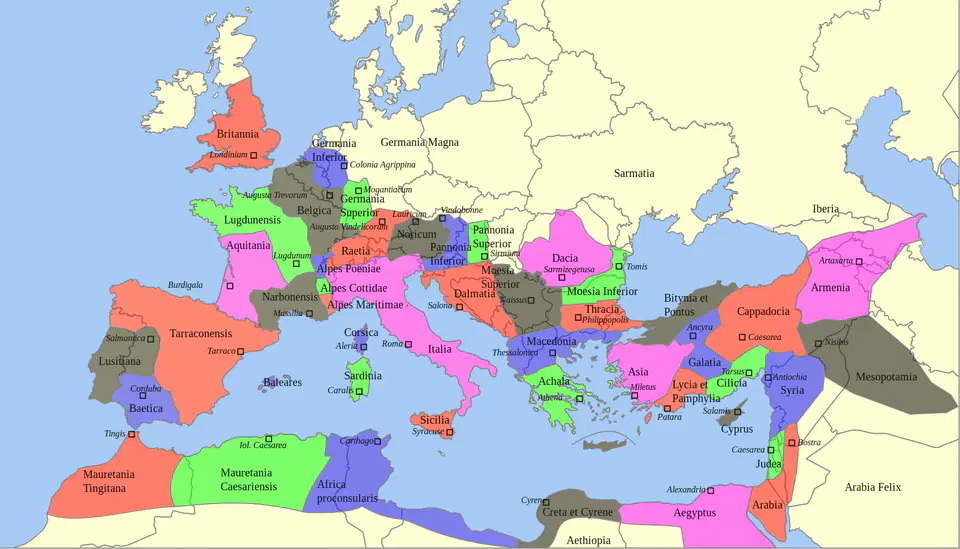
Territory outside of Italy that was supervised by a Roman governor. Choose the best vocabulary word.
Province
Republic
Forum
Romance Languages
Consuls
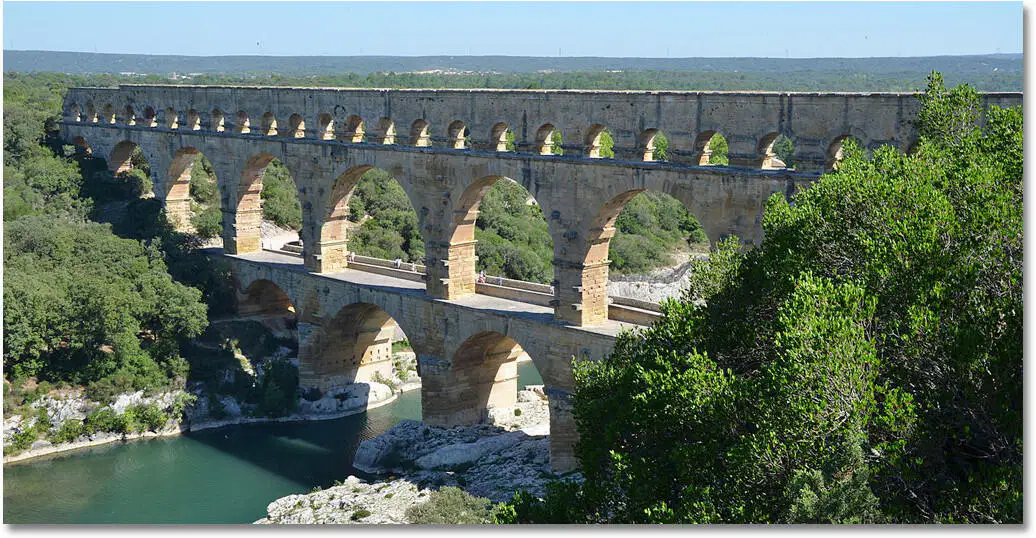
A structure that carried water into Roman cities from the mountains. Choose the best vocabulary word.
Aqueduct
Legions
Veto
Gladiators
Forum
Spoken communication systems that developed out of Latin after the fall of Rome. Choose the best vocabulary word.
Romance Languages
Satire
Pax Romana
Plebeians
Province

Spoken communication systems that developed out of Latin after the fall of Rome. Choose the best vocabulary word.
Romance Languages
Satire
Pax Romana
Plebeians
Province
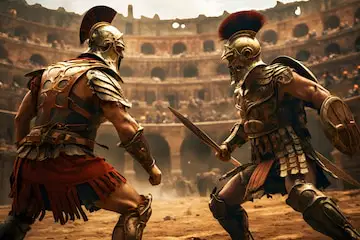
Enslaved people or criminals who were forced to become trained fighters and battle to the death. Choose the best vocabulary word.
Gladiators
Legions
Patricians
Plebeians
Consuls

Artisans, builders, farmers, merchants, and other workers who were not from the oldest families in Rome. Choose the best vocabulary word.
Plebeians
Patricians
Consuls
Province
Romance Languages
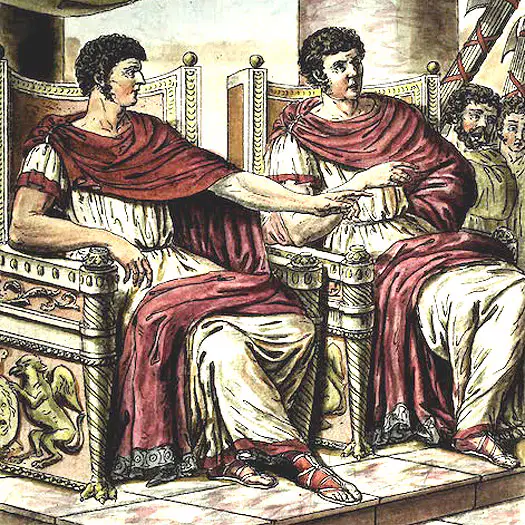
Two magistrates who held the most power in the Roman Republic. Choose the best vocabulary word.
Consuls
Dictator
Legions
Forum
Veto
Writing style that makes fun of others or society in general. Choose the best vocabulary word.
Satire
Romance Languages
Republic
Pax Romana
Province
Type of government in which people elect the leaders who govern them. Choose the best vocabulary word.
Republic
Dictator
Forum
Consuls
Veto
Wealthy landowners and business owners from the oldest families in Rome. Choose the best vocabulary word.
Patricians
Plebeians
Gladiators
Legions
Aqueduct
To prohibit or block a certain law or action from taking place. Choose the best vocabulary word.
Veto
Republic
Satire
Forum
Pax Romana
A leader with complete control and absolute power. Choose the best vocabulary word.
Dictator
Consuls
Province
Legions
Patricians
Organized groups of foot soldiers in the Roman army. Choose the best vocabulary word.
Legions
Gladiators
Aqueduct
Romance Languages
Veto
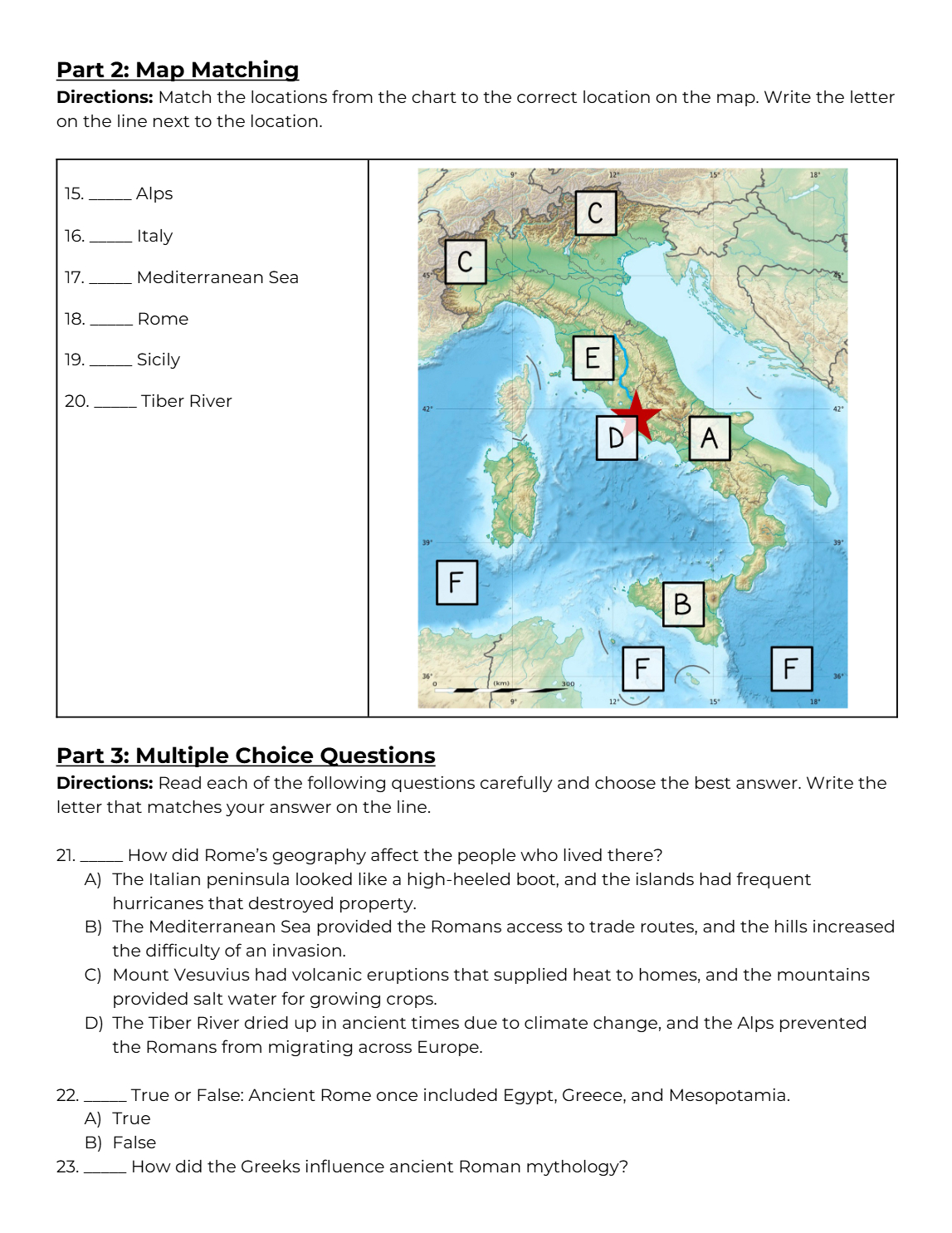
On the map, which letter identifies the Tiber River?
A
B
C
D
E
How did Rome’s geography affect the people who lived there?
The Italian peninsula looked like a high-heeled boot, and the islands had frequent hurricanes that destroyed property.
The Mediterranean Sea provided the Romans access to trade routes, and the hills increased the difficulty of an invasion.
Mount Vesuvius had volcanic eruptions that supplied heat to homes, and the mountains provided salt water for growing crops.
The Tiber River dried up in ancient times due to climate change, and the Alps prevented the Romans from migrating across Europe.
True or False: Ancient Rome once included Egypt, Greece, and Mesopotamia.
True
False
How did the Greeks influence ancient Roman mythology?
The Greeks conquered Rome after a series of wars and forced the Romans to change religions in a peace treaty.
The Greeks sent missionaries to share their religious ideas and convert as many people as possible across Europe.
The Romans adopted and modified Greek religion after learning it from Greek colonies established in Italy.
The Romans offered and paid a large sum of money to Greece for the rights to create new mythology using Greek gods.
Why was the story of Romulus and Remus important to the Romans?
The story explained the creation of the universe.
The story explained the founding of Rome.
The story explained the naming of the planets.
The story explained Rome's victory in the Trojan War.
Why did Judea and Rome fight during the Roman-Jewish Wars?
The Jews were upset that the Romans actively disrespected their religion, and corrupt leaders heavily overtaxed Judea.
The Jews were upset that the Romans sold the city of Jerusalem to another civilization so they could pay for their growing army.
The Romans were upset that the Jews had entered a secret alliance with Egypt to overthrow the Roman emperor.
The Romans were upset because the Jews were moving into Rome by the thousands and competing with locals for limited jobs.
Which of the following statements most accurately describes the consequences of the Roman-Jewish Wars?
The Jews won independence from the Roman Empire and formed their own country, Israel.
The Jews received the authority to govern all Roman territory in Asia due to their bravery in combat.
The Romans built several Jewish temples throughout the empire to make peace with the Jews.
The Romans destroyed the Second Temple and forced all Jews to move away from Jerusalem.
Jesus of Nazareth’s teachings of Judaism evolved into what other world religion?
Christianity
Hinduism
Islam
Roman Mythology
True or False: Jesus of Nazareth wrote the New Testament of the Bible to share his life, teachings, and instructions to the first churches.
True
False
According to the Bible, why did some people believe Jesus of Nazareth was the Messiah?
He gained many followers, such as twelve men who became the Apostles.
He performed several miracles, such as instantly healing people's illnesses.
He taught several parables, such as the story of the Good Samaritan.
He traveled to many places, such as Babylon, Alexandria, Athens, and Rome.
According to the Bible, what method did the Romans use to execute Jesus of Nazareth?
Crucifixion
Excommunication
Passover
Resurrection
According to Christianity, why did Jesus of Nazareth sacrifice his life?
His sacrifice was encouragement for the Apostles to become followers and spread Christianity.
His sacrifice was necessary after he chased away the sellers and customers at the Second Temple.
His sacrifice was necessary to become a god and one of the members of the Holy Trinity.
His sacrifice was repayment for the wrongdoings of his followers and would help them enter Heaven.
Which apostle contributed to the spread of Christianity by establishing several churches throughout the Roman provinces, writing most of the epistles in the New Testament, and sharing the religion with non-Jews?
James
John
Paul
Peter
Why is Constantine considered an important figure in world history?
He declared Christianity the official religion of the Roman Empire and banned the worship of all other faiths in the provinces.
He improved Christianity by proposing the concept of the Trinity and became the first pope of the Roman Catholic Church.
He opposed Christianity and persecuted Christians because their ideas were different from the traditional Roman religion.
He recognized Christianity as a religion and organized a convention to establish consistent teachings among churches.
What did the Romans build across their empire for 50,000 miles (80,000 kilometers) to improve the travel of armies and trade goods?
Aqueducts
Canals
Roads
Walls
Why do some historians consider the Roman replicas of ancient Greek sculptures, despite being copies, a significant achievement?
Many of the original Greek sculptures are lost, but the Roman versions still allow us to appreciate their artwork today.
Many of the original Greek sculptures were perfect and flawless, but the Roman versions show the actual appearances of people.
The Romans believed in innovation and original ideas, and the many copies of the Greek sculptures showed a decline in their creativity.
The Romans opened the world’s first art museum in Rome, and many copies of the Greek sculptures were the main attractions.
What language was spoken in ancient Rome and is the source of many English words today?
Greek
Italian
Latin
Roman
Why did the Romans establish a tripartite government during the Republic?
The Romans believed in checks and balances to keep any group from becoming too powerful.
The Romans could split their land into several parts, and each group could govern a small territory.
The Romans made it a requirement and wrote it down at the Library of Alexandria.
The Romans thought that everyone, including government officials, must obey the rule of law.
Why did the Romans repeatedly expand the size of their territory?
The Romans hoped to find intelligent people from other lands to increase their innovation.
The Romans wanted to increase their population to boost their tax revenue and the number of soldiers.
The Romans were competing against the Persian Empire in a scramble for territory across Europe and Asia.
The Romans wished to explore other lands beyond their borders and increase their understanding of the world.
What were the consequences of the Punic Wars between Rome and Carthage?
The Carthaginians burned the city of Rome and poured salt on farmland to prevent future crops.
The Carthaginians negotiated a treaty with the Romans to gain control of the olive oil trade.
The Romans built several Christian churches in Carthage to spread the religion further.
The Romans conquered a large amount of territory and took control of trade along the Mediterranean Sea.
Why is Julius Caesar considered an important figure in world history?
He was a farmer who organized several riots in the city of Rome to protest the lack of food and jobs for citizens.
He was a general who conquered Gaul and rose to power due to his popularity and victory in a civil war.
He was a gladiator who organized an armed rebellion of enslaved people that took over southern Italy.
He was a senator who led the passage of a policy that created small farms on public lands for low-income residents.
Why did several Roman senators murder Julius Caesar?
Caesar became a lifetime dictator of the Roman Republic, and some senators feared he would declare himself a king.
Caesar bribed the assemblies to release five personal friends from prison, who had fought against Rome during the Punic Wars.
Caesar started to practice Judaism and wanted it to replace traditional mythology as the official religion of the Roman Republic.
Caesar stole money from the Roman Republic’s treasury and built three pyramids in Egypt for himself and his family.
Why did Marc Antony and Octavian start a civil war in Rome after Julius Caesar’s death and fight against each other at the Battle of Actium?
Antony accused Octavian of cheating during several sporting games held at Julius Caesar’s funeral to win popularity among the people.
Antony was furious that Octavian convinced the Senate to name him general over the navy, allowing Octavian to invade Antony’s province.
Octavian called Antony a traitor after Antony agreed to free Julius Caesar’s killers from the death penalty in exchange for their financial support.
Octavian was upset that Antony broke their political alliance by divorcing Octavian’s sister and marrying Queen Cleopatra of Egypt instead.
What event do historians consider the start of the Roman Empire?
Cicero delivered a powerful speech that called for the Romans to remain unified and remember their greatness.
Cincinnatus was appointed dictator and led the Romans to victory in a critical battle before retiring on his farm.
Octavian was named Augustus by the Roman Senate and became the first citizen of the Roman government.
Tarquin the Proud killed several opponents and members of his own family to take the throne in Rome.
How did the Imperial Crisis contribute to the decline of the Roman Empire?
Several bishops took control of provinces, creating a conflict between church and state.
The two political parties could not agree on laws in the Senate that helped the citizens.
There was inconsistent leadership with over twenty different emperors in fifty years.
There were many natural disasters, including the volcanic eruption of Mount Vesuvius.
How did Diocletian attempt to save the Roman Empire?
He adjusted the education program for soldiers and wrote a code of honor to encourage loyalty.
He converted hundreds of thousands of people to Christianity and persecuted polytheists.
He moved the capital city from Rome to Britain to get away from the overcrowded Mediterranean Sea.
He split the Roman Empire into two halves and appointed a co-emperor to rule alongside him.
What was the most significant part of the Roman economy?
agriculture
construction
education
retail
Why did Rome’s economy depend on the colonization of new territories?
The Romans gained access to new cities to ease overcrowding in Rome.
The Romans gained access to new groups of cultures and ideas.
The Romans gained access to new lands to become junkyards for waste.
The Romans gained access to new sources of labor and resources.
How did using standard currency help support trade in ancient Rome?
The government could issue enough coins, so everyone had enough money.
The silver and gold used in coins were valuable to everyone and simplified trade.
Trading was not usually fair before the invention of coins in Rome.
Using coins made it easier for merchants to use the barter system.
Which of the following was NOT an economic problem that contributed to the fall of the Roman Empire?
Colonization and enslavement increased the gap between the wealthiest and the poorest Romans.
The empire was not able to conquer more territory, which meant that there was no new tax revenue to support government spending.
The Romans lost control of their trade empire due to the increased popularity of the Silk Road.
The value of money decreased after several emperors lowered the amount of precious metals used to make coins.
True or False: Enslaved people were responsible for providing labor on farms, mines, homes, and building projects that led to the economic success of the Roman Empire.
True
False
Which of the following statements most accurately explains why the Roman military was a powerful and effective fighting force?
The army included a division of soldiers that threw iron discuses as long-range weapons to break opponents’ defenses.
The soldiers ate large quantities of food to increase their weight and hold their ground in battle.
All soldiers trained in martial arts and other hand-to-hand combat to fight battles in close quarters.
The soldiers were organized into larger and smaller groups so they could quickly adapt their battle strategy.
What site was home to government buildings, religious temples, and a marketplace in ancient Rome and served as a spot for socializing and public speeches?
Appian Way
Circus Maximus
Forum
Pantheon
List the eras of ancient Roman history in chronological order.
Roman Empire, Roman Republic, Roman Kingdom
Roman Kingdom, Roman Empire, Roman Republic
Roman Kingdom, Roman Republic, Roman Empire
Roman Republic, Roman Kingdom, Roman Empire
Why did the plebeians protest against the Roman government and form their own council?
The plebeians could not hold political offices or participate in government.
The plebeians did not want to pay property taxes to the government.
The plebeians had different views about religion than the government leaders.
The plebeians were upset that the government stopped giving food rations.
Which branch of the Roman Republic included different officials who commanded the military, judged court cases, organized festivals, and kept track of money?
Board of Directors
Magistrates
Royal Family
Tribal Council
What were the powers of the Senate in the Roman Republic?
The Senate could veto the decisions of any other government officials.
The Senate counted the population and divided them into voting groups.
The Senate debated policy and proposed potential laws to other officials.
The Senate maintained public buildings and managed the food supply.
True or False: The assemblies were voters who elected government officials, passed or rejected law proposals, served as a court of appeal for criminal cases, and declared war or peace with other civilizations.
True
False
True or False: Dictators from the Early Roman Republic, such as Cincinnatus, were seen as cruel or harmful rulers.
True
False
What was the name of Rome’s first written law code, which was displayed in the Roman Forum?
Byzantine Bill
Caesar’s Commandments
Justinian Code
Twelve Tables
Why did Julius Caesar align himself with Pompey and Crassus to form the First Triumvirate?
Caesar needed to secure funding to produce and distribute the Caesar Salad.
Caesar wanted to destroy powerful pirates that stole goods from Roman trade.
Caesar was an inexperienced politician who wanted to learn from his elders.
Caesar wished to overrule the Senate and take control of the government.
How did Augustus successfully establish himself as the first emperor of Rome?
He created a religious freedom policy and personally paid for churches and synagogues for monotheistic and polytheistic faiths.
He ended the policy of conquering land and sold several territories back to their original owners to pay off the national debt.
He organized the election process so women, immigrants, and enslaved people could vote for government officials and hold office.
He prevented civil wars, increased soldiers' pay, expanded trade, and expanded the network of roads and aqueducts.
Why was the rediscovery of Pompeii under layers of volcanic ash an important find for archeologists and historians?
Pompeii helped scientists create technology that makes human settlements resistant to volcanic eruptions.
Pompeii includes the remains of several extinct animal species, including dodo birds and Pyrenean ibexes.
Pompeii offers clues about life in an ancient Roman town and what happened during the volcanic eruption.
Pompeii provided Italy with a new tourist attraction that could boost its struggling economy.
How did the Romans use the Colosseum during ancient history?
banquet hall and convention center
gladiator fights and battle reenactments
public bath and social club
royal palace of the emperor and his family
Why did emperors and other government officials offer free entry and free food to the public at the Colosseum?
The events attracted good publicity and distracted people from their difficult lives.
The full crowds reduced crime because the police could watch everyone in one place.
The public already paid with their tax money and labor to build the Colosseum.
There were not enough employees to guard all eighty entrances to the Colosseum.
How did the Huns' invasion of the Goths’ territory affect the Roman Empire?
The Goths fought alongside the Romans against the Huns and lost thousands of soldiers in combat.
The Goths retreated from their land into Roman territory and eventually destroyed the city of Rome.
The Romans sold armor and weapons to the Huns and loaned part of their military to pay off debts.
The Romans took advantage of the war between the Goths and the Huns to take control of modern-day Germany.

