
 Worksheets
Unit 1 Exam: Introduction to Forensics & Criminal Investigation
Total questions: 44
Worksheet time: 23mins
Gina and Diego are excited about their first forensics lab of the year. Their teacher tells them that, for this lab, they will be conducting a burn test on various types of fibers. For this lab, they will use forceps to place unknown fibers under the flame of a candle and make note of how they burn. Which of the following lab safety symbols will they NOT see on their lab sheet?
(flame symbol)
(hand with glove symbol)
(goggles symbol)
(hand washing symbol)
Huang and Deion are performing a toxicology lab in forensics class. Their lab sheet states that they will be testing unknown samples of white powders to determine which powders contain the drug Lithlethyzne. Their teacher has mentioned in the lab sheet that the chemicals that they are working with are toxic. Which of the following lab safety rules will they need to remember for today’s lab?
Never touch or taste chemicals in the laboratory.
When using chemicals, safety goggles are required.
Never touch electrical appliances with wet hands.
Be careful not to cross-contaminate chemicals.
Lynn transports her microscope from the front of the classroom to her lab station. Which of the following parts of the microscope must Lynn hold during the transport of the microscope?
the base and eyepiece
the eyepiece and stage
the base and arm
the stage and eyepiece
Casey places a specimen on the stage of the microscope. To see the image better, he turns the objective lens to the highest power (40X). He then turns the course adjustment knob and then the fine adjustment knob so that he can see the object more clearly. Which of the following did Casey do incorrectly?
He should have placed the specimen on the base instead of the stage.
He should not have used the high objective lens.
He should not have used the course adjustment knob with the high objective setting.
He should not have used the fine adjustment knob with the high objective setting.
How can a scientist determine the magnification of a specimen that is being viewed under the microscope?
All specimens are viewed at 100X magnification on a microscope.
The adjustment knob will tell the scientist the magnification.
The scientist should multiply the magnification of the eyepiece (10X) by the magnification of the objective lens in use.
The scientist should refer to the microscope’s manual for the correct magnification.
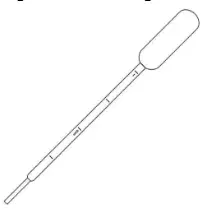
The image below shows a tool that is commonly used in the forensics lab. It is designed to transfer small amounts of liquids. Which piece of lab equipment is shown in the picture below?
pipette
forceps
test tube
scalpel
Locard’s Exchange principle supports all of the following claims, except:
Fibers can be transferred from one person to another.
Blood spatter is used to identify blood type.
Cat hair can be transferred to your jacket.
Leaves and soil can be carried from the yard into your home.
Direct evidence can include all the following except:
a toxicology report
a signed ransom note
a surveillance film
a sample of hair
Two or more investigators form a grid by searching in line patterns that overlap and are perpendicular to each other.
- most likely used for murders
spiral
grid
quadrant
line/strip
The reason that it is important to separate witnesses at a crime scene is to __.
prevent contamination of the evidence.
prevent fighting among witnesses.
prevent the witnesses from influencing one another.
protect them from the perpetrator.
Correct collection of evidence requires which of the following?
documenting the location where the evidence was found
correct packaging of the evidence
maintaining proper Chain of Custody
all of the above
A crime-scene sketch should include all of the following except ___
a scale of distance
a North direction
date and location of crime scene
the type of search pattern that was used
Which of the following best describes the difference between circumstantial evidence and direct evidence?
Direct evidence can lead to the conviction of a suspect, while circumstantial evidence cannot.
Direct evidence is not admissible in court; however, circumstantial evidence is admissible with the approval of a judge.
Direct evidence is used to imply a fact, while circumstantial evidence includes first-hand observations.
Direct evidence includes first-hand observations, while circumstantial evidence is used to imply a fact.
The documented and unbroken transfer of evidence is known as ____.
Locard’s Exchange Principle
Chain of Custody
Frye Standard
Daubert Standard
Which of the following evidence is considered to be direct evidence?
a fingerprint left on a door knob
a fiber from a suspect’s couch found on the victim’s shirt
blood from a victim found under the fingernails of a suspect
a confession in a police report
Which of the following evidence is considered to be biological?
dental impressions
fingerprints
Read the scenario below and answer questions ( 17-19)
The Bank of Eastman was robbed last Friday. The first responder secured the scene and immediately began looking and collecting evidence (without gloves). When the crime scene investigators arrived, the first responder and C.S.I members immediately opened the packs from the top, breaking the signed seal. Several pieces of evidence were analyzed such as a surveillance film from the bank, a ransom letter that requested $10,000.00, a set of car keys left by the robber, and a hair sample (with the root intact) found near the ransom letter. After analyzing the evidence, customers and bank personnel were interviewed by detectives. The bank robber was never found.
Which of the following did the first responder do incorrectly during the investigation? (CHOOSE ALL THAT APPLY.)
a. He secured the crime scene.
b. He collected evidence before the C.S.I contaminated the scene.
c. He collected evidence without gloves.
d. He opened evidence packs from the top of the package, breaking the signed seal.
How would the set of keys be useful?
They may contain physical evidence, such as fingerprints.
They may contain biological evidence, such as DNA.
They may serve as class evidence to help detectives determine information about the suspect.
All of the above.
Which of the following pieces of evidence would most likely be considered individual evidence?
the car keys
the hair sample
the ransom letter
the eye witnesses
According to the Steps of Crime Scene Investigation, which of the following steps should follow the first responders “securing the scene”?
sketching the scene
photographing the scene
scanning the scene
separating the witnesses
When packaging evidence, which of the following is NOT a procedure that should be followed?
The evidence should be approved by a judge.
The evidence must be naturally dried if it’s wet.
The evidence must be placed in a bindle if it’s small and fragile.
According to the Chain of Custody, which of the following must be done when working with evidence?
Sealed evidence must be opened at a location other than the sealed/signed edge.
Sealed evidence must remain in its container for 7 days.
Sealed evidence must never be opened by more than one person.
Sealed evidence must be carefully opened at the sealed/signed edge.
Which of the following is NOT a member of the Crime Scene Investigation team?
police officer
judge
detective
medical examiner
Which of the following is completed after the crime scene is scanned and evidence is marked with evidence markers?
Evidence is sorted.
Evidence is destroyed.
Evidence is analyzed.
Evidence is photographed.
Which of the following C.S.I. team member is responsible for declaring the cause of death when a homicide occurs?
detective
crime scene investigator
medical examiner
first responder
What is the minimum number of photographs that an investigator will take of ONE piece of evidence at a crime scene?
24
12
9
3
A forensic scientist may be asked to testify in court as an expert witness. He/she is there to provide ____.
fact
opinion
judgment
Our state of mind affects how we observe our surroundings. What mental state is best for observing?
distressed
relaxed
nervous
excited
The Innocence Project found that mostly faulty convictions were based on ______.
out-of-date investigating equipment.
untrained C.S.I.
inaccurate eyewitness accounts.
officers not following the 7 S’s of C.S.I.
All of the following are ways to improve our observational skills except ____.
Be sure to look at the entire area of a crime scene.
Observe everything, no matter how big or small.
When collecting evidence, record only those things that you are sure are important.
Write down and photograph everything you find.
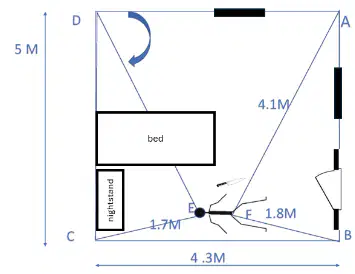
What process was being initiated when the sketcher measured the distance from the victim to two fixed points in the bedroom?
following the chain of custody
securing the crime scene
collecting evidence
A hand lens provides more magnification than a microscope. Therefore, it would be better when viewing fibers and hairs found at a crime scene.
True
False
Forensic investigators must rely on their ability to observe, interpret, and report observations clearly.
True
False
Good observation skills come naturally to investigators; they do not need to be trained.
True
False
If a witness remembers seeing something happen, we can trust that it happened just as they remembered.
True
False
A thermometer is a tool used in science to measure the mass of a substance.
True
False
The Innocence Project is an organization, established in 1992, that seeks to exonerate wrongfully convicted people using advancements in scientific equipment and procedures.
True
False
First responding officers must identify the extent of a crime, secure the scene, and dictate/record who enters and leaves the scene.
True
False
There are four regions of the brain. They are referred to as "lobes." They include the parietal lobe, the occipital lobe, the hypothalamus lobe, and the neuron lobe.
True
False
Eyewitness accounts are always accurate.
True
False
The Jon Benet Ramsey case is an example of why there is a need for forensics steps and procedures when it comes to processing a crime scene.
True
False
Techniques and procedures used in forensics has remained the same for the past century. Very few changes have been made to the way that investigators process the crime scene and analyze evidence.
True
False
Frontal Lobe is associated to:
movement, orientation, recognition of stimuli
visual processing
Perception, memory and speech
reasoning, planning, parts of speech, emotions and problem solving
A crime-scene sketch should include all of the following except ___.
A scale of distance
A North direction
Date and location of crime scene
The type of search pattern that was used.

