
Font size
 Worksheets
Kinetics and Equilibrium Review
Total questions: 34
Worksheet time: 17mins
A chemical reaction between iron atoms and oxygen molecules can only occur if...
the particles are heated
the atmospheric pressure decreases
there is a catalyst present
there are effective collisions between the particles
An effective collision between reactant particles requires the particles to have the proper
charge and mass
charge and orientation
energy and mass
energy and orientation
The energy needed to start a chemical reaction is called
potential energy
kinetic energy
activation energy
ionization energy
Which factors have the greatest effect on the rate of a chemical reaction between AgNO3(aq) and Cu(s)?
solution concentration and temperature
solution concentration and pressure
molar mass and temperature
molar mass and pressure
For a reaction at equilibrium, which change can increase the rates of the forward and reverse reactions?
a decrease in the concentration of the reactants
a decrease in the surface area of the products
an increase in the temperature of the system
an increase in the activation energy of the forward reaction
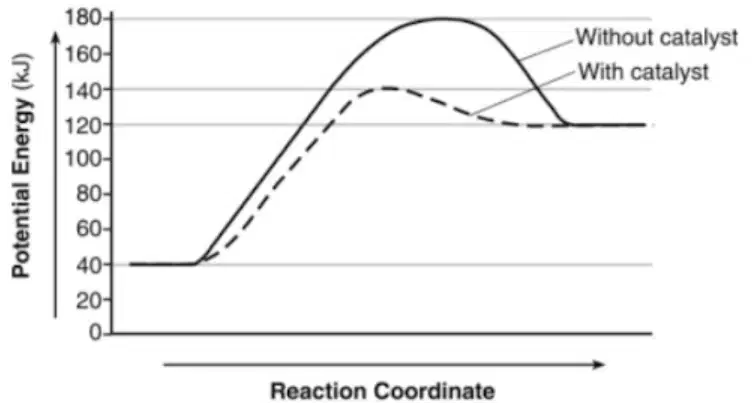
Base your answer to the following question on the potential energy diagram below. What is the activation energy for the forward reaction with the catalyst?
140 kJ
120 kJ
80 kJ
100 kJ
A catalyst lowers the activation energy of a reaction by
providing an alternate reaction pathway
decreasing the heat of reaction
increasing the mass of the reactants
changing the mole ratio of the reactants
Entropy is a measure of the
acidity of a sample
disorder of a system
concentration of a solution
chemical activity of an element
Which expression represents the heat of reaction for a chemical change in terms of potential energy, PE?
(PEproducts) + (PEreactants)
(PEproducts) - (PEreactants)
(PEproducts) × (PEreactants)
(PEproducts) ÷ (PEreactants)
Which statement describes a reversible reaction at equilibrium?
The activation energy of the forward reaction must equal the activation energy of the reverse reaction.
The rate of the forward reaction must equal the rate of the reverse reaction.
The concentration of the reactants must equal the concentration of the products.
The potential energy of the reactants must equal the potential energy of the products.
Systems in nature tend to undergo changes toward
lower energy and higher entropy
lower energy and lower entropy
higher energy and higher entropy
higher energy and lower entropy
The entropy of a sample of CO2 increases as the CO2 changes from
gas to liquid
gas to solid
liquid to solid
solid to gas
As the temperature of a reaction increases, it is expected that the reacting particles collide
more often and with greater force
more often and with less force
less often and with greater force
less often and with less force
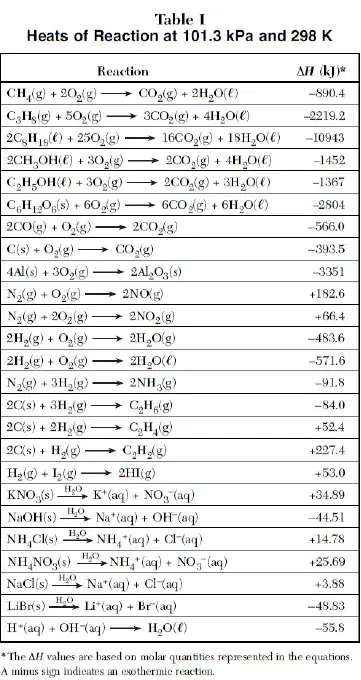
At 101.3 kPa and 298 K, a 1.0‑mole sample of which compound absorbs the greatest amount of heat as the entire sample dissolves in water?
LiBr
NaCl
NaOH
NH4Cl
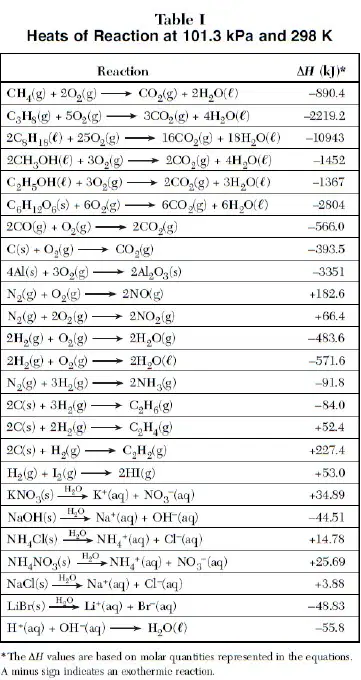
Which compound is formed from its elements by an exothermic reaction at 298 K and 101.3 kPa?
C2H4(g)
HI(g)
C2H6(g)
NO2(g)
Which equation represents a change that results in an increase in disorder (entropy)?
2Na(s) + Cl2(g) → 2NaCl(s)
C2H5OH(l) → C2H5OH(g)
CO2(g) → CO2(s)
2H2(g) + O2(g) → 2H2O(l)
Fe(s) + 2HCl(aq) → FeCl2(aq) + H2(g). This reaction occurs more quickly when powdered iron is used instead of a single piece of iron of the same mass because the powdered iron
acts as a better catalyst than the single piece of iron
absorbs less energy than the single piece of iron
has a greater surface area than the single piece of iron
is more metallic than the single piece of iron

Given the potential energy diagram for a reaction: Which intervals are affected by the addition of a catalyst?
1 and 2
1 and 3
2 and 4
3 and 4
For a given chemical reaction, the addition of a catalyst provides a different reaction pathway that
decreases the reaction rate and has a higher activation energy
decreases the reaction rate and has a lower activation energy
increases the reaction rate and has a higher activation energy
increases the reaction rate and has a lower activation energy
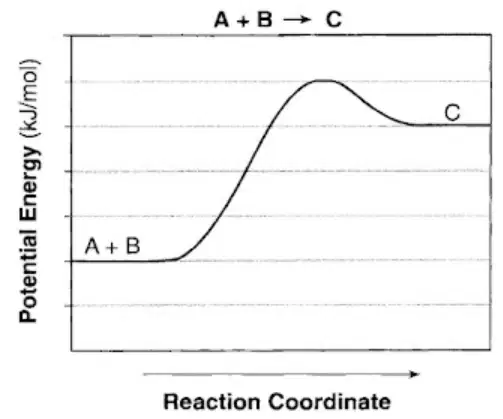
Given the equation and potential energy diagram representing a reaction: A + B → C. If each interval on the axis labeled "Potential Energy (kJ/mol)" represents 10 kJ/mol, what is the heat of reaction?
+60 kJ/mol
+20 kJ/mol
+30 kJ/mol
+40 kJ/mol
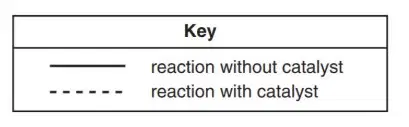
Which potential energy diagram represents the change in potential energy that occurs when a catalyst is added to a chemical reaction?
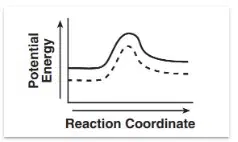
Option 1
Option 1
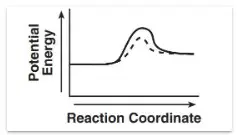
Option 2
Option 2

Option 3
Option 3
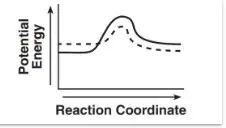
Option 4
Option 4
Given the following reaction at equilibrium, what change will increase the concentration of SO3?
2SO2(g) + O2(g) ⇌ 2SO3(g) + 44 kcal
increasing the temperature
increasing the concentration of O2(g)
decreasing the pressure
decreasing the concentration of SO2(g)
Given the equation representing a system at equilibrium: AgCl(s) ⇌ Ag+(aq) + Cl−(aq). When the concentration of Cl−(aq) is increased, the concentration of Ag+(aq):
decreases, and the amount of AgCl(s) increases
decreases, and the amount of AgCl(s) decreases
increases, and the amount of AgCl(s) increases
increases, and the amount of AgCl(s) decreases
Given the equation representing a reaction at equilibrium: 2SO2(g) + O2(g) ⇌ 2SO3(g) + heat. Which change causes the equilibrium to shift to the right?
adding a catalyst
adding more O2(g)
decreasing the pressure
increasing the temperature
Given the equation representing a system at equilibrium: N2(g) + 3H2(g) ↔ 2NH3(g) + energy. Which changes occur when the temperature of this system is decreased?
The concentration of H2(g) increases and the concentration of N2(g) increases.
The concentration of H2(g) decreases and the concentration of N2(g) increases.
The concentration of H2(g) decreases and the concentration of NH3(g) decreases.
The concentration of H2(g) decreases and the concentration of NH3(g) increases.

Compared to trial 1, what is the expected reaction time for trial 2 and the explanation for that result? In the laboratory, a student investigates the effect of concentration on the reaction between HCl(aq) and Mg(s), changing only the concentration of HCl(aq). Data for two trials in the investigation are shown.
less than 48 s, because there are fewer effective particle collisions per second
less than 48 s, because there are more effective particle collisions per second
more than 48 s, because there are fewer effective particle collisions per second
more than 48 s, because there are more effective particle collisions per second
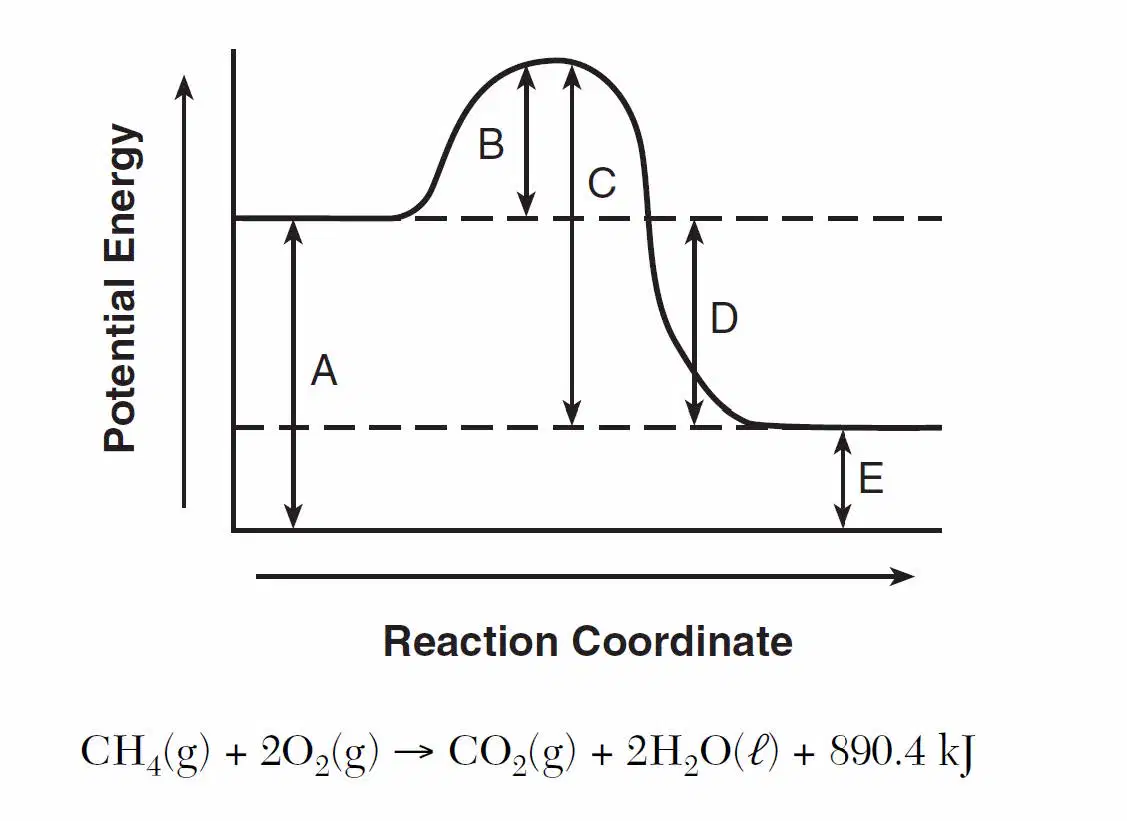
Which potential energy interval in the diagram represents the activation energy of the forward reaction?
A
B
C
D
E

How will a lower concentration of oxygen gas (O2) affect the rate of the forward direction of this reaction?
The rate of the forward reaction will not change
The rate of the forward reaction will increase because of fewer particle collisions with the reactants
The rate of the forward reaction will decrease because of fewer particle collisions with the reactants
The rate of the forward reaction will decrease because of greater particle collisions with the reactants
Common household bleach is an aqueous solution containing hypochlorite ions. State the effect on the concentration of the ClO− ion when there is a decrease in the concentration of the OH− ion.
Cl2(g) + 2OH−(aq) ⇌ ClO−(aq) + Cl−(aq) + H2O(ℓ).
The concentration of the ClO− ion decreases.
The concentration of the ClO− ion increases.
The concentration of the ClO− ion remains constant.
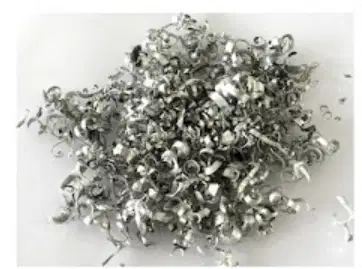
A 10-gram sample of magnesium shavings is stirred into a beaker of 1.0 M hydrochloric acid (HCl). The following reaction occurs: Mg(s) + 2HCl(aq) → MgCl2(aq) + H2(g). Which of the following would increase the rate of reaction?
Change the concentration of hydrochloric acid to 2.0 M.
Let the solid reactant settle naturally instead of stirring.
Use a 10-gram piece of solid magnesium instead of the 10-gram sample of shavings.
Hydrogen and bromine react to form hydrogen bromide: H2(g) + Br2(g) ⇌ 2HBr(g). This reaction is allowed to come to equilibrium in a closed container at a certain temperature and pressure. Which changes in concentration would increase the rate of the reverse reaction? Check all that apply.
Increase the concentration of H2
Increase the concentration of Br2
Increase the concentration of HBr
Decrease the concentration of H2
Methane is commonly called “natural gas,” and has the formula CH4. Although methane is produced naturally, it can be made by reacting coal with hydrogen gas. C(s) + 2H2(g) ⇌ CH4(g) + heat. If a chemist wants to increase the concentration of methane (CH4) at equilibrium, what is the best strategy?
lowering the temperature
raising the temperature
maintaining a constant temperature
The Haber process produces ammonia by reacting nitrogen and hydrogen at high temperatures and pressures: N2(g) + 3H2(g) ⇌ 2NH3(g). A chemist allows this reaction to reach equilibrium in a sealed container. After reaching equilibrium, the volume of the container is decreased by 20%. Which direction does the equilibrium shift and why?
Towards the reactants. The system must produce more gas molecules to raise the pressure.
Towards the reactants. The increased pressure lowers the activation energy of the reverse reaction.
Towards the product. The system must reduce the number of gas molecules to lower the pressure.
Towards the product. The increased pressure lowers the activation energy of the forward reaction.

A 4.0-gram copper wire is placed in a 0.10 M solution of silver nitrate. The solution gradually turns blue, and atoms of pure silver are produced. The equation for this reaction is Cu(s) + 2AgNO3(aq) → Cu(NO3)2(aq) + 2Ag(s). Which of the following actions would decrease the rate of reaction?
Use 4.0 grams of copper grains instead of wire
Change the concentration of AgNO3 to 0.05 M
change the concentration of AgNO3 to 0.20 M

