
NEW
Font size
S
M
L
XL
 Worksheets
PH AP Chemistry
Total questions: 29
Worksheet time: 39mins
Name
Class
Date
1.
If a solution has a [OH-] of 3.42 x 10⁻¹²M what is the [H+]?
a)
2.92 x 10⁻³M
b)
3.42 x 10²M
c)
2.92 x 10⁻²M
d)
3.42 x 10⁻⁵M
2.

What is the conjugate acid in the following equation?
a)
PO43-
b)
HNO3
c)
NO3-
d)
HPO42-
3.
Which of the following represents the chemical formula for hydronium?
a)
H2O
b)
H+
c)
H3O+
d)
OH-
4.
Which of the following is not a strong acid?
a)
HCl
b)
HF
c)
HBr
d)
HNO3
5.
When citric acid is produced by the cells of an orange and dissolves in water, it produces a relatively small number of hydronium ions. Citric acid is best described as a
a)
concentrated acid.
b)
weak acid.
c)
dilute acid.
d)
strong acid.
6.

What is the conjugate base in the following reaction?
a)
HCO3-
b)
HCl
c)
H2CO3
d)
Cl-
7.
If a solution has a [H+] of 1.2 x 10⁻⁴M what is the [OH-]?
a)
8.3 x 10⁻⁴M
b)
8.3 x 10⁻¹¹M
c)
1.2 x 10¹⁰M
d)
1.2 x 10⁻⁴M
8.
Which donates protons?
a)
Brønsted-Lowry Acids
b)
Brønsted-Lowry Bases
c)
Arrhenius Acids
d)
Arrhenius Bases
9.
Which accepts protons?
a)
Brønsted-Lowry Acids
b)
Brønsted-Lowry Bases
c)
Arrhenius Acids
d)
Arrhenius Bases
10.
I am titrating 1M HCl with 1M NaOH. I have 25mL of HCl. How much NaOH will I need?
a)
2.5mL
b)
5mL
c)
25mL
d)
50mL
11.
I have 25mL of 1M HCl which neutralises 20mL of NaOH. What is the concentration of the NaOH?
a)
0.8 M
b)
1 M
c)
1.25 M
12.
What acid and what base would you choose to prepare the salt potassium chlorate?
a)
KOH and HClO3
b)
KOH and HClO2
c)
HK and OHClO3
d)
HK and OHClO2
13.
A 50.0 mL sample of Ca(OH)2 is neutralized by 300.0 mL of HCl solution with a pH of 1.3. Calculate the molarity of the Ca(OH)2 solution.
a)
1.0 M
b)
0.50 M
c)
0.15 M
d)
0.30 M
14.
The pH at the equivalence point of the titration of a strong acid with a strong base is usually:
a)
acidic 3.9
b)
acidic 4.5
c)
neutral 7.0
d)
basic 8.2
15.

Which is the weakest acid?
a)
HF
b)
HNO2
c)
CH3COOH
d)
HClO
16.
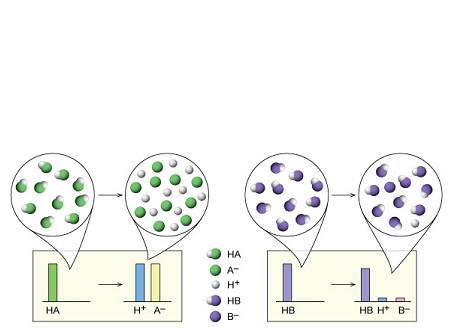
Which of the following correctly describes the strengths of the acids in solution?
a)
HA and HB are both examples of strong acids.
b)
HA and HB are both examples of weak acids.
c)
HA is an example of a strong acid, HB is an example of a weak acid.
d)
HA is an example of a weak acid, HB is an example of a strong acid.
17.
Consider the general equation for an acid in water:
HA(aq) + H2O ↔ H3O+ + A-
If there is a lot of product, what does that tell you about the acid?
HA(aq) + H2O ↔ H3O+ + A-
If there is a lot of product, what does that tell you about the acid?
a)
Ka > 1 Strong acid
b)
Ka > 1 Weak acid
c)
Ka < 1 Strong acid
d)
Ka < 1 Weak acid
18.

Use the Ka values to determine whether there are more products or reactants at equilibrium for the given reaction.
Ka NH4+1= 5.6x10⁻¹⁰
Ka HCO3-1= 4.8x10⁻¹¹
Ka NH4+1= 5.6x10⁻¹⁰
Ka HCO3-1= 4.8x10⁻¹¹
a)
More products.
Ka NH4+1 > Ka HCO3-1
Ka NH4+1 > Ka HCO3-1
b)
More products.
Ka NH4+1 < Ka HCO3-1
Ka NH4+1 < Ka HCO3-1
c)
More reactants.
Ka NH4+1 > Ka HCO3-1
Ka NH4+1 > Ka HCO3-1
d)
More reactants.
Ka NH4+1 < Ka HCO3-1
Ka NH4+1 < Ka HCO3-1
19.
Calculate the [H+] in a solution that has a pH of 2.73.
a)
5.4 x 10⁻¹² M
b)
1.9 x 10⁻³ M
c)
2.7 M
d)
11.3 M
20.
pH greater than 7.
a)
Acids
b)
Bases
c)
All
21.
A sample of pure water is neutral because it contains
a)
some H+ ions.
b)
equal amounts of hydroxide and hydrogen ions.
c)
some hydroxide ions.
d)
only H2O molecules.
22.
The following neutralization reaction occurs in the classroom.
HCl + KOH --> H2O + KCl
If a student uses 25.0 mL of a 0.5M solution of KOH, what is the molarity of the acid if the is 15.0mL of acid neutralized?
HCl + KOH --> H2O + KCl
If a student uses 25.0 mL of a 0.5M solution of KOH, what is the molarity of the acid if the is 15.0mL of acid neutralized?
a)
0.8M
b)
1.2M
c)
12.5M
23.
A 0.95 M solution of 10.0 mL Al(OH)3 is neutralized using a 2 M solution of H2SO4. How much H2SO4 was needed?
3H2SO4 + 2Al(OH)3 --> 6H2O + 1Al2(SO4)3
3H2SO4 + 2Al(OH)3 --> 6H2O + 1Al2(SO4)3
a)
0.1 mL
b)
7 mL
c)
5 mL
d)
0.2 mL
24.
A student titrates 20.0 mL of 1.0 M NaOH with 2.0 M formic acid (weak monoprotic acid). Ka=1.8 x 10⁻⁴ . How much formic acid is necessary to reach the equivalence point?
a)
10.0 mL
b)
20.0 mL
c)
30.0 mL
d)
40.0 mL
25.
A student titrates 20.0 mL of 1.0 M NaOH with 2.0 M formic acid (weak monoprotic acid). Ka=1.8 x 10⁻⁴ .
What is the solution at the equivalence point?
What is the solution at the equivalence point?
a)
acidic, the strong acid dissociates more than the weak base
b)
basic, the only ion present at equilbrium is the conjugate base
c)
basic, the higher concentration of the base is the determining factor.
d)
neutral, equal moles of both acid and base are present
26.
A student titrates 20.0 mL of 1.0 M NaOH with 2.0 M formic acid (weak monoprotic acid). Ka=1.8 x 10⁻⁴ .
Which pH range would a buffer made with formic acid be more effective? (hint: think of pka)
Which pH range would a buffer made with formic acid be more effective? (hint: think of pka)
a)
0-2
b)
2-7
c)
7-12
d)
12-14
27.
If the formic acid were replaced by a strong acid like HCl at the same concentration, how would that affect the volume needed to reach equivalence point?
a)
the change would reduce the amount because the acid fully dissociates
b)
the change would reduce the amount because the base is now more strongly attracted to the acid
c)
the change would increase the amount because reaction will go to completion instead of equilibrium
d)
changing the strength of the acid will not change the volume needed to reach equivalence pt.
28.
What volume of 0.05 M HCl is required to neutralize 50 mL of 0.10 M Sr(OH)2 solution?
a)
100 mL
b)
200 mL
c)
300 mL
d)
400 mL
29.
A 1 molar solution of a weak monoprotic acid has a pH of 5. What is the value of Ka for the acid?
a)
1 x 10⁻¹⁰
b)
1 x 10⁻⁷
c)
1 x 10⁻⁵
d)
1 x 10⁻²
Reset

