
 Worksheets
25-26 World History Midterm Exam Review
Total questions: 50
Worksheet time: 25mins
What led to the fall of the kingdom of Ghana?
decline in population due to disease
constant invasions from Muslim states
decrease in trade with neighboring civilizations
increased drought, which led to famine
What do B.C.E. and C.E. stand for?
Before Cost Evidence and Cost Evidence
Before Core Evolution and Core Evolution
Before Common Era and Common Era
Before Conquest Era and Conquest Era
When was cuneiform writing first used?
3000 B.C.E.
221 B.C.E.
800 C.E.
1215 C.E.
What is the primary reason for the conflict between the Shia and Sunni Muslims?
They have disagreements on who should be in power.
They both want to settle the same land.
They have issues with basic teachings of the faith.
They both say that Muhammad gave them special authority.
"Learn to do well;
Seek justice, relieve the oppressed,
Judge the atherless, plead for the widow."
What does this excerpt imply about the influence of the Jewish faith on early societies?
Because of the beliefs of the Jewish faith, polytheism became an acceptable religious belief.
The Jewish faith introduced the concept of original sin.
Jewish scholars are responsible for the creation of laws necessary for the betterment of society.
The Jewish doctrine’s emphasis on the proper treatment of everyone in society became a source for ideals of social justice.
Which factor contributed to the decline of the kingdom of Mali following Mansa Mūsa’s death?
unfair trade agreements
outbreak of civil war
growth of the slave trade
dwindling gold supplies
How did the development of systematic agriculture change the way people lived in the Neolithic Age?
It allowed people to move from place to place.
It promoted hunting and gathering.
It encouraged people to settle in communities.
It ended hunting and gathering.
What was the significance of Julius Caesar “crossing the Rubicon”?
He was declaring his support for the triumvirate to continue.
He was declaring his support for the Senate’s decision.
He was declaring an end to the triumvirate and starting civil war.
He was declaring his goals to restore order.
Which of the following statements best explains why people found Christianity appealing?
It was impersonal and state sponsored.
It offered an intense initiation rite.
It gave a sense of belonging and community.
It could be spread through written messages.
Which people are credited with sacking Rome in 410 A.D., signaling the end of the Roman Empire in the west?
Huns
Visigoths
Vandals
Gauls
Justinian’s The Body of Civil Law impacted the European kings during the Middle Ages by supporting
the rights of the people to elect their own government.
aristocratic ability to gain power within the nation.
religious freedom within all parts of the empire.
the idea that the emperor was the source of authority and all law.
Which of the following statements best explains the role of commerce within Constantinople before the twelfth century?
the center of exchange for products between the West and East
A Christian city that did not trade with non-Christian empires
a major importer of all goods from outside places
directly controlled by the patriarch, who also controlled all commerce
The Hijrah was
the annual pilgrimage for Muslims to Makkah.
the collected works of Muhammad’s sayings and actions.
the code of laws based on the teachings of Muhammad.
the journey of Muhammad and his followers from Makkah to Madinah.
Which action is a way to observe one of the Five Pillars of Islam?
abstaining from eating pork
refusing to gamble
donating to a homeless shelter
being honest in a business transaction
What knowledge were Muslim scholars pivotal in preserving?
the process of paper making
the art of navigation
works of Roman art
works of Greek philosophy
The invention of the astrolabe by Muslim scholars
helped determine that the Earth is round.
made it possible for Europeans to sail to the Americas.
helped translate important texts into Latin and other languages.
made it possible for paper making to spread outside of China.
Why were many Europeans willing to enter into feudal contracts at the time of the Viking raids?
Feudalism offered protection and safety.
Feudalism provided business opportunities.
Feudalism made food production more efficient.
Feudalism allowed freedom for more people.
How did the three-field crop rotation system result in increased food production during the High Middle Ages?
The use of different fields forced communities to work together.
Serfs and peasants could work on different fields at different times.
Only a small part of the fields stayed fallow at any one time.
Fields could be planted more quickly and produce more crops.
How was the Investiture Controversy resolved?
German bishops would be nominated by the king.
German bishops would be appointed directly by the pope.
German bishops would be nominated by local lords, then confirmed by Church officials.
German bishops would be elected by Church officials, and then they would pay homage to the king.
The Magna Carta recognized that
the relationship between kings and vassals was based on mutual rights and obligations.
all persons were of equal status in the feudal structure regardless of social class.
representative government overrode the wishes of a monarchy.
people were naturally divided into three orders, called estates.
Which of the following was an effect of the Hundred Years’ War?
a union between France and England
a strong national feeling among the French
a strong English economy
a period of peace in England
What was the goal of the Reconquista?
for Spanish Christians to take control of the Muslim controlled areas of Spain
for Spain to be religiously tolerated
for Spanish nobles to assert their rights over the king
for Spain to make violent raids into the Holy Roman Empire
The kingdom of Mali built its wealth on the trading of
gold and salt.
grains and enslaved peoples.
iron ore and millet.
copper and textiles.
The kingdom of Axum exported gold, ivory, and salt to the
Sao people.
Kanem Empire.
Bantu people.
Roman Empire.
What was an important part of the religious practices in Great Zimbabwe?
saying Christian prayers
honoring ancestors
visiting Islamic mosques
revering animals
Mayan society comprised independent city-states governed by
democratically elected councils.
military generals.
a class of scribes and priests.
a hereditary ruling class.
What is one way that the Aztec kingdom was similar to other great empires in ancient times?
It had a noble class made up of highly educated merchants.
It had a class of enslaved people that inherited that status at birth.
It was a centralized state that exerted control of its people from afar.
It was ruled by an authoritarian government that held all of the power.
Both the Mayan and Aztec empires
fought off external invasion by the Spanish.
utilized a writing system that is still used.
created sophisticated calendars.
practiced a religion that is still practiced in Mexico.
What is often considered the greatest public works project of the Inca?
an extensive system of roadways and bridges
the use of the wheel to quickly transport goods
growing large amounts of crops on barren land
a temple with stone figures depicting gods
Which statement best describes the collapse of the Inca Empire?
The Inca fought off the Spanish invasion but were defeated by another Andean society.
The Inca worked together with the Spanish and a new culture emerged.
The Inca fought against the thousands of Spanish soldiers but lost their territory.
The Inca were weakened by civil war and smallpox brought by the Spanish.
Which statement describes one way that Inca society was highly regimented?
Men and women had to marry within their tribal groups.
Women were responsible only for the care of children after marriage.
Young boys were required to serve as priests in temples.
Men and women both had to serve in the military.
What happened as a result of the rise of Islam?
It led to the unification of Arabian tribes and challenges to the Eastern Roman Empire.
It led to more illiteracy amongst followers.
It led to peace among the Arab Empire and its neighbors.
It led to decentralized governmental powers.
Which was a contribution of people from the Arabic-speaking world?
gunpowder
astrolabe
telescope
cathedrals
Why did Pope Urban II call for the First Crusade?
to reunite the Roman Catholic and Byzantine churches
to free the Holy Land of Muslim rule
to reduce conflict between European armies
to establish a new kingdom in Jerusalem
One reason ancient Egyptian civilization experienced stability and continuity for thousands of years was its
ability to communicate.
access to rich Mesopotamian soil.
transportation network.
geographic isolation.
The Inca kept records of economic exchanges using
written accounts.
painted bark.
knotted strings.
solar calendars.
The development of cuneiform was significant because it enabled the Sumerians to
preserve and pass on knowledge.
develop weapons made from bronze.
transport goods overland with ease.
tell time throughout the day.
One reason anti-Semitism rose in medieval Europe is that Jewish people were falsely accused of
causing the Little Ice Age.
starting the bourgeoisie.
causing the plague.
starting the Great Famine.
The compilation of Hammurabi’s Laws
eliminated the need for multiple social classes.
informed subjects of their rights and duties.
were based on a system of religious beliefs.
allowed leaders to easily conquer nearby lands.
How did the fall of the Western Roman Empire affect the economic landscape of Europe?
It led to increased trade with the Eastern Roman Empire
It resulted in the immediate industrialization of Western Europe
It caused a decline in long-distance trade and urban centers
It prompted the rapid development of a banking system
What was the economic consequence of the Black Death?
Increased demand for luxury goods caused trade to grow.
Decreased incomes and rents for feudal lords caused serfdom to expand.
Widespread crop shortages caused peasants to pay taxes with money.
Widespread labor shortages caused prices for workers to rise.
One reason The Body of Civil Law is significant is because it
extended citizenship to all peoples.
simplified the law in the West.
was originally written in Greek.
shaped contemporary legal systems.
What was the main purpose of the Magna Carta?
to affirm the idea that the power of the monarch was limited
to revive the traditional legal system of the Romans
to merge Church and secular rules into a single code of law
to institute a legal system based on citizen participation
The concept of democracy and the development of philosophical thought are primarily associated with which ancient civilization?
Persian
Mesopotamian
Roman
Greek

Which statement is best supported by the map?
The West Indies produced most of the sugar and rum that Europeans used.
Richmond, Charleston, and Savannah received the most enslaved peoples each year.
Enslaved Africans were taken to Europe.
Enslaved Africans were taken to North, Central, and South America.
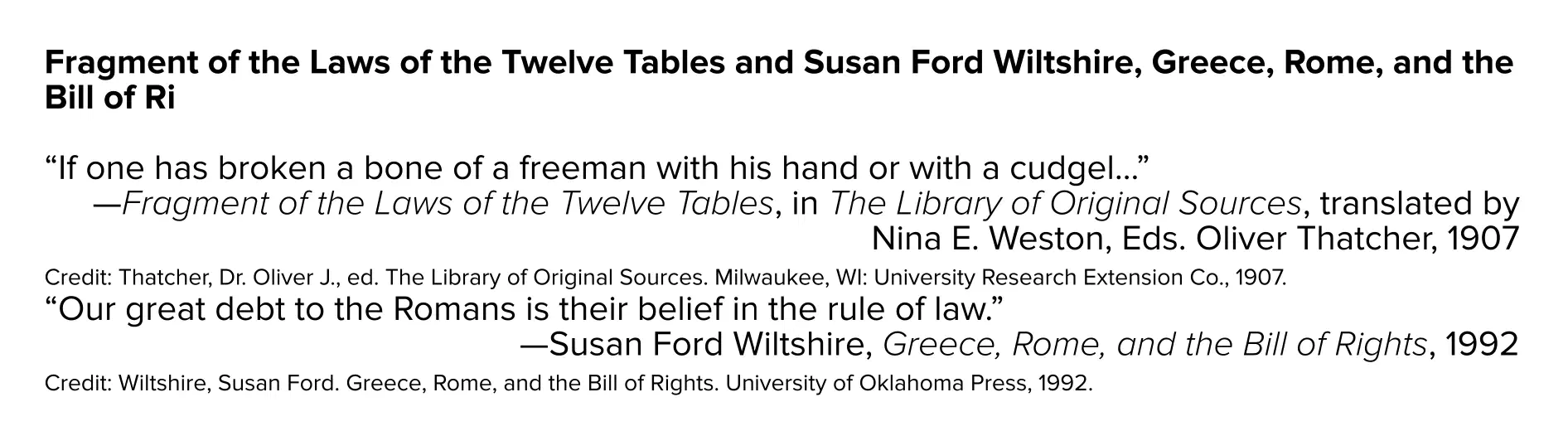
Which of the sources is a primary source, and why?
the second source because it is an eyewitness account
the second source because it is a personal point of view
the first source because it is a firsthand piece of evidence
the first source because it is published in a book
Why did complex societies develop in the Fertile Crescent?
Its abundance of iron ore sparked the invention of more effective metal tools.
The annual flooding of the Tigris and Euphrates was predictable for farmers.
Its rich soil made it possible to grow crops that supported large permanent settlements.
The development of a written language encouraged trade to flourish in the region.
What was the primary goal of the Inquisition?
to prosecute heretics
to preserve classical works
to promote a life of simplicity
to reform monasticism
Why do some historians consider the Agricultural Revolution to be the single most important development in human history?
It facilitated the development of settled communities.
It improved the digestion and nutrition of early people.
It caused the rapid destruction of nomadic lifestyles.
It triggered the evolution of verbal communication.
While the Hundred Years’ War created a strong national spirit for France, the end of war in England resulted in
the consolidation of royal power.
the popularity of private armies.
internal conflict between rival houses.
economic stability from higher taxes.

