
 Worksheets
FINAL TERM_Electronics 3
Total questions: 60
Worksheet time: 45mins
What makes CMOS technology consume very low static power?
High switching frequency
Only one transistor conducts at a time in steady state
Both NMOS and PMOS conduct simultaneously
Large leakage current
The threshold voltage of a MOSFET is the:
Minimum input voltage that turns the transistor off
Maximum drain voltage
Minimum gate voltage required to form a conduction channel
Maximum current rating
CMOS inverters have high noise immunity because:
They use only PMOS
They use only NMOS
They have rail-to-rail output
They use complementary transistor pairs
Propagation delay in CMOS mainly depends on:
Load capacitance
Wire thickness
Gate oxide color
Supply noise
Which pair forms the pull-up network in a CMOS NAND gate?
NMOS transistors in series
PMOS transistors in parallel
NMOS transistors in parallel
PMOS transistors in series
CMOS biasing ensures that:
The circuit overheats
The transistors operate in the correct region
Leakage current increases
The output stays at zero
Static power in CMOS is mainly due to:
Capacitive charging
Short-circuit current during switching
Subthreshold leakage
High output voltage
What happens when both NMOS and PMOS are ON during switching?
No current flows
Short-circuit current flows
Output becomes high impedance
Device shuts down
CMOS logic levels are determined by:
Current rating only
Temperature only
Supply voltage
Resistance size
CMOS stands for:
Central Metal-Oxide Semiconductor
Complimentary Metal-Oxide Semiconductor
Complementary Metal-Oxide Semiconductor
Composite Main Operator Semiconductor
Inverting amplifier gain is given by:
1 + (Rf/R1)
–(Rf/R1)
Rf × R1
1 / (Rf + R1)
What is the gain of a voltage follower?
0
-1
1
Infinity
Negative feedback generally:
Increases gain
Decreases bandwidth
Improves stability
Increases distortion
Negative feedback causes input impedance to:
Increase
Decrease
Go to zero
Stay constant
Negative feedback causes output impedance to:
Increase
Decrease
Stay unchanged
Become unstable
Closed-loop gain depends mainly on:
Supply voltage
External resistors
Internal transistors
Heat dissipation
A non-inverting amplifier has a gain of:
Negative feedback reduces:
Linearity
Distortion
Bandwidth
Noise margin
The input impedance of an ideal op-amp is:
1kΩ
10kΩ
Increasing feedback resistance in an inverting amplifier:
Open-loop gain of an op-amp is typically:
10
100
10,000 to 100,000
1
The frequency at which the gain becomes 1 is called:
Threshold frequency
Unity-gain bandwidth
Switching frequency
Phase margin
As frequency increases, open-loop gain:
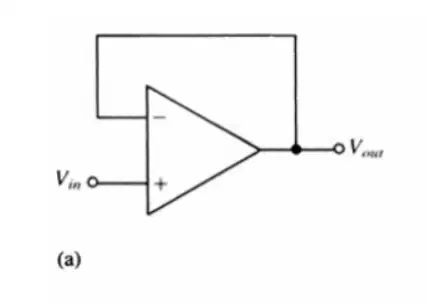
Refer to Figure 12-1(a). This amplifier is known as
an inverting amplifier
a non-inverting amplifier
a voltage-follower
a common-source amplifier
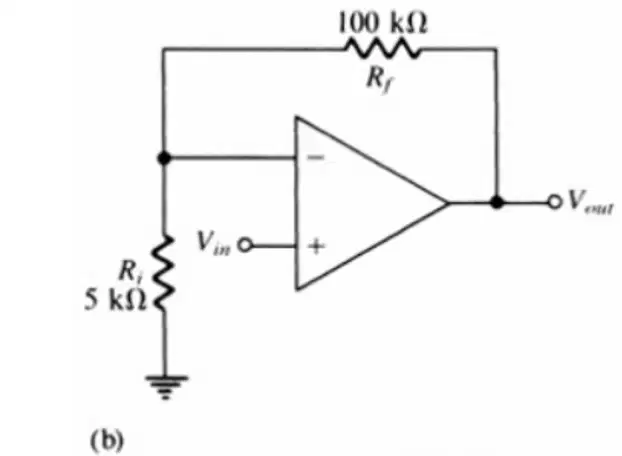
Refer to Figure 12-1(b). This amplifier is known as
an inverting amplifier.
a non-inverting amplifier.
a voltage-follower
a voltage-follower.
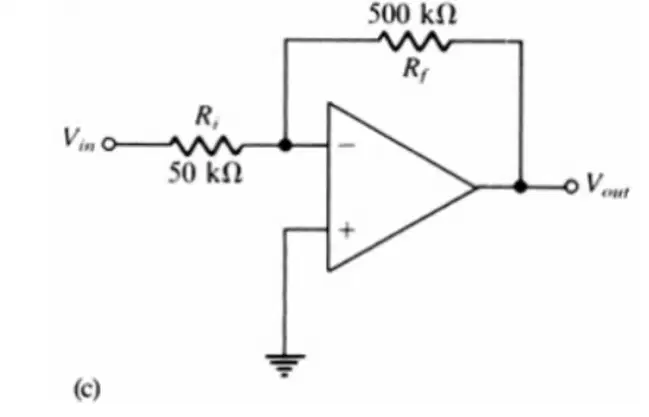
Refer to Figure 12-1(c). This amplifier is known as
an inverting amplifier
a non-inverting amplifier
a voltage-follower
a common-source amplifier
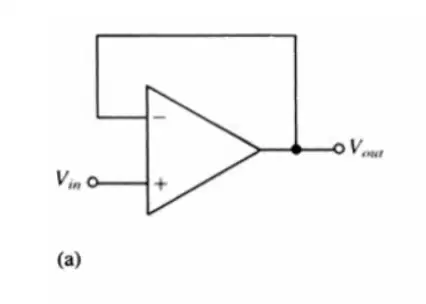
Refer to Figure 12-1(a). A dc voltage of -1.2 V is applied. VCC = ±12 V. What is the output voltage?
1.2 V
-1.2 V
0 V
12 V
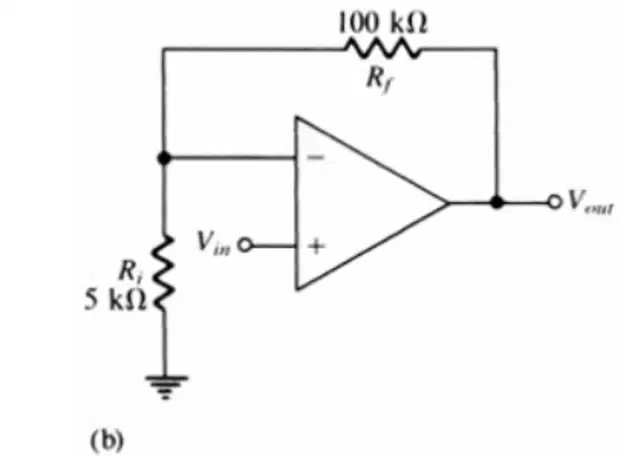
Refer to Figure 12-1(b). The voltage gain of this amplifier is
100
5
20
21
Closed-loop bandwidth is:
Smaller at higher closed-loop gains
Larger at high gains
Unrelated to gain
Same for all gains
Open-loop gain is always smaller than closed-loop gain.
True
False
Maybe
None of the choices
A comparator operates in:
Linear region
Saturation region
Cutoff region
Open-loop mode
A zero-crossing detector switches output when:
Vout = 0
Vin = 0
Rf = 0
Input is positive only
A Schmitt trigger adds:
Hysteresis
Distortion
Delay
Noise
In an inverting summing amplifier, inputs are:
Added directly
Multiplied
Added after being inverted
Ignored
A non-inverting summing amplifier creates:
Weighted average
Negative gain
Constant voltage
Zero output
Comparators frequently use reference voltage to:
Stabilize power supply
Define switching threshold
Increase gain
Reduce current
A summing amplifier can act as:
Oscillator
Audio mixer
Power supply
Filter
In an ideal comparator, output saturates at:
The accuracy of a summing amplifier depends mainly on:
Op-amp input bias current
Temperature only
Wire length
None
A comparator without hysteresis can:
Remove noise
Increase switching speed
Cause output bouncing near threshold
Improve stability
An ideal op-amp integrator output is proportional to:
The derivative of input
The integral of input
Input itself
Zero
Practical integrators include a resistor in parallel with the capacitor to:
Reduce noise
Prevent drift and saturation
Increase frequency
Reduce impedance
A differentiator amplifies:
High frequencies
Low frequencies
Both equally
Noise only
Differentiators are sensitive to noise because:
They reduce gain at high frequencies
They amplify high-frequency signals
They short input to ground
They do not use capacitors
An integrator can be used in:
Oscillators
Slope/ramps generation
Voltage regulation
Rectification
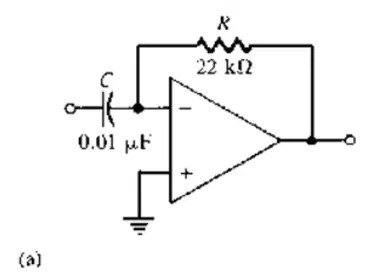
Refer to Figure 13-4(a). This circuit is known as:
differentiator
summing amplifier
integrator
comparator
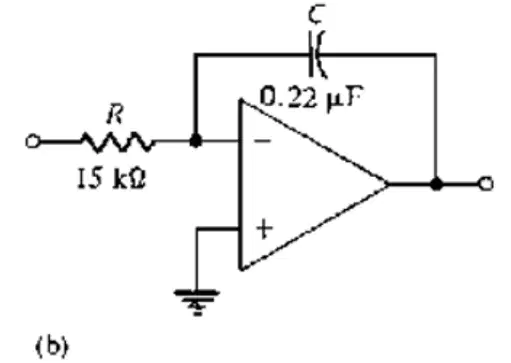
Refer to Figure 13-4(b). This circuit is known as:
summing amplifier
comparator
differentiator
integrator
If an op-amp output is pegged at +Vcc, it is likely:
Stable
Oscillating
In positive saturation
Damaged permanently
Op-amps in control systems are used for:
Generating mechanical force
Signal conditioning
Power generation
Cooling
A practical differentiator adds a resistor in series with the input to:
Reduce high-frequency noise
Increase oscillation
Increase gain
Remove DC component
Operational amplifiers are never used as nonlinear devices.
True
False
The output voltage of a summing amplifier is proportional to the sum of the input voltages.
True
False
An op-amp integrator uses a capacitor as the feedback element
True
False
Negative feedback increases the distortion of an op-amp.
True
False
A summing amplifier can add multiple input signals together.
True
False
An integrator circuit produces a constant (DC) output for a constant input.
True
False
Negative feedback decreases the output impedance of an op-amp circuit.
True
False
A differentiator amplifies low-frequency signals more than high-frequency signals.
True
False
Comparators use op-amps without negative feedback.
True
False
A noninverting amplifier produces an output that is 180° out of phase with the input.
True
False

