
 Worksheets
Final Exam Review Quiz (Highest Grade will replace an NTI)
Total questions: 65
Worksheet time: 41mins
The distance between two objects doubles, how does that affect the gravitational force between the two objects? (choose an equation to solve the problem)


Mary sped up for 10 seconds. She started at 4 m/s and ended at 8 m/s. What is her acceleration? (choose a formula to solve the problem)


Steven traveled 15 seconds at a speed of 19 m/s. What distance did he travel? (choose the correct formula to solve the problem)
v = d/t
t = d/v
d = v x t
v = d x t
You are given the numbers for acceleration, time, and initial velocity. Which variable can you solve for?
speed
final velocity
distance
displacement
You are given mass and gravity, which variable can you solve for?
acceleration
distance
time
weight
You are given the mass and velocity in a word problem, which variable can you solve for?
momentum
acceleration
force
kinetic energy
You are given the time and force in a word problem, which variable can you solve for?
potential energy
impulse
kinetic energy
delta
Sarah is moving furniture and pushes her couch with 15N of force a distance of 6 meters to the right. How much work was done on the couch? (choose a formula to solve the problem)
p = w/t
w = f x d
f = ma
w = mg
A crane lifts an object weighing 60 newtons to a height of 18 meters in 25 seconds. What power is required for the crane to lift the object? (which variables are you given to work with in the equation?)
force, weight, and time
speed, distance, and acceleration
impulse, distance, and time
force, distance, and time
The current 2019, women's world record for the 400-meter run around an oval track is held by Marita Koch, with a time of 47.60 seconds. What was her average velocity during this race? (which formula will you use to solve the problem?)
d=m/v
t=v/m
v=t/F
v=d/t
A freely falling object falls from rest. What will be the speed of the falling object after 6.0 s? (which information will you use to solve the problem?)
you need an equation with gravity
you need an equation with initial velocity
you need an equation with time
You need all three variables mentioned in the choices
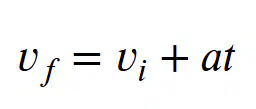
If I want to solve the problem for initial velocity, how can I rearrange this formula?
divide both sides by at
divide both sides by "initial velocity"
subtract "initial velocity" from both sides
subtract "at" from both sides
A car accelerates at a rate of 2.0 m/s2. Assuming the car starts from rest, how much time does it need to reach a speed of 20. m/s? (pick the information you need to solve the problem)
an equation with a, initial velocity, and final velocity
an equation with distance, mass, and time
an equation with friction force, mass, and time
an equation with time, final velocity , and mass
A passenger in a biplane drops a ball, and it falls freely from rest to the ground. What is the speed of the ball after falling a distance of 20 m, assuming the acceleration due to gravity is equal to 9.81 m/s2? (you need an equation with ______________)
a, d, t, and final velocity
a, m, d, and final velocity
a, p, t, and final velocity
a, d, initial velocity, and vinal velocity
A 80-kg skater skates across a flat sheet of ice at a constant speed of 6.0 m/s. What is the kinetic energy of the skater? (you need a formula with the following variables ________)
KE, final velocity, initial velocity
mass, velocity, and PE
mass, velocity, and KE
PE, velocity and momentum
you are trying to find the velocity, radius of .5 mm, and 25 sec. Which formula can you use?
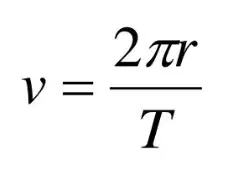
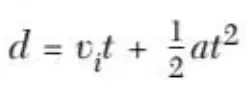
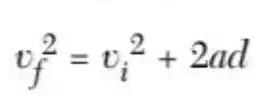

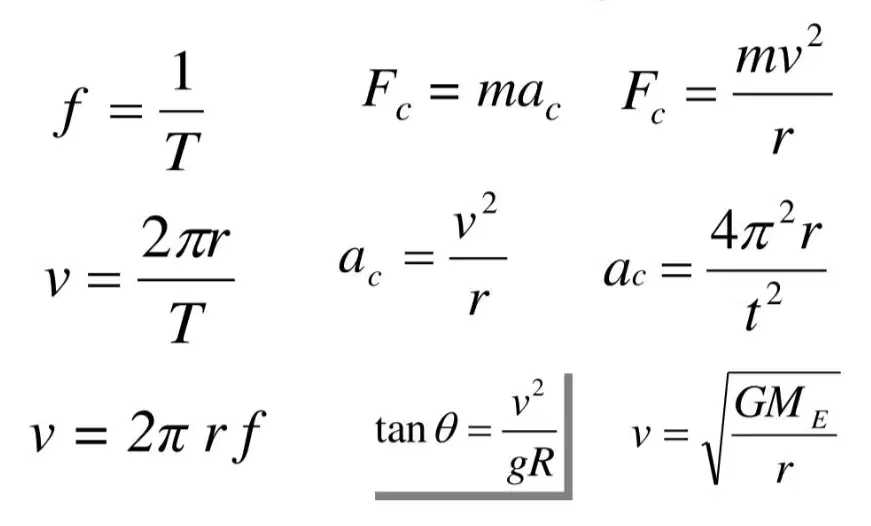
you're given a radius of 2.5 cm and 33 sec, which variables can you solve for?
velocity and frequency
acceleration and Force
frequency and acceleration
velocity and acceleration
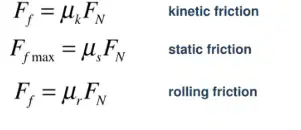
Which variables do you need to be provided to you if you want to solve for kinetic friction?
mu for kinetic friction
normal force
both mu for kinetic friction and normal force
you can't solve for kinetic friction


Which type of force resists motion?
Friction
Gravity
Pull
Push


In the diagram below, a girl sits on a sled and slides down a hill of snow. Which arrow represents the force of friction opposing the motion of the sled down the hill?
Arrow A
Arrow B
Arrow C
Arrow D

What is the kinetic energy of a 26 kg eagle, flying at an altitude of 65 m at a speed of 19 m/s?
32,110 J
16,055 J
4693 J
247 J
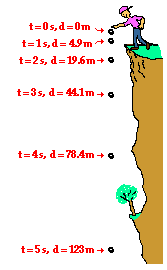

A textbook is dropped from a second floor window and falls to the ground. What happens to the acceleration as the book falls to the ground
the acceleration increases
the acceleration decreases
the acceleration remains constant
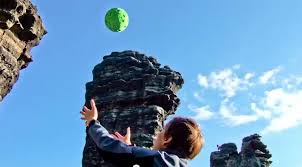
A baseball is thrown up into the air. What happens to the velocity as the ball rises in the air?
the velocity increases
the velocity decreases
the velocity remains constant

A baseball is thrown up into the air. What happens to the acceleration as the ball rises in the air?
the acceleration increases
the acceleration decreases
the acceleration remains constant
The acceleration due to gravity near the surface of Earth is equal to
9.8 m/s
9.8 kg x m/s
9.8 N
9.8 m/s2
An object in free fall
ignores air resistance.
undergoes a downward acceleration.
has an acceleration of -9.8 m/s2.
all of these.
Ball A is dropped from rest from a window. At the same instant, ball B is thrown downward; and ball C is thrown upward from the same window. Which statement concerning the balls after their release is necessarily true if air resistance is neglected?
At some instant after it is thrown, the acceleration of ball C is zero.
All three balls have the same initial velocity.
All three balls have the same velocity at any instant.
All three balls have the same acceleration at any instant.
Heavier objects free fall faster than lighter objects.
True
False
1. In analyzing freely falling bodies, we neglect the effect of ___ to the object.
A. gravity
B. air resistance
C. gravity and air resistance
D. all forces except air resistance
2. A freely falling object's motion is under the sole influence of ____.
A. gravity
B. air resistance
C. gravity and air resistance
D. applied forces such as a persons push or pull
The momentum of an object depends upon the object's ___________&_____________.
size and shape
mass and speed
mass and veloctiy
mass and energy

After collision, the two objects move off with different velocity. What type of collision is this?
Inelastic
Elastic
Which is newtons first law states
An object at rest will remain at rest unless a force is applied
An object is moving
An object has stopped
An moving object will keep going when a force is applied to it
Which is newtons 3rd law
for every thing there is reaction
for every reaction there is a unusual action
For every reaction there is an equal and opposite reaction
for every reaction there is an good action
Which is newtons 2nd law
Acceleration is a change in speed
Acceleration is a change in action
Acceleration is a change in name
Acceleration is a change in velocity
What is an example of newtons 2nd law
sleeping
velocity
driving
sitting
What is an example of newtons 3rd law
running
car crash
high five
walking
Which type of force(s) will cause a change in an object's motion?
gravity
balanced forces
unbalanced force
net force
Newton's third law states that any action will have a(n) _______ and ______ reaction
equal and same
equal and opposite
equal and equal to
What are the appropriate units to describe acceleration?
m/p
m/h
m/s
m/s square
The tendency of objects to resist a change in motion is called:
Friction
Inertia
Gravity
Velocity
In referring to how much matter a body contains, we use the term:
Volume
Weight
Mass
If an object has twice as much mass as another, then it also has twice as much:
Area
Center of gravity
Weight
Acceleration


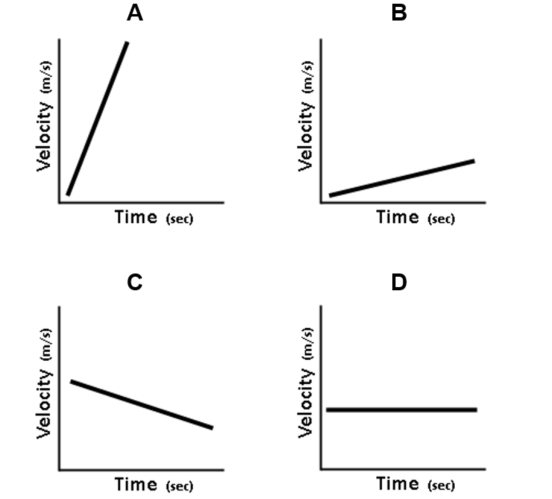
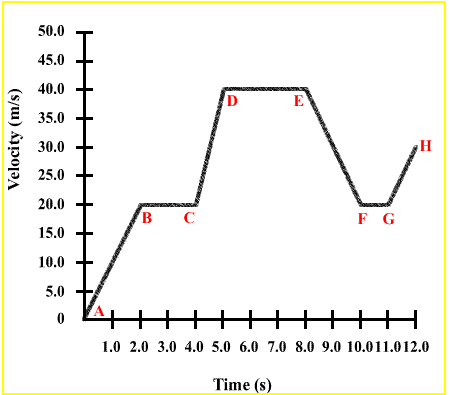
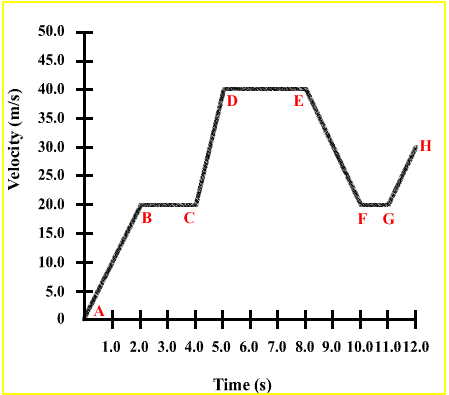

What is happening at segment E?
acceleration
deceleration
constant speed
no motion/object at rest
What is happening at segment A?
acceleration
deceleration
constant speed
no motion/object at rest
What is happening at segment D?
acceleration
deceleration
constant speed
no motion/object at rest


