
 Worksheets
Geometry A Final Exam Review
Total questions: 113
Worksheet time: 9hrs 15mins
Simplify and write the resulting polynomial in standard form. Then classify (name) by degree and number of terms: 35+30x3−30x2+25x−25x2−42x .
30x3−55x2+17x+35 , cubic polynomial (4 terms)
30x3−55x2−17x , cubic trinomial
30x3−5x2−17x+35 , cubic polynomial (4 terms)
30x3−55x2−17x+35 cubic polynomial (4 terms)
Simplify and write the resulting polynomial in standard form. Then classify (name) by degree and number of terms: −x3+2x−4x2+7+3x3+4x−2x3 .
−4x2+6x+7 , quadratic trinomial
−4x2+6x+7 , quadratic binomial
−x3−4x2+6x+7 , cubic polynomial (4 terms)
4x2+6x+7 , quadratic trinomial
Add or subtract the given polynomials. Write the resulting polynomial in standard form. Then classify (name) by degree and number of terms: (5x2−8x−3)+(2x+7−6x2) .
−x2−6x+4 , quadratic trinomial
x2−6x+4 , quadratic trinomial
−x2+6x−4 , quadratic trinomial
−x2−6x−4 , quadratic trinomial
Add or subtract the given polynomials. Write the resulting polynomial in standard form. Then classify (name) by degree and number of terms: (2x2−8x+2)+(5+x2) .
3x2−8x+7 , quadratic trinomial
x2−8x+7 , quadratic trinomial
3x2+8x+7 , quadratic trinomial
3x2−8x−7 , quadratic trinomial
Add or subtract the given polynomials. Write the resulting polynomial in standard form. Then classify (name) by degree and number of terms: (7x2+3x+5)−(3x2+x+1) .
4x2+2x+4 , quadratic trinomial
4x2+4x+2 , quadratic trinomial
10x2+2x+4 , quadratic trinomial
4x2−2x+4 , quadratic trinomial
Add or subtract the given polynomials. Write the resulting polynomial in standard form. Then classify (name) by degree and number of terms: (4x2+2x+9)−(6x2+7x+8) .
−2x2−5x+1 , quadratic trinomial
2x2−5x+1 , quadratic trinomial
−2x2+5x+1 , quadratic trinomial
−2x2−5x−1 , quadratic trinomial
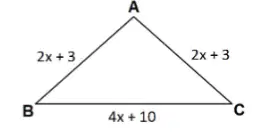
Find the perimeter of the given polynomials. Triangle ABC has sides labeled 2x+3 , 2x+3 , and 4x+10 . Find the perimeter.
8x+16
8x+10
6x+16
4x+13
Find the perimeter of the Rectangle with side lengths of (x+3) and (3x+8) . Label the rectangle and find the perimeter.
8x+22
4x+11
6x+14
8x+11
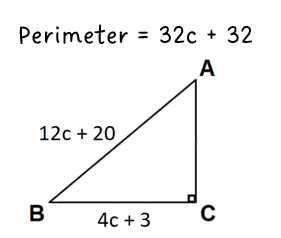
The perimeter of the triangle is (32c+32) . How tall is the triangle’s side length AC?
16c+9
20c+9
16c+29
12c+9
A square has a side length of 3z−2 . Find the perimeter of the square.
12z−8
9z−6
6z−4
3z−2
Multiply the given polynomials. Write the result in standard form: 5x(6x−5) .
30x2−25x
30x−25x2
11x2
30x2+25x
Multiply the given polynomials. Write the result in standard form: 7(4x2+3x+5) .
28x2+21x+35
28x2+3x+5
28x3+21x+35
4x2+3x+35
Multiply the given polynomials. Write the result in standard form: (7x−6)(5x+2) .
35x2−16x−12
35x2+16x−12
12x2−16x+35
35x2−16x+12
Multiply the given polynomials. Write the result in standard form: (3x+2)(7x2+9x+4) .
21x3+41x2+30x+8
21x3+27x2+12x+8
21x2+41x2+30x+8
21x3+41x+30x2+8
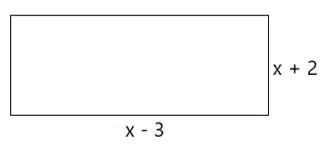
Find the area of this rectangle. A=(b)(h) . The rectangle has base x−3 and height x+2 .
x2−x−6
x2+x−6
x2−5
x2−x+6

Find the area of the given shapes. A rectangle has side lengths of (x−5) and (8x−8) . Label the rectangle below and find the area of the rectangle. A=(b)(h) .
8x2−48x+40
8x2−13x−40
8x2−40
8x2−48x−40
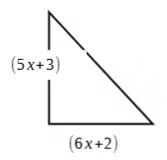
Find the area of the right triangle shown. A=21bh . The legs are labeled (5x+3) and (6x+2) .
15x2+14x+3
30x2+28x+6
15x2+5x+9x+3
15x2
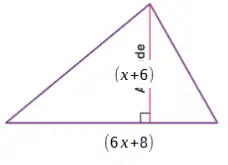
Find the area of the triangle shown. A=21bh . The base is labeled (6x+8) and the height is labeled (x+6) .
3x2
6x2+44x+48
3x2+22x+24
3x2+4x+18x+24
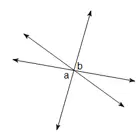
Identify the relationship between ∠a and ∠b
alternate exterior angles
alternate interior angles
vertical angles
linear pair
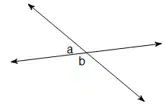
Identify the relationship between ∠a and ∠b
alternate exterior angles
alternate interior angles
vertical angles
linear pair
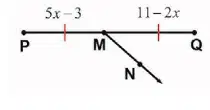
MN bisects PQ Find the value of x.
1
2
3
4

Line LM bisects PQ . Find the value of x.
7.5
9
6
12
M is the midpoint of PQ. If PM = 6x + 7 and MQ = 9x − 8, find the length of PQ.
64
70
74
80
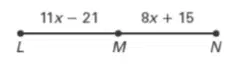
M is the midpoint of LN. Which set of values is correct for x, LM, and MN?
x = 12, LM = 111, MN = 111
x = 9, LM = 78, MN = 78
x = 6, LM = 45, MN = 57
x = 15, LM = 144, MN = 120
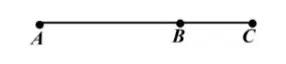
Find BC if B is between A and C, AC = 25, and AB = 11.
12
14
15
36
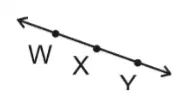
Find WX if X is between W and Y, XY = 20, and WY = 50.
25
30
20
35
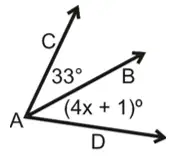
AB bisects ∠CAD . Find the value of x.
4
8
33
5
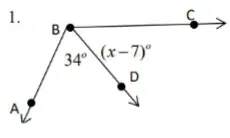
BD bisects ∠ABC. In the diagram, m∠ABD = 34° and m∠DBC = (x − 7)°. Find the value of x.
27
34
41
48
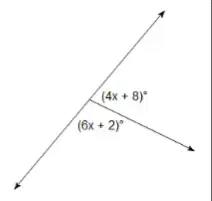
Find the value of x. The two adjacent angles form a straight line and are labeled (4x + 8)° and (6x + 2)°.
14
16
17
18
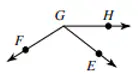
m∠HGF=16x+4 , m∠EGF=110° , and m∠HGE=3x+11
Find x.
33
9
5
24
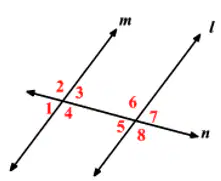
Name the relationship between ∠1 and ∠3 in the diagram shown.
Same side interior angles
vertical angles
corresponding angles
alternate exterior angles
Name the relationship between ∠3 and ∠7 in the diagram shown.
Same side interior angles
vertical angles
corresponding angles
alternate exterior angles
Name the relationship between ∠4 and ∠6 in the diagram shown.
Same side interior angles
alternate interior angles
corresponding angles
alternate exterior angles
Name the relationship between ∠4 and ∠5 in the diagram shown.
Same side interior angles
alternate interior angles
corresponding angles
alternate exterior angles
Name the relationship between ∠1 and ∠7 in the diagram shown.
Same side interior angles
vertical angles
corresponding angles
alternate exterior angles
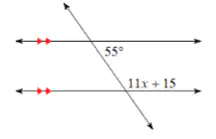
Find the value of x.
10
5
25
20
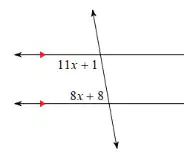
Find the value of x.
9
7
2
3
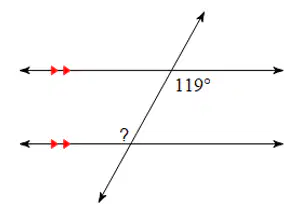
Find the missing (?) angle.
119°
61°
122°
78°
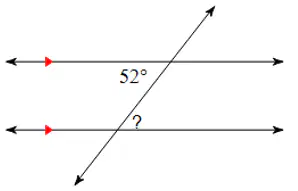
Find the missing (?) angle.
128°
38°
52°
98°
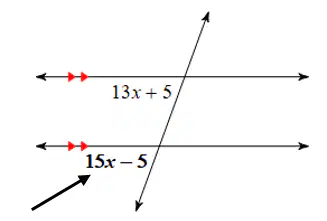
Solve for x.
Then find the measure of the angle indicated by the arrow.
60°
65°
70°
75°
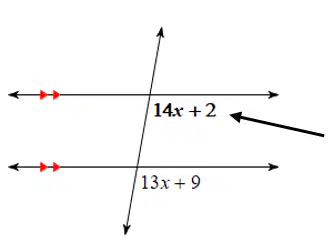
Solve for x. Then find the measure of the angle indicated by the arrow.
100°
80°
70°
110°
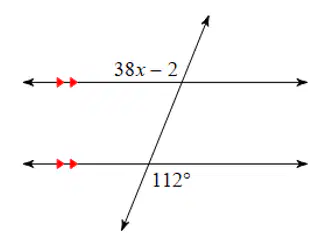
Find the value of x.
4
5
3
6
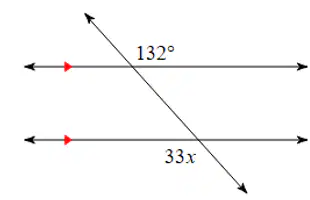
Find the value of x.
4
5
6
3
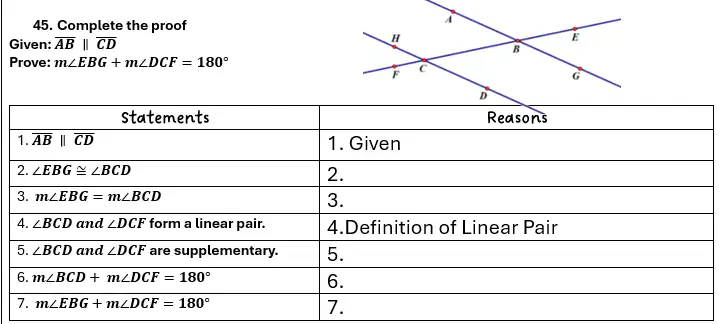
Complete the two-column proof by matching the correct reasons to the statements.
∠EBG≅∠BCD
Corresponding Angles Theorem
m∠EBG=m∠BCD
Definition of Congruent
∠BCD and ∠DCF are supplementary
Linear Pair Theorem
m∠BCD+m∠DCF=180°
Definition of Supplementary
m∠EBG+m∠DCF=180°
Substitution Property
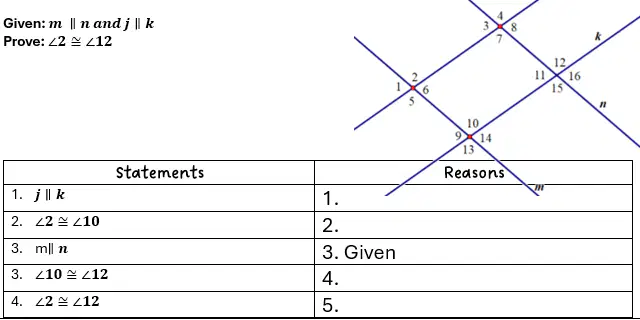
Complete the two-column proof by matching the correct reasons to the statements.
j ∥ k
Given
∠2≅∠10
Corresponding Angles Theorem
∠10≅∠12
Corresponding Angles Theorem
∠2≅∠12
Transitive Property
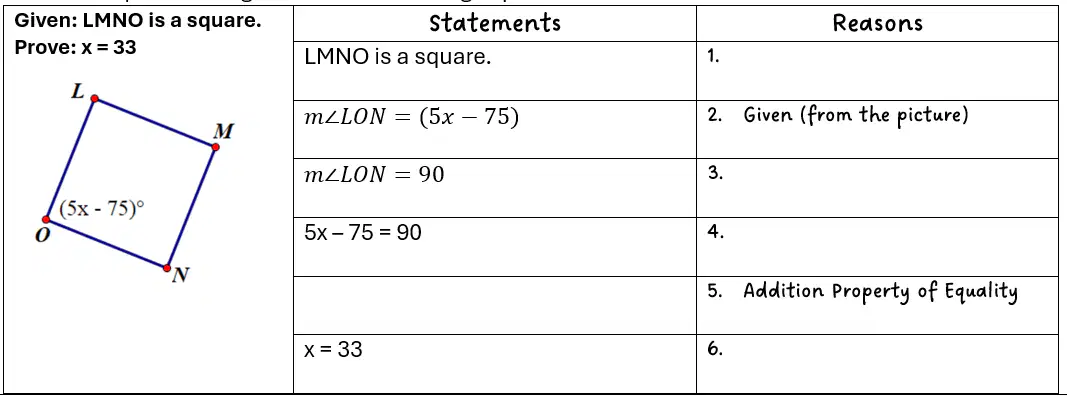
Complete the proof by matching the correct information for each blank.
LMNO is a square
Given
m∠LON=90°
A square has 4 right angles
5x - 75 = 90
Substitution property
5x = 165
Addition Property
x = 33
Division Property
Using the quadrilateral properties chart, choose all statements that are always true for a rectangle.
Opposite sides are parallel.
Opposite sides are congruent.
All four angles are congruent.
Diagonals bisect each other.
Diagonals are congruent.
Using the quadrilateral properties chart, choose all statements that are always true for a rhombus.
Opposite sides are parallel.
All four sides are congruent.
Diagonals bisect opposite angles.
Diagonals are perpendicular.
All four angles are congruent.
Using the quadrilateral properties chart, choose all statements that are always true for a square.
All four sides are congruent.
All four angles are congruent.
Diagonals are congruent.
Diagonals are perpendicular.
Opposite sides are not parallel.
Using the quadrilateral properties chart, choose all statements that are always true for a parallelogram.
Opposite angles are congruent
Diagonals bisect each other.
Diagonals are congruent.
Consecutive angles are supplementary.
Opposite sides are parallel and congruent.
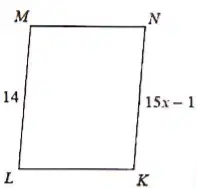
Solve for x.
1
2
3
4
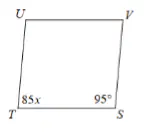
Solve for x.
1
2
85
95
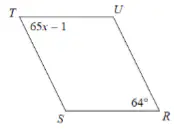
Solve for x.
1
9
2
5
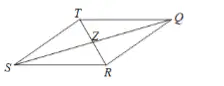
In parallelogram STRQ, the diagonals intersect at Z. If RT = 12 and ZT = x − 2, find x.
6
8
10
12
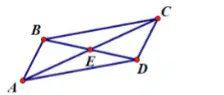
ABCD is a parallelogram. Which side is congruent to AB?
BC
CD
AD
AC
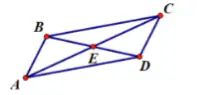
ABCD is a parallelogram. Which side is congruent to BC?
AB
CD
AD
BD
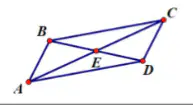
ABCD is a parallelogram. Which segment is congruent to AE?
BE
CE
DE
AB
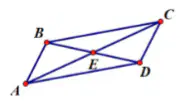
In parallelogram ABCD, which angle is congruent to ∠ABC?
∠BAD
∠CDA
∠BCD
∠BEA
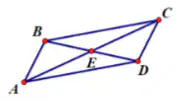
In parallelogram ABCD, which angle is congruent to ∠BEA?
∠CED
∠BEC
∠AED
∠ABC
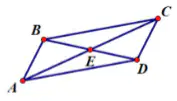
In parallelogram ABCD, what is the value of m∠BAD + m∠CDA?
90∘
120∘
180∘
360∘

In parallelogram FGHI, solve x, y, and z.
x = 38, y = 75, z = 75
x = 38, y = 75, z = 67
x = 38, y = 67, z = 75
x = 38, y = 75, z = 105
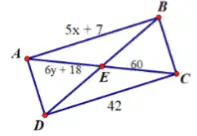
ABCD is a rectangle. Find x.
7
14
21
28
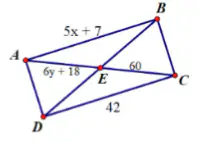
ABCD is a rectangle. Find y.
7
5
10
12
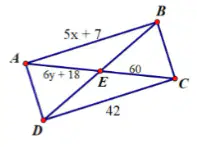
In the rectangle from the diagram, find BD.
60
120
30
150
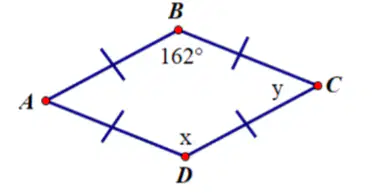
ABCD is a rhombus. Solve for x.
18
36
81
162
ABCD is a rhombus. Solve for y.
18
36
81
162
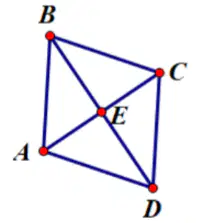
ABCD is a rhombus. What is m ∠ BEC?
180
90
45
15
ABCD is a rhombus. What is m ∠ CEA?
180
90
45
15
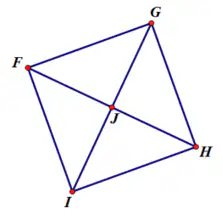
FGHI is a square. What is m ∠ FIJ?
180
90
45
30
FGHI is a square. What is m ∠ JHG?
180
90
45
30
FGHI is a square. What is m ∠ FJG?
180
90
45
30
FGHI is a square. If GJ = 4 cm, what is JI?
4
8
2
12
FGHI is a square. If GJ = 4 cm, what is FJ?
4
8
2
12
FGHI is a square. If GJ = 4 cm, what is FH?
4
8
2
12
Quadrilateral ABCD has the following ordered pairs: A: (-3, 1) B: (4, 2) C: (9, -3) D: (2, -4). Using the distance formula d=(x2−x1)2+(y2−y1)2 , find the length of AB .
26
52
50
7
Quadrilateral ABCD has the following ordered pairs: A: (-3, 1) B: (4, 2) C: (9, -3) D: (2, -4). Using the slope formula m=x2−x1y2−y1 , find the slope of BC .
−1
1
45
−54
Quadrilateral ABCD has the following ordered pairs: A: (-3, 1) B: (4, 2) C: (9, -3) D: (2, -4). Using the midpoint formula (2x1+x2,2y1+y2) , find the midpoint of CD .
(211,−27)
(27,−211)
(6,−2)
(3,−1)
Quadrilateral ABCD has the following ordered pairs: A: (-3, 1) B: (4, 2) C: (9, -3) D: (2, -4). Using the distance formula d=(x2−x1)2+(y2−y1)2 , find the length of diagonal AC .
410
136
160
85
Quadrilateral ABCD has the following ordered pairs: A: (-3, 1) B: (4, 2) C: (9, -3) D: (2, -4). Using the slope formula m=x2−x1y2−y1 , find the slope of diagonal BD .
−3
31
3
−23
Quadrilateral ABCD has the following ordered pairs: A: (-3, 1) B: (4, 2) C: (9, -3) D: (2, -4). Using the midpoint formula (2x1+x2,2y1+y2) , find the midpoint of AC .
(0,−1)
(3,−1)
(3,1)
(0,1)
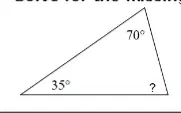
Solve for the missing angle (?) in the triangle shown.
55∘
65∘
75∘
85∘
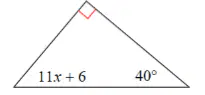
What is the value of x?
3
25
50
4
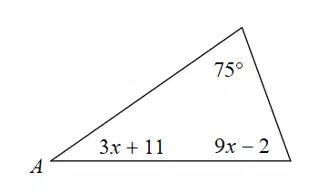
Solve for x. Then find the measure of Angle A.
x = 8, m<A = 35
x = 8, m<A = 70
x = 5, m<A = 26
x = 5, m<A = 43
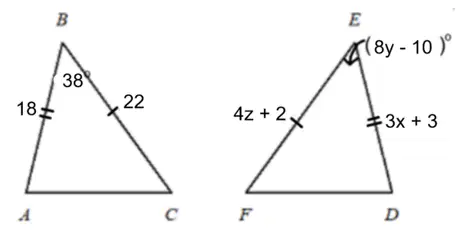
Solve for x.
4
5
6
7
Solve for y.
4
5
6
7
Solve for z.
4
5
6
7
Given △ABC≅△XYZ . Which side is congruent to CA ?
ZX
XY
YZ
XZ
Given △ABC≅△XYZ . Which angle is congruent to ∠Y ?
∠A
∠B
∠C
∠X
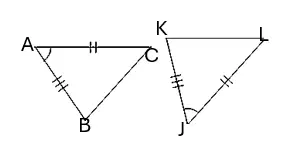
What criterion would prove △ABC≅△ADC ?
SSS
SAS
ASA
AAS
HL
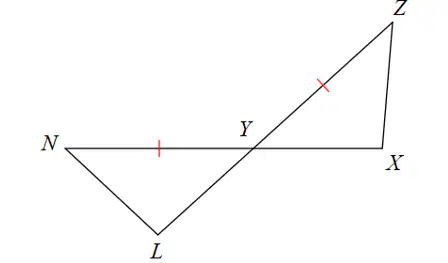
Given NY ≅ ZY , what additional information is needed to prove △LNY≅△XZY by SAS? (which pair of sides or angles?)
YL ≅ YX
NL ≅ ZX
∠L ≅ ∠X
∠N ≅ ∠Z
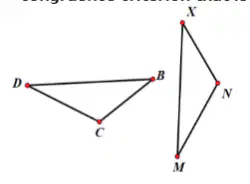
Mark the triangles using the given information.
∠D ≅ ∠M; DC ≅ MN; BD ≅ XM
How are the triangles congruent?
SSS
SAS
ASA
AAS
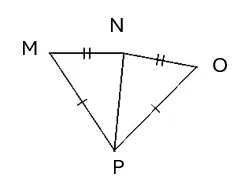
The triangles shown are congruent by what criterion?
SSS
SAS
ASA
AAS
HL
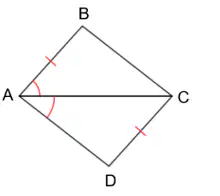
The triangles shown are congruent by what criterion?
Not congruent
SAS
ASA
AAS
HL
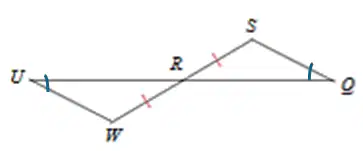
The triangles shown are congruent by what criterion?
Not congruent
SAS
ASA
AAS
HL
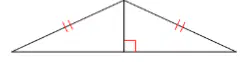
The triangles shown are congruent by what criterion?
SSS
SAS
ASA
AAS
HL
What is the image of the point (−9, 0) after a reflection over the x-axis?
(−9, 0)
(9, 0)
(0, 9)
(0, -9)
What is the image of the point (−8, 2) after a reflection over the y-axis?
(−8, −2)
(8, 2)
(−8, 2)
(8, −2)
What is the image of the point (0, −8) after a reflection over the line y = x?
(−8, 0)
(8, 0)
(0, 8)
(0, −8)
What is the image of the point (−2, 5) after a translation right 3 units and up 4 units?
(1, 9)
(−5, 9)
(1, 1)
(−5, 1)
What is the image of the point (0, −5) after a translation left 5 units and down 2 units?
(5, −3)
(−5, −7)
(−5, −3)
(5, −7)
What is the image of the point (6, 8) after a translation right 5 units and down 3 units?
(1, 11)
(11, 5)
(11, −5)
(−1, 5)
What is the image of the point (−8, 0) after a rotation of 180° clockwise about the origin?
(−8, 0)
(0, −8)
(8, 0)
(0, 8)
What is the image of the point (−1, 2) after a rotation of 270° counterclockwise about the origin?
(−2, −1)
(2, 1)
(−1, −2)
(1, −2)
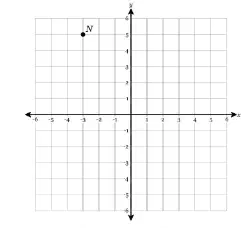
The point N is plotted on a coordinate grid. When a point is reflected over the x-axis, which coordinate changes sign?
x-coordinate
y-coordinate
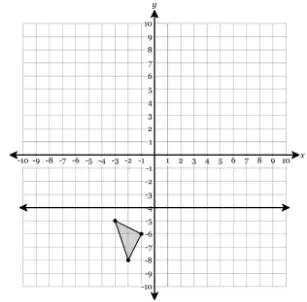
When the figure is reflected over the line y = -4 as shown in the picture, what are coordinates of the point whose original coordinates were (-3, -5)?
(-3, -4)
(-3, -3)
(-4, -3)
(-5, -3)
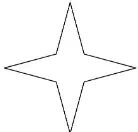
If the star-shaped figure does have rotational symmetry, what is the smallest possible rotation that maps the figure onto itself?
90°
120°
180°
45°
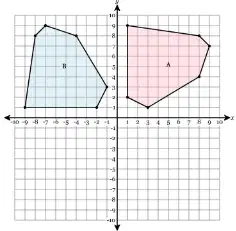
Which transformation would take Shape A to Shape B?
A reflection over the y-axis
A reflection over the x-axis
A clockwise rotation of 90° about the origin
A clockwise rotation of 270° about the origin
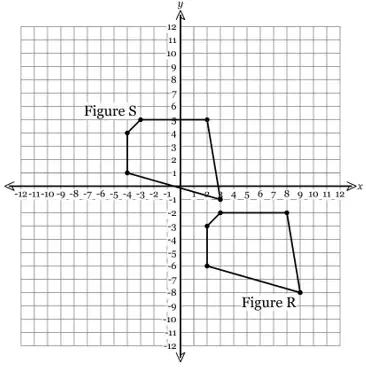
Which transformation would take Figure R onto Figure S?
A translation right 6 and down 7
A translation left 6 and up 7.
A translation right 7 and down 6.
A translation left 7 and up 6.
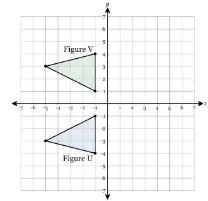
Figure V is the result of a transformation on Figure U. Which transformation would accomplish this?
A rotation 180° clockwise about the origin
A reflection over the y-axis
A reflection over the x-axis
A translation 2 units up
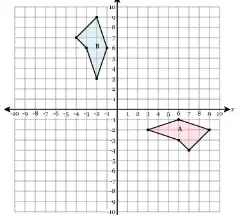
Which transformation would take Shape A to Shape B?
A counterclockwise rotation of 90° about the origin
A reflection over the line y = −x
A reflection over the line y = x
A counterclockwise rotation of 180° about the origin
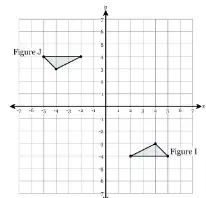
Figure J is the result of a transformation on Figure I. Which transformation would accomplish this?
A reflection over the x-axis
A translation 4 units to the left and 8 units up
A rotation 180° clockwise about the origin
A rotation 90° counterclockwise about the origin
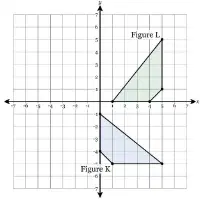
Figure L is the result of a transformation on Figure K. Which transformation would accomplish this?
A translation 4 units to the left and 4 units down
A rotation 180° clockwise about the origin
A rotation 90° clockwise about the origin
A rotation 90° counterclockwise about the origin
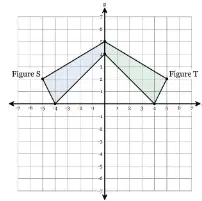
Figure T is the result of a transformation on Figure S. Which transformation would accomplish this?
A rotation 90° clockwise about the origin
A reflection over the y-axis
A reflection over the x-axis
A rotation 90° counterclockwise about the origin

