wayground logo

Free Printable Worksheets

Font size

S
M
L
XL
Worksheets

Geometry Semester 1 Exam Review - Mrs. Powers

Total questions: 114

Worksheet time: 10hrs 30mins

Name
Class
Date
1.

Points that lie on the same line

a)

Space

b)

Collinear Points

c)

Bisector

d)

Coplanar Points

2.

An undefined term in Geometry. A connected straight path. It has no thickness and it continues forever in both directions.

a)

Endpoints

b)

Midpoint

c)

Line

d)

Segment Bisector

3.

Points or lines all in one plane.

a)

Ray

b)

Collinear

c)

Point

d)

Coplanar

4.

The point that divides the segment into two segments that have the same length.

a)

Coplanar

b)

Midpoint

c)

Ray

d)

Line

5.

A portion of a line consisting of two points (endpoints) and all points between them.

a)

Line

b)

Point

c)

Line Segment

d)

Collinear Points

6.

Two segments that have the same length.

a)

Line Segment

b)

Parallel

c)

Coplanar

d)

Congruent Segments

7.

An undefined term in Geometry. A flat surface. It has no thickness and it extends forever in all directions.

a)

Plane

b)

Line

c)

Point

d)

Ray

8.

Lines in the same plane that do not intersect.

a)

Bisector

b)

Collinear

c)

Coplanar

d)

Parallel Lines

9.

A line, ray or segment that divides a segment into two congruent segments.

a)

Ray

b)

Midpoint

c)

Bisector

d)

Plane

10.
An angle with measure between 90° and 180
a)
Acute angle
b)
Obtuse angle
c)
Right angle
d)
Straight angle
11.
An angle with measure equal to 180°
a)
Straight angle
b)
Supplementary angle
c)
Linear pair
d)
Obtuse angle
12.
Two angles whose measures have the sum 180°
a)
Complentary angles
b)
Supplementary angles
c)
Obtuse angle
d)
Straight angle
13.
Two angles whose sides form two pairs of opposite rays
a)
Vertical angles
b)
Adjacent angles
c)
Straight angle
d)
Linear Pair
14.
An angle with measure between 0° and 90°
a)
Acute angle
b)
Complementary angle
c)
Right angle
d)
Adjacent angle
15.
The point where two rays, segments, etc. come together
a)
Midpoint
b)
Ray
c)
Vertex
d)
Intersection
16.
Two angles that share a common vertex and side, but have no common interior points
a)
Supplementary angles
b)
Complementary angles
c)
Adjacent angles
d)
Vertical angles
17.
Two angles whose measures have the sum 90°
a)
Complementary angles
b)
Right angle
c)
Supplementary angles
d)
Adjacent angles
18.
Two adjacent angles whose noncommon sides are opposite rays
a)
Linear pair
b)
Adjacent angles
c)
Supplementary angles 
d)
Vertical angles
19.

If angle DCA is 125 degrees, what is the measure of angle DCB?

a)

50 degrees

b)

60 degrees

c)

55 degrees

d)

65 degrees

20.

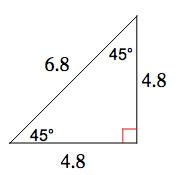
Name this shape

a)

Isosceles triangle

b)

Acute triangle

c)

Scalene triangle

d)

Equilateral triangle

21.

What are lines that intersect to form a right angle called?

a)

Interesecting lines

b)

Line segment

c)

Perpendicular lines

d)

Lines

22.

Two parallel lines intersect.

a)

True

b)

False

23.

A ray has one endpoint.

a)

True

b)

False

24.

Perpendicular lines DO NOT form right angles.

a)

True

b)

False

25.

If RT=36, find the value of x.

a)

3

b)

4

c)

5

d)

6

26.
What does the word BISECT mean?
a)
To cut something into more than five pieces.
b)
It is a plane with two sets of wings.
c)
A shape that has three sides. 
d)
To cut something into two congruent pieces or in half.
27.

If T is the midpoint of SU, find x.

a)

3

b)

4

c)

5

d)

2

28.

If DF=9x-39, find EF.

a)

16

b)

58

c)

116

d)

23

29.
a)

x = 6°

b)

x = 7°

c)

x = 12°

d)

x = 144°

30.
a)

x = 5°

b)

x = 11°

c)

x = 33°

d)

x = 55°

31.

If m∠RST = (12x -1)°, m∠RSU = (9x -15)°,

and m∠UST = 53°, find each measure.

a)

x = 13

m∠RST = 155°

m∠RSU = 102°

b)

x = 3

m∠RST = 35°

m∠RSU = 12°

c)

x = 22

m∠RST = 263°

m∠RSU = 183°

d)

x = 8

m∠RST = 95°

m∠RSU = 57°

32.

∠1 and ∠2 form a linear pair.

If m∠1 = (5x + 9)° and m∠2 = (3x + 11)°, find the measure of each angle.

a)

m∠1 = 110° and m∠2 = 70°

b)

m∠1 = 109° and m∠2 = 71°

c)

m∠1 = 70° and m∠2 = 110°

d)

m∠1 = 71° and m∠2 = 109°

33.

∠K and ∠L are complementary angles.

If m∠K = (3x + 3)° and m∠L = (10x -- 4)°, find the measure of each angle.

a)

m∠K = 24° and m∠L = 66°

b)

m∠K = 66° and m∠L = 24°

c)

m∠K = 40° and m∠L = 50°

d)

m∠K = 30° and m∠L = 60°

34.

A(3,1) B(-2,-1) written correctly is:

a)

(23)2 + (11)2\sqrt{\left(-2-3\right)^2\ +\ \left(-1-1\right)^2}

b)

(13)2 + (12)2\sqrt{\left(1-3\right)^2\ +\ \left(-1-2\right)^2}

c)

(23)2  (11)2\sqrt{\left(-2-3\right)^2\ -\ \left(-1-1\right)^2}

d)

(23)2  (11)2\sqrt{\left(-2-3\right)^2\ -\ \left(-1-1\right)^2}

35.
Find the distance between (-12, 1) and (12, -1).
a)
24.05
b)
24.06
c)
24.07
d)
24.08
36.
Find the distance between (-5, -8) and (-1, -16).
a)
8.9
b)
9.8
c)
10.3
d)
11
37.
What is the midpoint between (3, -1) and (7, -5)
a)
(5, -2)
b)
(10, -6)
c)
(5, -3)
d)
(2, -2)
38.
What is the midpoint between (-4,4) and (-2,2)?
a)
(3,2)
b)
(-3,3)
c)
(4,5)
d)
(6,7)
39.
Point M with coordinates (3,4) is the midpoint of the line AB and A has the point (-1,6). What is the point of B?
a)
(1,5)
b)
(2,10)
c)
(7,2)
d)
(1,2)
40.

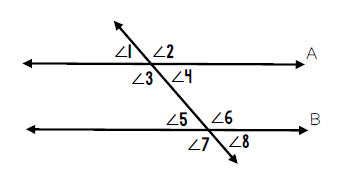
Angle 3 and Angle 6 are examples of which type of angle pair?

a)

Alternate exterior angles

b)

Alternate interior angles

c)

Vertical angles

d)

Corresponding angles

41.

Angle 1 and Angle 5 are examples of which type of angle pair?

a)

Alternate exterior angles

b)

Alternate interior angles

c)

Vertical angles

d)

Corresponding angles

42.

Angle 6 and Angle 7 are examples of which type of angle pair?

a)

Alternate exterior angles

b)

Alternate interior angles

c)

Vertical angles

d)

Corresponding angles

43.

Which of the following is NOT an example of supplementary angles?

a)

7 and 8\angle7\ and\ \angle8  

b)

2 and 3\angle2\ and\ \angle3  

c)

1 and 7\angle1\ and\ \angle7  

d)

6 and 4\angle6\ and\ \angle4  

44.
Name the angle relationship.
a)
Alternate Interior
b)
Alternate Exterior
c)
Corresponding
d)
Vertical Angles
45.
a)
41°
b)
65°
c)
102°
d)
115°
46.

Find the value of x and y.

a)

x = 20 and y = 94

b)

x = 67 and y = 40

c)

x =117 and y = 63

47.
Solve for x.
a)
-11
b)
9
c)
-9
d)
10
48.
Solve for x.
a)
5
b)
12
c)
-7
d)
-6
49.

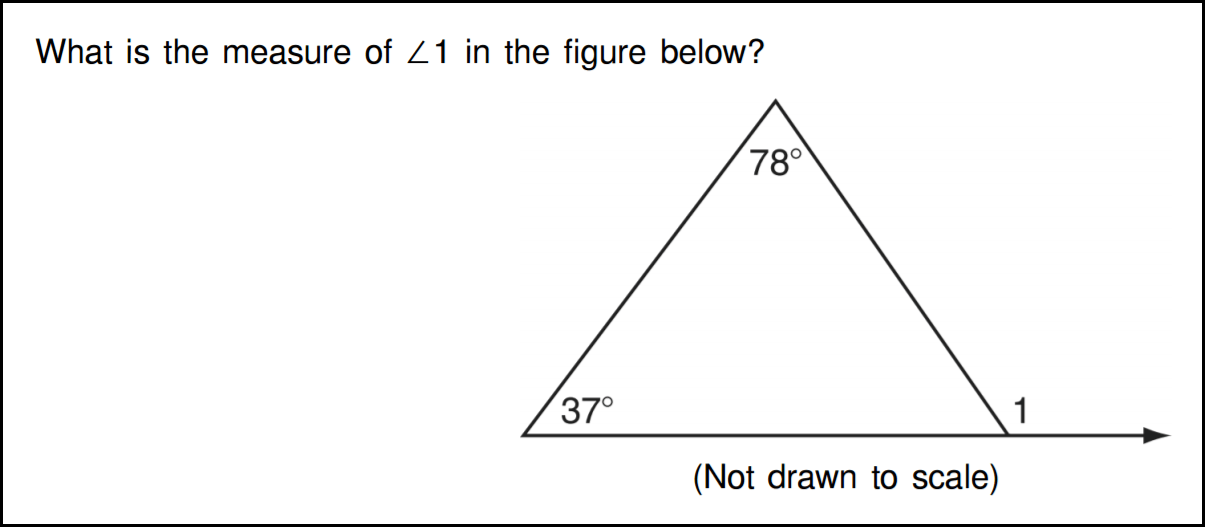
Find <S

a)

A

b)

B

c)

C

d)

D

50.
What is the measure of angle b?
a)
36o
b)
56o
c)
63o
d)
117o
51.
2x and 10x are two angles that are supplementary. What do the angles measure? (Hint: 2x + 10x = 180)
a)
30°,150°
b)
5°,10°
c)
15°, 75°
d)
90°, 180°
52.
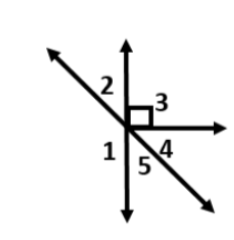
Identify the angle pair.
a)
complementary angles
b)
congruent angles
c)
linear pair
d)
vertical angles
53.
Identify the angle pair
a)
adjacent angles
b)
complementary angles
c)
consecutive angles
d)
supplementary angles
54.
Identify the angle pair.
a)
complementary angles
b)
linear pair
c)
supplementary 
d)
vertical angles
55.
Identify the angle pair.
a)
Complementary angles
b)
Congruent angles
c)
Linear Pair
d)
Vertical Angles
56.

∠7 and ∠8 are _______________

a)

Vertical

b)

Nothing

c)

Adjacent

d)

Supplementary

57.

What angle is vertical to angle 2?

a)

∠4

b)

∠1

c)

∠2

d)

∠5

58.
The sides of an equilateral triangle have...
a)
different measures.
b)
Febtober.
c)
equal measures.
d)
60°.
59.
What do the angles in an equilateral triangle measure?
a)
30, 60, 90
b)
60, 60, 60
c)
45, 45, 90
d)
35, 55, 90
60.

What is the measure of BC?

a)

12

b)

6

c)

not enough information

d)

10

61.

What is the value of x?

a)

16

b)

60

c)

8

d)

not enough information

62.
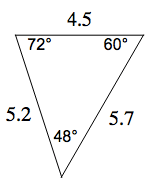
Which would be the best classification for the triangle shown?
a)
acute isosceles
b)
right scalene
c)
acute scalene
d)
obtuse scalene
63.
Which would be the best classification for the triangle shown?
a)
right isosceles
b)
obtuse scalene
c)
obtuse isosceles
d)
right scalene
64.
a)
72
b)
67
c)
65
d)
54
65.

Solve for x

 (Hint: mL=42°m\angle L=42\degree )

a)

48

b)

42

c)

90

d)

132

66.

Solve for x

a)

70

b)

40

c)

140

d)

Not enough information

67.

What are the values for x, y, z?

a)

x=47 , y=5 , z=10

b)

x=10 , y=5 , z=47

c)

x=47 , y=10 , z=5

d)

x=5 , y=47 , z=10

68.

Find the length of LM.

a)

4

b)

5

c)

3

d)

6

69.
Triangle ABC is going to be translated. How is ABC being translated if the rule (x,y) --> (x+3, y-2) is used?
a)
3 up and 2 left
b)
3 right and 2 down
c)
3 left and 2 up
d)
3 right and 2 up 
70.
Determine where T' would be if you translated T three units to the right and six units up.
a)
(5, 1)
b)
(2, -5)
c)
(-1, 1)
d)
(8, -2)
71.
Triangle ABC will be dilated by a scale factor of 1/2.  What will be the coordinates of C'?
a)
(-1, -2.5)
b)
(12, 6)
c)
(3, -1.5)
d)
(0, 1.5)
72.
Enlargement or reduction?  Find the scale factor!
a)
It's a reduction; the scale factor is 2.
b)
It's an enlargement; the scale factor is 2.
c)
It's an enlargement; the scale factor is 1/2.
d)
It's a reduction; the scale factor is 1/2.
73.

Determine how to translate triangle ABC to triangle A'B'C'.

a)

(x+2, y-5)

b)

(x-2, y+9)

c)

(x-2, y-9)

74.
How many degrees was the figure rotated?
a)
90 degrees counterclockwise 
b)
180 degrees
c)
90 degrees clockwise
75.
If you were to rotate ABCD 180°  about the origin, what would the coordinate of A' be?
a)
(-5, 5)
b)
(-3, -5)
c)
(-5, 3)
d)
(-3, 3)
76.
Rotate the point (-5,8) around the origin 270 degrees counterclockwise. State the image of the point.
a)
(-8,5)
b)
(8,-5)
c)
(8,5)
d)
(5,-8)
77.
What is the rule for the following reflection? 
a)
Reflection across       y = −1
b)
Reflection across        y = 1
c)
Reflection across            x = −1
d)
Reflection across          x = 1
78.
Point C (-5, 4) is reflected over the x-axis. What are the coordinates of C'? 
a)
(5, 4)
b)
(-5, -4)
c)
(5, -4)
d)
(-5, 4) 
79.
State if the triangles are congruent and why.
a)
Not congruent
b)
SAS
c)
ASA
d)
HL
80.
State if the triangles are congruent and why.
a)
AAS
b)
SAS
c)
ASA
d)
Not congruent
81.
State if the triangles are congruent and why.
a)
AAS
b)
SAS
c)
ASA
d)
SSS
82.
State if the triangles are congruent and why.
a)
SSS
b)
ASA
c)
AAS
d)
HL
83.
State if the triangles are congruent and why.
a)
AAS
b)
ASA
c)
Not congruent
d)
SSS
84.
State if the triangles are congruent and why.
a)
ASA
b)
AAS
c)
SAS
d)
Not congruent
85.
State if the triangles are congruent and why.
a)
HL
b)
SAS
c)
Not congruent
d)
AAS
86.
a)
A
b)
B
c)
C
d)
D
87.
a)
A
b)
B
c)
C
d)
D
88.

Does a triangle with these side lengths exist?

15, 12, 9

a)

Yes

b)

No

c)

I don't know.

d)

Cannot be determined

89.

Can the sides of a triangle have lengths 3, 4, and 9?

a)

Yes

b)

No

c)

I don't know

d)

Cannot be determined

90.
Which set of numbers may represent the lengths of the sides of a triangle?
a)
{2,5,9}
b)
{6,6,7}
c)
{6,4,2}           
d)
{7,8,1}
91.

What is the slope of a line parallel to the line whose equation is: -2x + y = - 7?

a)

-2

b)

1/2

c)

-1/2

d)

2

92.
What slope is perpendicular to:  
m = 5/8
a)
-5/8
b)
5/8
c)
-8/5
d)
8/5
93.
y = 6x + 2
y = -6x + 2
These lines are...
a)
Parallel
b)
Perpendicular
c)
Neither
94.
2x - 6y = 3
-2x + 6y = 3
Are the lines parallel or perpendicular?
Hint* get both to y = and look at slope
a)
parallel
b)
perpendicular
c)
neither
95.
What is the justification (reason)?
a)
Reflexive Property
b)
Symmetric Property
c)
Transitive Property
d)
Substitution
96.
What is the justification (reason)?
a)
reflexive property
b)
definition of segment bisect
c)
definition of a midpoint
d)
substitution property
97.
Which of the following is NOT a triangle congruence criteria?
a)
SAS
b)
AAS
c)
SSA
d)
ASA
98.
What does CPCTC stand for?
a)
Corresponding Parts of Congruent Triangles are Congruent
b)
Congruent Parts of Congruent Triangles are Corresponding
c)
Colorful Pieces of Corresponding Triangles are Congruent
d)
Congruent Pieces of Congruent Triangles are Congruent
99.
When using hypotenuse leg (HL) in a proof, you must first state ...
a)
CPCTC.
b)
there are right triangles.
c)
that vertical angles are congruent.
d)
the reflexive property.
100.
What is the missing piece of information required to prove these triangles congruent?
a)
QY ≅ QY
b)
NY ≅ PY
c)
∠N ≅ ∠P
d)
QY is the perpendicular bisector
101.

If A = B, then 8A = 8B Which of the following "reasons" fits for the statement?

a)

Multiplication POE

b)

Division POE

c)

Reflexive POE

d)

Addition POE

102.
If X = Y, then X + 5 = Y + 5
a)
Addition POE
b)
Subtraction POE
c)
Reflexive POE
d)
Transitive POE
103.
AB = AB
a)
Reflexive POE
b)
Transitive POE
c)
Symmetric POE
d)
Distributive POE
104.
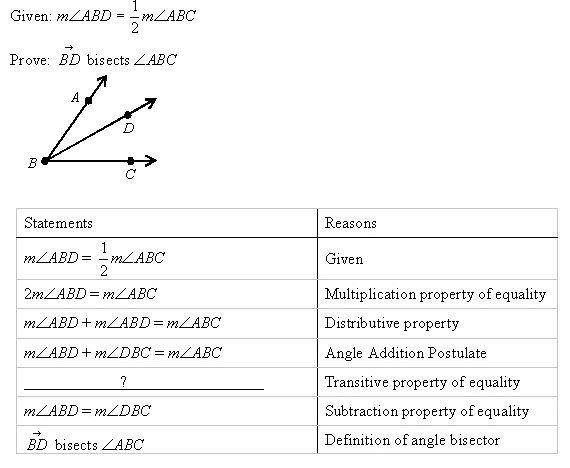
What is the missing statement in the proof?
a)
2m∠ABD=m∠ABD+m∠ABD
b)
m∠ABD=m∠DBC
c)
m∠ABC=m∠ABC
d)
m∠ABD+m∠ABD=m∠ABD+m∠DBC
105.
What is the reason?
a)
Definition of congrucent
b)
Definition of midpoint
c)
Definition of segment
d)
Segment Addition 
106.
What is the reason?
a)
Transitive 
b)
Substitution
c)
Middle Man
d)
Replacing 
107.
What is the reason?
a)
Definition of Complementary
b)
Definition of 180 
c)
Definition of supplementary
d)
Angle Addition
108.
What is the reason?
a)
Angle Addition 
b)
Segment Addition
c)
Definition of Congruence
d)
Definition of Between
109.
Name the property of equality or congruence that justifies going from the first statement to the second statement.
a)
Reflexive Property of Equality
b)
Symmetric Property of Equality
c)
Symmetric Property of Congruence
d)
Reflexive Property of Congruence
110.
Name the property of equality or congruence that justifies going from the first statement to the second statement.
a)
Associative Property
b)
Commutative Property
c)
Distributive Property
d)
Combine Like Terms
111.
Name the property of equality or congruence that justifies going from the first statement to the second statement.
a)
Reflexive Property of Congruence
b)
Symmetric Property of Congruence
c)
Distributive Property
d)
Transitive Property of Congruence
112.
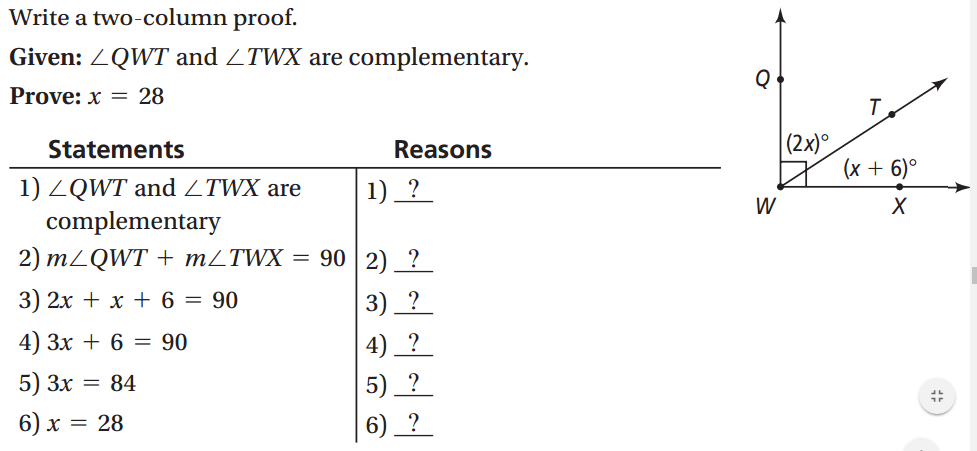
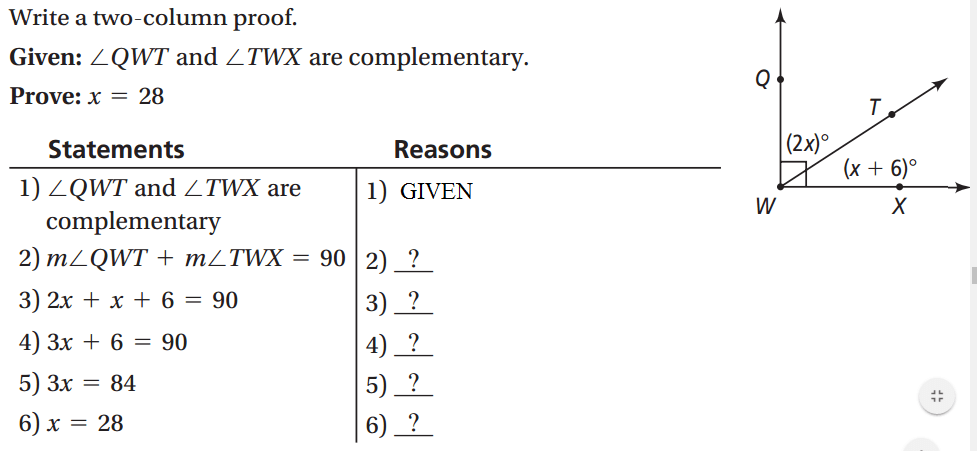
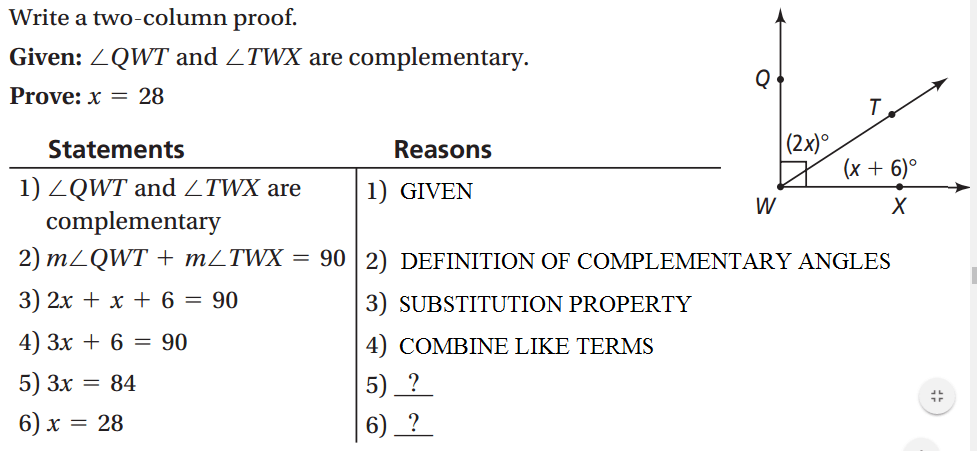
What is the REASON for Statement #1?
a)
Given
b)
Definition of Complementary Angles
c)
Substitution Property
d)
Reflexive Property of Congruence
113.
What is the REASON for Statement #2?
a)
Given
b)
Definition of Complementary Angles
c)
Substitution Property
d)
Reflexive Property of Congruence
114.
What is the REASON for Statement #5?
a)
Addition Property of Equality
b)
Subtraction Property of Equality
c)
Multiplication Property of Equality
d)
Division Property of Equality