
 Worksheets
Cycle 2 Review
Total questions: 59
Worksheet time: 30mins

Which legal principle did this 1896 Supreme Court decision affirm as constitutional?
The Three-fifths Compromise as a basis for representation.
The legality of state-enforced racial segregation under Jim Crow laws.
The use of affirmative action to promote racial equality.
The requirement for racial integration in public institutions.
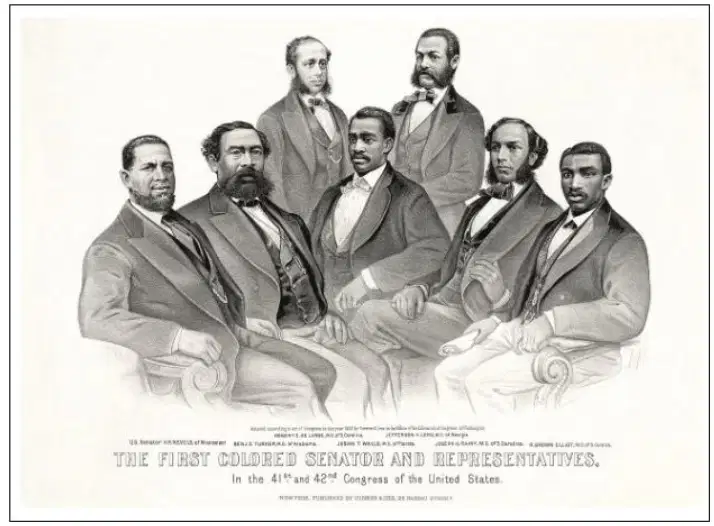
Which constitutional development most directly enabled the election of African American legislators?
The expansion of voting rights through the women’s suffrage movement.
Ratification of the 14th Amendment.
Implementation of Jim Crow laws, enforcing racial segregation in the South.
Ratification of the 15th Amendment.
Which core belief was central to the Radical Republicans within the Republican Party?
The preservation of states’ rights over federal authority.
A gradual approach to ending slavery.
Immediate and full civil rights for formerly enslaved people.
Strengthening ties with Southern Democrats.
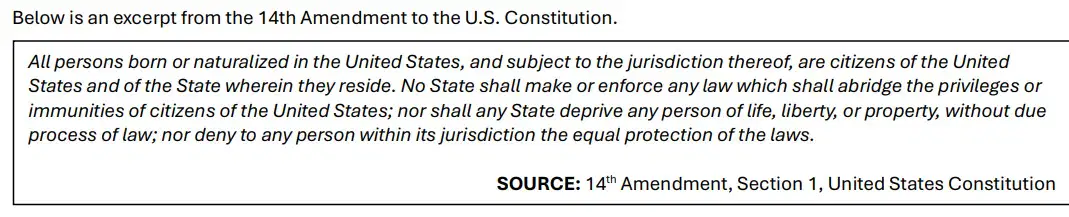
Why was this amendment primarily adopted into the U.S. Constitution in 1868?
To protect the rights of formerly enslaved persons.
To make it easier for immigrants to become citizens.
To extend suffrage to settlers on the Great Plains.
To require the federal government to pay the costs of Reconstruction.
How did the enactment of Black Codes in the South after the Civil War affect the progress of Reconstruction and the rights of newly freed African Americans?
They promoted equal access to education and employment opportunities.
They supported federal efforts to expand civil rights protections.
They created legal barriers that limited the freedoms and opportunities of African Americans.
They encouraged political participation among all citizens regardless of race.
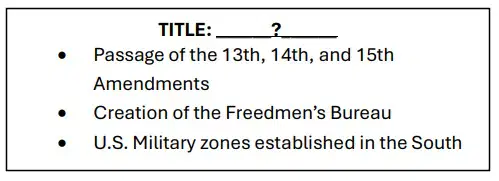
Which of the following would be the best title for the list above?
Creation of States’ Rights
Outcomes of Manifest Destiny
Elements of Reconstruction
Restrictions on Civil Rights
According to President Lincoln’s Reconstruction Plan, what condition did a Southern state need to meet to rejoin the Union?
Ratify the 15th Amendment and abolish slavery.
Have a majority of voters swear loyalty to the Union.
Allow African Americans the right to vote.
Require 10% of voters to take an oath of allegiance to the Union.
What was an important effect of the sharecropping and debt peonage system?
Freedmen achieved political and social equality in the South.
This cycle of poverty limited economic mobility of African Americans for generations.
Women played an important role in local and state governments in support of farmers.
Formerly enslaved people were treated fairly under improved labor practices.
According to Radical Republican Thaddeus Stevens, why was it important to give African American men the right to vote after the Civil War?
Because African Americans had worked without pay for generations and deserved equal rights.
Because both Democrats and Republicans in Congress agreed that voting rights are for all regardless of race.
Because Republicans needed to act before Southern Democrats gave voting rights to freedmen.
Because African American voters would help Republicans keep power in Congress and the presidency.
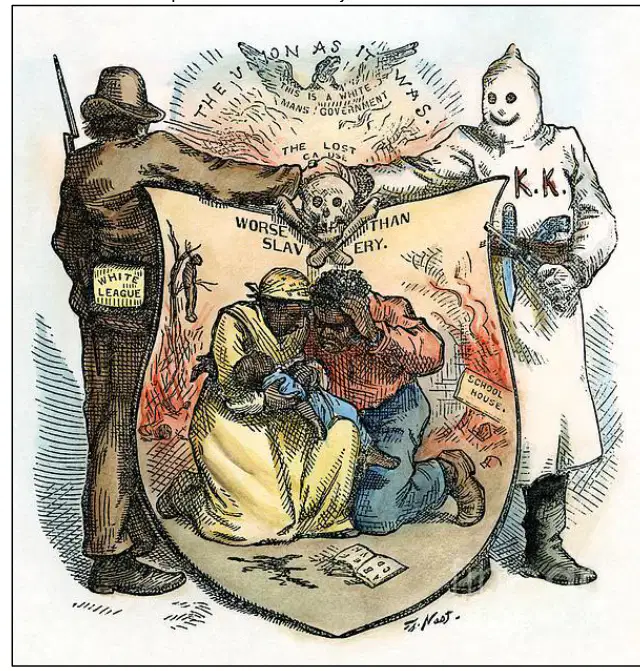
Based on the cartoon, what can be concluded about the effectiveness of Reconstruction policies in protecting African Americans, and how did organized resistance shape the postwar South?
Violent groups actively undermined Reconstruction, making it difficult for freedmen to exercise their rights.
Southern society united to rebuild peacefully and support African American civil rights.
Organizations who previously resisted change began to help integrate freedmen into society.
Legal protections were fully enforced by state and local governments that prevented racial violence in the South.
Based on the excerpt, what was one significant consequence of Harriet Beecher Stowe’s novel, Uncle Tom’s Cabin, on America?
The book directly led to Abraham Lincoln’s election as President of the United States.
It heightened national awareness of the moral issues surrounding slavery.
The novel sparked the beginning of the Abolitionist movement across the United States.
It heightened Harriet Beecher Stowe’s leadership in the women’s suffrage movement.
How did most Southerners justify their views on secession during the crisis of 1860–1861?
They believed secession was unconstitutional and would weaken their political influence.
They supported remaining in the Union to negotiate better trade agreements.
They believed the federal government would abolish slavery peacefully without conflict.
They supported secession as a legal right to preserve their economic and social systems.
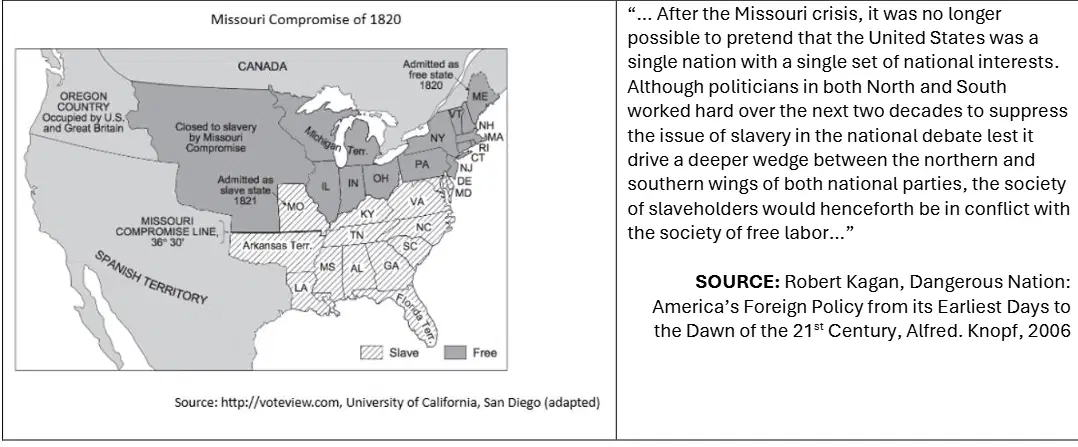
Which conclusion is best supported by both the map and excerpt regarding the impact of the Missouri Compromise of 1820?
The Missouri Compromise introduced the principle of popular sovereignty, allowing settlers to vote on the issue of slavery in their territories.
The Missouri Compromise reinforced sectional divisions by establishing a geographic boundary between free and slave regions.
The Missouri Compromise focused on admitting Maine as a free state and Missouri as a slave state, without any other provisions.
The Missouri Compromise permanently settled the issue of slavery in U.S. territories until the Civil War began in 1861.
What was one major outcome of the Supreme Court’s decision in Dred Scott v. Sandford (1857)?
The Supreme Court ruled that Congress had no authority to limit the expansion of slavery.
The Supreme Court declared slavery to be unconstitutional.
The decision caused a political disagreement between Lincoln and Douglas.
The ruling allowed Dred Scott and his wife to gain their freedom.

Based on the data in the chart, what conclusion can be drawn about the economic capabilities of the North and South at the onset of the Civil War?
The South had a stronger industrial base and exported more manufactured goods than the North.
The North faced greater logistical challenges in supplying its military forces than the South.
The North possessed significantly more economic resources, giving it a strategic advantage in the war.
The South had superior transportation infrastructure, making it easier to mobilize troops.

What event led to the creation of this poster?
A. President Lincoln’s Emancipation Proclamation, which encouraged Black men to serve in the Union Army.
B. The Kansas-Nebraska Act, which let people in new states vote on slavery.
C. Congress’s decision not to ban slavery in territories gained from Mexico.
D. The Missouri Compromise of 1820, which kept a balance between free and slave states.
14th December 1855
"Dear Sir, I have just returned from the Kansas war (about which you have no doubt learned by the newspapers)… I intend to send you shortly a paper published here giving you a fuller account of the invasion… I will only say at this time that the Territory is now entirely in the power of the Free State men… I believe the Missourians will give up all further hope of making Kansas a Slave State. Tomorrow the people of Kansas will decide whether to adopt or reject the Free Constitution submitted to them…"
What major political development contributed to the violent conflict John Brown refers to in his letter?
The relocation of Native American tribes into Kansas Territory.
The Supreme Court’s decision in the Dred Scott case, denying citizenship to African Americans.
The deployment of Union troops into contested border regions.
The passage of the Kansas-Nebraska Act, which allowed popular sovereignty on slavery.
How did the Compromise of 1850 attempt to resolve sectional tensions over slavery?
It temporarily settled disputes over the expansion of slavery but deepened divisions that led to the Civil War.
It resolved border conflicts with Britain and strengthened U.S. control over the Pacific Northwest.
It improved relations with Native American tribes by establishing new treaties and land agreements.
It promoted industrial growth by increasing federal investment in transportation and manufacturing.
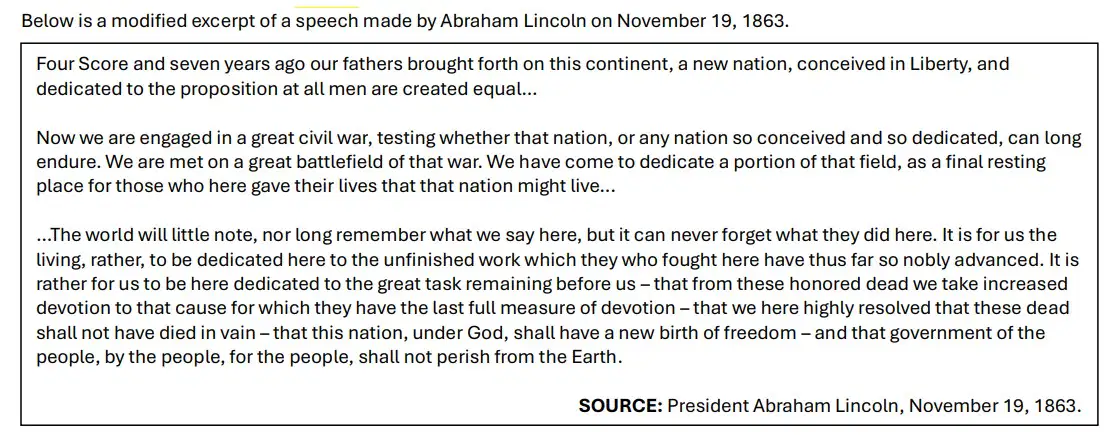
Which historical event most directly shaped the context and purpose of Lincoln’s speech?
The Confederate military success at the Second Battle of Bull Run.
The heavy casualties suffered during the Battle of Antietam.
The formal surrender of Confederate forces under General Robert E. Lee.
The devastating human cost of the Battle of Gettysburg.
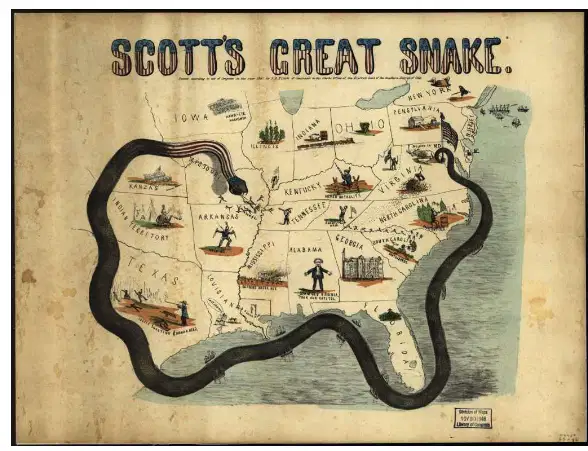
What was the main reason the Union used a naval blockade against the Confederacy during the Civil War?
A. To help Southern factories grow by limiting foreign competition.
B. To encourage enslaved people to escape to the North.
C. To cut off the South’s access to supplies and weaken its war effort.
D. To persuade Southern states to rejoin the Union through economic pressure.
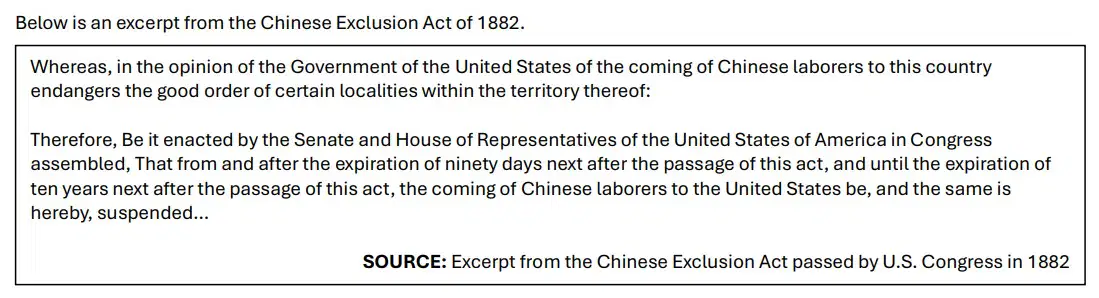
Why did Congress pass the law described in the excerpt, and what does it reveal about attitudes toward immigration at the time?
To increase the number of Chinese laborers working in U.S. industries.
To limit Chinese immigration due to rising nativist sentiments.
To protect European immigrants from dangerous working conditions.
To require immigrants to serve in the military as a condition of entry.
According to The New Colossus, what were the primary reasons immigrants sought refuge in the United States?
To reunite with relatives who had already immigrated.
To explore and enjoy the scenic beauty of the American landscape.
To flee from poverty, persecution, and violence in their home countries.
To pursue wealth and success in America’s expanding economy.
Why was the passage of the Interstate Commerce Act of 1887 and the Sherman Antitrust Act of 1890 significant?
They helped large businesses grow by raising tariffs on foreign goods.
They stopped unsafe products from being sold across state lines.
They allowed monopolies to grow without interference from the federal government.
They marked the beginning of federal efforts to regulate unfair business practices.
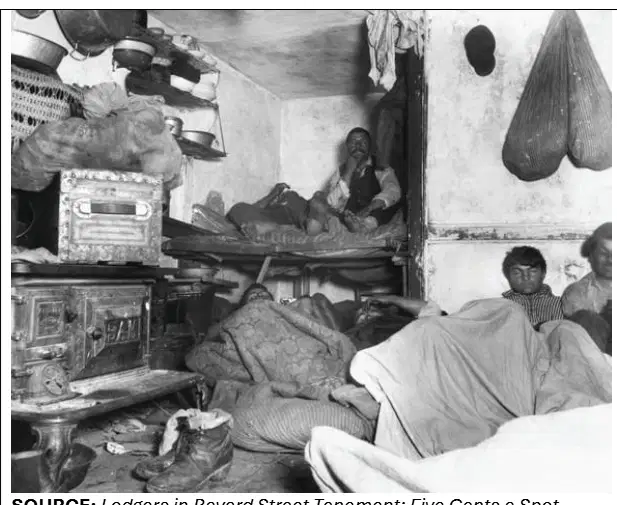
What strategies did reformers like Jacob Riis use to address the urban housing crisis illustrated by the documents above?
They authorized forced evictions and demolition of unsafe housing.
They lobbied for government-funded housing projects for laborers.
They exposed poor housing conditions and pushed for legislative reforms.
They conducted inspections and prosecuted residents for violating housing codes.
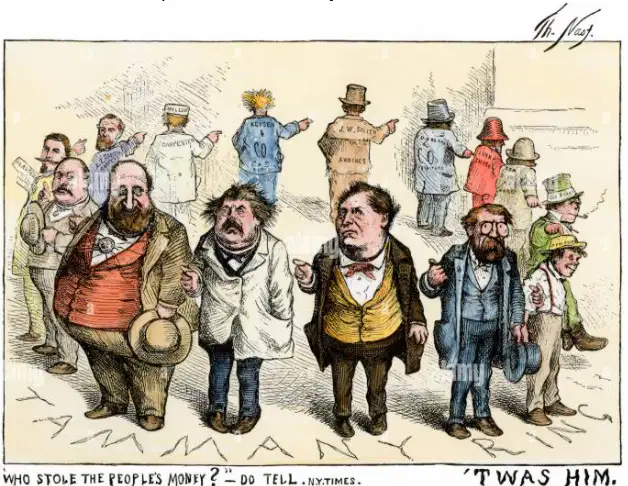
How does this political cartoon reflect the broader issues of city politics during the late 19th century in America?
It demonstrates the corruption tactics that occurred in government institutions.
It shows how societal changes led to increased cooperation among different political groups.
It reflects an era of strong leadership and clear decision-making processes.
It indicates that lack of accountability was effectively addressed by those in power.

How can Jane Addams’ social philosophy best be described based on this excerpt?
She advocates for workers to gain economic control over industrial systems.
She supports business leaders who aim to reduce labor costs.
She believes in the notion that industrialization has created opportunities for all social classes.
She encourages upper and middle-class citizens to take action to improve urban living conditions.
Which of the following best explains a similarity between the Temperance Movement and the Social Gospel Movement during the late 19th and early 20th centuries?
A. Both movements focused on rejecting religious influence in public life.
B. Both were primarily concerned with increasing industrial profits.
C. Both aimed to improve society by addressing moral and social issues.
D. Both were led by political parties seeking to gain voter support.
How did the public’s reaction to The Jungle lead to changes in government policy during the Progressive Era?
It led to a strong demand for federal regulation of food and drug safety.
It caused a national shift toward vegetarianism.
It sparked a wave of labor activism that resulted in workplace safety laws.
It resulted in Upton Sinclair being prosecuted for exposing factory conditions.
How did Progressive reformers’ efforts to end child labor reflect various changes during the industrial era?
A. They showed how reformers prioritized economic growth over social justice.
B. They demonstrated a shift toward government responsibility in protecting vulnerable populations.
C. They reflected a belief that industrialization should remain unregulated to earn maximum profits.
D. They indicated that most Americans supported child labor as a necessity.
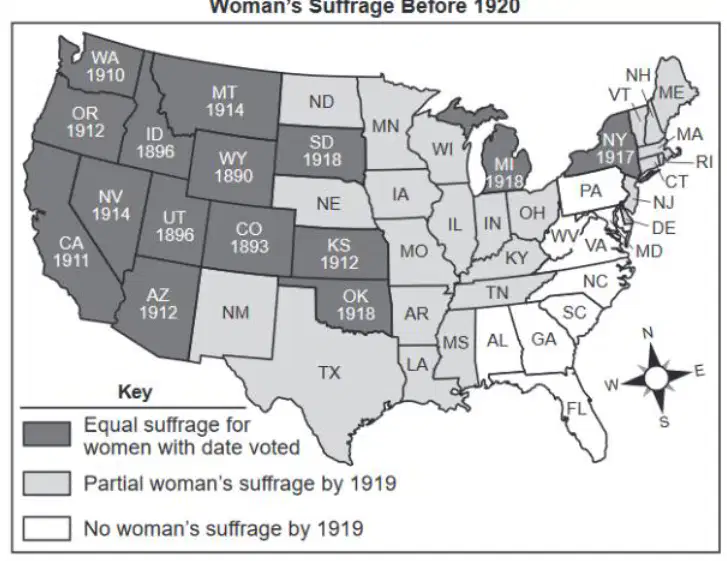
Which major constitutional development followed the trends shown on the map?
The repeal of the 15th Amendment to the U.S. Constitution.
The ratification of the 19th Amendment to the U.S. Constitution.
The formation of the National Women's Party.
A large-scale protest in Washington, D.C. to demand universal suffrage.
Which of the following was the most significant factor in America’s interest in annexing Hawaii?
American consumers had an increased desire for imported fruits.
The Hawaiian military was threatening the American West Coast.
Hawaii was seen as a key strategic trading and military post between the U.S. and Asia.
Hawaiian businesses cut off the sugar supply to the United States.
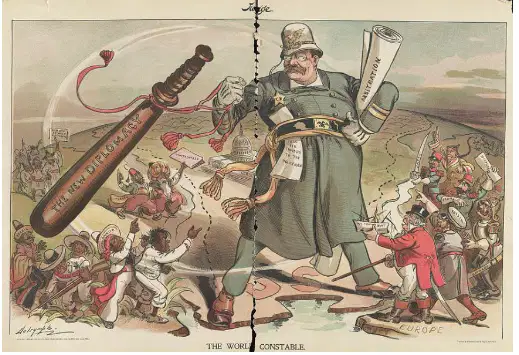
Which of the following best describes the goal of President Theodore Roosevelt’s Big Stick Policy?
To conduct foreign relations with an immediate show of military force.
To work to share resources with other countries and build strong relationships.
To maintain a limited number of alliances in order to build U.S. military strength.
To be diplomatic and negotiate with foreign countries but prepared to use force if needed.
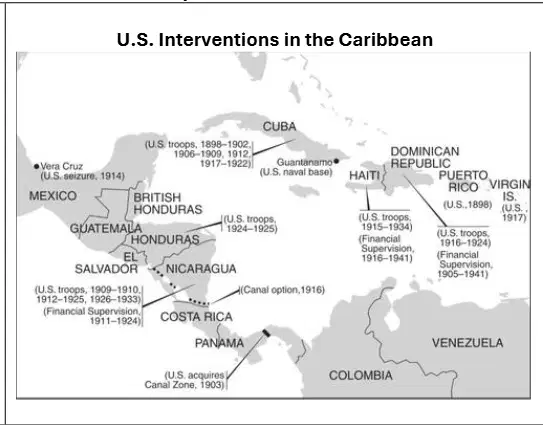
Based on these two documents, what was one effect of US expansion in the 1890’s?
American imperialism was generally opposed by U.S. politicians.
American participation in the Spanish-American War did not change American foreign policy.
The United States established dominance over the Caribbean and gained recognition as a world power.
American influence in the Caribbean led to American influence in Asia.
What was the main goal of U.S. Secretary of State John Hay’s Open Door Policy in response to foreign powers establishing spheres of influence in China?
To support Chinese rebels in removing foreign influence.
To ensure all nations had equal trading rights in China.
To help China reclaim territory taken by European powers.
To demand control of Hong Kong through military threats.
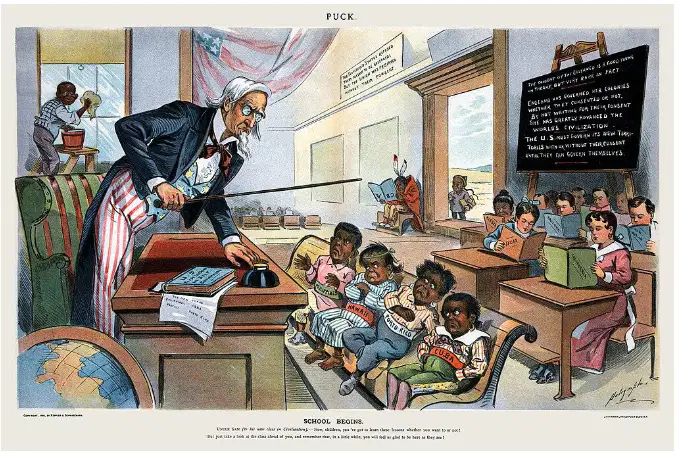
The cartoon above best reflects which of the following motivations for imperialism?
Americans believed that they could influence the people from the newly acquired territories into becoming more civilized.
The American government wanted to support the people from new acquired territories in becoming more economically self-sufficient.
The cartoon suggests that Americans were motivated by a desire to gain more land for trade and additional expansion.
Americans believed they had accomplished their goals and were no longer interested in imperialistic pursuits.
"U.S. Naval Officer Alfred T. Mahan published Influence of Sea Power Upon History in 1890 regarding America’s focus on expanding the Navy, establishing military bases around the world, and developing battleship technology"
How did this information influence foreign policy decisions made by the U.S. government during the late 1800s?
The U.S. began acquiring overseas ports for military and refueling purposes.
The U.S. focused on building textile factories in foreign territories.
The U.S. promoted democracy through peace treaties.
The U.S. reduced its military presence to avoid international conflict.
According to the American Anti-Imperialist League, why was U.S. imperialism in the Philippines considered a betrayal of American values?
It encouraged economic competition with European powers.
It was viewed as a violation of the basic principles of liberty and self-determination.
It reduced the size of the U.S. military.
It led to stronger diplomatic ties with Asian nations.
During the Spanish-American War, how did yellow journalism affect public opinion and government decision-making?
It provided balanced coverage to help the public understand both sides of the conflict.
It focused on criticizing U.S. military leaders for their lack of preparation.
It ignored the conflict until after the sinking of the USS Maine.
It sensationalized events to stir public emotions and pressure the government to declare war.
Which of the following events led to the area of Tampa Bay, Florida becoming an area of vast importance during the Spanish American War in 1898?
It was the site of the U.S.S. Maine explosion that triggered the war.
It served as a major military staging area for troops, supplies, and equipment heading to Cuba.
It was used by Cuban revolutionaries to launch attacks on Spanish forces.
It became the main shipbuilding center for the U.S. Navy during the war.
What was the major cause of African American migration from the rural South to northern cities during World War I?
Offers of free public education
Availability of factory jobs
Desire to live in integrated neighborhoods
Opportunity to gain religious freedom
During World War I, what was President Woodrow Wilson’s purpose in outlining the Fourteen Points?
Asking Congress for additional funding for the war effort
Suggesting a peace plan to prevent future wars
Proposing war crimes trials for leaders of enemy nations
Calling for military alliances against aggressor nations
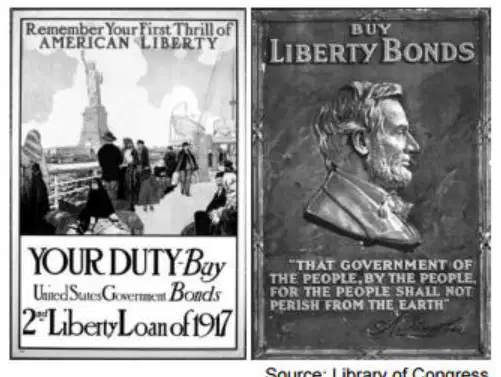
Why did the United States government publish these World War I posters?
Encourage Americans to increase military enlistments
Encourage Americans to reduce the use of consumer goods
Encourage Americans to invest in the war effort
Encourage Americans to conserve scarce resources for the military
Which factor was the basis of the United States Senate’s opposition to the League of Nations after World War I?
Rejection by President Woodrow Wilson of internationalism
The high financial cost of membership to the League of Nations
Concern over communist control of international organizations
Fear of becoming involved in another European war
What was President Woodrow Wilson’s stated policy toward the warring nations of Europe prior to United States entry into World War I?
Neutrality
Containment
Internationalism
Dollar diplomacy
Which event most influenced President Woodrow Wilson’s decision to enter World War I?
Defeat of Russia by Germany
Assassination of Archduke Franz Ferdinand
Raids by Mexico on the Southwestern United States
Renewal of unrestricted submarine warfare by Germany
Which issue was the focus of the Supreme Court decision in Schenck v. United States (1919)?
Freedom of speech for war protestors
Relocation of ethnic minority groups
Use of detention camps for enemy aliens
Integration of military forces
In Schenck v. United States (1919), the Supreme Court decided that a “clear and present danger” to the country allowed the federal government to do which of the following?
Establish a peacetime draft
Restrict first amendment rights
Suspend habeas corpus
Limit minority voting rights
The Espionage Act (1917) and the Sedition Act (1918) were used by President Woodrow Wilson’s administration during World War I for what purpose?
Discourage congressional support for the war
Place German Americans in internment camps
Remove Communists from government positions
Silence critics of the war effort
Why did Henry Cabot Lodge and other senators oppose ratification of the Treaty of Versailles (1919)?
They believed the treaty failed to punish Germany for its involvement in World War I
They believed the treaty excluded reparations for European allies
They believed the treaty could draw the United States into future conflicts
They believed the treaty placed blame for World War I on all the warring countries
Which of the following was a result of the Palmer raids, immigration quotas, and the trial of Sacco and Vanzetti during the 1920s?
Racial prejudice against African Americans
Opposition to the Ku Klux Klan
Fear that American values were threatened by radical ideas
The need to strengthen national defense
How did the Harlem Renaissance of the 1920s expand the influence of African Americans?
By financing the construction of apartments in New York City
By gaining passage of civil rights legislation
By helping elect African Americans to high political offices
By promoting the artistic contributions of African Americans
Which event of the of the 1920s best reflects the conflict in American society between Protestant fundamentalism and science?
Passage of the quota acts
The Scopes Trial
Trial of Sacco and Vanzetti
The Red Scare
In the early 20th century, which policy for the advancement of African Americans was favored by W.E.B. Du Bois and the newly formed National Association for the Advancement of Colored People (NAACP)?
Mass migration to northern cities
Immediate action to end segregation and win equal rights
Establishment of a new republic in Africa for freedmen
Emphasis on economic advancement over social equality
What was a major reason for the emergence of a “consumer culture” in the 1920s?
The Federal Government encouraged labor to unionize
Enforcement of antitrust laws resulted in higher prices
Minimum-wage laws expanded buying power
Advertising and installment payments encouraged buying
Which of the following illustrates the influence of nativism during the 1920s?
Increase in the popularity of the automobile
Emergence of the flappers
Expansion of trusts and monopolies
Growth of the Ku Klux Klan
What would a study of the “flappers” of the 1920s indicate about the period?
Some women rejected traditional feminine roles
Many women were elected to national political office
Women were fired from traditionally male occupations
The earning power of women was equal to that of men in the same occupation
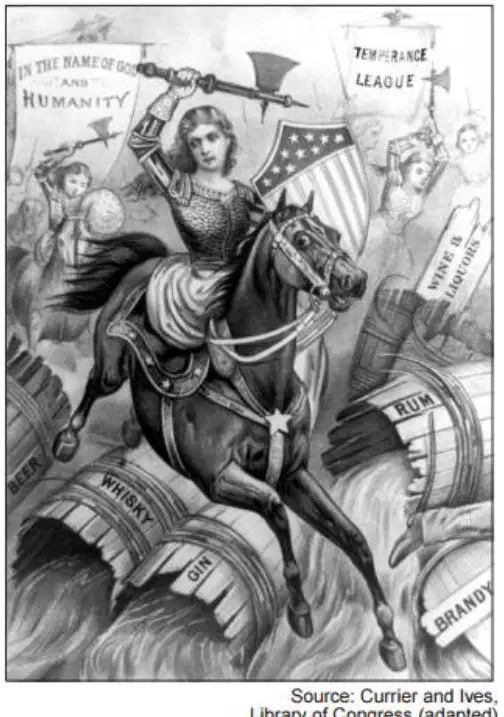
What was the purpose of the “Holy War” illustrated in the cartoon?
To recruit women soldiers
To promote world peace
To ban the sale of alcoholic beverages
To spread Christian religious beliefs
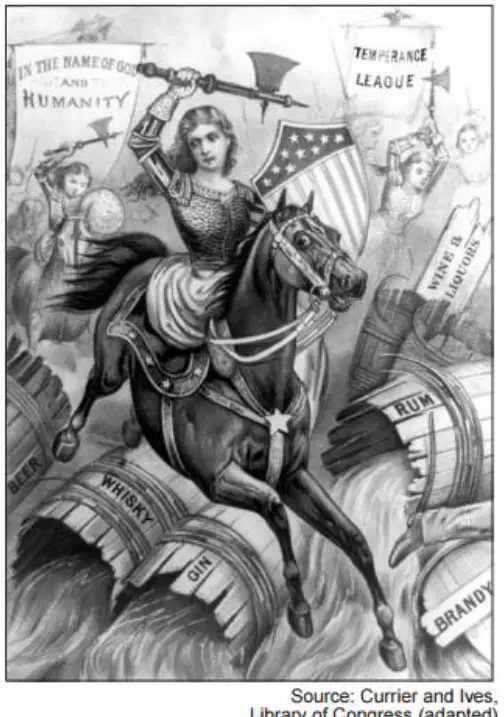
How did women gain a victory in the “war” shown in the cartoon above?
Through ratification of a constitutional amendment
Through legalization of birth control
Through expansion of missionary activities overseas
Through repeal of national Prohibition
Which quote below best aligns with the beliefs of W.E.B. Du Bois?
“The [African American] demands equality—political equality, industrial equality, and social equality; and he is never going to be satisfied with anything less.”
“Equal but separate accommodations for the white and colored races is for the preservation of the public peace and good order.”
“Vocational training will provide the means for African Americans to gain the civil liberties they deserve.”
“The best answer for the equality of the [African American] lies in a return to his homeland in Africa.”

