
 Worksheets
Humanities Final Fall 2025
Total questions: 59
Worksheet time: 35mins
What was so special about Michelangelo’s Pieta, compared to other pietas?
It was colorful.
It was incredibly lifelike.
It was expensive.
It was carved from hard marble.
What did Michelangelo carve into the Pieta that is unique to this statue among all his works?
He carved the date.
He carved his secret symbol.
He carved the seal of the Pope.
He carved his name.
What is a fresco?
a large-scale painting, usually done on a wall or ceiling, that is created by a specific technique using plaster
a mayor
a Renaissance man
a statue of the Blessed Mother and her son, Jesus
What opportunity did Michelangelo have in the hospital at Santo Spirito that helped him advance in his study of the human body?
He was given permission to dissect bodies.
He was allowed to shadow physicians.
He was allowed to visit patients and sketch them.
He was given permission to study in the hospital library.
How did Michelangelo solve the problem of wanting to work at night?
He set up many candles around the room.
He found an apprentice to work at night for him.
He wore a hat made of thick paper with a candle set in the middle of it.
He decided he was too old for that.
"Do you see a man skillful in his work? He stands before kings; he will not stand before obscure men."
How does this relate to the story of Michelangelo?
(a)
What is the reason Mrs. Frankweiler is writing to her lawyer?
She wanted to complain about his last visit.
She wanted to tell him about her vacation.
She wanted to change her will.
She needed to clarify something on her bill.
Why does Claudia pick Jamie out of all her brothers to run away with?
He could be counted on to be quiet.
He was good for a laugh.
He was rich.
All of the above
What are some of the reasons Claudia thinks she is running away?
She is bored with her monotonous life and seeks adventure.
She is tired of the “injustices” of being the eldest sibling and only girl. She wants to be appreciated.
Both a and b
None of the above
What are some of the important things the Kincaid children learn from the newspaper article about the statue they saw?
It was purchased for $225.
It might be the work of Michelangelo.
It was purchased from the collection of Mrs. Basil E. Frankweiler.
all of the above
What clue do the children find on the velvet where the angel statue used to be?
a symbol with three rings and the letter M in one ring
a faint signature
a business card from the auction house
a flake from the base of the statue
What interesting feature of Mrs. Frankweiler’s office takes up a whole wall?
a fresco
a filing cabinet
a fireplace
a meeting table
What new thing would Mrs. Frankweiler like to experience that she says is impossible?
She wanted to be a mother.
She wanted to marry Saxonberg.
She wanted to become an artist.
She wanted to meet Michelangelo.
Why does Claudia think Mrs. Frankweiler allowed the statue to be sold for so little?
The statue reminded her of her husband.
She found it to be ugly.
She thought the statue would bring more money at auction.
She wanted people to know that she had a secret.
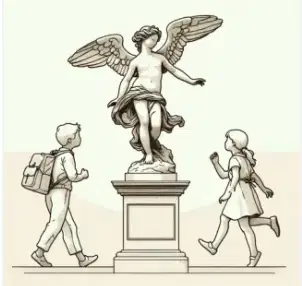
How do the children reason that the statue is an angel rather than a cupid?
(a)
What is heresy?
a belief or opinion contrary to orthodox religious doctrine
a belief that fully agrees with the official teaching of the church
What is a bull?
an informal note from the pope offering advice to the faithful
a formal written statement from the pope declaring church law or judgment
What were indulgences?
certificates that encouraged people to seek forgiveness of sins through prayer and good works
certificates that promised the forgiveness of sins through the authority of the church
Why did they make Dr. Luther angry?
He believed true forgiveness came only from God, not from something purchased.
He believed true forgiveness came only from sincere effort and extra acts of charity.
What did the people of Leipzig give to Dr. Luther to honor him as he rode into town?
the key to the city
the traditional cup of wine
a free meal at the finest restaurant
What does Luther do at each town he stays in along the way?
He preaches.
He teaches at the university.
He honors the mayor.
What does “renounce” mean?
to admit the truth of what you’ve said
to say publicly that you no longer believe something
Why don’t Karl’s captors reveal their true identities to Karl?
They represented a very important person.
They were part of a secret convoy of the emperor.
They knew he couldn’t keep a secret.
What is Luther’s response to John Eck on the second day of his trial?
The heresy of the church has doomed you all.
Unless I am shown from the Scriptures that I have made mistakes, I am neither able nor willing to revoke even one word of what I have written.
Where do you find indulgences in the word of God?
What surprising verdict and punishment does Emperor Charles give to Luther?
He ordered that he be burned at the stake.
He ordered him to teach mass every Sunday.
He ordered that his family join him in prison.
He cannot preach or teach. All his writings are to be burned.
What is an ambush?
a surprise attack
to defend your position in the battle field
What decision does Karl make when he has the opportunity to run?
He took off into the forest with Dr. Luther.
He blocked the avenue of escape.
To whom does Luther compare Arlene in her courage?
King Arthur
Jesus Christ
John Calvin
Joan of Arc
What does the fact that Sturm left the room after Martin Bucer comes to Luther with his message show you about him?
(a)
How would it be dishonest for Luther to recant all that he has written?
(a)
What was a common goal of the three explorers we studied (Christopher Columbus, Vasco de Gama, and Ferdinand Magellan)?
They all sought to own slaves.
They all sought to find a trade route to obtain spices.
They all wanted control of other lands.
They all wanted to find a wife.
What does “Dawn Treader” mean?
one who walks on the sunrise
one who walks on the sunset
What is the meaning of “valiant” as used for Reepicheep?
cowardly faith
courageous faith
How do the children get into Narnia this time?
through a magical wardrobe
through a magical door
through a magical painting of a ship
through a pool of worlds
What happens when the picture of the ship comes to life?
A great sea beast captures Lucy, Edmund, and Eustace.
Reepicheep calls to them from the Dawn Treader.
Water floods the room as the painting expands, pulling Lucy, Edmund, and Eustace into the ocean.
none of the above
Why is Caspian sailing to the Lone Islands?
He is avenging his father’s death.
He is looking for treasure buried deep beneath the surface of the ocean.
He wants to find the seven loyal lords of Narnia whom his usurping uncle, Miraz, had sent away.
He needs to test the loyalty of his crew.
What makes Reepicheep so excited when he goes overboard after Ramandu’s Island?
The sea has turned sweet and tastes like liquid light, which fulfills a prophecy.
He sees a vision of Aslan’s country.
He finds a new sword in the water.
He realizes he has finally beaten Eustace in a contest.
What does Aslan tell Lucy and Edmund about knowing Him in their own world?
He tells them they will soon forget about Narnia and him.
He reveals that they will meet him again in their world, but by a different name.
He promises to visit them in their world as a regular lion.
He gives them a magical object that will allow them to visit him whenever they like.
What is the meaning behind Eustace's undragoning?
(a)
What is periodization?
to make a timeline that shows the first things that happened.
to break history into big, easy-to-study parts, like the "Stone Age" or "Modern Times."
to make a list of all the important people who lived a long time ago.
to put the dates of different events in the right order.
Name the 4 cardinal directions.
(a)
What is a compass?
It's a special type of map that shows you the whole world.
It's a drawing tool with two legs used to make perfect circles.
It's a small device with a magnetic needle that points North, helping you find directions.
It's a clock that only tells time when you are outside.
What did Sir Francis Bacon contribute to the world of science?
He created the scientific method.
He developed the polio vaccine.
He developed a hybrid plant.
He improved the steam engine.
Put the parts of the scientific method in order.
hypothesize, question, experiment, observe, conclude
(a)
In music or poetry, what is a refrain?
It is the very first line of a song or poem.
It is the name of the person who wrote the lyrics.
It is a line or group of lines that repeats several times throughout the song or poem.
It is the type of music that is played only by instruments, without singing.
The refrain of "Trust and Obey" says:
"Trust and obey, for there's no other way
To be happy in Jesus, but to trust and obey."
Relate this to our story by using at least one example from the text.
(a)
How is the Bible like a compass for us?
(a)
What were some of the ways Isaac Newton was described as a boy?
cunning
crafty
clever
cunning and crafty
all of the above
What is an apothecary?
a person who works in a baker and sells bread
a person who fixes cars and changes the oil
a healer who used plants and natural things to make medicine
a store that only sells ice cream and candy
What scientist, who was considered the first astronomer, captured Isaac’s interest?
Copernicus
Galileo
Thomas Edison
Benjamin Franklin
What did Isaac measure with his sundials?
the length of shadows
how the days grew shorter
the difference between the different time zones
the amount of time it takes for the earth to revolve around the sun
What did Isaac bring with him to college?
a pound of candles
a chamber pot
ink
all of the above
Which astronomer did Newton study as he wrestled with the movement of the planets?
Kepler
Copernicus
Boyle
Bacon
What does annus mirabilis mean?
leap year
year of great sorrow and disaster
miraculous year
year of war and conflict
Which law did Newton discover that became the guiding principle of physics?
The Law of the Color Spectrum
The Laws of Motion
The Law of the Water Cycle
The Law of Photosynthesis
Name the colors that Isaac discovered the light would split into when it shone through the prism in order.
orange, green, indigo, red, yellow, blue, violet
yellow, green, blue, red, indigo, orange, violet
red, orange, yellow, green, blue, indigo, violet
violet, blue, yellow, red, indigo, green, orange
What color became one of Isaac’s favorites, at least based on what he purchased and surrounded himself with?
crimson (red)
blue
green
orange
Which 20th century scientist and mathematician famously took inspiration from Newton and went beyond him into new ideas and discoveries?
Marie Curie
Albert Einstein
Thomas Edison
Alexander Fleming
How did Isaac control the variable of light to try to study it most precisely with the prism?
(a)

