
Font size
 Worksheets
FINAL EXAM REVIEW
Total questions: 235
Worksheet time: 3hrs 16mins
Anterior
Near the front
Near the back
Farther from the body core
Nearer the body core
Posterior means:
Closer to the front
Along the front of the vertebral column
Closer to the back
Along the back of the vertebral column
The midsagittal plane separates the body into...
top and bottom
equal left and right
front and back
The frontal plane/coronal separates the body into...
anterior and posterior
medial and lateral
proximal and distal
cranial and caudal
The transverse plane separates the body into...
anterior/posterior
superior/inferior
medial/lateral
proximal/distal

Which anatomical plane is the ONLY horizontal plane?
sagittal
transverse
frontal

Which anatomical plane divides the body into anterior and posterior
frontal/coronal
transverse
sagittal
midsagittal
The study of the functions of the body
physiology
psychology
physics
anatomy
The study of the structures of the body
biology
physiology
anatomy
geology
Standard reference for describing body locations, positions, and directions
anatomical planes
anatomical position
anatomical terms
anatomical divisions
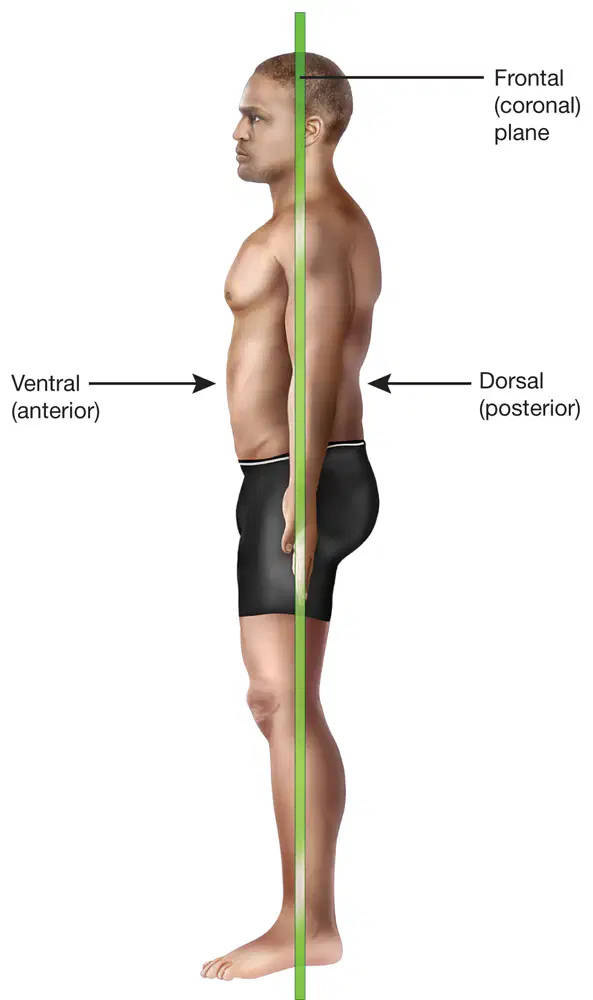
The vertical plane that divides the body into front and back sections.
frontal/coronal plane
sagittal plane
midsagittal plane
transverse plane

The plane that divides the body vertically into unequal left and right sides.
transverse
sagittal
midsagittal
frontal/coronal

The horizontal plane that divides the body into upper and lower sections
sagittal plane
midsagittal plane
transverse plane
frontal/coronal plane
What are two major body cavities?
thoracic
abdominopelvic
dorsal
ventral
cranial
What is the point of a feedback loop?
To provide the body with more energy
To provide the body with more food
To make sure the conditions in the body are always changing
To make sure the conditions in the body remain stable

Loops that cause a response to build up and build up until something big happens are called ____________ loops
positive
negative
The heater kicks on and the house warms up, so it kicks off. Then the house cools a bit and the heater kicks back on. This continues all day. It's a _____________ loop.
positive
negative
Labor during pregnancy is an example of a ____________ feedback loop
positive
negative
Blood sugar regulation is an example of a ______________ loop
positive
negative
Which of these conditions indicate positive feedback has occurred?
The production of a particular product continues its production
The production of a particular product stops its production
Sweat evaporates from a person's skin
__________________ feedback is the most common type of feedback in living systems because it brings levels back to normal. Counteracting the original stimulus.
Negative
Positive
Neutral
Osmosis
The Body’s Attempt to Adjust to a Fluctuating External Environment
is the maintenance of an exact internal environment
The two major body cavities are the _______ and __________.
abdominal /pelvic
ventral/dorsal
cranial/vertebral
thoracic/abdominal
The ventral body cavity consists of
the cranial and spinal cavities
the thoracic cavity
the cranial and abdominopelvic cavity
the abdominopelvic and thoracic cavities
Which body plane divides the body into equal left and right halves?
sagittal
mid sagittal
coronal/frontal
transverse
Which of these is a function of the skeletal system? (a)
A function of the skeletal system is (a)
A function of the skeletal system
nervous system pathways
exocrine pathways
support
hormone storage
Hematopoiesis occurs in the ______bone marrow.
red
yellow
The ends of a long bone
diaphysis
periosteum
medullary cavity
epiphysis
The ‘shaft’ or middle of a long bone
epiphysis
medullary cavity
diaphysis
periosteum
This structure covers the outside of a long bone
epiphysis
diaphysis
periosteum
yellow bone marrow
Thin layer of cells lining the medullary cavities and the trabeculae of spongy bone inside the bone
epiphysis
diaphysis
endosteum
lacunae
Hollow space within the diaphysis, which contains the yellow marrow
medullary cavity
caniculi
osteons
spongy bone
Where bone increases in length in a long bone
diaphysis
periosteum
epiphyseal plate
Forms the central axis of the body & protects critical organs
axial skeleton
appendicular skeleton
Function of the ______skeleton is movement.
axial
appendicular
Bones are classified by their _____.
size
shape
type of bone they mare made up of
weight
At which week after conception does ossification begin?
week 3
week 4
week 5
week 6
Step 1 in the endochondral ossification process is:
cartilage becomes bone
bone becomes hardened
blood vessels invade the cartilage cells
cartilage template is formed
During the second step of ossification the perichondrium becomes:
condrocytes
nutrient foramen
periosteum
hard
During step 3 the blood vessels enter at the diaphysis and form the:
cartilage template
secondary ossification center
primary ossification center
nutrition center
During step 4 the osteoclasts form the:
nutrient foramen
medullary cavity
secondary ossification center
growth plate
Step 5 at the time of birth blood vessels enter__________and create the secondary ossification center.
diaphysis
epiphyses
medullary cavity
periosteum
During the final step of ossification the only cartilage remaining in the bone is:
the diaphyseal cartilage
epiphyseal growth plates and the fibrocartilage
the articular cartilage and the epiphyseal growth plates
the epiphyseal growth plates and the endosteum
Ossification of the diaphysis occurs from the:
inside - out
outside - in
The skeletal system provides ___________ for fat, calcium (Ca) and phosphorus (P).
movement
support
storage
formation
What are the two main types of bone tissue?
Thick bone and thin bone
Compact bone and spongy bone
Dense bone and porous bone
Hard bone and soft bone
Where does calcium homeostasis happen?
brain
pancreas
kidney
liver
What is the point of a feedback loop?
To provide the body with more energy
To provide the body with more food
To make sure the conditions in the body are always changing
To make sure the conditions in the body remain stable
What type of feedback loop is the calcium feedback loop?
positive
negative
both, depending on what half of the loop you are looking at
Immobile joints:
Amphiarthrosis
Synarthroses
Diarthroses
Limited-mobility joints:
Synarthroses
Amphiarthrosis
Diarthroses
Freely moveable joints:
Synarthroses
Amphiarthrosis
Diarthroses
Allows rotation and the widest range of motion among all joints
Gliding
Ball and Socket
Saddle
Hingel
A _________joint has surfaces that are flat or slightly curved that slide.
gliding
pivot
ball and socket
hingel
The elbow , knee , and between phalanges joints are examples of _____joints.
pivot
ball and socket
hinge
gliding
The axis/atlas joint is an example of a _____joint.
saddle
pivot
ball and socket
condyloid
The thumb is an example of a _____joint.
pivot
hinge
ball and socket
saddle
The anatomical names of the 3 joints are:
fibrous
cartilaginous
synovial
all of these
There are ______types of synovial joints in the body.
3
8
6
2
Match the following
Fibrous Joint
Immovable
Cartilaginous Joint
Slight movement
Synovial Joint
Freely moveable
Skeletal muscle is:
involuntary
voluntary
Skeletal Muscle has ______nuclei.
No
One
many
Skeletal muscle is:
striated
unstriated
Has a centrally located nucleus
smooth and skeletal
cardiac and skeletal
skeletal and smooth
smooth and cardiac
This muscle contracts slowly
smooth
cardiac
skeletal
Which myofilament shortens when a sarcomere contracts?
Actin
Myosin
Both
Neither
Which myofilament is thick?
Actin
Myosin
Both
Neither
Which myofilament has many heads to grab the other one?
Actin
Myosin
Both
Neither
Which myofilament is attached to the Z line?
Actin
Myosin
Both
Neither
Which myofilament has tropomyosin on it?
Actin
Myosin
Both
Neither
Which myofilament has troponin on it?
Actin
Myosin
Both
Neither
Which myofilament is powered by ATP?
Actin
Myosin
Both
Neither
Which myofilament has two regulatory proteins on it?
Actin
Myosin
Both
Neither
Which regulatory protein blocks myosin-binding sites on actin?
Troponin
Tropomyosin
Neither
Which regulatory protein blocks actin-binding sites on myosin?
Troponin
Tropomyosin
Neither
Which regulatory protein has a binding site for calcium ions?
Troponin
Tropomyosin
Neither
Which regulatory protein stiffens actin so that it can resist tension?
Troponin
Tropomyosin
Neither
What happens when calcium binds to troponin?
It moves tropomyosin on top of the myosin-binding sites
It moves tropomyosin off of the myosin-binding sites
It moves tropomyosin to cover the actin-binding sites
It moves tropomyosin off of the actin-binding sites
Once the myosin-binding sites are uncovered, what does myosin need in order to power it to cock up and bind?
Calcium
Acetylcholine
ATP
Actin
With ATP and calcium present, what is able to happen?
Myosin can grab actin, shortening the sarcomere
Actin can grab myosin, shortening the sarcomere
Actin and myosin can shorten
With ATP and calcium absent, what happens?
Actin relaxes
Actin contracts
Myosin relaxes
The sarcomere relaxes
Why does the sarcomere relax when calcium is absent?
The myosin heads release and go back down
The actin heads release
Troponin covers the myosin-binding sites
Tropomyosin covers the myosin-binding sites
What is the smallest unit of a muscle to contract?
Sarcomere
Myofibril
Muscle fiber
Myofilaments
Which myofilament is thick?
Myosin
Collagen
Elastin
Acetylcholine
Which myofilament pulls the other one when a muscle contracts?
Actin pulls myosin
Myosin pulls actin
Connective tissue sheath that surrounds the entire muscle
perimysium
epimysium
endomysium
fascicle
Bundle of muscle fibers
fascicle
epimysium
perimysium
tendon
Connective tissue sheath that surrounds each fascicle
tendon
endomysium
perimysium
ligament
Connective tissue sheath that surrounds each muscle fiber
endomysium
perimysium
ectomysium
sarcolemma
Plasma membrane that around each muscle fiber
actin
myosin
sarcolemma
myofilament
Long proteins that make up each muscle fiber
fascicle
myofibril
tendon
calcium
Contacting unit of the muscle
sarcomere
tendon
sarcolemma
epimysium
What is a crossbridge?
Where myosin binds to actin
Where the calcium crosses into the cytoplasm
Where calcium binds with troponin
Where titin and myosin are connected
What does calcium do to the actin?
Covers myosin binding sites
Uncovers myosin binding sites
Covers actin binding sites
Uncovers actin binding sites
What is the name of the protein that covers the binding sites on actin?
Myosin
Titin
Troponin
Tropomyosin
What is the name of the protein that covers the binding sites on actin?
Myosin
Titin
Troponin
Tropomyosin
What is the name of the place where a nerve meets a muscle fiber
Nerve junction
Neuromuscular junction
Muscle junction
Crossbridge
How does the sarcomere shorten (contract) ?
The myosin filaments contract
The actin filaments contract
The myosin is pulled by the actin
The actin is pulled by the myosin
What two chemicals are necessary for muscle contraction to occur?
Niacin and Potassium
Calcium and ATP
Sodium and Potassium
Acetylcholine and Potassium
The neurotransmitter that signals muscle contraction is...
Calcium
Actin
Myosin
Ach (acetylcholine)
Which of the following statements correctly explains the sliding filament model?
Actin head attaches to a binding site on a myosin filament, forming a cross bridge.
Myosin head attaches to a binding site on an actin filament, forming a neuromuscular junction.
Actin head attaches to a binding site on a myosin filament, forming a neuromuscular junction.
Myosin head attaches to a binding site on an actin filament, forming a cross bridge.
Abduction
movement of a limb in a circle
movement of a limb toward the midline
movement of a limb away from the midline
turning a limb upward
Movement of a limb toward the midline
adduction
abduction
circumduction
rotation
Lack of muscle coordination during voluntary movements
ataxia
dyskinesia
atonic
atrophy
Circular movement at the distal end of a limb
dorsiflexion
pronation
circumduction
ataxia
Moving the foot up toward the ankle
plantarflexion
dorsiflexion
rotation
pronation
Limp or without muscle tone
origin
prime mover
flaccid
myalgic
A loss of muscle bulk in one or more muscles
strain
dyskinesia
atrophy
hypertrophy
A general term for muscle disease
strain
myopathy
sprain
flaccid
Cordlike, band of nonelastic fibrous connective tissue that attaches a muscle to a bone
tendon
ligament
neuron
antagonist
Fibrous band that connects bone to bone
prime mover
tendon
synergist
ligament
Sheet of connective tissue that acts as a muscle attachment
neuron
tonus
aponeurosis
synergist
Inflammation of a tendon
synergist
strain
tendinitis
sprain
The most important muscle that causes a movement; prime mover
origin
insertion
agonist
fixator
Muscle attachment at the immovable bone
insertion
origin
Muscle attachment to the movable bone
insertion
origin
Cooperating action of certain muscles
agonist
insertion
synergistic
origin
A lack of coordination of a muscle during movement, particularly gait(how you walk)
synergistic
ataxia
agonist
atagonist
Bending a joint to decrease the angle of a joint
extension
flexion
rotation
adduction
Straightening a joint to increase the angle of a joint
flexion
extension
rotation
circumduction
The rotation is a single spinning movement around a fixed axis
rotation
flexion
extension
abduction
An injury to a muscle
strain
sprain
Which statement best describes one main function of the muscular system?
It allows the body to move.
It makes bones grow faster.
It produces blood cells.
It stores vitamins for later use.
Which of the following is a function of the muscular system?
Movement
Support
Protection
Heat Generation
All of the above
The cortex of the brain is the_______ layer.
inner
outer
The___________ of the brain is where choice making occurs.
cerebellum
cortex
parietal lobe
pons
The structures that make up the CNS:
Brain & Spinal Cord
Cervical plexus & Thoracic Plexus
Lumbar Plexus & Sciatic Nerve
Peripheral Nerves
Sorts out all the sensory impulses from the body
Frontal Lobe
Temporal Lobe
3 Ventrical
Thalamus
Hypothalamus Controls:
blood pressure, heart rate
body temperature, hunger
digestive tract, pupil of the eyes,
thirst, sleep
pain perception, pleasure, fear
All of These
Functions of the Nervous System:
Receive information
Process information
Communicates the information
All of these
The pathways that carry messages to the brain are known as: afferent pathways
efferent pathways
afferent pathways
This pathway carries messages from the brain to the body is the _______pathway.
efferent
afferent
Voluntary movements are called:
somatic
autonomic
Autonomic movements are:
involuntary
voluntary
The Autonomic Nervous System is divided into two parts:
sympathetic and parasympathetic
voluntary and somatic
Fight or Flight
sympathetic
parasympathetic
Restores the body to a state of calm after a stressful event.
sympathetic
parasympathetic
The dominate part of the Autonomic Nervous System
sympathetic
parasympathetic
The _________ lobe is the OUTPUT center of the brain
frontal
parietal
temporal
occipital
The _______lobe is the largest part of the brain.
parietal
temporal
occipital
frontal
Our personality, morals and ethics, ability to form words for speaking, and skeletal muscle movements are all controlled by the________lobe.
frontal
parietal
occipital
temporal
Understanding speech, recognition of objects, people, places, and events
and memory of events and outcome of choices are all controlled by the ______lobe.
frontal
occipital
parietal
temporal
Controls coordination:
parietal lobe
cerebellum
frontal lobe
cervical plexus
The brain stem controls:
speech
hearing
heartbeat, breathing and blood pressure
None of these
The nervous system
detects changes in the internal or external environment
integrates information from several sources and uses it to determine an appropriate response.
controls the movement of muscles.
all of the above.
Nerve fibers that carry impulses away from the central nervous system organs to effector organs (muscles and glands)
motor
somatic sensory
visceral sensory


This structure is involved in fear/panic response
Cerebellum
Hippocampus
Amygdala
Parietal Lobe
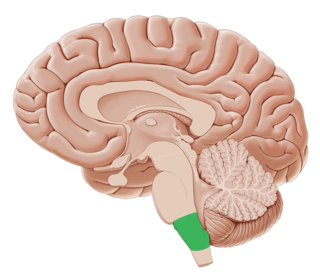
What is this?
Corpus callosum
Medulla Oblongata
Cerebellum
Hypothalamus
What are the ridges on the cerebrum called?
Gyri
Sulci
Fissure
White matter
The _______ is an almond shaped structure in the brain's limbic system that encodes emotional messages to long-term storage.
Hippocampus
Amygdala
Hypothalamus
Cerebrum
Which are the three parts of the brainstem?
Midbrain, pons, and medulla oblongata
Frontal, parietal, and temporal
Thalamus, hypothalamus, and pineal gland
Cerebrum, cerebellum, and diencephalon
What is the insulating membrane that surrounds parts of the axon that helps to speed up action potential?
Axon
Dendrites
Node of Ranvier
Myelin Sheath

An electrical impulse within a single neuron is called a
synapse
membrane potential
action potential
cell body

What maintains the resting membrane potential in a neuron?
sodium-potassium pumps
sodium channels
potassium channels
gravity
Which part of a neuron TRANSMITS an electrical impulse?
(a)
The electrical impulse that travels down the axon of a neuron is called
action potential
signal
message
none of these
The difference in charge between the inside and outside of a cell is called:
depolarization
membrane potential
resting state
repolarization
The sodium-potassium pump requires:
water
concentration gradient
ATP
calcium
When an action potential travels down the axon it:
ensures everything is the same
reverses the charge from positive to negative
reverses the charge from negative to positive
none of these
Functions of the Nervous System
sensory input
integration (choice making)
motor output
sensory input
motor output
integration
output
none of these
Myelin sheath is the:
insulating wrap around neurons
covering of the brain
only structure that is on a neuron
all of these
The___________ of the brain is where choice making occurs.
cerebellum
cortex
parietal lobe
pons
There are ______ventricles of the brain.
2
3
4
5
The central canal along with the ventricles are filled with:
synovial fluid
myelin sheath
cerebral spinal fluid
all of these
The layers of protection for the brain are called:
meninges
myelin
schwann
CSF
In order from outside to inside the meninges are:
pia mater
arachnoid
dura mater
arachnoid
pia mater
dura mater
dura mater
arachnoid
pia mater
pia mater
dura mater
arachnoid
Hypothalamus Controls:
blood pressure, heart rate
body temperature, hunger
digestive tract, pupil of the eyes,
thirst, sleep
pain perception, pleasure, fear
All of These
The pathways that carry messages to the brain are known as:
efferent pathways
afferent pathways
Voluntary movements are called:
somatic
autonomic
Autonomic movements are:
involuntary
voluntary
The Autonomic Nervous System is divided into two parts:
sympathetic and parasympathetic
voluntary and somatic
Fight or Flight
sympathetic
parasympathetic
Restores the body to a state of calm after a stressful event.
sympathetic
parasympathetic
Association or interneurons transmit impulses:
outside the CNS
Within the CNS
outside of the spinal cord
Long, slender fiber that transmits signals from the cell
body to the axon terminals in a neuron.
dendrites
cell body
axon
Nerve fibers that carry impulses away from the central nervous system organs to effector organs (muscles and glands)
motor
somatic sensory
visceral sensory
The cortex of the brain is the_______ layer.
inner
outer
The pathways that carry messages to the brain are known as:
efferent pathways
afferent pathways
This pathway carries messages from the brain to the body is the _______pathway.
efferent
afferent
Our personality, morals and ethics, ability to form words for speaking, and skeletal muscle movements are all controlled by the________lobe.
frontal
parietal
occipital
temporal
Breathing, heartbeat, blood pressure and swallowing.
When a neuron is at REST,
the inside of the neuron is negatively charged compared to the outside.
the inside of the neuron is positively charged compared to the outside.
there is no charge difference established
none of these is true
_________helps the impulses travel faster down the axon of a neuron.
boutons
dendrites
synaptic terminals
myelin sheath
Transmits impulses within the CNS between the sensory and motor neurons.
bipolar neurons
unipolar neurons
interneurons/
association neurons
none of these
__________nerves ALWAYS go to the CNS
motor
sensory
Outnumber neurons 10:1 and support, insulate, and protect neurons.
neuroglial cells
spinal nerves
cranial nerves
What are reflexes?
What is a rapid, predictable and involuntary response to a stimuli known as?
reflex
synapse
neurotransmission
electrochemical
Carries sensory impulses to the brain and then carries the motor impulses to the muscles and glands.
vertebrae
spinal cord
saltatory conduction
none of these
Over 70% of the sensory receptors in our body are in our:
ears
eyes
hands
nose
2 types of photoreceptors:
Low light levels are produced by the:
rods
cones
High light levels; capable of color vision
rods
cones
Myopia
nearsightedness
farsightedness
Hyperopia
nearsightedness
farsightedness
Causes blurred or distorted vision at any distance
myopia
hyperopia
astigmatism
Receptors for both hearing and equilibrium are found in the:
eye
ear
nose
mouth
Converting soundwaves (vibrations) into impulses the brain is how we:
see
hear
taste
smell
A sense of balance is called:
seeing
hearing
equilibrium
tasting
When sound vibrations can’t be properly conducted through the outer or middle ear it is called_______________hearing loss.
conductive
sensorineural
______________ hearing loss involves damage to the inner ear or auditory nerve, preventing proper signal transmission to the brain
conductive
sensorineural
The __________ apparatus is responsible for equilibrium
vestibular
discord
neural
ocular
How does our vestibular apparatus detect motion?
blood pools when we talk
muscles bounce
fluid & hair cells move as the head moves
Chemical Senses are:
Taste and Smell
Vision and Hearing
Hearing and Taste
Vision and Smell
Taste receptor cells called__________ cells for tasting foods.
chemical
gustatory
beta
On the tongue, taste buds are found within the ___________
Papillae
beta cells
canals
The primary tastes are:
sweet, sour, salty, bitter, umami
sweet, sour, salty,
sweet and salty
sweet and sour

