
Font size
 Worksheets
Physical Science 1st Semester Final
Total questions: 62
Worksheet time: 38mins





nonmetals
metals
groups

metalloids
nonmetals
metals
groups
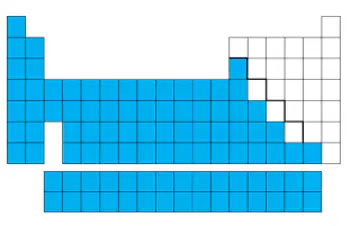
metalloids
nonmetals
metals
groups

Using the image provided, match the color to the Family/Group name.
Alkali Metals
Red
Alkaline Earth Metals
Orange
Transition Metals
White
Boron Family
Yellow
Carbon Family
Green
Using the image provided, match the color to the Family/Group name.
Nitrogen Family
Light Blue
Oxygen
Blue
Halogens
Dark Blue
Noble Gases
Purple

Why do elements form chemical bonds?
Because they're friendly
To create a new element
To become stable
Because they all need to gain more electrons

Atoms are most stable when their outer shell is complete.
True
False

Ionic bonds typically form between
A metal and a nonmetal
Two nonmetals
Two metals
A metalloid and a metal

Fluorine would have properties most like (a)
iodine
potassium
oxygen
neon

Ca
Symbol
20
Atomic Number (Protons)
40
Atomic Mass (protons + neutrons)
Calcium
Common Name
When does an atom become an ion?
When it gains or loses electrons and takes on a charge.
When it is stable because it has a full set of valence electrons.
When it forms a compound with another atom.

Ionic bonds are formed when electrons get
Shared between two atoms
Removed from both atoms
Transferred from one atom to another
Added to both atoms
Categorize the following as either ionic or covalent.
Metal & Nonmetal
Nonmetal & Nonmetal
KF
CO₂
NaCl
FeO
H₂O
CH₄
O₂
NaF
Hydrogen and Chlorine will from a _________ bond
ionic
covalent
metallic
If two fluorine atoms bond they will make a _____ bond.
ionic
covalent
metallic
Which of these element pairs would bond covalently?
Fr and K
Sc and O
F and Cl
He and Pt

When electrons are lost by one atom and gained by another, so that they both get full outer shells.
Covalent bond
Ionic bond
Pairing
Compound
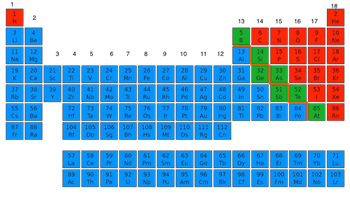
Name this group: These metals are the most reactive.


Name this group: These metals contain familiar metals such as gold, iron, and copper.



