
Font size
 Worksheets
Semester 1 Final Giga Review
Total questions: 82
Worksheet time: 4hrs 53mins

How is AB written in the distance formula?
d = (5−3)2 + (0−−2)2
d = (2−5)2 + (3 −0)2
d = (5−3)2 − (0−−2)2
d = (4−3)2 − (2−4)2
Find the midpoint of the line segment with the given endpoints.
(0, 2), (-2, -8)
(1, 5)
(-4, -18)
(-1, -3)
(1, -5)

Use the picture to write the correct Segment Addition statement.
BC + BA = BC
BA + AC = BC
AB + BC = AC

Use the figure to write and solve an equation for x.
11
19
33
57


The intersection of 2 planes forms ______.
A point
A plane
A line segment
A line
Two or more points that lie on the same line are _________.
coplanar
colinear
collateral
colorado
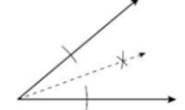
The drawing shows a compass and straight edge construction of...what?
the bisector of a given angle
a perpendicular to a given line at a point on the line
a perpendicular to a given line from a point NOT on the line
an angle congruent to a given angle
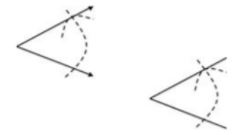
The given diagram is what kind of construction?
Perpendicular bisector
Congruent angles
Angle bisector
Congruent line segments


Name the same-side (consecutive) interior angle to angle 4.


Solve for x and use x to find the measure of the shaded angle.
(a)

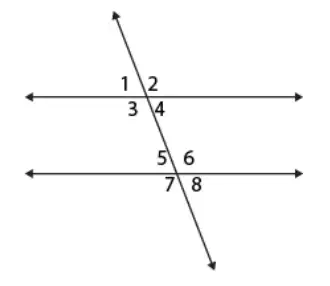
Two parallel lines intersect a transversal. Select all that apply.
Angles 1 and 2 are congruent because they are vertical angles.
Corresponding & alternate interior angles are congruent when a transversal intersects two parallel lines.
Consecutive Interior angles are supplementary.
Vertical angles are always congruent.

Supply the second reason.
Linear Pair Postulate
Alternate Interior Angles Theorem
Vertical Angles Theorem
Corresponding Angles Postulate

Supply the third reason.
Vertical Angle Theorem
Corresponding Angles Postulate
Alternate Interior Angles Postulate
Same Side Interior Angles Theorem

Find the missing angle TSR.
A
B
C
D
What is the sum of interior angles of a triangle?
60 degrees
90 degrees
180 degrees
360 degrees


Identify the transformation. Then use arrow notation to describe the transformation.
The transformation is a 90° rotation. ABC → A'B'C'
The transformation is a 45° rotation. ABC → A'B'C'
The transformation is a reflection. ABC → A'B'C'
The transformation is a translation. ABC → A'B'C'
A figure has vertices at E(-3, 1), F(1, 1), and G(4, 5). After a transformation, the image of the figure has vertices at E'(-3, -1), F'(1, -1), and G'(4, -5). Identify the transformation.
The transformation is a reflection across the x-axis.
The transformation is a 180° rotation.
The transformation is a 90° rotation.
The transformation is a translation.

Find the coordinates for the image of ΔEFG after the translation (x, y) → (x - 6, y + 2). Draw the image.


A triangle has vertices at A(1, 3), B(4, 2), and C(3, 8). Which transformation would produce an image with vertices A'(3, -1), B'(2, -4), C'(8, -3)?
a reflection over the x-axis
a reflection over the y-axis
a rotation 270° counterclockwise about the origin
a rotation 90° counterclockwise about the origin
A triangle has vertices at A(-7, 6), B(4, 9), C(-2, -3). What are the coordinates of each vertex if the triangle is translated 4 units right and 6 units down?
A'(-11, 12), B'(0, 15), C'(-6, 3)
A'(-11, 0), B'(0, 3), C'(-6, -9)
A'(-3, 12), B'(8, 15), C'(2, 3)
A'(-3, 0), B'(8, 3), C'(2, -9)
The point P (-3, 7) is reflected over the line y = x. What are the coordinates of P'?
(7, -3)
(3, -7)
(3, 7)
(-7, 3)

Use the graph to complete the sentence. Figure A'B'C'D' is the image of figure ABCD under a rotation _____________.
270° counterclockwise about the origin.
180° about the origin.
90° counterclockwise about the origin.
270° clockwise about the origin.
What is the arrow notation for a translation 2 units right and 5 units up?
(x, y) --> (x - 2, y - 5)
(x, y) --> (x + 2, y + 5)
(x, y) --> (x + 5, y + 2)
(x, y) --> (5x, 2y)

What are rigid motions?
Transformations that preserve the size and shape of a figure.
A rigid motion that shifts or moves a figure.
A rigid motion that turns a figure around a center point.
The resulting figure after it is transformed, the outputs.
A rule that takes an input and transforms it to produce an output.

reflection across x = -2
reflection across y = -2
Define the following: The figure before a transformation has occurred.
Definition of Congruence: If ∠D ≅ ∠E, then _______________________________
∠D ≅ ∠E
∠E ≅ ∠D
they are congruent
∠D = ∠E
Definition of Complementary Angles: If m∠1 + m∠2 = 90°, then ___________________________________________
They are complementary angles.
They are supplementary angles.
They are vertical angles.
They are adjacent angles.
Supplement Theorem: If ∠X and ∠Y form a linear pair, then _______________________________________
They are supplementary.
They are complementary.
They are congruent.
They are adjacent.
Congruent Complements Theorem: If ∠1 is complementary to ∠2 and ∠2 is complementary to ∠4, then __________________
∠1 is congruent to ∠4.
∠1 is complementary to ∠3.
∠2 is congruent to ∠3.
∠3 is complementary to ∠4.
Congruent Supplements Theorem: If ∠J is supplementary to ∠K and ∠J is supplementary to ∠L, then __________________
∠K and ∠L are congruent.
∠K and ∠L are supplementary.
∠J and ∠K are congruent.
∠J and ∠L are complementary.
If m∠3 + m∠4 = 180°, then ∠3 and ∠4 are supplementary angles.
Definition of Perpendicular
Definition of Complementary ∠'s
Definition of Congruence
Definition of Supplementary ∠'s
If m∠PQR = m∠RST, then ∠PQR ≅ ∠RST
Definition of Perpendicular
Definition of Complementary ∠'s
Definition of Congruence
Definition of Supplementary ∠'s
If ∠PQR and ∠STU are complementary angles, then m∠PQR + m∠STU = 90°.
Definition of Congruence
Definition of Perpendicular
Definition of Supplementary ∠'s
Definition of Complementary ∠'s
If K is between J and L, then JK + KL = JL is justified by which property?
Property of Equality
Property of Congruence
Definition of Addition
Segment Addition Postulate
EF ≅ EF
Reflexive Property of Congruence
Symmetric Property of Congruence
Transitive Property of Congruence
Substitution Property of Equality
If RS = TU, then RS + XY = TU + XY. Which property justifies this statement?
Addition Property of Equality
Subtraction Property of Equality
Multiplication Property of Equality
Division Property of Equality
If AB = DE, then DE = AB. Which property justifies this statement?
Symmetric Property of Equality
Transitive Property of Equality
Reflexive Property of Equality
Substitution Property of Equality
If Y is the midpoint of XZ, then XY = YZ. Which property justifies this statement?
Property of Equality
Property of Congruence
Definition of Midpoint
Postulate
Justify each of the following statements using a property of equality, property of congruence, definition, or postulate. If AB + CD = EF + CD, then AB = EF
Addition Property of Equality
Subtraction Property of Equality
Multiplication Property of Equality
Division Property of Equality
If FG ≅ HI and HI ≅ JK, then FG ≅ JK. Which property justifies this statement?
Transitive Property of Congruence
Reflexive Property of Congruence
Symmetric Property of Congruence
Addition Property of Congruence
Fill in the blank using the substitution property:
If PQ + RS = TV and RS = WX, then ______
PQ + WX = TV
PQ + WX = RS
PQ + WX = PQ
PQ + WX = WX

(X, Y) -> (1/4X, 1/4Y),
what is the dilation factor?
Is it an enlargement or reduction?
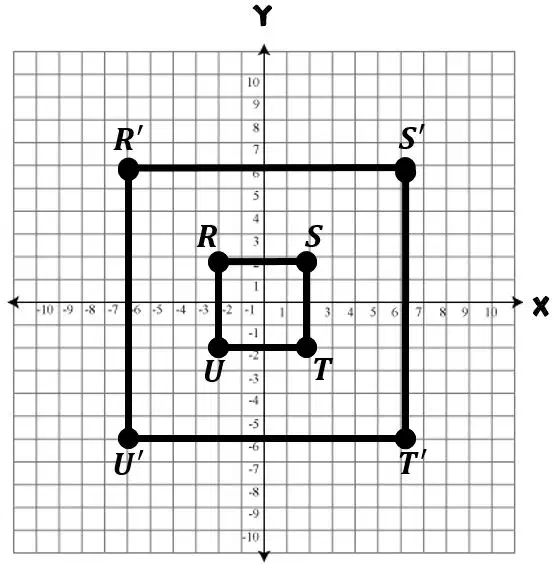
Which transformation is shown?
Dilation k=3
Dilation k =1/2
Dilation, k= 2
Dilation, k=1/3


∠K ≅ ____


What is #4 Statement?
∠MNL ≌ ∠ONP
MN ≌ ON
N ≌ N
MO ≌ OM

What is #3 Reason?
Alternate Exterior Angles are congruent when formed by parallel lines
Alternate Interior Angles are congruent when formed by parallel lines
Vertical Angles are congruent
Definition of Angle Bisector

What postulate or theorem shows that the triangles are congruent?
SSS: Side Side Side
SAS: Side Angle Side
AAS: Angle Angle Side
ASA: Angle Side Angle
HL: Hypotenuse Leg

Which postulate or theorem proves the triangle congruent?
ASA: Angle Side Angle
AAS: Angle Angle Side
AAA: Angle Angle Angle
SSS: Side Side Side
Not enough information

Which postulate or theorem proves the triangle congruent?
ASA: Angle Side Angle
SAS: Side Angle Side
SSA: Side Side Angle
SSS: Side Side Side
Not enough information

Which postulate or theorem proves the triangle congruent?
ASA: Angle Side Angle
SAS: Side Angle Side
SSA: Side Side Angle
SSS: Side Side Side
HL: Hypotenuse Leg

Which postulate or theorem proves the triangle congruent?
ASA: Angle Side Angle
Not enough information
AAA: Angle Angle Angle
SSS: Side Side Side
HL: Hypotenuse Leg

For the parallelogram, find x and y.
x = 30, y = 40
x = 40, y = 30
x = 40, y = 15
x = 30, y = 30
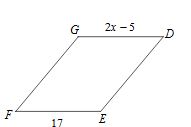
Solve for x.

For the parallelogram, find x and y.
x = 9, y = 4
x = 6, y = 4
x = 6, y = 2
x = 4, y = 2

MNKL is a square. Find the measure of angle MKN.
180 degrees
90 degrees
60 degrees
45 degrees
CHECK ALL THAT APPLY:
All angles are right angles.
Parallelograms
Rhombuses
Rectangles
Squares
CHECK ALL THAT APPLY:
The lengths of the diagonals are congruent.
Parallelograms
Rhombuses
Rectangles
Squares
CHECK ALL THAT APPLY:
All sides are congruent.
Parallelograms
Rhombuses
Rectangles
Squares
CHECK ALL THAT APPLY:
Diagonals bisect the angles.
Parallelograms
Rhombuses
Rectangles
Squares

Using what you about the following Rectangle, solve for x.
9.644 in.
5 in.
22.023 in.
14 in.

If PQRS is a square. Find the length of QR.
3 3
7.3
10.4
9
What quadrilateral is created by the following set of points?
A(-5,-2) B(1,2) C(3,-1) D(-3-5)
Square
Rectangle
Rhombus
Parallelogram
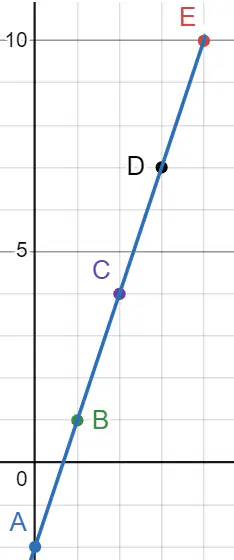
Which point partitions line segment AE to a 1:3 ratio?
B
C
D
E

