
 Worksheets
Chemistry Unit Exam
Total questions: 18
Worksheet time: 54mins
A student conducts a chemical reaction in a closed container and measures the mass before and after the reaction. What should the student expect to find, and why?
The mass stays the same because matter is conserved in closed systems
The mass increases because new matter is created
The mass decreases because matter escapes
The mass changes randomly
Which statement correctly compares the number of atoms in the reactant and in the products?
A chemical equation is shown: 2H₂O₂ (liquid hydrogen peroxide) → 2H₂O (liquid water) + O₂ (oxygen gas)
The number of atoms in each molecule of liquid water is equal to the number of atoms in each molecule of oxygen gas.
The number of atoms in each molecule of hydrogen peroxide is equal to the number of atoms in each molecule of oxygen gas.
The total number of atoms in the hydrogen peroxide molecules is equal to the total number of atoms in the liquid water and oxygen gas molecules.
The total number of atoms in the hydrogen peroxide molecules is equal to the total number of atoms in each molecule of liquid water.
A student measures the mass of a tarnished silver ring and 50 mL of a baking soda solution. The student puts the ring in a pan, adds the baking soda solution to the pan, and stirs it well. After 30 minutes, the student removes the ring from the pan, and it appears shiny and new. The student observes tiny, yellow flakes in the solution at the bottom of the pan.
What is the student MOST LIKELY to discover about the mass of the ring and the solution after the ring is removed from the pan?
Move the correct answer to each box.
The mass of the ring will (a) . The mass of the solution will solution will (b) . The total mass of the ring and the solution will (c) .
An equation for a chemical reaction is shown. NaOH + HCl → NaCl + H₂O Which statement provides evidence that mass is conserved in the reaction?
Two new substances are formed in the products.
Water is one of the products, but not one of the reactants.
Two hydrogen atoms are in the reactants, and two hydrogen atoms are in the products.
One chlorine atom pairs with one sodium atom in the products, and one chlorine atom pairs with one hydrogen atom in the reactants.
The chemical formula for acetic acid is CH₃COOH. How many hydrogen atoms are in one molecule of acetic acid?
3
4
5
6
Which statement is an accurate comparison of the formula for ammonia (NH₃) and the formula for sodium hydroxide (NaOH)?
The formula for sodium hydroxide has more atoms and more elements than the formula for ammonia.
The formula for ammonia has more atoms and more elements than the formula for sodium hydroxide.
The formula for sodium hydroxide has more atoms, but the formula for ammonia has more elements.
The formula for ammonia has more atoms, but the formula for sodium hydroxide has more elements.
The mineral albite is composed of four elements and has the chemical formula NaAlSi₃O₈. Which of these elements does albite contain?
Astatine
Sulfur
Nitrogen
Aluminum
The chemical formula for methane is CH₄. Which statement describes the atoms present in FOUR molecules of methane?
Four molecules of methane would contain 1 atom of carbon and 4 atoms of hydrogen.
Four molecules of methane would contain 4 atoms of carbon and 1 atom of hydrogen.
Four molecules of methane would contain 4 atoms of carbon and 16 atoms of hydrogen.
Four molecules of methane would contain 16 atoms of carbon and 16 atoms of hydrogen.
A student places ice cubes into a beaker filled with warm water. Which statement BEST identifies and explains the change that will occur to the ice cubes?
They will undergo a physical change to the state of matter, from solid to liquid.
They will undergo a chemical change that permanently changes the shape of the ice cubes in the liquid.
They will undergo a physical change caused by a transfer of heat from the ice cubes to the liquid.
They will undergo a chemical change because a new substance, made up of a solid and liquid, is formed.
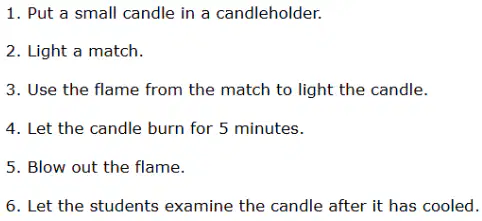
A teacher performs these steps for a class demonstration and students record their observations (above).
What is an example of a physical change that occurred during the demonstration AND what is an example of a chemical change during the demonstration? Explain your reasoning.
Read the question carefully and then type your answer and explanation.
Matter can undergo physical or chemical changes. Which of these are examples of physical changes? Select TWO correct answers.
Burning wood
Breaking an egg
Cooking an egg
Freezing a popsicle
Rusting iron
An element has these properties: - is ductile - has a shiny luster - is solid at room temperature - is a good conductor of thermal energy Which element has the properties listed?
Arsenic (As)
Neon (Ne)
Palladium (Pd)
Silicon (Si)
Elements that are generally good conductors of heat and electricity are (a) .
Elements that are generally poor conductors of heat and electricity are (b) .
Elements that are average conductors of heat and electricity are (c) .

A chemist observes two elements and records the observations in the table show.
What is the most likely classification of Element X and Element Y?
Element X and Element Y are both metals.
Element X and Element Y are both metalloids.
Element X is a metal, and Element Y is a metalloid.
Element X is a metalloid, and Element Y is a metal.
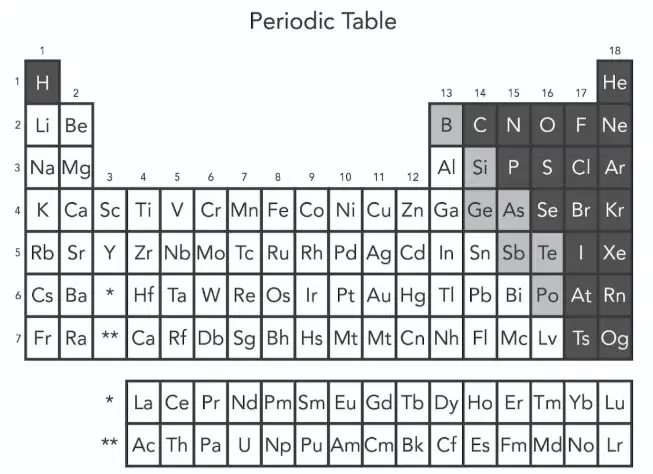
All the known elements are listed in the periodic table.
A chemist has a sample of an element. The chemist makes the following observations of the element:
Solid
Malleable
Shiny
High electrical conductivity
High thermal conductivity
Gray color
Which type of element could the chemist be studying?
The element could be Ag because Ag is a metal.
The element could be Sn because Sn is a metalloid.
The element could be Ge because Ge is a metalloid.
The element could be Ar because Ar is a nonmetal.
Two students mix together a substance. A precipitate forms. This is likely a (a) . Two other signs of this type of change are (b) and (c) .
Which of the following words best completes these sentences?
Two white powders are mixed and added to water in a beaker. The beaker immediately turns cold. A color change was not observed.
Did a chemical change occur?
No, because no gas formed.
Yes, because there was no color change.
Yes, because there was a change in temperature.
No, because there was no color change.
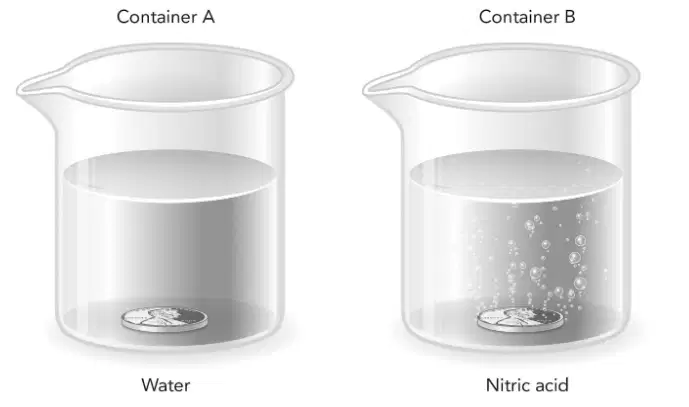
A student puts pennies into separate containers. The image shows the results.
Which container showed a chemical change?
Container A because the penny got wet in the water.
Container B because bubbles formed in the liquid.
Containers A and B because the penny was a precipitate.
Containers A and B because there was a change in heat.

