
 Worksheets
Study Guide (8th Grade Science Winter Exam) — Unit 1 and Unit 2
Total questions: 104
Worksheet time: 52mins
Physical science is the study of (nonliving/living) things.
Nonliving things
Living things
What is the goal of science?
To explain and understand the natural world using evidence
To prove personal opinions are correct
To keep traditions unchanged
To collect facts without drawing conclusions
What accumulates over time in order for science to progress?
Knowledge built from evidence
Random guesses
Unchanging rules
Personal beliefs
What are the two branches of physical science?
Physics and chemistry
Biology and geology
Astronomy and zoology
Ecology and botany
Does physical science follow a strict sequence of unchangeable steps?
No, the process can vary
Yes, the steps never change
What gives matter the ability to change?
Energy
Mass
Shape
Volume
The study of matter and energy at the scale of atoms and molecules is called ________.
Chemistry
Geology
Meteorology
Astronomy
What are the forms energy can take?
Kinetic and potential
Solid and liquid
Hot and cold
Mass and volume
Give an example of a problem that is most likely to be investigated by a physical scientist.
How the mass of a ball affects its acceleration down a ramp
How leaves make food in a plant
Why a species of bird migrates earlier in the spring
How a vaccine triggers an immune response
Place the following steps of the scientific method in the correct order: Experiment – Observation – Hypothesis – Conclusion.
Observation → Hypothesis → Experiment → Conclusion
Hypothesis → Observation → Experiment → Conclusion
Experiment → Observation → Hypothesis → Conclusion
Observation → Experiment → Hypothesis → Conclusion
What should a scientist do after forming a hypothesis?
Design and conduct an experiment to test it
Write the final report immediately
Change the hypothesis until results fit
Ignore evidence that disagrees
Label the sentence: "The increased amount of CO2 in the air is because of pollution." Choose hypothesis, question, or observation.
Hypothesis
Question
Observation
Label the sentence: "Why is there so much CO2 in the air?" Choose hypothesis, question, or observation.
Hypothesis
Question
Observation
Label the sentence: "I wonder if the CO2 in the air is causing pollution." Choose hypothesis, question, or observation.
Hypothesis
Question
Observation
Place the 5 steps of the scientific method in order.
Ask a question → Form a hypothesis → Conduct an experiment → Analyze data → Draw a conclusion
Make an observation → Draw a conclusion → Form a hypothesis → Analyze data → Conduct an experiment
Ask a question → Conduct an experiment → Form a hypothesis → Analyze data → Draw a conclusion
Form a hypothesis → Analyze data → Conduct an experiment → Ask a question → Draw a conclusion
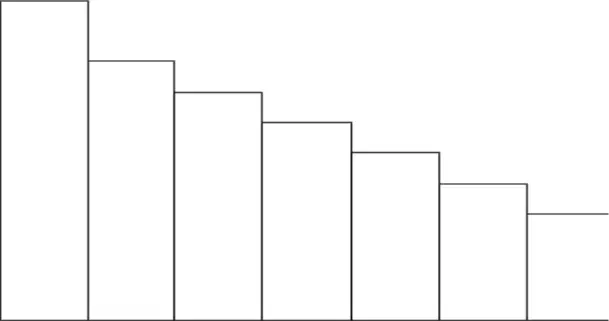
Fill in the unit conversion stairs.
kilo → hecto → deka → base (meter/liter/gram) → deci → centi → milli
kilo → deci → centi → milli → base → hecto → deka
milli → centi → deci → base → deka → hecto → kilo
base → kilo → hecto → deka → deci → centi → milli
How many grams are in 1 kilogram?
1,000 g
100 g
100,000 g
10 g
What prefix multiplies a basic SI unit by 0.001 ?
Milli-
Centi-
Deci-
Micro-
What prefix multiplies a basic SI unit by 0.01 ?
Centi-
Milli-
Deci-
Micro-
Complete the conversion: 2,000 m= ______.
2 km
0.2 km
20 km
200 km
Complete the conversion: 5,000 m= ______.
5 km
0.5 km
50 km
500 km
Complete the conversion: 3 kg= ______.
3,000 g
300 g
30 g
3 g
What SI base unit is used to measure length?
Meter (m)
Gram (g)
Liter (L)
Second (s)
In the USA, what unit is used to measure length?
Inches, feet, and miles (customary units)
Meters and kilometers only
Liters and grams
Newtons
What piece of lab equipment measures the volume of a liquid?
Graduated cylinder
Triple-beam balance
Thermometer
Meterstick
The amount of matter in a substance is called what?
Mass
Volume
Density
Weight
What is the measure of how closely packed together the particles of matter are in a specific substance or object called?
Density
Volume
Mass
Buoyancy
How do we find the volume of an irregularly shaped object?
By using water displacement in a graduated cylinder
By measuring its length, width, and height and multiplying
By weighing it and dividing by density
By measuring with a ruler and protractor
Which has the greater density: Helium with density 0.167 kg/m3 or air with density 1.225 kg/m3 ?
Helium
Air
If an object has a mass of 60 g and a volume of 30 cm3 , what is the object's density?
0.5 g/cm3
2 g/cm3
30 g/cm3
1 g/cm3
At 4∘C , water has a density of 1000 kg/m3 and ice has a density of 917 kg/m3 . Why does ice float in water?
Ice is less dense than water
Ice is more massive than water
Water repels solid ice
Ice has a larger volume than water
A graduated cylinder contains 10 mL of water. After an irregular solid is added, the level rises to 25 mL . What is the volume of the irregular solid?
10 mL
15 mL
25 mL
35 mL
Given mass =60 g and volume =30 mL , what is the density of the substance?
0.5 g/mL
1.5 g/mL
2.0 g/mL
3.0 g/mL
Given volume =10.4 mL and density =7.75 g/mL , what is the mass?
72.2 g
80.6 g
88.0 g
104.0 g
Given mass =598 g and density =1.04 g/mL , what is the volume?
556 mL
570 mL
575 mL
598 mL
A property that can be measured or observed without matter changing to an entirely different substance is called what?
A physical property
A chemical property
A mixture
A reaction
Which of the following are physical properties of matter? Select all that apply.
Density
Color
Volume
Reactivity
Flammability
To see if a substance is sugar or salt, we can dissolve it in alcohol. The ability of a substance to dissolve is known as what?
Solubility
Electrical conductivity
Density
Malleability
What is a characteristic of matter that can be observed as it changes to a different type of matter?
A chemical property
A physical property
An extensive property
A mixture
Which of the following are chemical properties of matter? Select all that apply.
Flammability
Reactivity with acids
Ability to rust
Density
Color
Rust forms when iron is exposed to water and oxygen during what process?
Oxidation
Melting
Evaporation
Condensation
What is the ability of matter to combine chemically with other substances known as?
Reactivity
Conductivity
Solubility
Malleability
What are the building blocks of matter?
atoms
molecules
compounds
elements
All atoms of the same element can have different numbers of what?
protons
neutrons
electrons
nuclei
Which subatomic particles make up an atom? Select all that apply.
protons
neutrons
electrons
photons
Which subatomic particles are in the nucleus of an atom? Select all that apply.
protons
neutrons
electrons
positrons
What charge does a proton have?
positive
negative
neutral
What charge does a neutron have?
positive
negative
neutral
What charge does an electron have?
positive
negative
neutral
What does the atomic number tell us?
number of protons
number of neutrons
total electrons
number of valence electrons
What does the atomic mass tell us?
number of protons
number of neutrons
total of protons and neutrons
electrons plus protons
How many neutrons are in Carbon-14? (14 is the atomic mass. 6 is the atomic number.)
6
8
14
20
What is an atom that has a positive or negative charge because it has unequal numbers of protons and electrons?
isotope
ion
molecule
element
What are atoms of the same element that differ in their numbers of neutrons called?
ions
isotopes
molecules
allotropes
What do we call a negatively charged ion?
cation
anion
isotope
neutral atom
What is a pure substance that cannot be separated into any other substances?
mixture
compound
element
solution
An element is represented by how many capital letter(s)?
one capital letter
multiple capital letters
lowercase letters only
a symbol with a number but no letters
A compound is represented by how many capital letter(s)?
one capital letter
multiple capital letters
a single lowercase letter
a single number
Which of the following are examples of elements? Select all that apply.
oxygen
water
sodium
iron
carbon dioxide
What is the most common element in the universe?
oxygen
hydrogen
carbon
helium
Which are properties of metals? Select all that apply.
good conductors of heat and electricity
typically malleable and ductile
tend to be brittle
often have luster
Which are properties of metalloids? Select all that apply.
have properties of both metals and nonmetals
act as semiconductors
generally very reactive metals
usually gases at room temperature
Which are properties of nonmetals? Select all that apply.
poor conductors of heat and electricity
brittle when solid
dull appearance
malleable and ductile
What are unique substances that form when two or more elements combine chemically?
mixtures
solutions
compounds
alloys
The properties of a compound can be which of the following compared to the properties of the elements that form them?
different from
the same as
identical and unchanged
unpredictable only
What elements make up the compound H2O ?
hydrogen and oxygen
hydrogen and nitrogen
oxygen and carbon
carbon and hydrogen
How much carbon, hydrogen, and oxygen are in the compound C6H12O6 ?
6 carbon, 12 hydrogen, 6 oxygen
1 carbon, 2 hydrogen, 1 oxygen
12 carbon, 6 hydrogen, 6 oxygen
6 carbon, 6 hydrogen, 12 oxygen
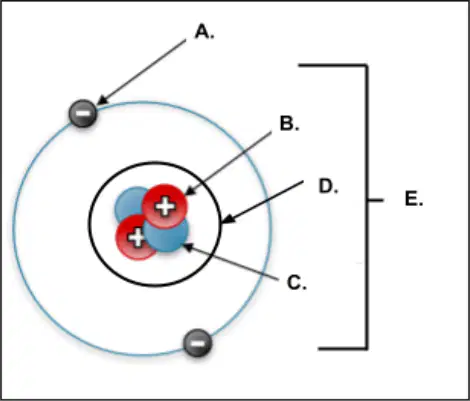
Label A in the atom diagram: Identify what the label A points to in the pictured atom.
Electron
Proton
Neutron
Nucleus
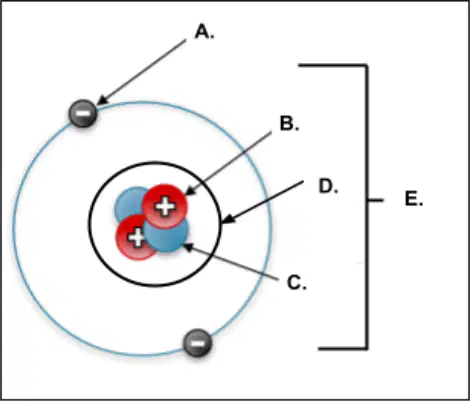
Label B in the atom diagram: Identify what the label B points to in the pictured atom.
Energy level (electron shell)
Electron
Proton
Neutron
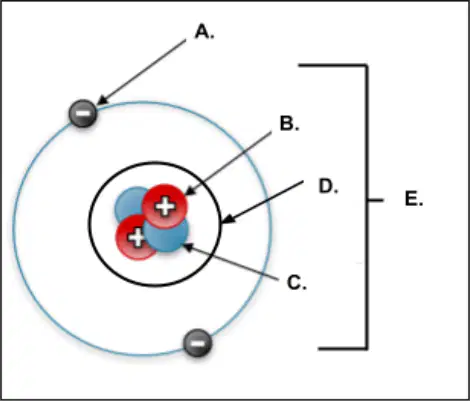
Label C in the atom diagram: Identify what the label C points to in the pictured atom.
Neutron
Electron
Proton
Nucleus
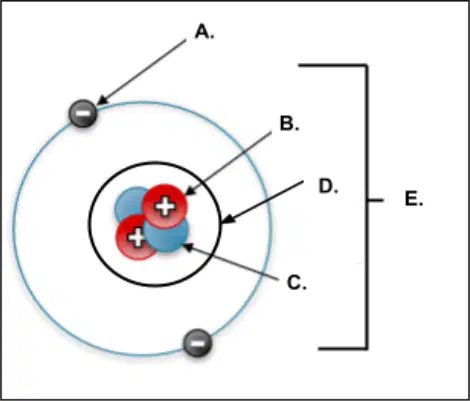
Label D in the atom diagram: Identify what the label D points to in the pictured atom.
Proton
Electron
Neutron
Energy level (shell)
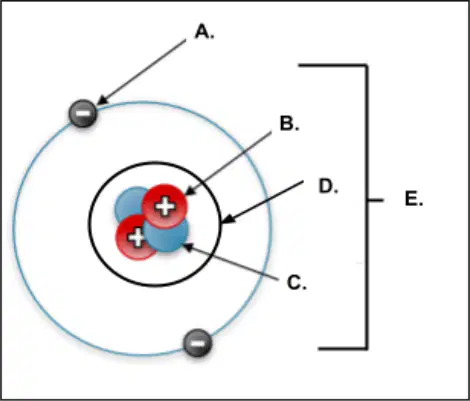
Label E in the atom diagram: Identify what the bracket E represents in the pictured atom.
Electron cloud (all energy levels)
Single proton
Single energy level only
Nucleus only
What are the electrons in the outermost energy level of an atom known as?
Valence electrons
Core electrons
Protons
Nuclear electrons
Which rule states that atoms tend to want 8 valence electrons in their outer shell to be stable?
Octet rule
Pauli exclusion principle
Law of conservation of mass
Heisenberg uncertainty principle
What determines the chemical behaviors of atoms?
Protons
Neutrons
Valence electrons
Atomic mass
Why are noble gases in group 18 of the periodic table very unreactive?
They have full outer electron shells
They contain no protons
They have unstable nuclei
They share electrons easily
Which element in group 18 only has 2 valence electrons?
Helium
Neon
Argon
Krypton
For oxygen (O), how many valence electrons should be shown in its electron dot diagram?
6
2
4
8
For boron (B), how many valence electrons should be shown in its electron dot diagram?
3
2
5
7
For chlorine (Cl), how many valence electrons should be shown in its electron dot diagram?
7
5
6
8
For argon (Ar), how many valence electrons should be shown in its electron dot diagram?
8
6
4
2
For beryllium (Be), how many valence electrons should be shown in its electron dot diagram?
2
3
4
6
Rubidium (Rb) contains 1 valence electron.
True
False
Tin (Sn) contains 4 valence electrons.
True
False
Xenon (Xe) contains 8 valence electrons.
True
False
Helium (He) has 8 valence electrons.
True
False
All elements in the same group (column) have the same number of what?
Valence electrons
Protons
Neutrons
Energy levels
What is a force of attraction between atoms or ions called?
Chemical bond
Electric field
Magnetic force
Nuclear force
What is the bond between metals and nonmetals that holds together oppositely charged ions called?
Ionic bond
Covalent bond
Metallic bond
Hydrogen bond
How many electrons typically make a full outer shell for most atoms?
8
2
10
12
Classify the bonding in NaCl.
Ionic
Covalent
Metallic
Hydrogen
Classify the bonding in FeAu.
Metallic
Ionic
Covalent
Hydrogen
Classify the bonding in CO.
Covalent
Ionic
Metallic
Hydrogen
In ionic compounds, which types of elements become cations?
Metals
Nonmetals
Metalloids
Noble gases
Why do metals tend to lose valence electrons?
To achieve a stable full outer shell
Because electrons repel the nucleus completely
To decrease their number of protons
To become nonmetals
In ionic compounds, which types of elements become anions?
Nonmetals
Metals
Noble gases
Metalloids
Why do nonmetals tend to gain valence electrons?
To achieve a stable full outer shell
To increase atomic mass
To lose energy levels
To become metals
Complete the statement about ionic bonds: Ionic bonds ______ electrons.
transfer
share
split evenly
create new protons from
Complete the statement about covalent bonds: Covalent bonds ______ electrons.
share
transfer
destroy
repel
What is the term for a covalent bond where electrons are not shared equally between two atoms?
Polar covalent bond
Nonpolar covalent bond
Ionic bond
Metallic bond
What is the term for a covalent bond where valence electrons are shared equally between two atoms?
Nonpolar covalent bond
Polar covalent bond
Ionic bond
Metallic bond
Up to how many covalent bonds can nitrogen form?
3
2
4
1
Identify the properties of covalent compounds.
Low melting and boiling points
Poor electrical conductivity
Often gases or liquids at room temperature
Form molecules with definite shapes
Conduct electricity when dissolved in water
Identify the properties of ionic compounds.
High melting and boiling points
Conduct electricity when molten or dissolved
Form crystal lattices
Often gases at room temperature
Do not conduct electricity in any state

