
 Worksheets
World Geography Semester Exam Review - 1A
Total questions: 78
Worksheet time: 7hrs 30mins
Seasons change throughout the year because of two factors. The two factors are:
The calendar
The tilt of the earth
The revolution of the earth
Both B and C
The sun is shining directly on the Southern Hemisphere. What season is it in Sherman?
Summer
Winter
Spring
Fall
The part of a map tells us the directions is called:
Compass Rose
Longitude and Latitude
Key/Legend
Scale
The imaginary line at 0 degrees latitude that divides the earth into Northern and Southern hemispheres is called the Prime Meridian.
True
False
Using the Longitude and Latitude of a place gives us:
the GPS
the relative location
the address of a place
the absolute location
An appropriate way to best represent the earth is to use:
a globe
a map
an atlas
a GPS
The part of a map that tells what the lines, colors, and symbols mean is called:
Compass Rose
Longitude and Latitude
Key/Legend
Scale
This part of a map represents the distance.
Compass rose
Key/Legend
Scale
Title
This line divides the world into two hemispheres, Eastern and Western.
Equator
Latitude
Prime Meridian
This line divides the world into two hemispheres, Northern and Southern.
Prime Meridian
Equator
Latitude
This part of a map shows you the directions.
Title
Key/Legend
Compass Rose
Scale
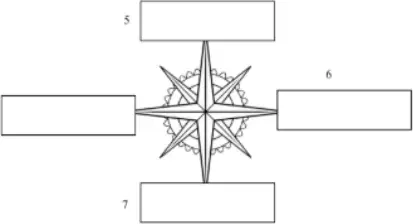
Label the 4 cardinal directions.
North, South, East, West
Up, Down, Left, Right
Spring, Summer, Fall, Winter
Red, Blue, Green, Yellow
What is the Earth's outer layer called?
Lithosphere
Mantle
Core
Crust
Which layer is under the crust and is not solid but not liquid either?
Upper Mantle
Inner Core
Outer Core
Crust
Which layer is made of melted rock but is cooler than the core?
Crust
Mantle
Outer Core
Lithosphere
Which layer is all fluid and controls the earth’s magnetic field?
Inner Core
Crust
Mantle
Outer Core
A narrow piece of land that connects two large landmasses.
island
peninsula
Isthmus
strait
Parts of land that rise above the rest of the land with steep slopes and a peak.
mountains
plains
valleys
plateaus
_____ Parts of land that rise above the rest of the land that are more rounded.
plains
valleys
rivers
hills
A large flat area of land that is higher than the surrounding land.
plateau
valley
plain
desert
Flat, gently rolling land.
mountain
plain
valley
plateau
A long hollow in the earth’s surface.
valley
mountain
river
desert
A piece of land that extends outward from a continent and is surrounded by water on three sides.
valley
island
mountain
peninsula
Any body of land smaller than a continent that is completely surrounded by water.
island
lake
peninsula
mountain
A group of closely scattered islands.
peninsula
archipelago
continent
isthmus
A narrow waterway connecting two large bodies of water.
bay
island
peninsula
strait
A body of water completely surrounded by land.
lake
river
ocean
pond
A body of water flowing through the land.
forest
mountain
river
desert
A stream of water of considerable volume.
mountain
river
forest
desert
Which of the following is the definition of region?
The exact location of someone or something
The basic unit of geography where areas are defined by a certain characteristic
The way people change themselves or their environment
The description of people's surroundings
Place is defined by what?
Landforms and buildings
Physical and human characteristics
Address and location
Absolute and relative location
What is the purpose of LATITUDE?
Measures how far east or west from the Prime Meridian
Measures how far above sea level
The direction of passing a ball in rugby
Measures how far north or south from the equator
Geography is ----.
The study of the atom and all of its particles inside and outside
The name of the book I have to read in class
A "view of the whole" earth by mapping the location of places
A class I have to take
The two types of locations are:
GPS and map
Place and region
Absolute and relative
Address and relative
Which of the following is NOT an example of human-environment interaction?
Building a bridge over a river
Wearing warm clothes in winter
Watching television at home
Planting trees in a park
Which of the following is an example of humans modifying the environment?
Humans adapting to environments by wearing appropriate clothes in different weather types
Water eroding the riverbanks
Humans modify the environment by using heaters in the winter
Humans depend on the environment i.e. farmers need water to grow crops.
Which statement best describes what movement means?
Movement is when people interact and exchange information through email, mail, etc
Movement is when people adapt to their environment
Movement is when people move their bodies like their arms or their legs
Movement is when people use GPS to locate where they are
A way of life of a group of people who share traditions, interests, beliefs, and ways of making a living.
Culture
Climate
Economy
Government
A culture that has organized a social, economic, and political system and has achieved a certain level of development in the arts and sciences.
Tribe
Tradition
Civilization
Community
The written information about a people’s past
History
Geography
Biology
Mathematics
The time in people’s past before written records were kept
Modern Era
Renaissance
Industrial Age
Prehistory
Objects that were made or used by people (weapons, tools, pottery, etc)
Fossils
Artifacts
Minerals
Landforms
Places where civilization began
Fountain of Youth
Deserts of isolation
Cultural Hearths
Islands of exile
The spread of people, ideas, practices, and goods from one culture to another
Cultural isolation
Cultural assimilation
Cultural diffusion
Cultural stagnation
A group of languages having similar beginnings
Language family
Dialect
Alphabet
Script
An organized way of worshipping a spiritual being or thinking about life
Religion
Festival
Tradition
Myth
A system of government where people vote for their leaders
Democracy
Monarchy
Dictatorship
Oligarchy
A system of government where a country is ruled by a few leaders
Republic
Democracy
Monarchy
Oligarchy
A system of government where a country is ruled by representatives
Republic
Monarchy
Dictatorship
Theocracy
A system of government where the government owns everything and all decisions are made for the masses
Democracy
Communism
Monarchy
Capitalism
A system of government where one leader has full power over a country
Dictatorship
Democracy
Monarchy
Republic
A mixed system of government between a king/queen and a representative body (like Parliament in Britain)
Republic
Absolute monarchy
Direct democracy
Constitutional Monarchy
The quality of life based on available material goods
Gross Domestic Product
Standard of Living
Inflation Rate
Unemployment Rate
The measure of how much money per person a country/region earns
Standard of Living
Gross Domestic Product
Inflation Rate
Per Capita Income
The way people of a country produce, get, and use goods and services
Economic Systems
Political Systems
Social Customs
Cultural Traditions
Private businesses operate with little interference from government
Socialism
Communism
Capitalism
Feudalism
A system of government that decides how resources will be used and how business will be run
Communism
Democracy
Monarchy
Capitalism
The area of North America is:
24.7 million square kilometers
17.8 million square kilometers
30.2 million square kilometers
12.5 million square kilometers
North America covers an area of:
More than 7 million square miles
More than 9 million square miles
More than 11 million square miles
More than 15 million square miles
North America is located in which hemispheres?
Northern and Eastern
Southern and Western
Northern and Western
Southern and Eastern
What connects North America to South America?
Strait of Gibraltar
Isthmus of Panama
Bering Strait
Suez Canal
What is the highest peak in North America?
Mount McKinley
Denali
Mount Robson
Pico de Orizaba
Which mountain range is located in eastern North America?
Rocky Mountains
Sierra Madre
Appalachian Mountains
Cascade Range
What is the Canadian Shield?
A mountain range
A large plateau surrounding Hudson Bay
A desert region
A river system
How much rainfall do the Sonoran, Mojave, and Chihuahuan deserts receive per year?
Less than 5 inches
Less than 10 inches
Less than 15 inches
Less than 20 inches
What is the longest river in North America?
Missouri River
Colorado River
Which is the largest of the Great Lakes?
Lake Michigan
Lake Huron
Lake Erie
Lake Superior
During which months do hurricanes typically occur in North America?
March–August
June–October
September–December
January–May
Which animals are commonly found in the tundra region?
Jaguars and parrots
Prairie dogs and pronghorns
Musk oxen and polar bears
Moose and deer
What is Greenland famous for in terms of natural phenomena?
Volcanic eruptions
Aurora borealis (northern lights)
Frequent earthquakes
Tropical storms
What is the main language spoken in Mexico?
English
French
Portuguese
Spanish
Which river forms part of the U.S.–Mexico border?
Colorado River
Rio Grande/Rio Bravo
Mississippi River
Missouri River
What is Canada's rank in terms of country size worldwide?
First-largest
Second-largest
Third-largest
Fourth-largest
What is the capital of Canada?
Toronto
Montreal
Vancouver
Ottawa
How many provinces and territories does Canada have?
8 provinces and 2 territories
10 provinces and 3 territories
12 provinces and 1 territory
9 provinces and 4 territories
Which ocean borders North America to the west?
Atlantic Ocean
Arctic Ocean
Pacific Ocean
Indian Ocean
What type of vegetation dominates the Great Plains region?
Coniferous forests
Tropical rainforests
Desert cacti
Grasses and prairies
Which butterfly species migrates from the U.S./Canada to Mexico?
Swallowtail butterflies
Monarch butterflies
Blue morpho butterflies
Painted lady butterflies

