
 Worksheets
Environmental Science IA Final Exam - Ecosystems Unit
Total questions: 74
Worksheet time: 37mins
Primary producers could also be called…
Heterotrophs
Detritivores
Decomposers
Autotrophs
A rock is a non-living part of an ecosystem, so it could be called a(n)…
Non-Alive factor
Biotic factor
Abiotic factor
Biofactor
A group of the same species of organism living in the same location at the same time would be called:
A. A population
B. A community
C. A clade
D. An ecosystem
In a forest ecosystem, trees provide habitats and food for animals, and use water and minerals from the soil. They also compete with each other for resources. The information above is describing the tree’s…
Population
Habitat
Niche
Density
Abiotic & Biotic factors interacting together would best be described as a(n)…
Ecosystem
Habitat
Genetic diversity
Ecotype
Which of the following is an example of a typical carnivore?
A caterpillar
A cow
A lion
A deer
The biosphere describes….
Non-living things in the environment
Layer of the earth where life exists
Layer of the atmosphere that surrounds earth
Area directly above the troposphere
You find a small group of wolves that live together in one ecosystem. They tend to stay in one region and breed even though there are other wolves farther away. This group would be considered…
A species
A population
A habitat
A biome
An ecological community is defined as:
A population of the same organism
All of the herbivores in one ecosystem
Any place where life can exist
Groups of interacting populations in the same location
Which is a producer?
Poison ivy
Fungi living off rotting trees
Decomposers
Fish eating insects
This provides energy for most of the life on Earth
The moon
The sun
The atmosphere
The Earth’s core
The place where an organism lives is called its…
Biome
Population
Species
Habitat
The purpose of this process is to create sugars for organisms to use for energy.
Respiration
Photosynthesis
Digestion
Excretion
The chemical reaction photosynthesis cannot occur without carbon dioxide, sunlight, and…
Water
Sugar
Oxygen
ATP
In this model, the hawk is a…
Secondary consumer
Primary consumer
Tertiary consumer
Producer
When the frog eats the grasshopper, approximately what percentage of the grasshopper’s energy will the frog actually get to use?
A. 5-20%
B. 25-50%
C. 55-75%
D. 80-95%
The frog population would go up if which organism was removed from the ecosystem?
The hawk
The grasshoppers
The grass
Any of the above

Which organism is eating the producer?
The Frog
The grasshoppers
The hawk
The grass
Which types of organisms utilize cellular respiration to get energy from food?
Fungi
Animals
Bacteria
All of the above
A & B only
Which of the following makes food the others can use for energy?
Primary consumers
Secondary consumers
Producers
Tertiary consumers
An organism that eats others for food is a:
Producer
Heterotroph
Autotroph
Both A and C
Which of the following is FALSE when it comes to decomposers?
They rely on cellular respiration for their energy
They play an important part in the carbon and nitrogen cycles
They rely on photosynthesis for making their food
Without them, dead organisms would break-down much slower
A species that is introduced to a new environment and rapidly takes over is known as a(n)…
Native species
Invasive species
Omnivorous species
Parasitic species
The abundance and different types of organisms found in an environment is also known as the environment’s…
Facilitative sum
Adaptability
Niche variety
Biodiversity
Use respiration to get energy
A
H
A + H
Make food using photosynthesis
A
H
A + H
Form the bottom of an ecological pyramid
A
H
A + H
Eat other organisms for energy
A
H
A + H
Plants remove carbon dioxide from the atmosphere. This is one way carbon goes from the atmosphere into living things
True
False
Each year the total amount of carbon and other elements on Earth changes a great deal.
True
False
31. True or False: Carbon is usually converted into nitrogen
True
False
Organisms release carbon into the atmosphere during cellular respiration
True
False
Carbon dioxide is a natural part of the atmosphere and necessary for life
True
False
Relationship between species in which both species benefit.
Mutualism
Competition
Parasitism
Commensalism
Predation
Relationship between two species in which one species is neither helped nor harmed and the other one benefits.
Mutualism
Competition
Parasitism
Commensalism
Predation
Relationship between two species that are trying to use the same limited resources
Mutualism
Competition
Parasitism
Commensalism
Predation
A relationship between two species where one species lives off of another and harms it without usually killing it.
Mutualism
Competition
Parasitism
Commensalism
Predation
Generally speaking, the total amount of carbon on Earth would NOT change much, but the percentage of carbon found in each system (ex: atmosphere) can
True
False
Generally speaking, the total amount of energy found on Earth would NOT change over time, but it would change forms
True
False
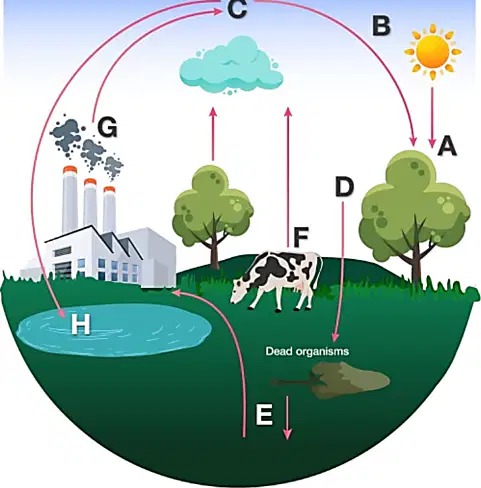
Which arrow best represents carbon dioxide moving from the atmosphere to the biosphere?
G
F
D
B
Populations are all the members one species that live in the same place at the same time
True
False
Carrying capacity is fixed (cannot go up or down)
True
False
Mortality rate is the number of organisms that are dying over time
True
False
Immigration is the number of organisms coming into a population over time
True
False
If you are studying an ecosystem, that is the same thing as studying a population
True
False

The type of growth the population to the right is showing is BEST described as…
Exponential
Logarithmic
Quadratic
Zero growth
A population shows zero growth when…
The birth rate is equal to zero
The population is declining
The death rate is equal to zero
The birth rate and death rate are equal
A population typically undergoes exponential growth when it has an abundance of resources and…
It has not reached its carrying capacity
It has many limiting factors
Its birth rates and death rates are equal
It is very close to carrying capacity
Something that prevents a population from growing continuously
Limiting factor
Exclusion
Causal agent
None of these
If something is a density-dependent factor, that means that it…
A. Affects dense populations and sparse populations the same
B. Affects dense populations and sparse populations differently
C. Affects only dense populations
D. Affects all populations equally
A population has its highest growth rate when this is happening
There are many more new individuals being added than there are dying
There are just as many individuals being added as there are dying
The population is close to carrying capacity
The population is at its highest point
One type of evolution where a trait becomes more common because it gives the organism an advantage in a certain environment
Sexual selection
Genetic drift
Natural selection
Artificial selection
Term meaning that there are many different versions of a gene within a population
Genetic variation
Phenotypic variation
Cryptic variation
Phenotypic plasticity
Name of the scientist who is credited with publishing the “Origin of Species”. He came-up with the theory of evolution by natural selection
Mendel
Lamarck
Wallace
Darwin
A change in the DNA of an organism is known as a(n)
Anomaly
Genotype
Mutation
Responding characteristic
Generally, evolution in biology means…
Organisms become better adapted to an environment
The genes of a populations change over time
Ecosystems go through specific sequences of changes
Stronger, faster organisms survive and become more common over time
A specific physical trait or behavior that an organism has genetically inherited is best known as a(n)
Artificial characteristics
Phenotypic advantage
Genotypic response
A species is defined as
a population of organisms similar in size, shape, and color
a group of organisms that live in the same habitat
a population of organisms that are able to interbreed and make fertile offspring
a population of organisms that have the same number of chromosomes
a population of organisms with a common ancestor
What’s wrong with this statement: “evolution is where species better adapted to their environments tend to survive and reproduce more”?
There is nothing wrong with this statement, it is correct
This is only true of microevolution, not macroevolution
This is only true of macroevolution, not microevolution
This is describing natural selection and it’s only 1 way evolution happens
How are genes and evolution related?
When a population’s genes change over time, that’s evolution
When a population’s genes stay the same over time, that’s evolution
Evolution only happens to genes in certain populations of organisms
Evolution cannot change the genes of a population, just an individual
Which of these is NOT necessary in order for evolution to occur in a population?
Genetic variation
Human influence determining which traits get passed on
Different percentages of survival and reproduction
Inheritance of traits
One modern example of evolution impacting humans is the evolution of drug-resistant bacteria sometimes referred to as “super bugs.” Which statement below best explains how these bacteria have come to exist through evolution?
A. Exposure to the antibiotics kills-off bacteria that are not resistant, leaving only drug-resistant bacteria around. The drug-resistant bacteria reproduce and their offspring are harder to kill
B. When exposed to antibiotics, the bacteria communicate with each other and determine how best to fight it. The next generation is much more resistant
C. Bacteria exposed to antibiotics die but leave behind genetic instructions that allow new bacteria the opportunity to become resistant after consuming them
D. Bacterial DNA does not change over time but the antibiotics become less likely to work due to build-up of chemicals in human environments
How is DNA related to evolution?
Evolution looks at traits that are not genetic, DNA deals with genetic traits
Mutations in DNA can changes traits and some traits become more common over time
DNA controls the genes of an organism, but evolution only deals with its adaptations
There is no relationship between DNA and evolution
Evolution is the process where…
The DNA of ONE SINGLE ORGANISM changes
Species decide which traits are the best for their environments
The DNA of a population of organisms change
Natural selection is one form of evolution where…
Certain traits make an organism more likely to pass its genes on
Certain traits make an organism more likely to mutate and interbreed
Genes change at random and are passed-on by chance
Genes from the most fit parent get passed-down to the offspring
If there were suddenly no new mutations in the world…
Populations could continue to evolve, but new traits would not arise
New adaptations would start arising even faster
Populations would most likely start to evolve even faster
New adaptations would still arise, but they would only harm species
Your friend remarks, "The giraffe stretched its neck while reaching for higher leaves; as a result, its offspring inherited longer necks" Which statement is the best response to correct your friend’s misconception?
Overproduction of offspring leads to a struggle for survival.
Only favorable adaptations have survival value.
Characteristics acquired during an organism's life are generally not passed on through genes to its offspring.
Disuse of an organ may lead to its eventual disappearance.
The more closely related two different organisms are, the
more recently they shared a common ancestor
more similar their habitats are
less similar their DNA sequences are
less likely they are to have the same genes in common
Which of the following is probably the best explanation for the fact that Antarctic penguins cannot fly, although there is evidence that millions of years ago their ancestors could do so?
Penguins live on land and feed in the water; therefore they have no need to fly.
The Antarctic home of penguins is flat and barren; therefore there is no place to fly.
Ancestral penguins without large wings were better able to swim and feed in the water; therefore they passed their genes for shorter wings structure onto their offspring.
Ancestral penguins did not use their wings for long periods of time; therefore today’s penguins have only tiny, nonfunctional wings.
Which of the following examples best illustrates how evolution could happen at random?
A. A predator moves into an area and tends to eat larger beetles. Beetles that happen to carry genes making them smaller tend to better survive and reproduce so smaller beetles become more common
B. A disease arrives in an area and kills-off almost all of the mice. Only mice that...
Microevolution, or evolution at its smallest scale, occurs when
an individual's traits change in response to environmental factors.
a community of organisms changes due to extinction of several dominant species.
a new species arises from an existing species.
a population's gene frequencies change over a span of generations.
Are humans evolving?
Yes – the genes of humans continue to change but only when we choose to change them
Yes – the genes of human populations continue to change over time
No – humans are already highly evolved so they have no need to change over time
No – human genes are not subject to natural selection
Evolution happens…
Randomly only
Nonrandomly only
Randomly and nonrandomly
Humans prefer certain traits in a species of canine. They choose and interbreed individuals that best showcase those traits, making the traits become more common over time.
Natural selection
Artificial selection
Genetic drift
Mutation

