
 Worksheets
Final Exam Biology 2 2025
Total questions: 79
Worksheet time: 40mins
Mitosis can be used by organisms to:
Grow
Replace damaged cells
Create identical cells
All of the above
None of the above
Cell transport that requires energy to move materials into and out of the cell is
Passive transport
Diffusion
Osmosis
Active transport
The process of making identical cells for growth, repair, or asexual reproduction is
Mitosis
Meiosis
Cloning
All of the above
None of the above
SpongeBob is homozygous dominant for his square shape. His wife, SpongeSusie, is heterozygous for square shape. What is the probability that they will have a square-shaped child?
0%
25%
50%
75%
100%
A color-blind man marries a woman who is a carrier for color blindness. What is the probability that they will have a son who is color blind?
100%
75%
50%
25%
0%
Greater genetic diversity results from
Independent assortment of genes
Crossing over during Prophase I
Random mating among species
All of the above
None of the above
If a cell is placed in a solution that contains 80% water, and the cell contains 50% water, in which direction will water move? (Hint: Think about osmosis.)
Water will move out of the cell.
Water will move into the cell.
Water will not move into or out of the cell.
Water never leaves the cell.
Which form of cell transport uses protein channels to move large molecules in, but does NOT require energy?
Osmosis
Diffusion
Facilitated diffusion
All of the above
None of the above
Which process returns blood sugar to a normal level after a person eats a very sugary snack?
Respiration
Digestion
Homeostasis
Circulation
Which of the following is an example of a positive feedback loop?
Childbirth
Sweating
Respiration
Digestion
Which strand of DNA below would be the complementary strand to the DNA sequence CTC AAG TGC TTC?
CUC AAG UGC UUC
GAG UUC ACG AAG
GAG TTC ACG AAG
AFA CCT GTA GGA
LADY GAGA RULZ
What is the purpose of DNA replication?
To make exact copies of DNA before the cell divides
To change the hereditary information of the cell
To make proteins using RNA
To introduce variation into the process of meiosis
What is a mutation?
A change in the DNA sequence
A change to a protein that has a negative effect on the individual protein
A change to a protein that has a positive effect on the individual protein
A change in phenotype
Natural selection can best be described as:
Organisms that are better adapted to their environment survive to produce more offspring.
Nature selects against organisms that it does not like.
Organisms will randomly survive to reproduce.
All of the above.
None of the above.
There are many pieces of evidence for evolution. Which of the following are considered evidence?
Fossil Record
Homologous structures
DNA
All of the above
None of the above
Organisms that are made up of only one cell are called
Viruses
Unicellular
Simple
Complex
Species that reproduce sexually pass their traits onto their offspring. The offspring inherit
Half of their genes from the father and half from the mother
A random assortment of genes from each parent
More genetic information from the mother because the egg is larger than the sperm
More genetic information from the father because the sperm is dominant
A Punnett Square is a tool used to:
Show sex-linked traits through generations
Show dominant and recessive allele patterns
Predict the probability of the genotype of offspring
All of the above
None of the above
If an organism is heterozygous for a trait, what does it mean?
They have one dominant allele and one recessive allele.
They are hybrid.
Both of the above.
None of the above.
If an organism is homozygous for a trait, it means:
They have two dominant alleles.
They have two recessive alleles.
They are purebred.
All of the above.
None of the above.
If an organism is heterozygous, the recessive allele:
Is masked or hidden by the dominant allele
Cannot be passed on to their offspring
Will only be expressed if the dominant allele fails or is damaged
All of the above
None of the above
In an organism that is codominant for a trait, if it has two DIFFERENT dominant alleles (e.g., AB), what happens?
Both alleles are expressed
Neither allele is expressed (they cancel each other out)
The first allele is expressed and the second allele is hidden
A blend of the alleles is expressed (e.g., red flower crossed with white = pink)
Genetic diversity in organisms that reproduce sexually occurs because of
Crossing over during meiosis
Inheritance of genetic information from both parents
Both of the above
None of the above
The correct order of the phases of mitosis is:
Prophase, metaphase, anaphase, telophase
Interphase, prophase, anaphase, telophase
Prophase, interphase, anaphase, metaphase
Interphase, metaphase, anaphase, telophase
Meiosis, the process used to produce gamete cells (eggs and sperm), only occurs in organisms that reproduce sexually.
True
False
A cat has 38 chromosomes in its normal body cells. How many chromosomes would be present in its gamete cells?
28
38
19
16
The allele for brown eyes is dominant, and the allele for blue eyes is recessive. A heterozygous brown-eyed woman and a homozygous blue-eyed man have a baby. What is the probability that the baby will have blue eyes?
25%
50%
75%
100%
Mutations can be:
Beneficial to the organism
Harmful to the organism
Have no effect on the organism
All of the above
The main function of the nervous system is:
Receive and interpret information from the five senses.
Control digestion and excretion.
Pump blood throughout the body.
None of the above.
What is the main function of the skeletal system?
Produce immune responses to protect the body from bacteria.
Control heart rate and respiration.
Digest and process food.
Provide a framework for muscles and protect vital internal organs.
The circulatory system is composed of:
Blood, bones, and tendons
Veins, arteries, and plasma
Veins, arteries, blood, and the heart
Heart, lungs, and trachea
The four main components of blood are:
Plasma, platelets, glucose, and proteins
Proteins, carbohydrates, lipids, and fatty acids
Plasma, platelets, white blood cells, and red blood cells
Plasma, protein, white blood cells, and red blood cells
An example of homeostasis is:
Sweating
Eating
Growing
Sleeping
Cells that have membrane-bound organelles are classified as:
Eukaryotic cells
Prokaryotic cells
Executive cells
All of the above
None of the above
Cellular division that produces identical cells is
Mitosis
Meiosis
Cellular respiration
Homeostasis is the ability to:
Replicate cells for growth and repair
Fight pathogens in the body
Maintain a stable internal environment
Heal wounds and help blood clot
Cellular respiration is performed by living organisms in order to
Reproduce
Produce energy for cellular processes
Exchange toxins and chemicals
All of the above
None of the above
There are two types of cells.
Prokaryotic and eukaryotic
Simple and complex
Nerve and muscle
Bone and blood
The organelle where DNA is found in the cell is:
Cytoplasm
Ribosome
Cell membrane
Nucleus
The part of the cell that controls what enters and exits the cell is the
Cytoplasm
Nucleus
Cell membrane
Golgi Apparatus
The movement of water into a cell is:
Osmosis
Active transport
Protein-mediated transport
Phagocytosis
The four basic macromolecules are:
Proteins, lipids, fats, and nucleic acids
Proteins, lipids, amino acids, and nucleic acids
Proteins, lipids, carbohydrates, and amino acids
Proteins, lipids, carbohydrates, and nucleic acids
The smallest unit of life is:
Atom
Organelle
Cell
DNA
The organism's genetic makeup or alleles is its
Genotype
Phenotype
Chromosomal snapshot
Autosomal DNA
The physical appearance of an organism is called its
Genotype
Phenotype
Chromosomal snapshot
Karyotype
DNA codes for:
Carbohydrate
Nucleic acids
Proteins
Lipids
The cell spends most of its time in:
Interphase
Prophase
Metaphase
Anaphase
What type of cells does meiosis produce?
Gametes
Sperm cells
Egg cells
All of the above
None of the above
How many chromosomes does a normal human body cell have?
23
46
92
12
Enzymes are an example of which type of biomolecule?
Proteins
Lipids
Carbohydrates
Nucleic acids
Which biological molecule makes up cell membranes and stores energy for the long term?
Proteins
Lipids
Carbohydrates
Nucleic acids
Which biological molecule speeds up reactions and builds muscle?
Proteins
Lipids
Carbohydrates
Nucleic acids
Which biological molecule makes up nucleotides, DNA and RNA?
Proteins
Lipids
Carbohydrates
Nucleic acids
DNA codes for
Proteins
Lipids
Carbohydrates
Nucleic acids
Which of the following has these 4 bases: adenine, uracil, cytosine, guanine?
DNA
RNA
Proteins
Nucleotides
Making an RNA segment of a DNA segment is called
Transplantation
Transcription
Metabolism
What do you call the 3-base segments found on RNA?
Triplets
Codons
Nucleotides
Tripods
Making a protein from RNA is called
Transcription
Translation
Metabolism
Homeostasis
What is the name of the sugar in DNA?
Ribose
Deoxyribose
Deoxyglucose
Glucose
What process is responsible for making gamete cells?
Meiosis
Mitosis
Metabolism
Reproduction
Protein synthesis occurs in the
Nucleus
Golgi Complex
Ribosome
DNA
What is the term “fitness” in the biological sense?
The ability to live a long time
The ability to stay healthy and in shape
The ability to outwit other species
The ability to produce a lot of offspring
A species of frog living in a shady area of a pond has two skin colors, light green and dark green. Over time, there are more dark green frogs in the population. This would be an example of
Fitness
Natural selection
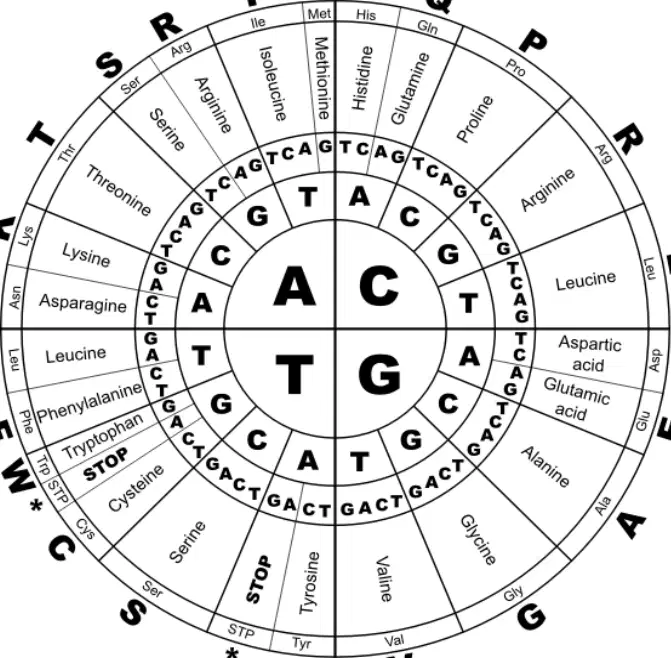
What amino acid correspond with the following codon: CAT
Asparagine
Tyrosine
Histidine
Stop
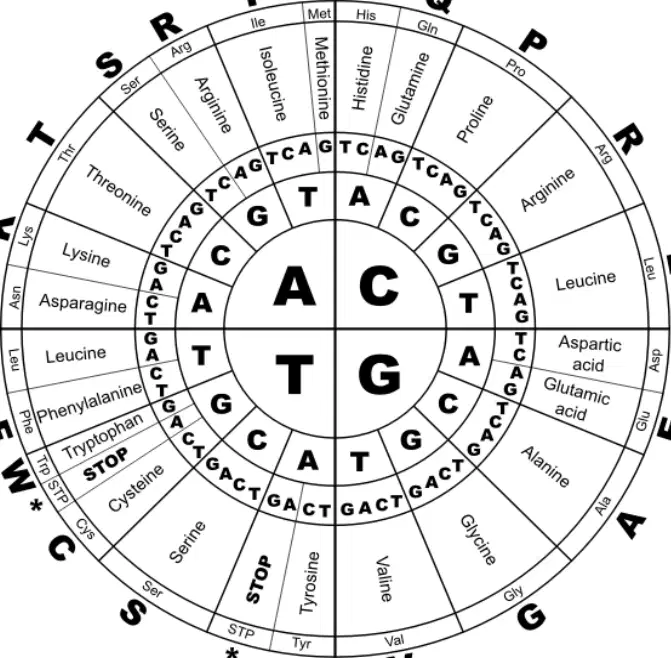
What amino acid correspond with the following codon: TAG
Tyrosine
Cysteine
Tryptophan
Crossing over occurs during which phase of meiosis?
Interphase
Telophase
Metaphase
Prophase
A picture that shows all of the chromosomes of an organism is a
Pedigree
Punnett square
Karyotype
Polaroid
Evolutionary change happens
Quickly
Over a few generations
Over thousands of years
Only can occur if a mutation in the genetic code occurs
An example of a caterpillar turning into a butterfly is
Reproduction
Growth and development
Homeostasis
Excretion
How do mutations affect the fitness of a species?
They may have no effect
They may have a positive effect
They may have a negative effect
All of the above
None of the above
In the biological sense, “fitness” is defined as
How healthy an organism is
How long an organism lives
How strong an organism is
How many offspring an organism produces
Which frogs will be selected against?
Frogs with light green skin
Frogs with dark green skin
Frogs that are speckled with both colors
All the above
None of the above
After several generations of reproduction, what would you expect to observe in the frog population?
A greater percentage of the frog population will be dark skinned
A greater percentage of the frog population will be light skinned
There will be an equal number of dark and light skinned frogs
The frogs with light green skin will become extinct
Evidence that supports the theory of evolution is
Fossils
Homologous and analogous structures
Embryology
All the above
None of the above
Genes code for
Proteins
Traits
DNA
RNA
Osmosis is the movement of
Proteins into the cell
Solutes into the cell
Water from a high concentration to a lower concentration
All of the above
None of the above
Passive transport requires energy
True
False
Facilitated diffusion requires energy
True
False
Active transport requires energy
True
False

