
 Worksheets
2nd Sem Physics Final 2024
Total questions: 84
Worksheet time: 42mins
Name
Class
Date
1.
Current is...
a)
moving protons
b)
moving electrons
c)
measured in volts
d)
measured in ohms
2.
Resistance is...
a)
What "slows down" electrons
b)
What "speeds up" electrons
c)
Moving electrons
d)
What "pushes" electrons
3.
Clouds form during the process of...
a)
evaporation
b)
condensation
c)
precipitation
d)
runoff
4.
Which term best describes water vapor?
a)
Solid
b)
Liquid
c)
Gas
5.
What are clouds made out of?
a)
Molecules of pure oxygen
b)
ozone and carbon dioxide
c)
water droplets, dust, and smoke particles
d)
78% nitrogen, 21% oxygen, and 1% other gases
6.
As the air temperature increases, the air's capacity for water vapor:
a)
increases
b)
decreases
c)
remains the same
d)
is unrelated to air temperature and can either increase or decrease
7.
What gas makes up 3/4th of earth's air?
a)
oxygen
b)
nitrogen
c)
carbon
8.
What force pulls the air down?
a)
gravity
b)
barometric pressure
c)
electricity energy
d)
elastic energy
9.
What type of large scale winds blow constantly, predictably, and over long distances?
a)
mountain breezes
b)
global winds
c)
land breezes
d)
sea breezes
10.
Where does the initial source of energy come from that creates winds?
a)
the moon
b)
the sun
c)
the Earth's surface
d)
the rotation of the Earth
11.
The Coriolis effect causes ___________.
a)
the Earth to rotate on its axis
b)
earthquakes
c)
global winds to move in a curved path instead of a straight line
d)
the Earth to revolve around the sun
12.
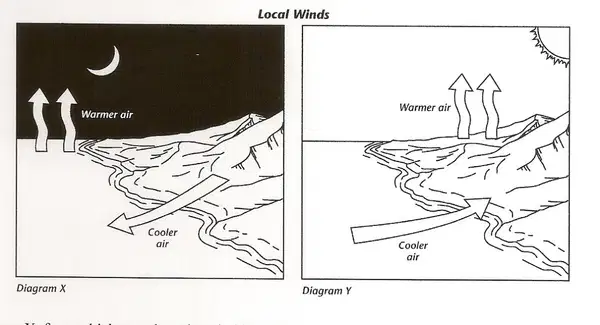
Which diagram shows the formation of a land breeze?
a)
diagram Y
b)
diagram X
c)
neither
d)
both
13.
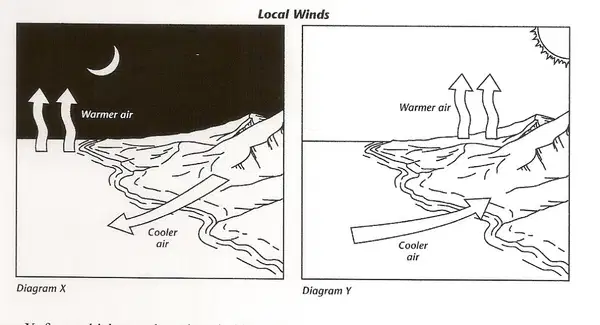
Which diagram shows the formation of a sea breeze?
a)
diagram Y
b)
diagram X
c)
neither
d)
both
14.
Which statement correctly describes the properties of cold air?
a)
less dense and less pressure than warm air
b)
more dense and more pressure than warm air
c)
more dense and less pressure than warm air
d)
less dense and more pressure than warm air
15.
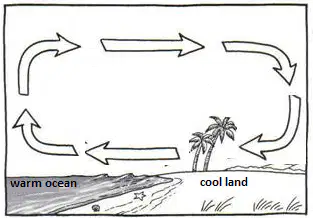
What kind of breeze is this and when would it form?
a)
Land breeze - daytime
b)
Land breeze - nighttime
c)
Sea breeze - daytime
d)
Sea breeze - nighttime
16.
In which direction do the westerlies flow?
a)
from east to west
b)
from west to east
c)
from north to south
d)
from south to north
17.
Which global winds are found at the poles?
a)
Polar Westerlies
b)
Prevailing Easterlies
c)
Polar Easterlies
d)
Trade Winds
18.
The tropical winds running that blow from east to west near the Equator are called the
a)
subtropical westerlies
b)
polar westerlies
c)
Equatorial easterlies
d)
polar winds
19.
Warm, rising air near the equator creates an area of very little wind called the:
a)
Doldrums
b)
Trade Winds
c)
Polar Easterlies
d)
Westerlies
20.
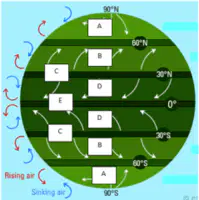
Which global wind belt is found at letter E?
a)
Polar Easterlies
b)
Prevailing Westerlies
c)
Doldrums
d)
Tradewinds
21.
As you go higher in the troposphere, the temperature _______________.
a)
decreases
b)
increases
c)
stays the same
22.
Voltage is simply defined as...
a)
what 'pushes' electrons
b)
what 'stops' electrons
c)
moving electrons
23.
What characteristics impact resistance of a material?
a)
Thickness
b)
Temperature
c)
Length
d)
All of these
24.
An object through which electrons can easily flow is called a(n) ___________.
a)
Conductor
b)
Insulator
25.
current is measured in....
a)
volts
b)
amps
c)
watts
d)
mph
26.
If the voltage stays the same, but the resistance goes up, the current will....
a)
increase (speed up)
b)
decrease (slow down)
c)
stay the same
27.
To have a complete electric circuit, the path must be _____
a)
small
b)
closed
c)
big
d)
open
28.
An electric current is made up of _____ charged electrons
a)
neutral
b)
negative
c)
positive
d)
balanced
29.
What size resistor would produce a 3 Amp current flow with a 12 Volt battery
a)
1 Ohm
b)
3 Ohms
c)
4 Ohms
d)
12 Ohms
30.
What is resistance measured in?
a)
Ω (Ohms)
b)
V (Volts)
c)
A (Amps)
d)
W (Watts)
31.
What is Resistance?
a)
The flow of electrons
b)
Electric potential difference
c)
A battery
d)
The ability to reduce the flow of electrons
32.
What types of charges attract?
a)
Positive and Positive
b)
Positive and Neutral
c)
Negative and Neutral
d)
Positive and Negative
33.
What is the Voltage of a circuit that has a resistance of 5 Ω and a current of 2 A?
a)
25 V
b)
10 V
c)
2.5 V
d)
0.4 V
34.
If the Voltage is increased and the resistance stays the same, Current will
a)
Increase
b)
Decrease
c)
Stay the same
d)
X
35.
If the battery produced 12 Volts what would be the current flow for a 6 Ohm resistor?
a)
2.1 Amps
b)
2.4 Amps
c)
60 Amps
d)
2 Amps
36.
How many Volts would we need to produce a current flow of 8 Amps through a 6 Ohm resistor
a)
12 volts
b)
24 volts
c)
1.3333
d)
48 volts
37.
This circuit has a 24 volt battery and the resistor is 6 ohms. How many amps are running through the circuit?
a)
3 Amps
b)
192 Amps
c)
2 Amps
d)
4 Amps
38.
A gas has
a)
A definite volume and no definite shape
b)
A definite volume and definite shape
c)
No definite volume but definite shape
d)
no definite volume and no definite shape
39.
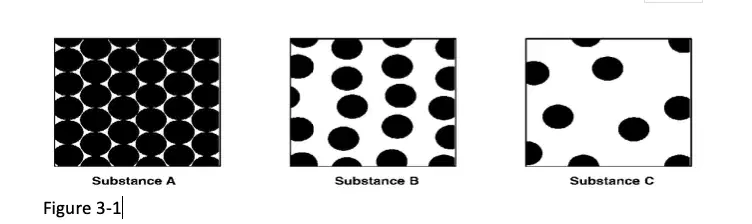
In which of the substances in Figure 3-1 are the Intermolecular forces among the particles so weak that they can be ignored under ordinary conditions?
a)
A
b)
B
c)
C
40.
In which phase of matter are particles only vibrating in a back and forth motion (moving at their slowest)?
a)
a gas
b)
a solid
c)
a liquid
d)
both b and c
41.
Forces of attraction limit the motion of particles most in...... (Particles moving slowest)
a)
solid
b)
liquid
c)
gas
d)
both liquid and gas
42.
Intermolecular forces limit the motion of particles most in
a)
liquid
b)
both b and c
c)
gas
d)
solid
43.
If you move a substance from one container to another and its volume changes, the substance is a ...... the substance is moving freely.......
a)
solid
b)
liquid
c)
gas
d)
both liquid and gas
44.
If you move a substance from one container to another and its shape does NOT change, the substance is a
a)
liquid
b)
both a and b
c)
gas
d)
solid
45.
If you move a substance from one container to another and its shape changes, but the volume remains the same, the substance is a
a)
solid
b)
liquid
c)
gas
d)
both b and c
46.
What two types of measurements make up DENSITY?
a)
Mass and Volume
b)
Temperature and Mass
c)
Grams and Centimeters
d)
Volume and Weight
47.
Frank has a paper clip. It has a mass of 9g and a volume of 3 ml. What is its density?
a)
3 g/ml
b)
1/3 g/ml
c)
27 g/ml
d)
39 g/ml
48.
Jack has a rock. The rock has a mass of 14g and a volume of 2 ml. What is the density of the rock?
a)
7 mL
b)
28 g/ml
c)
7 g/ml
d)
7 g
49.
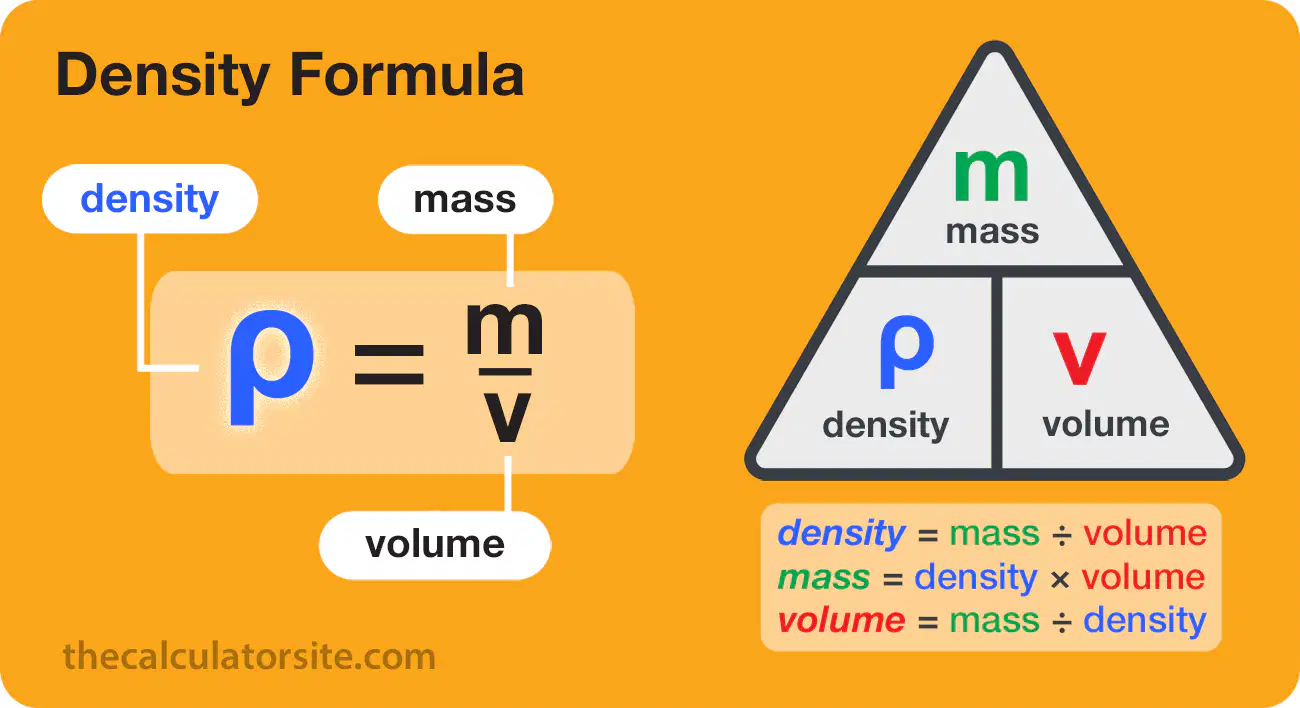
Which ones can be units for density?
(Multiple responses)
a)
N/ml
b)
KG/N
c)
g/mm
d)
g/cm cubed
50.
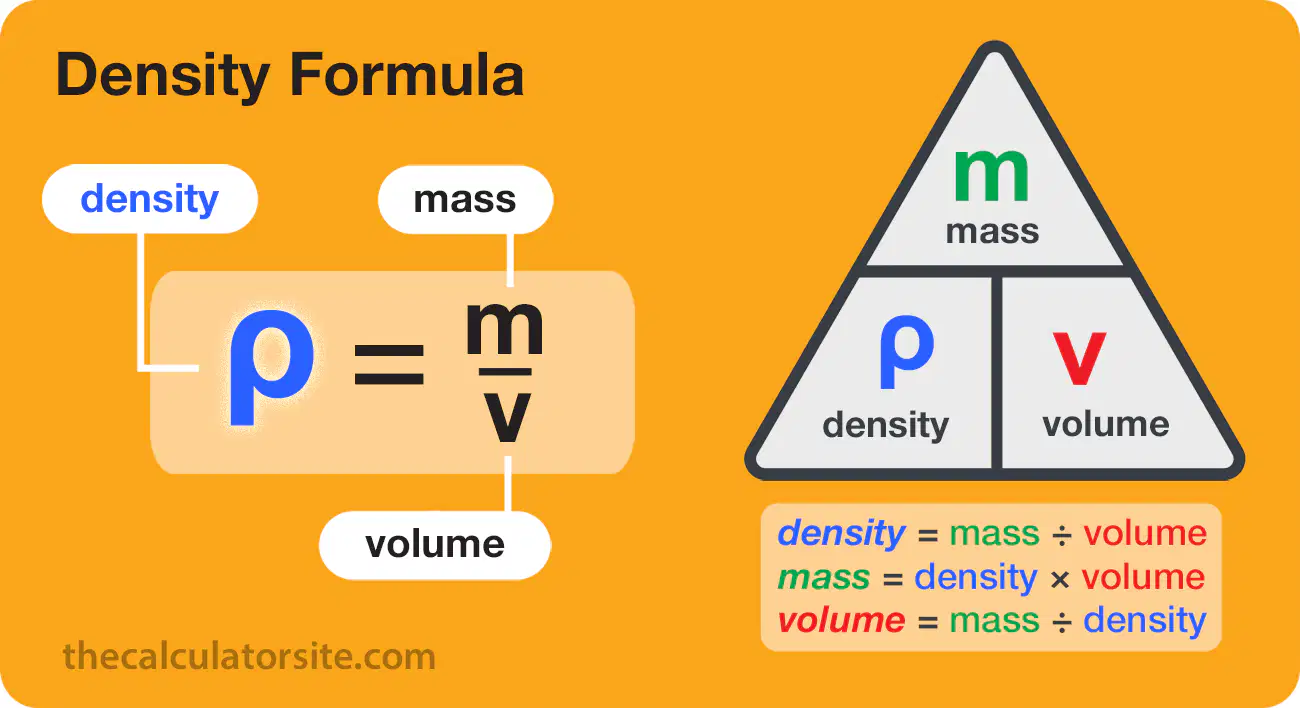
What is the mass of a 25 cm3 liquid if it has a density of 5 g/cm3?
a)
125 g
b)
5 g
c)
0.2 cm
d)
125g/cm cubed
51.
Helium balloons rise on earth because?
a)
helium is less dense than air
b)
helium is more dense than air
c)
helium is cooler than air
d)
helium is warmer than air
52.
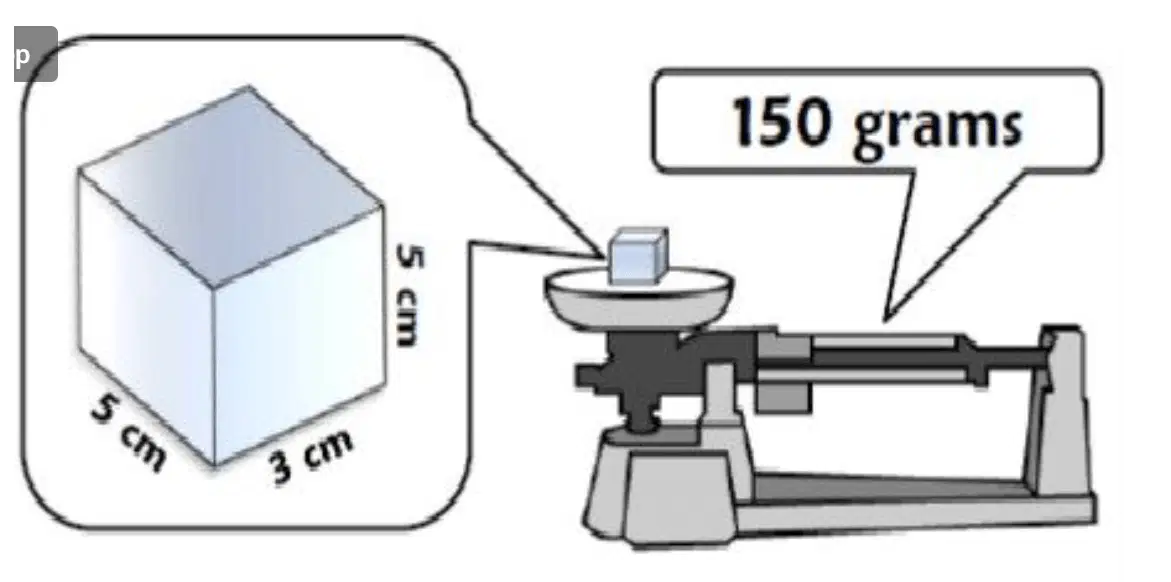
Calculate the density of the rectangular prism
a)
2 g/cm3
b)
4 g/cm3
c)
6 g/cm3
d)
2 g/cm2
53.
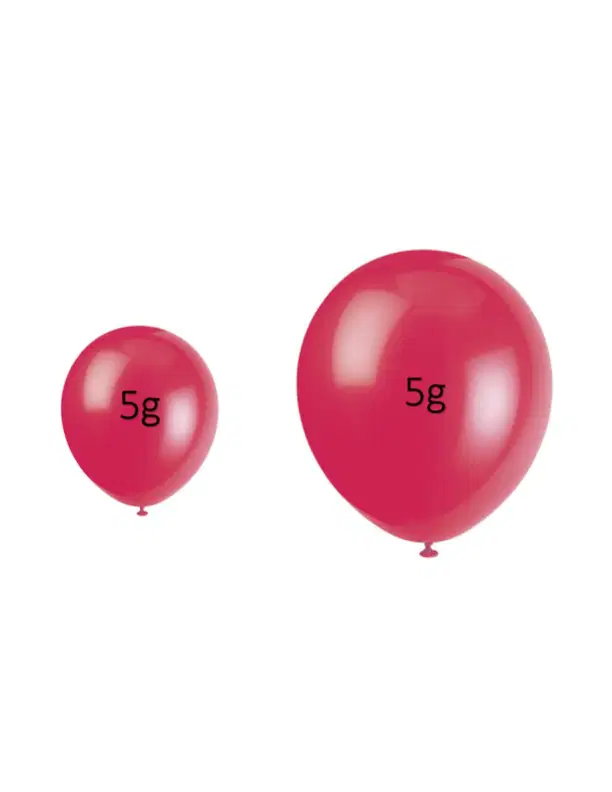
What happens to the density of the balloon if volume is doubled?
a)
The density is cut in half.
b)
The density stays the same.
c)
The density doubles.
d)
Not enough information to tell.
54.
As a substance is COOLED its VOLUME...
a)
increase
b)
decreases
c)
remains equal
d)
doubles
55.

As a substance is HEATED it's DENSITY...
a)
increase
b)
decreases
c)
remains equal
d)
turns to plasma
56.
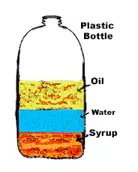
Which liquid is the most dense? (like you :)
a)
oil
b)
water
c)
gas
d)
syrup
57.
Which of the following best describes a star? A star is a celestial body ---
a)
composed of rock and metal with a very high density
b)
that is too big to be an asteroid, but too small to be a planet.
c)
that rotates on an axis and revolves around the Sun
d)
composed of gases that emit light due to nuclear reactions
58.
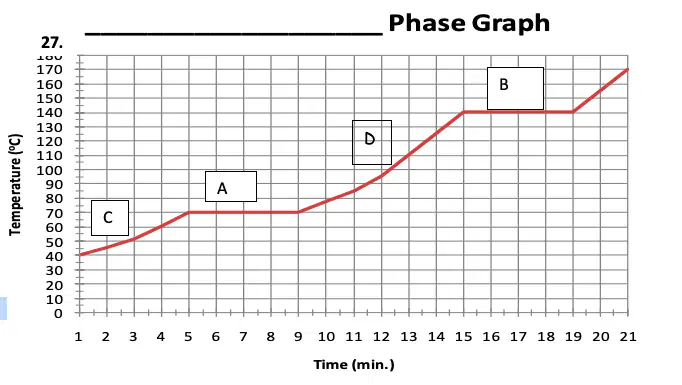
At what point on the graph are both Solid and Liquid present
a)
A
b)
B
c)
C
d)
D
59.
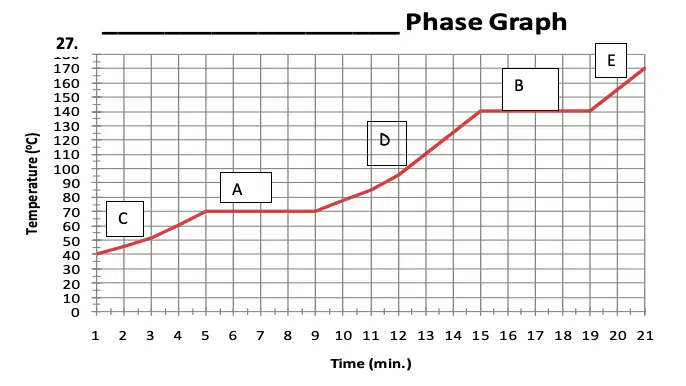
At what point on the graph are the molecule's Kinetic energy (energy of motion) the HIGHEST?
a)
A
b)
B
c)
C
d)
D
e)
E
60.
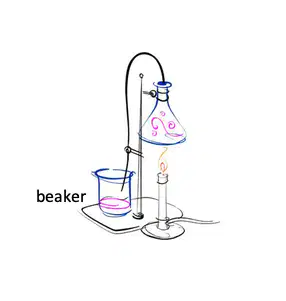
Is energy ABSORBED or RELEASED during the phase change described in the previous question (gas turning into liquid)
a)
Absorbed
b)
Released
61.
When you freeze a substance, the temperature is not changing. However energy is either being absorbed or released. Which one is it?
a)
released
b)
absorbed
62.
Which statement describes the nucleus of an atom of radium-235?
a)
88 protons and 147 neutrons
b)
138 electrons and 88 protons
c)
142 neutrons and 88 protons
d)
138 protons, 88 neutrons, and 88 electrons
63.
Which statement describes the nucleus of an atom of Uranium - 240?
a)
142 protons and 92 neutrons
b)
148 neutrons and 92 protons
c)
92 protons, 158 neutrons, and 92 electrons
64.
How are carbon-18 and carbon-12 different?
a)
Carbon-18 has more Neutrons.
b)
Carbon-12 has less protons.
c)
Carbon-14 has more electrons.
d)
Carbon-14 has a greater charge.
65.
Which form of nuclear radiation gives off energy without giving off a particle?
a)
Alpha decay
b)
Gamma radiation
c)
Beta decay
66.
Which form of nuclear radiation gives off a helium nucleus (2 protons and2 neutrons)?
a)
Alpha decay
b)
Gamma radiation
c)
Beta decay
67.
Which form of nuclear radiation gives off an electron?
a)
Alpha decay
b)
Gamma radiation
c)
Beta decay
68.
Which form of nuclear radiation can be stopped by a piece of paper?
a)
Alpha decay
b)
Gamma radiation
c)
Beta decay
69.
The half-life of hydrogen-3 is 12 years. How much of an 80 gram sample will remain unchanged after 24 years?
a)
40 grams
b)
20 grams
c)
30 grams
d)
10 grams
70.
Cobalt-60 is a radioactive isotope used in cancer treatment. Co-60 has a half-life of 4 years. If a hospital starts with a 2000 mg supply, how many mg will need to be purchased after 12 years to replenish the original supply?
a)
125 mg
b)
500 mg
c)
1750 mg
d)
875 mg
71.
How many half-lives have passed if 75g of Co-60 remain from a sample of 600g?
a)
2 half-lives
b)
5 half- lives
c)
3 half-lives
d)
6 half-lives
72.
A radioisotope has a half-life of 2 hour. If you began with a 200 g sample of the element at noon, how much remains at 2PM? At 4 PM? At 6 PM?
a)
100g, 50g, 25g
b)
125g, 55g, 20g
c)
100g, 50g, 22g
d)
89g, 49.8g, 22.5g
73.
If uranium - 238 has a half-life of 10 years how many half-lives has occurred if from a sample of 2500g remains 312.5 g?
a)
2 half-lives
b)
3 half-lives
c)
5 half-lives
d)
6 half-lives
74.
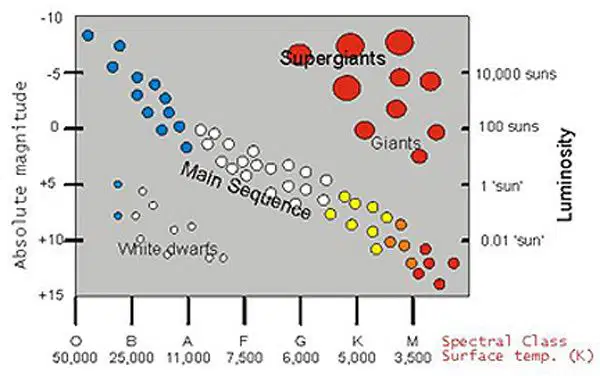
Based on this diagram which type of stars would belong to spectral class M and have the lowest luminosity and are the coolest?
a)
Main Sequence Stars
b)
Giants
c)
Super Giants
d)
White Dwarfs
75.
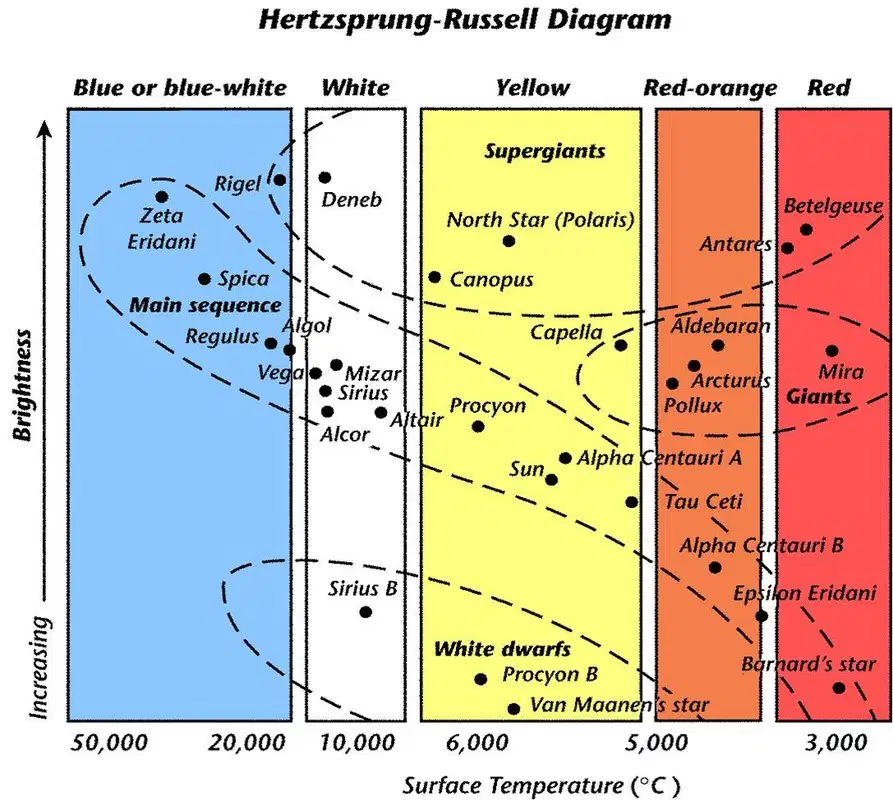
Use the Hertzsprung-Russell Diagram to answer the following question. Sirius B is a _____
a)
Hot and Bright Star
b)
Cool and Bright Star
c)
Hot and Dim Star
d)
Cool and Dim Star
76.
What is the reason that a main sequence star changed to a red giant?
a)
Helium runs out
b)
Hydrogen runs out
c)
The star explodes
d)
I have no idea
77.
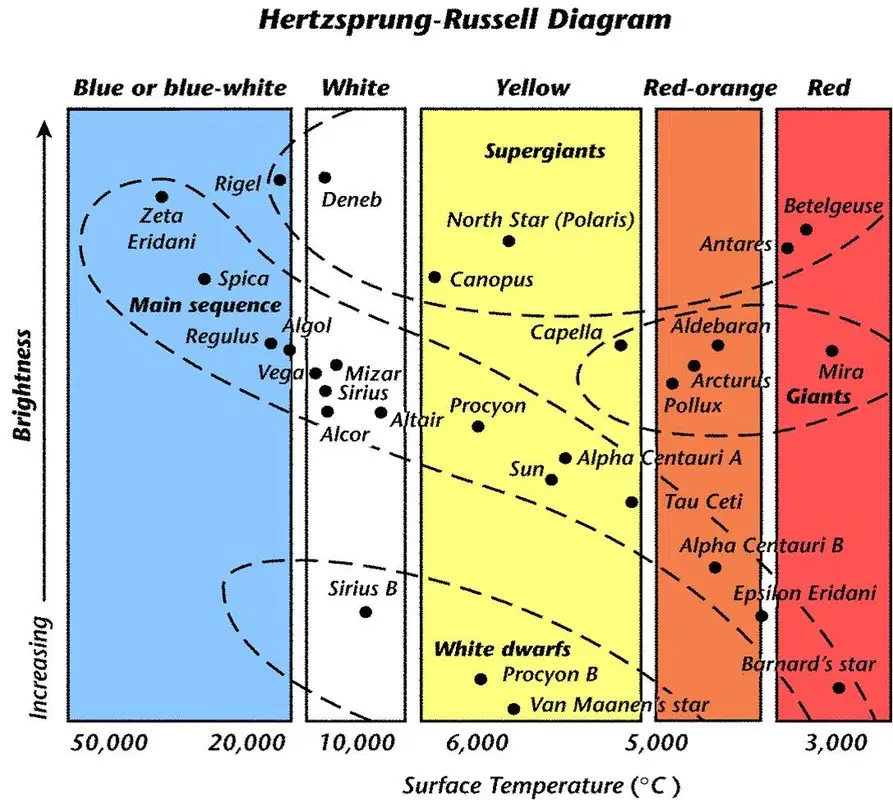
Use the Hertzsprung-Russell Diagram to answer the following question. Zeta Eridoni is a _____
a)
Hot and Bright Star
b)
Cool and Bright Star
c)
Hot and Dim Star
d)
Cool and Dim Star
78.
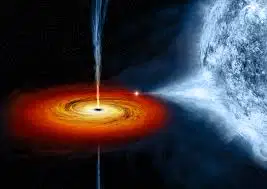
Black holes are best described as:
a)
space fillers
b)
holes
c)
a place in space where gravity pulls so much even light can't get out
d)
gravity bombs
79.
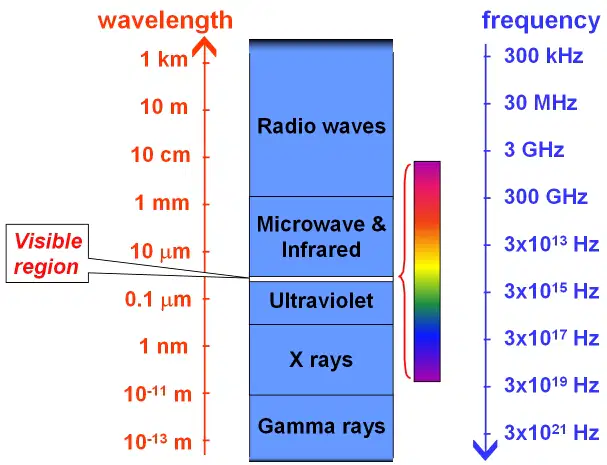
Black holes can be found in the Universe. When examining a black hole with a special telescope, scientist determined that a specific black hole was emitting waves with a wavelength of 1.41x10⁻¹² m. The special telescope most likely detects:
a)
microwaves
b)
visible light
c)
x-rays
d)
gamma rays
80.
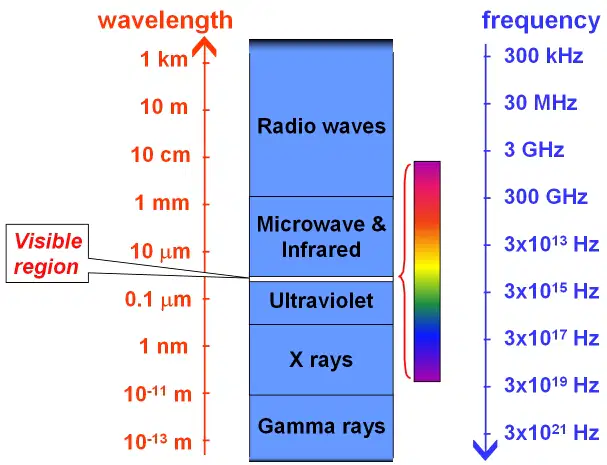
The universe is believed to be moving away because the electromagnetic spectra frequency that is being picked up by special telescope most likely detects the longest waves. Pick the longest wave.
a)
microwaves
b)
visible light
c)
x-rays
d)
gamma rays
81.

Which star has the lowest temperature?
a)
A
b)
B
c)
C
d)
D
82.
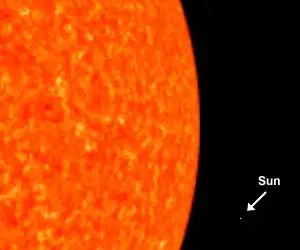
What is the name of the largest stars?
a)
Protostars
b)
Supergiants
c)
Red Giants
d)
Dwarf Stars
83.
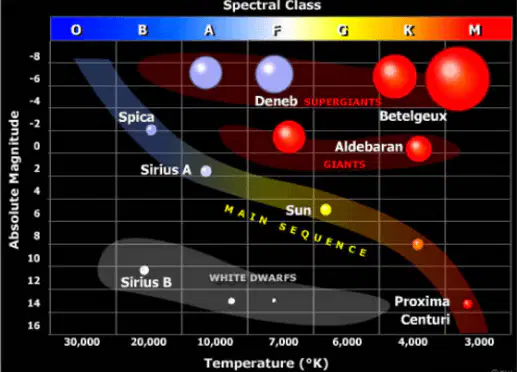
Which of these observations of Proxima Centuri's Star is most likely accurate?
a)
Proxima Centuri's Star is less bright than the sun and has a surface temperature below 3,400 K
b)
Proxima Centuri's Star is less bright than the sun and has a surface temperature above 3,400 K
c)
Proxima Centuri's Star is brighter than the sun and has a surface temperature below 4,000 K
d)
Proxima Centuri's Star is brighter than the sun and has a surface temperature above 4,000 K
84.
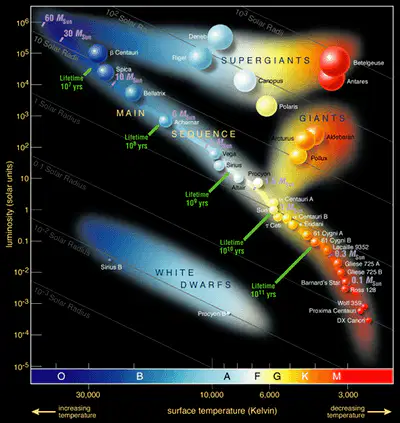
On the H-R diagram, the Sun is a _____.
a)
Main Sequence star
b)
Red Giant
c)
White Dwarf
d)
Blue Giant
100 %

