
 Worksheets
Principles of Engineering EOC Review Game Semester 1 EOC
Total questions: 35
Worksheet time: 18mins
Simple machines are devices that make work easier by changing the __________ or __________ of a force.
magnitude; direction
speed; color
weight; temperature
size; texture
Lever: Definition: ____________________________
A rigid bar that rotates around a fixed point called the fulcrum.
A device used to measure weight.
A machine that produces electricity.
A tool for cutting materials.
Lever: Example: ____________________________
Seesaw, crowbar, or scissors.
Wheelbarrow, pulley, or screw.
Inclined plane, wedge, or ramp.
Spring, magnet, or battery.
Pulley: Definition: ____________________________
A wheel with a grooved rim in which a rope or chain can run to change the direction of the force applied to move a load.
A lever used to lift heavy objects by hand.
A flat surface used to reduce friction.
A device that stores electrical energy.
Pulley: Example: ____________________________
Flagpole or crane.
Bicycle wheel.
Electric fan.
Television remote.
Wheel and Axle: Definition: ____________________________
A simple machine consisting of a wheel attached to a smaller axle so that these two parts rotate together.
A device used to measure the speed of a moving object.
A tool for cutting materials into small pieces.
A machine that uses gears to increase force.
Wheel and Axle: Example: ____________________________
Doorknob or car steering wheel.
Knife blade
Screwdriver (used as a lever)
Inclined plane
Inclined Plane: Definition: ____________________________
A flat surface set at an angle to help raise or lower objects.
A machine that rotates to lift objects.
A lever used to balance weights.
A pulley system for moving objects.
Inclined Plane: Example: ____________________________
Ramp or slide.
Pulley system.
Lever arm.
Wheel and axle.
Wedge: Definition: ____________________________
A device that is thick at one end and tapers to a thin edge at the other end, used to split or cut objects.
A tool used to measure angles in construction.
A machine that rotates to lift heavy objects.
A flat surface that connects two different heights.
Wedge: Example: ____________________________
Axe or knife.
Screwdriver.
Pulley.
Lever.
Screw: Definition: ____________________________
An inclined plane wrapped around a cylinder or cone to form a spiral.
A flat surface used to lift objects vertically.
A lever used to rotate objects.
A wheel attached to a fixed axle.
Screw: Example: ____________________________
Jar lid or bolt.
Hammer or nail.
Wheel or axle.
Pulley or rope.
A farmer uses a wheelbarrow to haul a 240-pound load of grain. The length from the wheel and axle to the center of the load is 2 feet. The length from the wheel and axle to the effort is 8 feet. What is the ideal mechanical advantage (IMA) of the lever?
2
4
6
8
A first-class lever in static equilibrium has a 100-pound resistance force and a 25-pound effort force. The lever’s effort force is located 4 feet from the fulcrum. What is the Actual Mechanical Advantage (AMA) of the lever?
AMA = Resistance Force / Effort Force = 100 / 25 = 4
AMA = Effort Force / Resistance Force = 25 / 100 = 0.25
AMA = Resistance Force x Effort Force = 100 x 25 = 2500
AMA = Resistance Force / Effort Force = 25 / 100 = 0.25
Definition of a Gear Ratio:
The ratio of the number of teeth on two meshing gears.
The speed at which a gear rotates.
The distance between two gears.
The material from which gears are made.
Gear Ratio Formula =
Gear Ratio = Number of teeth on driven gear / Number of teeth on driving gear
Gear Ratio = Number of teeth on driving gear / Number of teeth on driven gear
Gear Ratio = Number of teeth on driven gear × Number of teeth on driving gear
Gear Ratio = Number of teeth on driving gear + Number of teeth on driven gear
If Gear A has 10 teeth and Gear B has 40 teeth, the ratio is __________.
4:1
1:2
2:1
1:4
Effects of Gear Ratios: Torque: When a smaller gear drives a larger gear, torque __________.
increases
decreases
remains the same
is unaffected
Effects of Gear Ratios: Speed: When a larger gear drives a smaller gear, the output speed __________.
increases
decreases
remains the same
becomes zero
If the input gear rotates at 60 RPM and the gear ratio is 5:1, the output gear rotates at __________ RPM.
12
5
300
15
Key Concept: High gear ratios increase __________, while low gear ratios increase __________.
torque; speed
speed; torque
friction; efficiency
efficiency; friction
Definition of a Rube Goldberg Machine:
A complex device that performs a simple task in an indirect and convoluted way.
A machine designed for high-speed manufacturing.
A device used for scientific experiments.
A simple tool for solving mathematical problems.
Characteristics of a Rube Goldberg Machine: Uses a series of ____________________ ____________________ ____________________.
chain reactions or simple machines
chemical reactions and explosions
random electronic circuits
complex computer algorithms
Characteristics of a Rube Goldberg Machine: Often includes multiple ________________ machines.
simple
complex
digital
automatic
Characteristics of a Rube Goldberg Machine: Emphasizes creativity and (simplicity or complexity) over efficiency.
complexity
speed
accuracy
cost
Examples: A machine that uses _________________, ramps, and _________________ to turn off a light switch.
levers, pulleys (or other simple machines, but levers and pulleys are common answers)
wheels, gears
springs, magnets
screws, chains
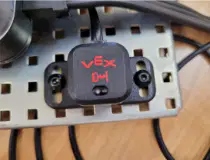
Know the names of these robot parts and sensors: 1. ___________________________
Potentiometer
Distance Sensor
Gyroscope
Infrared Sensor

Know the names of these robot parts and sensors: ___________________________
Robot Brain (VEX Cortex or similar controller)
Ultrasonic Sensor
Limit Switch
Optical Sensor
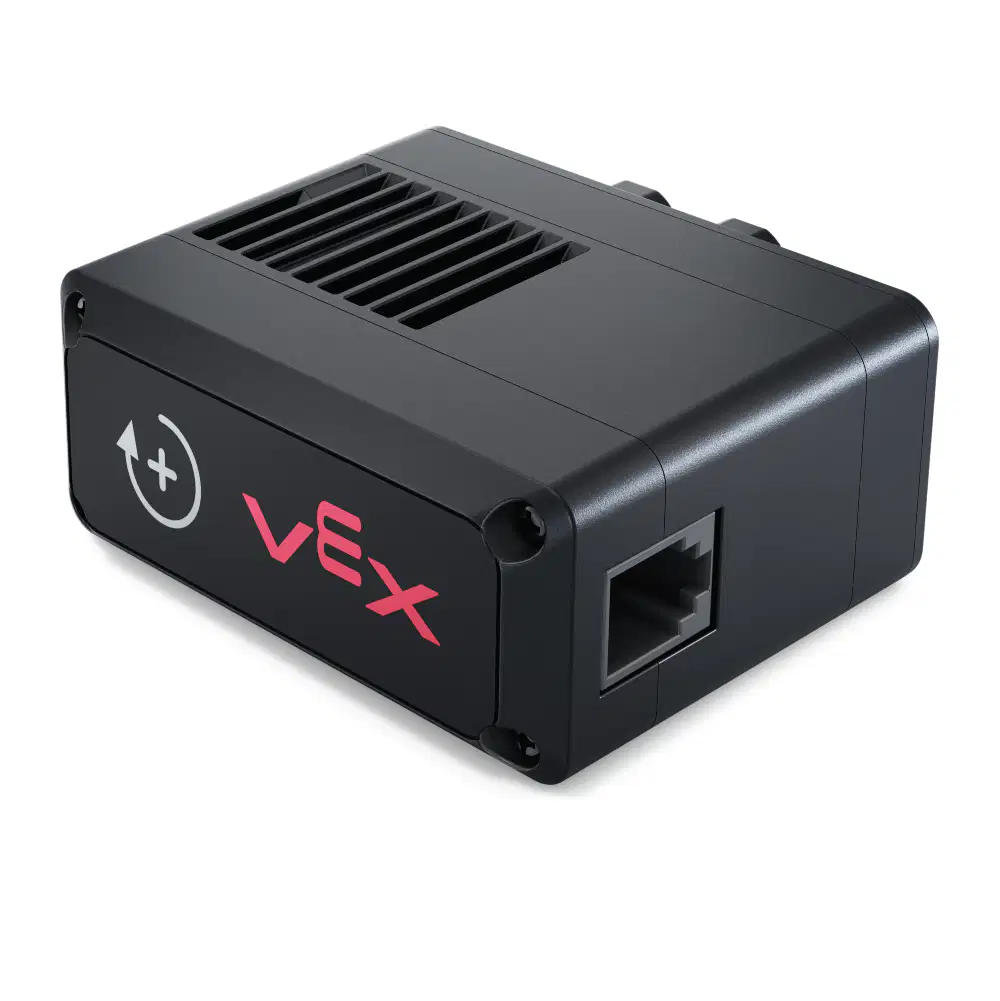
Know the names of these robot parts and sensors: ___________________________
Motor
Sensor
Wheel
Battery
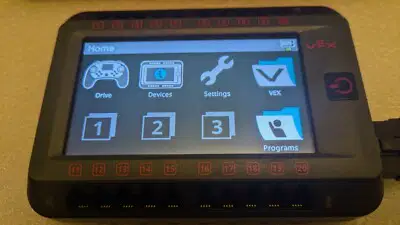
Know the names of these robot parts and sensors: 4. ___________________________
Bumper Switch
Ultrasonic Sensor
Robot Brain
Potentiometer

Know the names of these robot parts and sensors: 5. ___________________________
Optical Sensor
Ultrasonic Sensor
Servo Motor
Potentiometer
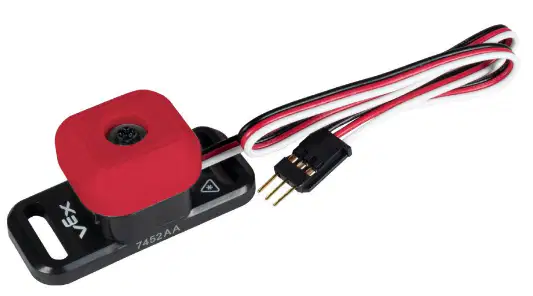
What is the name of the component shown in the image?
Bumper switch (or Bumper sensor)
Ultrasonic sensor
Potentiometer
Line follower sensor
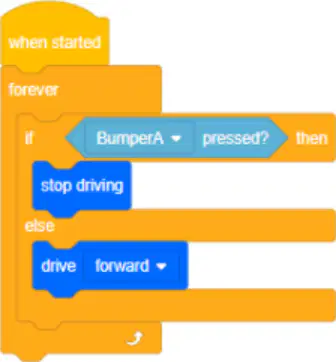
What will the program below do? (Describe what happens when the program runs.)
The robot will drive forward until BumperA is pressed, then it will stop driving.
The robot will spin in place until BumperA is pressed, then it will reverse.
The robot will drive forward for 5 seconds, then stop regardless of BumperA.
The robot will not move at all until BumperA is pressed, then it will start driving.
The difference between an OPEN-Loop Control System and a CLOSED-Loop Control System is that an OPEN-Loop system does not use feedback, while a CLOSED-Loop system uses feedback. Which of the following pairs correctly matches an example for each system?
OPEN-Loop: Toaster, CLOSED-Loop: Air Conditioner with thermostat
OPEN-Loop: Refrigerator, CLOSED-Loop: Light Switch
OPEN-Loop: Car with Cruise Control, CLOSED-Loop: Simple Electric Kettle
OPEN-Loop: Washing Machine with Sensor, CLOSED-Loop: Manual Fan

