
 Worksheets
Art History Midterm Review
Total questions: 32
Worksheet time: 16mins
José Guadalupe Posada was born in which country?
Spain
Italy
Mexico
Portugal
Posada was best known as a
Renaissance sculptor
Political printmaker
Abstract painter
Architect
What is a calavera?
A flower
A mask
A skeleton
A style of hat
What technique did Posada use to create his prints?
Sfumato
Lithography
Woodcut
Engraving
The 'Catrina' figure was originally created to:
Honor ancient gods
Celebrate weddings
Make fun of the dictator's obsession with European luxury
Represent wealth and status
Over time, La Catrina became an icon for which celebration?
Cinco de Mayo
Dia de los Muertos
Carnival
Independence Day
'Satire' means:
A serious tribute
A style of painting using dark tones
The use of humor or exaggeration to expose people's actions
A story told with skeletons
What is crosshatching?
Using bright colors to create texture
Layering intersecting lines to show value
Drawing in perspective
Mixing paint with water
Leonardo da Vinci was born in which country?
France
Greece
Italy
Spain
Leonardo da Vinci lived during which major cultural movement?
Baroque
Romanticism
Renaissance
Industrial Revolution
The Renaissance was known for a renewed interest in:
Science and human potential
Religion and medieval traditions
War and conquest
Abstract expressionism
What is sfumato?
A type of sculpture
A smoky painting technique with soft transitions
A system of linear perspective
A shading tool used in drawing
Which of the following are Leonardo's two most famous paintings?
Starry Night and Guernica
The Thinker and The Kiss
Mona Lisa and The Last Supper
Birth of Venus and School of Athens
What did Leonardo da Vinci keep that showed his wide range of interests?
Pictures
Journals
Blueprints
Letters
Approximately how many journals did he have?
5
15
25
More than 50
What is composition in art?
The colors used in an artwork
The arrangement of elements within an artwork to create the intended message or feeling
The texture of an artwork
The tools an artist uses
Which part of an artwork appears closest to the viewer?
Background
Middleground
Foreground
Focal point
The area in an artwork that appears furthest from the viewer is called the:
Foreground
Background
Focal point
Composition
What is balance in art?
The way colors are chosen
A sense of harmony created by the arrangement of elements
Equal spacing of shapes
The brightness of an image
A focal point is:
The middle of the canvas
Where the artist places the lightest color
The area where the artist wants to guide the viewer's attention
The edge of the painting
What are leading lines in artwork?
Lines that form the borders
Thick outlines around objects
Lines that guide the viewer's eye toward a focal point
Curves and spirals
Which of the following best describes middleground?
The very back of the image
The area between the foreground and background
The most detailed part
The least important part
Which composition type is based on a mathematical ratio thought to create beauty and harmony?
Rule of Thirds
Golden Ratio
Radial Balance
Asymmetry
Which best shows how a triangular composition affects the viewer?
It adds motion
It hides the focal point
It creates stability at a base and guides the eye to a focal point
It makes the piece asymmetrical
What is the Rule of Thirds used for?
To create symmetry
To split a canvas into sections for arranging elements like foreground, middleground, and background
To measure colors
To balance radial designs
What is symmetry in composition?
Using circles only
Having identical elements repeated throughout the work
Similar parts on either side of an implied line to create balance
Random arrangement of shapes
In asymmetrical balance:
Both sides of the artwork are identical
Both sides are different but still visually balanced
There is no balance
The artwork is split in half
Which composition type arranges elements around a central point in a circular pattern?
Triangular
Radial
Symmetrical
Rule of Thirds
What purpose does composition serve in artwork?
To create random designs
To express music through color
To guide the viewer's eye, communicate a message, and create balance
To describe the artist's tools

In this artwork by Caravaggio, he creates______ by filling the top half of the composition with his model and the bottom half with darkness.
Movement
Balance
Rhythm
Perspective
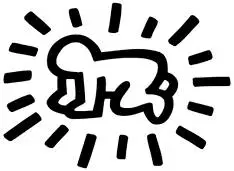
Keith Haring often used this 'radiant baby' to refer to an abundance of energy and potential as well as purity and hope. This is an example of which technique?
Contrast
Perspective
Symbolism
Pattern
Salvador Dali often experimented different ways to tap into the subconscious such as staying awake for prolonged periods of time. This 'dreamlike' theme is main part of which art movement?
Renaissance
Chicano art movement
Street art
Surrealism

