

wayground logo

Free Printable Worksheets

Font size

S
M
L
XL
Worksheets

Chapter 10 Test

Total questions: 14

Worksheet time: 7mins

Name
Class
Date
1.

Potassium-40 is used to find the ______________________ of ancient rocks, because it has a long half-life. Carbon-14 is used for dating much younger rocks due to its shorter ____________________.

a)
absolute age, absolute age
b)
half-life, relative age
c)
relative age, absolute age
d)
absolute age, half-life
2.

Why is it important for geologists to use both relative and absolute ages to determine the age of rocks?
a)
Scientists want to learn about the age of rocks.
b)
Scientists need only one way to determine the age of rocks.
c)
Scientists may not be able to determine the absolute age of some rocks.
d)
Scientists can tell the age of rocks using the law of superposition.
3.

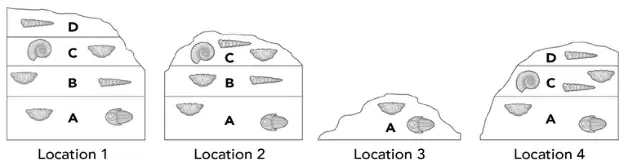
The rock layers at Location 4 are different from the other three locations. What likely occurred at Location 4?

a)
Layer B isn't shown due to the absence of index fossils.
b)
Location 4 held index fossils similar to the other locations.
c)
Location 4 had heavy erosion, and soon a layer of rock will be deposited on top of it.
d)
Layer B eroded away, and layers C and D were deposited on top of layer A at a later time.
4.

During ___________________, atoms of one element break down into another, more stable element. Each radioactive element has a constant rate of decay that is called its ________________________.

a)
radioactive decay, half-life
b)
half-life, radiation
c)
energy and particles, radioactive decay
d)
radioactive decay, radioactive decay
5.

What is the purpose of the geologic time scale?

a)
to organize the eras and periods of major events of fossils
b)
to organize the kinds of plants and animals that lived during those times on Earth
c)
to organize the kinds of rocks in order for people to study the life forms and classify fossils
d)
to organize Earth's history in a record of geologic events and show the evolution of life forms
6.

Why do so few fossils from the Precambrian time on the geologic timeline exist?

a)
Single-celled organisms don't form fossils.
b)
The single-celled organisms died out before any fossils were formed.
c)
The time was so long ago that most fossils may have been destroyed.
d)
The time was long ago, and the fossils are so deeply buried that they haven't been discovered.
7.

What does the law of superposition mean?

a)
The rock layers can change their position and push younger rock layers under older rock layers.
b)
The rock layers can change their position and push older rock layers under younger rock layers.
c)
The rock layers on top are the youngest layers, and the lower rock layers are the oldest layers.
d)
The rock layers on top are the oldest layers and the lower rock layers are the youngest layers.
8.

In the Paleozoic Era, evidence showed that many volcanic eruptions and their debris slowed _____________________ and the amount of carbon dioxide in the oceans _____________________.

a)
photosynthesis, increased
b)
photosynthesis, decreased
c)
respiration, increased
d)
respiration, decreased
9.

Which term would describe the ordering of things based on their general age?

a)
superposition
b)
rock layers
c)
relative age
d)
absolute age
10.

In what way do index fossils help determine rock ages?

a)
Index fossils are widely distributed but were not around long, and so they show up in only a few rock layers.
b)
Index fossils are widely distributed and were around for a long time, and so they show up in many rock layers.
c)
Index fossils were around only a short time but they show up in many rock layers.
d)
Index fossils are widely distributed and are always found in every sedimentary rock layer.
11.

Which of the following would provide physical evidence that could change the divisions on the geologic timeline?

a)
the discovery of ancient ruins buried deep in ocean floor sediments
b)
the discovery of fossilized microorganisms in ocean floor sediments
c)
the discovery of evidence of humans who lived long ago
d)
the discovery of evidence of different kinds of rocks that recently appeared
12.

Quaternary period is best known for which two major events?

a)
the rise of reptiles and flowering plants
b)
the rise of mammals and swimming mammals
c)
the ice ages and the rise of humans
d)
the rise of dinosaurs and other reptiles
13.

What kind of organisms were found in the Precambrian time?

a)
invertebrates with hard shells
b)
early reptiles and amphibians
c)
animals with shells and outer skeletons
d)
single- and simple multi-celled organisms
14.

How did the second mass extinction and the loss of the dinosaurs affect the remaining populations of mammals that did survive?

a)
With less competition, the remaining mammals had to move from their established habitats.
b)
With less competition, the remaining mammals had more food, water, and habitats.
c)
With more competition among the other kinds of populations, the mammals had to struggle to survive.
d)
With more competition among the other kinds of populations, the mammals were able to thrive.