wayground logo

Free Printable Worksheets

Font size

S
M
L
XL
Worksheets

Final Exam REVIEW Fall 25

Total questions: 40

Worksheet time: 20mins
Name
Class
Date
1.
The Periodic Table is made of Metals, Nonmetals, and Metalloids. On what side of the Periodic Table are Nonmetals located?
a)
Right Side
b)
Top
c)
Left Side
d)
Bottom
2.
Kool-Aid is composed of Water, Kool-Aid Mix, and Sugar. Which of these is considered the solvent?
a)
Water
b)
Sugar
c)
Kool-Aid Mix
d)
None of the above.
3.
Which of the following will not increase the rate of solubility in a solution with a solid solute?
a)
Increasing Temperature
b)
Increasing Surface Area
c)
Increasing Pressure
d)
Agitating (Mixing / Stirring)
4.

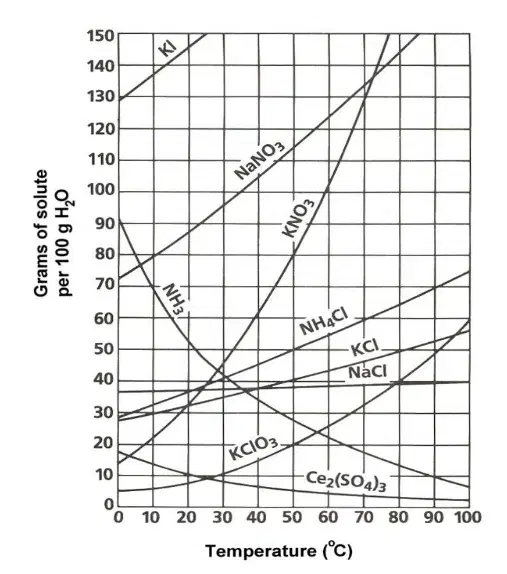
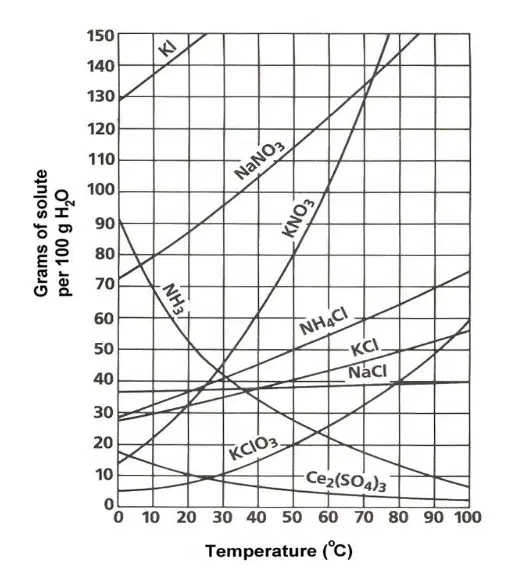
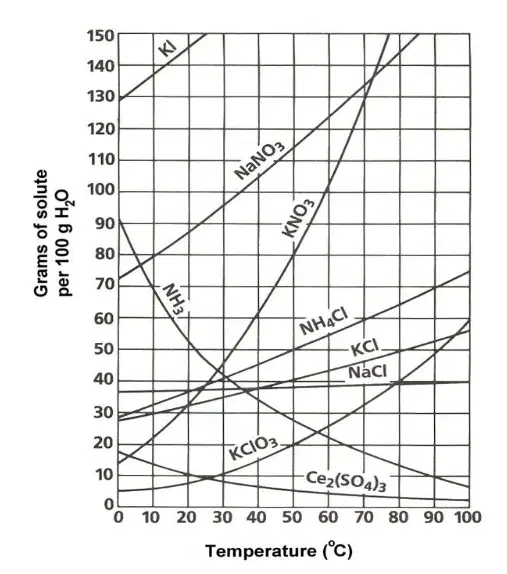
A chemist dissolved 120.00 grams of Sodium Nitrate (NaNO3) in boiling water and the solution was allowed to cool. According to the above solubility curve, at what temperature would you call the solution saturated?
a)
18C
b)
65C
c)
55C
d)
88C
5.

A chemist dissolved 50 grams of Sodium Nitrate (NH4Cl) in boiling water and the solution was allowed to cool. According to the above solubility curve, at what temperature would you describe the solution as unsaturated?

a)

50oC

b)

25oC

c)

0oC

d)

75oC

6.

A chemist dissolved 80 grams of Sodium Nitrate (KNO3) in 100 grams of boiling water and the solution was allowed to cool. According to the above solubility curve, at what temperature would you describe the solution as supersaturated?

a)

90oC

b)

25oC

c)

100oC

d)

75oC

7.
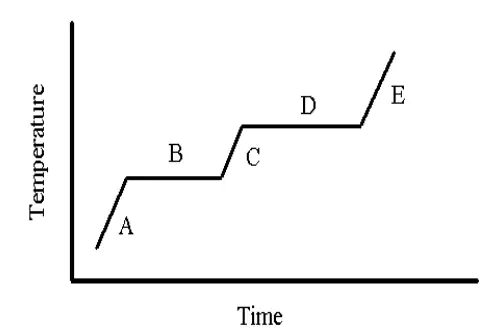
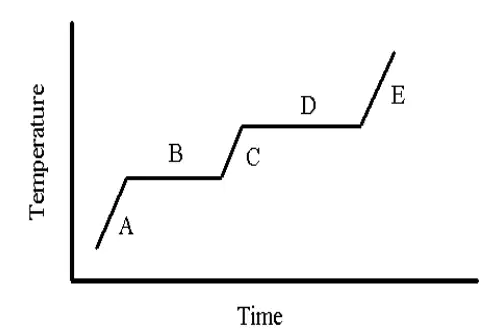
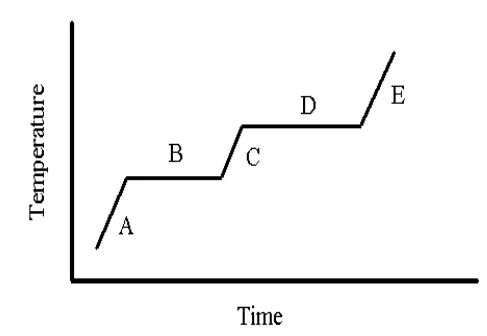
As a solid is heated its particles break the attractions holding them together and it becomes a liquid. At what point on the heating curve is this transformation occurring?
a)
A
b)
B
c)
C
d)
D
e)
E
8.
Which two letters on the heating curve would show the transformation of a Gas to a Solid?
a)
A → E
b)
C → E
c)
E → A
d)
E → C
9.
Which letter indicates condensation on the heating curve?
a)
A
b)
B
c)
C
d)
D
e)
E
10.
What energy transformation is occurring in the diagram below?
a)
Electrical → Light
b)
Chemical → Light
c)
Mechanical → Light
d)
Light → Nuclear
11.
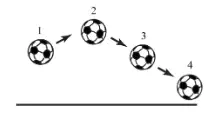
A soccer ball is thrown into the game from the sidelines. Which number represents the highest Potential Energy (PE) and which number represents the highest Kinetic Energy (KE).
a)
PE → 1 / KE → 4
b)
PE → 4 / KE → 2
c)
PE → 2 / KE → 4
d)
PE → 4 / KE → 1
12.
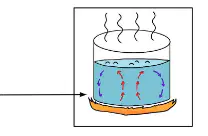
Heating up water in a pot on the stove is an example of which form of heat transfer?
a)
Conduction
b)
Radiation
c)
Convection
d)
Emissions
13.
A 10.00-gram sample of pure water goes from 22.00 °C to 32.00 °C. How much heat did that sample gain? The specific heat of pure water is 4.184 J/g × °C. (Heat Lost or Gained = Mass × Specific Heat × Change in Temperature) (Q = m c ΔT)
a)
83.58 J
b)
24.179 J
c)
418.40 J
d)
23.93 J
14.
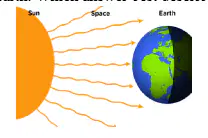
Energy from the Sun is transferred to Earth. Which answer best describes how this energy transformation occurs?
a)
Conduction
b)
Radiation
c)
Convection
d)
Emissions
15.
Which of the following subatomic particles has a positive (+) charge?
a)
Protons
b)
Electrons
c)
Neutrons
d)
None of the above.
16.
Which of the following subatomic particles has a negative (-) charge?
a)
Protons
b)
Electrons
c)
Neutrons
d)
None of the above.
17.
Which of the following subatomic particles has a neutral (+/-) charge?
a)
Protons
b)
Electrons
c)
Neutrons
d)
None of the above.
18.
Calcium (Ca) is in Group 2 on the Periodic Table. How many valence electrons does Calcium have and what would its ionic charge be?
a)
2 Valence Electrons → +2 Ionic Charge
b)
6 Valence Electrons → +2 Ionic Charge
c)
2 Valence Electrons → -2 Ionic Charge
d)
6 Valence Electrons → 12 Ionic Charge
19.
Elements in this group are located in Group 17, they have 7 valence electrons, and form a -1 charge in an ionic compound. They are very reactive and create salts when they bond with metals.
a)
Alkaline Earth Metals
b)
Alkali Metals
c)
Noble Gasses
d)
Halogens
20.
If you have an atom with 8 protons, 9 neutrons, and 10 electrons, what is the mass number of the atom?
a)
8
b)
27
c)
17
d)
10
21.
If you have 5 protons, 6 neutrons, and 2 electrons, what would the element symbol look like?
a)
Boron - Atomic Number 5, Atomic Mass 6, No Charge
b)
Boron - Atomic Number 5, Atomic Mass 11, No Charge
c)
Boron - Atomic Number 6, Atomic Mass 5, -3 Charge
d)
Boron - Atomic Number 5, Atomic Mass 11, +3 Charge
22.

What is the correct formula for a Sodium Oxide, a compound created from Sodium (Na) and Oxygen (O)? Hint: drop and swap.

a)
NaO
b)

NaO2

c)

Na2O

d)

Na2O2

23.

Name the following Ionic Compound → Mg3N2

a)
Magnesium Nitrogen
b)
Trimagnesium Dinitride
c)
Magnesium Nitride
d)
Manganese Nitrate
24.

Name the following Covalent Compound → H2O

a)
Hydrogen Oxide
b)
Dihydrogen Monoxide
c)
Monohydride Dioxide
d)
Hydrogen Dioxide
25.
What is the correct formula for Carbon Dioxide, a compound created from Carbon (C) and Oxygen (O)?
a)
CO
b)

CO2

c)

C2O

d)

C2O2

26.

Which of the following is NOT a property of an Ionic Compound?

a)
Electrons are shared within the outer energy level.
b)
High Melting and Boiling Point.
c)
Metal and Nonmetal
d)
Example → Table Salt (NaCl)
27.

Which of the following is NOT a property of a Covalent Compound?

a)
Electrons are shared within the outer energy level.
b)
Low Melting and Boiling Point.
c)
Metal and Nonmetal
d)
Example → Water (H2O)
28.
A student adds 5 grams of Vinegar to 7 g of Baking Soda in a sealed container. He watches the chemical reaction that occurs. Which of these predicts the mass of the materials in the container after the reaction is complete?
a)
35 grams
b)
2 grams
c)
12 grams
d)
57 grams
29.
The following is a chemical reaction. What type of reaction is shown above?
a)
Synthesis
b)
Single Replacement
c)
Decomposition
d)
Double Replacement
30.

Use this chemical equation to answer the question. What coefficients of Fe, O2, and Fe2O3 will show that matter is conserved in this chemical reaction?

a)
2, 1, 2
b)
4, 1, 2
c)
2, 3, 2
d)
4, 3, 2
31.
The following is a chemical reaction. What type of reaction is shown above?
a)
Synthesis
b)
Single Replacement
c)
Decomposition
d)
Double Replacement
32.
Use the chemical equation to answer the question. What coefficient of KCl will balance the equation?
a)
1
b)
3
c)
2
d)
4
33.
If the half-life of Carbon-14 is 5,730 years. How much of a 100 gram sample will remain after 11,460 years?
a)
50 grams
b)
200 grams
c)
25 grams
d)
400 grams
34.
The following in a Nuclear Decay Reaction: What type of reaction is shown?
a)
Alpha Decay
b)
Nuclear Fission
c)
Beta Decay
d)
Nuclear Fusion
35.
The following in a Nuclear Decay Reaction: What type of reaction is shown?
a)
Alpha Decay
b)
Nuclear Fission
c)
Beta Decay
d)
Nuclear Fusion
36.
Nuclear Energy has multiple positive aspects, which of the following is not a positive aspect of Nuclear Energy?
a)
Produces a very large amount of electricity.
b)
More efficient than fossil fuels.
c)
Cleaner in forms of air pollution.
d)
Easily disposable.
37.
A student placed a stuffed animal on the dashboard of a car. When the car accelerated quickly, the stuffed animal flew back onto the seat. Which principle best describes the motion of the stuffed animal as the car accelerated?
a)
Inertia
b)
Momentum
c)
Gravity
d)
Speed
38.
Jeff was riding in a car. Which change demonstrates the greatest effect of inertia?
a)
The car makes a sudden stop.
b)
The car slows down gradually.
c)
The car changes into another lane.
d)
The car runs out of gas and rolls to a stop.
39.
Which is a result of the effect of gravity?
a)
Rocket engines can force objects into space.
b)
Air friction causes falling objects to slow down.
c)
Released objects always fall towards Earth’s surface.
d)
Airplanes are able to fly without falling to the ground.
40.
The force that slows down and eventually stops a ball you rolled across the pavement is called what?
a)
Kinetic Force
b)
Frictional Force
c)
Slow Force
d)
Potential Force