wayground logo

Free Printable Worksheets

Font size

S
M
L
XL
Worksheets

Final Exam: Modern America

Total questions: 125

Worksheet time: 1hrs 3mins
Name
Class
Date
1.
Which of the following best defines Genocide?
a)
The forced relocation of people due to natural disasters.
b)
The mass killing of military forces during a war.
c)
Deliberate extermination of a particular ethnic, racial, religious, or national group.
d)
The act of declaring independence from a ruling government.
2.
Which of the following best defines Anti-Semitism?
a)
Support for the creation of a Jewish homeland.
b)
Hatred, prejudice, or discrimination against Jewish people.
c)
The blending of different religious traditions.
d)
A political movement for equal rights among all ethnic groups.
3.
Which of the following describes Holodomor?
a)
A natural famine caused by drought in Eastern Europe
b)
A war between Ukraine and Russia in the 1930s
c)
The mass slaughter of Tutsi people in Rwanda by members of the Hutu
d)
A man-made famine in Ukraine caused by Joseph Stalin
4.
How did the Treaty of Versailles contribute to the rise of the Nazi Party in Germany during the 1930s?
a)
It allowed Germany to keep its military and weapons, encouraging militarism.
b)
It caused economic hardship and national humiliation.
c)
It gave Germany new colonies, boosting national pride.
d)
The Treaty of Versailles gave Germany more land following WWI.
5.
During the Middle Ages, which of the following best explains why Jews have been persecuted throughout history?
a)
They were blamed by many Christians for the death of Jesus.
b)
They refused to participate in global economic systems.
c)
They were considered a terrorist organization who committed criminal acts.
d)
They sought to convert others to Judaism through military conquest.
6.
Which group(s) were persecuted during the Holocaust by Adolf Hitler and the Nazi regime?
a)
People living in Ukraine who opposed Stalin's Soviet regime.
b)
Only Jewish people.
c)
Jews, Roma (Gypsies), disabled individuals, LGBTQ+ people.
d)
People of the Aryan race with blonde hair and blue eyes.
7.
Which of the following is true about the Nuremberg Code?
a)
It was a set of military strategies used by the Allies during World War II.
b)
It was a peace treaty signed between Germany and the Allied powers.
c)
It was a Nazi policy used to identify and segregate Jewish citizens.
d)
It was a Jewish policy that prevented Germans from entering their communities.
8.
What was one effect of the Nuremberg Laws on the daily lives of Jewish people?
a)
They were excluded from public schools, jobs, and daily life.
b)
They were required to join the Nazi Party when they turned 18.
c)
They were forced to serve in the German military for 5 years.
d)
They were given more land and business opportunities in Poland.
9.
Which of the following best describes the propaganda used during the Holocaust?
a)
It encouraged Germans to support the Allied forces against Nazi rule.
b)
It focused on warning citizens about the dangers of fascism and totalitarianism.
c)
It promoted equal rights and tolerance for all religious groups in Europe.
d)
It spread false, hateful messages to dehumanize Jews and justify their persecution.
10.
Which of the following best defines Kristallnacht?
a)
A battle fought between German and Allied forces during World War II.
b)
A violent, state-sponsored attack on Jewish communities in Germany.
c)
A German holiday celebrating national unity.
d)
A peace agreement signed between Nazi Germany and Jewish leaders.
11.
What did Allied soldiers discover about prisoners when they liberated Nazi concentration camps near the end of World War II?
a)
The camps had already been completely abandoned with no evidence of abuse.
b)
Prisoners were moved to new, improved living quarters within the camp until the end of the war.
c)
They were transported to Germany by train for safety and were allowed to return home.
d)
Thousands were forced on death marches which resulted in death from sickness and exposure.
12.
Who was Dr. Josef Mengele and what is he known for during the Holocaust?
a)
A prisoner who led a rebellion against SS guards at Auschwitz.
b)
The Soviet general who liberated the camp of Dacchu.
c)
A physician who performed unethical surgeries and experiments on inmates.
d)
A physician who treated sick prisoners with modern medicine.
13.
What were living conditions like in the Jewish ghettos of Poland during the Holocaust?
a)
Clean, well-organized housing provided by German authorities.
b)
Overcrowded and unsanitary, with limited food and widespread disease.
c)
Spacious apartments with adequate medical care and food supplies.
d)
Temporary housing in the countryside with access to clean water.
14.
Which of the following best describes the purpose of the Nuremberg Trials?
a)
To reward Nazi officials for their loyalty to Germany.
b)
To create a peace treaty between Germany and the Allied powers.
c)
To prosecute the U.S. leaders for appeasing Adolf Hitler.
d)
To prosecute and punish Nazi officials for their crimes during the war.
15.
Which of the following best defines suburbanization?
a)
The development of factories and industry in urban neighborhoods.
b)
The movement of people from cities to surrounding residential communities.
c)
The process of people moving from rural areas to city centers.
d)
The process of people migrating from one rural place to another rural place.
16.
Which of the following best defines white flight during the 1950s?
a)
The movement of white families from the suburbs to rural areas in search of farmland.
b)
The migration of white Americans from southern states to northern cities for jobs.
c)
The movement of white residents out of urban areas into suburbs, often in response to racial integration.
d)
The relocation of white soldiers overseas during the Korean War.
17.
How did the GI Bill contribute to the baby boom?
a)
By offering veterans home loans and education benefits, encouraging family stability and growth.
b)
By increasing military spending and expanding overseas troop deployments.
c)
By reducing the amount of tax dollars U.S. citizens would need to pay, making it more affordable.
d)
By only allowing men who served in the military in Presidential elections.
18.
Which of the following was a negative impact of suburbanization in the 1950s?
a)
Increasing amount of traffic on highways making commutes longer.
b)
Reduced profits for transit systems in urban areas, leading to their decline.
c)
Segregated neighborhoods that lacked diversity and inclusion.
d)
All of the above.
19.
What was urban renewal, and what was a significant social consequence of urban renewal projects during the 1950s?
a)
A government effort to redevelop deteriorating urban areas, which displaced low-income and minority communities.
b)
A private business movement to create new suburban shopping centers, which contributed to downtown decline and loss of local jobs.
c)
A plan to expand rural farmland and relocate industries outside city centers, which caused migration pressures and fewer urban employment opportunities.
d)
A program to improve public transportation and reduce traffic in major cities, which sometimes left high-income neighborhoods with reduced access to resources and jobs.
20.
How did suburbanization impact city infrastructure during the 1950s?
a)
It led to increased investment in city infrastructure as people moved to larger cities.
b)
It improved public services within urban areas as the government prioritized low-income areas.
c)
It resulted in more federal funding for city projects that benefited low-income communities.
d)
It caused a decline in tax revenue for cities as the middle-class left for the suburbs.
21.
Which best describes gender roles in the 1950s?
a)
Men were seen as the primary breadwinners while women were expected to manage the household and care for children.
b)
Women were primarily expected to work outside the home and pursue careers.
c)
Gender roles were highly flexible, allowing individuals to choose their paths regardless of societal expectations.
d)
Both men and women shared equal responsibilities in both work and home life.
22.
What was the main purpose of Levittowns in the 1950s?
a)
To create urban housing for factory workers.
b)
To build luxury homes for wealthy business owners.
c)
To provide affordable, mass-produced homes for veterans and their families.
d)
To house immigrants arriving from Europe in the late 1930s.
23.
Which of the following was a major criticism of Levittowns?
a)
They were too affordable and accessible to any social class.
b)
They were too far from schools and shopping centers
c)
They lacked modern plumbing and electricity.
d)
They enforced racial segregation and often excluded Black families
24.
How did the media contribute to the Baby Boom era, particularly through pop culture representations like “Leave It to Beaver”?
a)
By focusing solely on economic growth and ignoring social issues.
b)
By promoting traditional family values and idealized domestic life.
c)
By depicting only single-parent households in television shows.
d)
By emphasizing the importance of individualism over family structures.
25.
What role did globalization play in postwar manufacturing changes?
a)
It led to isolationist policies.
b)
It decreased competition among manufacturers.
c)
It resulted in a decline in international trade agreements.
d)
It facilitated outsourcing and offshoring of production.
26.
What was Eisenhower’s Federal Highway Act?
a)
A program to fund public transportation systems in urban areas.
b)
A law that established a national system of interstate highways to improve transportation.
c)
Legislation aimed at regulating the trucking industry.
d)
An initiative to promote the use of electric vehicles across the United States.
27.
Which of the following best defines the Cold War?
a)
A period when the United States and Soviet Union merged political goals to rebuild war-torn nations cooperatively.
b)
A brief military confrontation in Europe that resulted in direct battles between the major superpowers.
c)
A global era of peace in which competing nations purposely reduced their armies and avoided political disputes.
d)
A conflict between the Soviet Union and the United States after World War II, driven by ideological differences.
28.
Which of the following best describes a Satellite State during the time of the USSR?
a)
A country that remained neutral during the Cold War.
b)
A country that traded equally with both the West and the Soviet Union.
c)
A country that was heavily influenced and controlled by the Soviet Union.
d)
A country that was winning the space race and had put their satellite into space first.
29.
Which of the following best describes the Domino Theory during the Cold War?
a)
The strategy of isolating countries to prevent foreign influence.
b)
The belief that if one country in a region fell to communism, neighboring countries would also fall.
c)
The notion that countries should remain neutral during conflicts to prevent military escalation.
d)
The idea that losing one military base overseas would cause all others to collapse due to weakened defenses.
30.
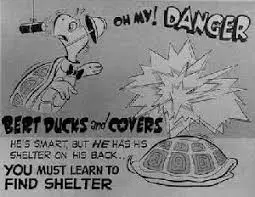
What was the primary purpose of the “Duck and Cover” campaign during the Cold War?
a)
To educate children on how to respond in case of a nuclear attack
b)
To encourage physical fitness through outdoor activities.
c)
To promote environmental awareness among children.
d)
To teach children about the importance of community service.
31.
Which best describes the Marshall Plan?
a)
Economic aid given by the Soviet Union to countries that vowed to become communist.
b)
A trade policy established by the U.S. to limit European imports and protect American industries.
c)
Economic aid given by the U.S. to kickstart the economy in numerous European countries.
d)
U.S. assistance offered to Greece and Turkey to counter the influence of communist forces.
32.
What was the name of the alliance established by European Communist nations in response to NATO?
a)
Iron Curtain
b)
Warsaw Pact
c)
Second World
d)
Union of Soviet Socialist Republics
33.
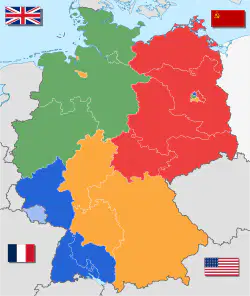
After WWII, Germany was divided into four occupied zones. Which countries occupied Germany?
a)
Denmark, Britain, France, and the Soviet Union
b)
U.S., Britain, France, and the Soviet Union
c)
U.S, Poland, Czechoslovakia, and the Soviet Union
d)
Britain, France, Austria, and the United States
34.
Which of the following best describes the Berlin Blockade?
a)
An Allied plan to isolate East Berlin in order to pressure the Soviet Union into leaving the city.
b)
A Soviet attempt to cut off Allied access to West Berlin by blocking roads and railways.
c)
A German effort to prevent both the Soviets and Allies from entering Berlin after World War II.
d)
A joint Soviet-Allied agreement to restrict travel into Berlin to reduce rising political tensions.
35.
How did the U.S. and our allies respond to the Berlin Blockade?
a)
They launched a massive airlift to supply West Berlin with food and fuel.
b)
They built a wall around West Berlin to keep supplies in.
c)
They withdrew from Berlin to avoid conflict and focus on the United States.
d)
They declared war on the Soviet Union and engaged in a bloody conflict.
36.
Why is the Korean War often known as the "forgotten war?"
a)
It was a short conflict with no American involvement.
b)
It was fought entirely by United Nations peacekeepers with no media coverage
c)
It was overshadowed by World War II and the Vietnam War.
d)
The U.S. clearly won the war, so there was no motive to discuss the war further.
37.
What was the outcome of the Korean War?
a)
The United States took control of the entire Korean Peninsula unti 1991.
b)
The war ended in a stalemate, with Korea remaining divided at the 38th parallel.
c)
North Korea and South Korea became unified and a communist regime.
d)
There was little fighting, so the United States decided to withdraw completely.
38.
Which best describes the Truman Loyalty Review Program?
a)
Economic assistance was provided to countries that followed the U.S.
b)
Excessive military force for countries unwilling to side with the U.S.
c)
President Truman gave tax breaks to people willing to publicly support him.
d)
Screened all federal employees fired people if they were believed to be communist.
39.
Which best describes McCarthyism?
a)
A campaign led by Senator McCarthy to accuse individuals of communist ties without evidence.
b)
A diplomatic strategy to strengthen relations between the U.S. and the Soviet Union.
c)
A political movement focused on civil rights for African Americans in the 1950s led by Senator McCarthy.
d)
A policy of economic isolationism promoted by the U.S. during the Cold War.
40.
What was the primary motivation for the United States to overthrow the President of Guatemala in 1954?
a)
To protect American business interests such as the United Fruit Company.
b)
To support a communist regime in Latin America.
c)
To establish a military base in Guatemala as it is a member of NATO.
d)
To promote democracy and human rights in Central America.
41.
What was the primary purpose of the Berlin Wall when it was constructed in 1961?
a)
To memorialize all the lives lost during the Cold War.
b)
To keep East Germans from fleeing to West Berlin and West Germany.
c)
To facilitate trade between East and West Berlin to improve their economy.
d)
To prevent migrants from crossing over from Poland.
42.
What was the main goal of the Bay of Pigs invasion?
a)
To overthrow Fidel Castro’s regime.
b)
To promote trade with Cuba.
c)
To support Cuban independence from Spain.
d)
To remove nuclear weapons in Cuba.
43.
What was the Cuban Missile Crisis?
a)
A 13-day confrontation between the U.S. and the USSR over Soviet missiles in Cuba.
b)
A trade embargo between Cuba and the United States.
c)
A failed U.S. invasion of Cuba to remove Fidel Castro that left many dead or imprisoned.
d)
An agreement to build a joint U.S.-Soviet space station in Cuba.
44.
What agreement ended the Cuban Missile Crisis?
a)
The withdrawal of Israeli forces from the Sinai Peninsula and recognition of Israel by Egypt.
b)
Promise by the U.S. not to invade Cuba and a secret agreement to remove U.S. missiles from Turkey.
c)
The Warsaw Pact that strengthened Soviet influence in Western Europe.
d)
Germany accepted responsibility for the war, paid reparations, disarmed, and ceded territory.
45.
Which Supreme Court case upheld racial segregation under the "separate but equal" doctrine, undermining the protections of the 14th Amendment?
a)
Plessy v. Ferguson
b)
Roe v. Wade
c)
Loving v. Virginia
d)
Miranda v. Arizona
46.
Which of the following was the primary issue addressed in Brown v. Board?
a)
The legality of poll taxes and whether states could require payment to participate in federal elections.
b)
The question of whether African American citizens could be denied access to public transportation services.
c)
The constitutionality of racial segregation in public schools and whether “separate but equal” violated the 14th Amendment.
d)
The regulation of voting districts and whether states could redraw boundaries to favor one political group.
47.
What event sparked the Montgomery Bus Boycott in 1955?
a)
Rosa Parks’ arrest for refusing to give up her seat to a white passenger
b)
Martin Luther King Jr.'s "I Have a Dream" speech
c)
The Supreme Court ruling in Brown v. Board of Education
d)
The integration of Little Rock Central High School
48.
What was the main goal of the Montgomery Bus Boycott?
a)
To end segregation in restaurants
b)
To protest voting restrictions
c)
To desegregate the public bus system
d)
To end housing segregation in white communities
49.
Which of the following best describes the lunch counter sit-ins during the Civil Rights Movement?
a)
Organized boycotts in which communities refused to purchase goods from stores that supported integration efforts.
b)
Nonviolent protests in which African American students sat at segregated lunch counters to challenge discriminatory service policies.
c)
Legal campaigns led by attorneys who filed lawsuits to overturn segregation laws in major southern cities.
d)
Large public marches designed to pressure federal officials to pass new civil rights legislation immediately.
50.
Which law helped end the use of literacy tests in U.S. elections?
a)
The Voting Rights Act of 1965
b)
The Emancipation Proclamation
c)
The 13th Amendment
d)
Title IX
51.
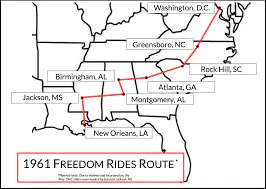
Which of the following best describes the Freedom Rides?
a)
Bus tours to promote voting rights in southern states.
b)
Marches from Selma to Montgomery to challenge inequallities with voting registration.
c)
Bus trips across state lines to challenge segregated bus terminals.
d)
Student-led campaigns to integrate public schools by enrolling in previously all-white classrooms.
52.
What happened to the Freedom Riders when they arrived in Jackson, Mississippi, during their civil rights campaign?
a)
They were arrested by local authorities for challenging segregated bus facilities.
b)
They were welcomed by city officials and allowed to use all bus facilities without interference.
c)
They were allowed to apply to receive their voting registration cards.
d)
They successfully negotiated with local businesses to voluntarily desegregate all public spaces.
53.
What was the Children’s Crusade in the Birmingham Campaign?
a)
Children organized school supply drives to support civil rights activists.
b)
African American children and teens marched to challenge segregation.
c)
Children boycotted lunch counters to demand equal access to public services.
d)
Nine students attempted to enter an all-white school in Birmingham.
54.
How did Birmingham police respond to the Children's Crusade?
a)
They ignored it and allowed the protests to continue peacefully
b)
They successfully protected the marchers from angry mobs
c)
They used fire hoses and police dogs against the children
d)
They allowed children to speak to the mayor and share their stories
55.
Why was Dr. Martin Luther King Jr. arrested in Birmingham?
a)
For leading a nonviolent protest without a permit
b)
For organizing a sit-in at a restaurant
c)
For refusing to pay taxes for two years prior
d)
For giving a speech in Washington, D.C.
56.
What was the outcome of the Birmingham Campaign?
a)
Birmingham remained completely segregated
b)
City officials agreed to desegregate public facilities
c)
The campaign led to new laws in New York
d)
The national guard was called into the school
57.
What made the March on Washington historically significant?
a)
It was on the 100th anniversary of the Emancipation Proclamation.
b)
It was one of the largest nonviolent protests with over 250,000 people.
c)
It included one of the most well-known speeches by Martin Luther King Jr.
d)
All of the above.
58.
What did the protesters demand in addition to civil rights at the March on Washington?
a)
Lower taxes
b)
Better environmental protections
c)
Jobs and fair wages
d)
Free college tuition
59.
What did marchers demand at the conclusion of the Selma to Montgomery march?
a)
Free college
b)
Voting rights legislation
c)
Desegregation of northern cities
d)
The resignation of the governor
60.
What law was passed shortly after the Selma marches?
a)
The Civil Rights Act of 1964
b)
The Voting Rights Act of 1965
c)
The Emancipation Proclamation.
d)
The 14th Amendment
61.
What was the main purpose of the Civil Rights Act of 1964?
a)
To lower federal income taxes and encourage economic growth across the states
b)
To end segregation and ban discrimination based on race, color, religion, sex, or national origin
c)
To reduce the voting age nationwide to 18 and expand access to polling places
d)
To create new states in the western U.S. to promote balanced political representation
62.
What was a key provision of the Civil Rights Act of 1968?
a)
It banned discrimination in housing and property sales or rentals.
b)
It guaranteed free public education for all children regardless of race.
c)
It allowed women to vote in all federal elections.
d)
It ended segregation in public transportation nationwide.
63.
What event is widely considered to have sparked the modern LGBTQ+ rights movement in the United States?
a)
The Civil Rights Act of 1964
b)
The Lavender Scare
c)
The Stonewall Riots
d)
The March on Washington
64.
What were the main goals of Lyndon B. Johnson’s Great Society programs?
a)
To expand the military and increase U.S. involvement in the Vietnam War
b)
To reduce poverty and inequality through education, healthcare, and job training programs
c)
To lower taxes for corporations and reduce government regulations
d)
To focus solely on foreign aid and international relations
65.
Why was the Peace Corps established in the early 1960s?
a)
To reduce federal spending to improve American infrastructure
b)
To recruit scientists for the U.S. space program
c)
To compete with the Soviet Union by promoting American values
d)
To establish permanent U.S. control over foreign governments
66.
What action did President Dwight D. Eisenhower take in response to the situation at Central High School with the Little Rock Nine.
a)
He supported the governor of Arkansas and publicly endorsed his behavior.
b)
He sent federal troops to protect the students and allow them to enter the building.
c)
He ignored the situation and hoped that things would improve without intervention.
d)
He requested that states wait on integration as he saw this would become a problem.
67.
What was the main goal of Ho Chi Minh and North Vietnam?
a)
To expand French colonial control
b)
To unify Vietnam under a communist government
c)
To support the monarchy in South Vietnam
d)
To gain independence from China
68.
What was Operation Rolling Thunder?
a)
A ground invasion of North Vietnam
b)
A plan to evacuate civilians from Saigon
c)
The code name for the Geneva Accords
d)
A bombing campaign carried out by American forces
69.
What countries were part of French Indochina before World War II?
a)
Vietnam, Laos, and Cambodia
b)
China, Japan, Russia
c)
Cuba, Panama, Honduras
d)
France, Germany, Ireland
70.
What was the My Lai Massacre?
a)
A major North Vietnamese victory during the Tet Offensive
b)
The killing of hundreds of unarmed Vietnamese civilians by U.S. troops
c)
The first major bombing campaign of the Vietnam War
d)
A surprise attack on American bases in South Vietnam
71.
What was the Tet Offensive?
a)
A peace negotiation between North and South Vietnam aimed at ending the conflict and reuniting the country under a single government.
b)
A large-scale bombing campaign launched by the United States to weaken North Vietnam’s supply routes and military strength.
c)
A series of coordinated attacks by North Vietnamese and Viet Cong forces against U.S. and South Vietnamese targets across major cities and bases.
d)
The planned withdrawal of U.S. troops from Vietnam following years of intense fighting and growing domestic opposition.
72.
What was the main purpose of the 1969 draft lottery held by the Selective Service System?
a)
To determine which men would be called to serve in the military
b)
To organize volunteers for community service programs
c)
To assign work placements for recent college graduates
d)
To select individuals for jury duty in the United States
73.
What happened during the Kent State Massacre in 1970?
a)
Police arrested students for vandalism during an anti-war protest
b)
President Nixon personally addressed protesting students
c)
The Pentagon was bombed by anti-war activists
d)
National Guard troops opened fire on students protesting the war
74.
What role did each U.S. president play in the Vietnam War?
a)
Kennedy expanded U.S. involvement by sending combat troops, Johnson ended the war, and Nixon refused to expand it into other countries.
b)
Kennedy began U.S. involvement by sending military advisors, Johnson escalated the conflict after the Gulf of Tonkin incident, and Nixon expanded the war into Cambodia.
c)
Kennedy withdrew all military advisors, Johnson avoided direct involvement, and Nixon began U.S. participation in the war.
d)
Kennedy initiated bombing campaigns, Johnson reduced troop levels, and Nixon increased military aid to France.
75.
What main idea is expressed in the following quote said by Jane Fonda in 1972? “He’ll never be able to turn Vietnam, north and south, into a neo-colony of the United States by bombing, invading, by attacking in any way. One has only to go into the countryside and listen to the peasants describe the lives they led before the revolution to understand why every bomb that is dropped only strengthens their determination to resist.”
a)
The Vietnamese people were eager for U.S. control to improve their living conditions.
b)
Bombing campaigns were the most effective way to win support from the Vietnamese population.
c)
The peasants in Vietnam were indifferent to the conflict and avoided involvement.
d)
More involvement of the U.S. in Vietnam would lead to greater resistance from Vietnamese people.
76.
Which event triggered the 1973 OPEC oil embargo during Richard Nixon’s presidency?
a)
The U.S. withdrew forces from Southeast Asia which resulted in OPEC's embargo of oil exports
b)
The build up of nuclear weapons increased tensions between the US and USSR resulting in an embargo
c)
Nixon provided military aid to Israel which resulted in OPEC halting oil exports to the U.S.
d)
Nixon staged the Bay of Bigs coup in Cuba which resulted in an embargo of oil
77.
Which of the following best defines "Detente"?
a)
The military buildup and increased competition between the United States and the Soviet Union
b)
The easing of Cold War tensions and beginning of cooperation between the US & USSR
c)
The policy of isolating the United States from global conflicts to focus on domestic issues
d)
The expansion of U.S. influence in Europe through NATO and economic aid programs
78.
Which of the following best describe Nixon's policy of Vietnamization?
a)
Increasing the number of American troops in Vietnam to achieve a quick victory through raids and bombing.
b)
Ending all U.S. involvement immediately without preparing South Vietnam to fight.
c)
Withdrawing American troops while training South Vietnamese army forces to take over their own defense.
d)
The decision by U.S. politicians to annex Vietnam and make it our 51st state.
79.
Which of the following best describes President Nixon’s policy of New Federalism?
a)
Expanding the power of the federal government by creating new national social welfare programs modeled after President Johnson’s Great Society initiatives.
b)
Reducing the role of state and local governments by placing most decision-making authority in the hands of federal agencies and Congress.
c)
Decentralizing federal programs by redistributing power and funds to state and local governments through revenue sharing and block grants.
d)
Eliminating all federal funding for state and local programs while requiring states to independently raise their own revenue to maintain existing services.
80.
What was the primary purpose of the Strategic Arms Limitation Talks (SALT) between the United States and the Soviet Union?
a)
To completely eliminate all nuclear weapons and military forces from both countries to reduce global tension.
b)
To allow each country to expand its nuclear arsenal freely while maintaining a balance of power over the long term.
c)
To limit the number of antiballistic missile sites to two per country and freeze intercontinental and submarine-launched ballistic missiles.
d)
To create a joint military alliance between the United States and the Soviet Union against other global powers.
81.
Which of the following lists accurately reflects some of President Nixon’s major domestic and foreign policy actions?
a)
Proposed guaranteed basic incomes and universal healthcare, created the EPA, signed Title IX, imposed school integration, lowered the voting age to 18, and normalized ties with China.
b)
Opposed environmental protection, rejected gender equality in schools, refused school integration, raised the voting age, and severed ties with China.
c)
Focused only on foreign policy by normalizing ties with China and the Soviet Union while ignoring domestic reforms such as healthcare, education, and voting rights.
d)
Eliminated all federal programs, reduced the voting age to 21, prevented school integration, and blocked environmental protections.
82.
Which of the following actions harmed democracy and violated ethical norms during Nixon’s presidency?
a)
Supporting a coup in Chile to replace democratically-elected Allende with a dictator.
b)
Promoting free and fair elections in Latin America without interfering in domestic politics.
c)
Strengthening civil liberties and supporting grassroots democratic movements abroad.
d)
Ignoring foreign affairs entirely and focusing only on domestic policy.
83.
What does the acronym CREEP stand in the context of the Watergate scandal?
a)
Central Regulatory Enforcement of Executive Policies, a White House oversight group for federal programs
b)
Committee for the Re-Election of the President, Nixon’s fundraising organization involved in illegal activities
c)
Congressional Review of Election and Political practices, a committee investigating campaign violations
d)
Covert Research and Espionage of Enemies of the President, a secret White House operations unit
84.
What was the main reason behind the Watergate break-in during Nixon’s presidency?
a)
To prevent a foreign invasion of the United States by gathering intelligence on enemy forces.
b)
To investigate corruption within Nixon’s own administration.
c)
To improve relations with Congress by exposing dishonest members.
d)
To wiretap and gather information on Democratic opponents and then attempt to cover it up.
85.
Why were Nixon’s White House tapes so significant in the Watergate scandal?
a)
They were personal conversations unrelated to the investigation.
b)
They contained only Nixon’s private opinions about foreign policy.
c)
They recorded Nixon discussing how to pay off one of the burglars.
d)
They proved that Nixon had no knowledge of the break-in or cover-up.
86.
Why did Nixon resign from the presidency in August 1974?
a)
Public protests forced him to step down immediately after the break-in.
b)
He lost the 1972 election and refused to serve.
c)
The release of the tapes proved his involvement and impeachment was imminent.
d)
Congress passed a law removing him from office without an investigation.
87.
"During this long period of delay and potential litigation, ugly passions. would again be aroused. And our people would again be polarized in their opinions. And the credibility of our free institutions of government would again be challenged at home and abroad... My conscience tells me clearly and certainly that I cannot prolong the bad dreams that continue to reopen a chapter that is closed. My conscience tells me that only I, as President, have the constitutional power to firmly shut and seal this book. My conscience tells me it is my duty, not merely to proclaim domestic tranquility but to use every means that I have to insure it." — Gerald Ford, 8 September 1974 Based on this excerpt, which of the following best explains the reasoning behind President Ford’s decision to pardon Richard Nixon?
a)
Ford wanted to protect Nixon from any legal consequences because he personally feared retaliation from the former president.
b)
Ford thought that public opinion polls clearly supported pardoning Nixon and wanted to follow the majority’s wishes.
c)
Ford believed that punishing Nixon further would delay national healing and prolong political divisions, and that he had the constitutional authority to end the controversy.
d)
Ford was required by law to pardon Nixon to prevent impeachment of other government officials connected to Watergate.
88.
What major challenge did Jimmy Carter face while running for president in 1976?
a)
He had too much foreign policy experience.
b)
He was a little-known governor without strong national experience.
c)
He had already served as vice president.
d)
He was widely criticized for pardoning Nixon.
89.
Why was President Ford criticized after signing the Helsinki Pact?
a)
It increased U.S. military spending.
b)
It expanded American influence in Asia.
c)
It formally recognized Soviet control over Eastern European borders.
d)
It weakened détente between the U.S. and USSR.
90.
What lasting legacy did Presidents Ford and Carter leave behind?
a)
They worsened political distrust after Watergate.
b)
They restored stability and helped rebuild Americans’ trust in government.
c)
They strengthened the power of the presidency beyond historical norms.
d)
They were the last two presidents who were impeached by Congress.
91.
Who was Mikhail Gorbachev?
a)
The last leader of the Soviet Union, known for significant reforms.
b)
A U.S. president who negotiated arms reductions with the Soviet Union.
c)
The first leader of independent Russia after the fall of the Soviet Union.
d)
A Soviet general who led military campaigns in Eastern Europe during the Cold War.
92.
How did communist authorities typically respond to the rise of punk culture in East Germany and the Soviet Union during the 1980s?
a)
They celebrated it as a symbol of socialist creativity.
b)
They ignored it completely and allowed it to spread freely.
c)
They monitored, censored, and sometimes arrested punk musicians and fans.
d)
They funded punk concerts to boost youth participation in state events.
93.
What were the main problems that caused the Soviet Union to weaken in the 1980s?
a)
Failing economy that struggled to compete with capitalist economies
b)
Excessive military spending to match U.S. advancements of technology and defense
c)
Public dissatisfaction with government control and lack of freedoms
d)
All of the above
94.
How did the fall of the Berlin Wall symbolize the end of Soviet control in Eastern Europe?
a)
It marked the end of communist rule in East Germany.
b)
It strengthened the influence of the Soviet Union in Eastern Europe.
c)
It led to the creation of new Soviet-aligned governments.
d)
It signaled renewed support for the division of Europe during the Cold War.
95.
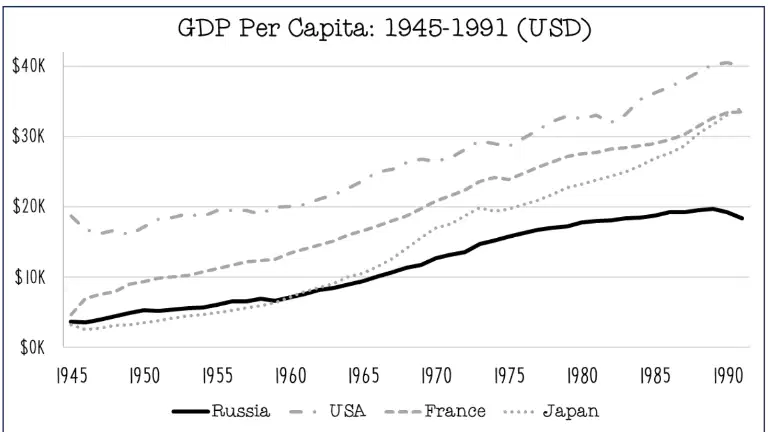
How does Russia's economic growth under communism compare to growth in the capitalist economies of the US, France, and Japan?
a)
Russia’s economic growth was significantly higher than that of the capitalist countries.
b)
Russia’s economic growth was about the same as the capitalist countries.
c)
Russia’s economic growth fell behind that of the capitalist countries.
d)
Russia’s economic growth steadily improved and eventually surpassed the capitalist economies.
96.
What was the main goal of Gorbachev’s policy of glasnost?
a)
To increase government censorship
b)
To promote openness and freedom of information
c)
To expand Soviet military power
d)
To return to strict Stalinist policies
97.
What was the main goal of Gorbachev’s policy of Perestroika?
a)
To increase government censorship and harsh punishments for political dissidents
b)
Restructuring of the economy and allowing some market-based practices
c)
To completely privatize all Soviet industries
d)
To increase military spending and expand the Soviet armed forces
98.

What was a significant challenge faced by Jimmy Carter during his time as president?

a)

The Cuban Missile Crisis.

b)

The Watergate scandal.

c)

The Iran Hostage Crisis.

d)

The Korean War.

99.

Which of the following best describes Malcolm X's approach to achieving civil rights for African Americans?

a)

He focused solely on economic reforms without addressing racial issues.

b)

He supported segregation and opposed any form of protest.

c)

He promoted self-defense and Black empowerment, sometimes criticizing nonviolent methods.

d)

He advocated for complete nonviolence and integration at all costs.

100.

Which of the following best describes the main goal of the Black Power Movement?

a)

To end the Vietnam War

b)

To support the integration of schools only

c)

To encourage Black pride, self-sufficiency, and political empowerment

d)

To promote nonviolent resistance to segregation

101.

Who was a prominent leader associated with the Black Power Movement?

a)

Martin Luther King Jr.

b)

Lyndon B. Johnson

c)

Malcolm X

d)

John F. Kennedy

102.

Which of the following was a major foreign policy achievement during Richard Nixon's presidency?

a)

The signing of the Camp David Accords

b)

The opening of diplomatic relations with China

c)

The creation of the United Nations

d)

The end of the Korean War

103.

What was the main purpose of the Watergate break-in during Nixon's presidency?

a)

To gather intelligence on foreign diplomats

b)

To sabotage the Democratic National Committee

c)

To promote Nixon's re-election campaign through legal means

d)

To protest against the Vietnam War

104.

Which domestic policy initiative is most closely associated with President Nixon?

a)

The Fair Deal

b)

The Environmental Protection Agency (EPA)

c)

The Great Society

d)

The New Deal

105.

Which of the following was a major reason for U.S. involvement in the Vietnam War?

a)

To support the spread of communism in Southeast Asia

b)

To assist France in regaining its colonial empire

c)

To establish new trade routes with Vietnam

d)

To prevent the domino effect of countries falling to communism

106.

What was the significance of the Tet Offensive during the Vietnam War?

a)

It marked the end of U.S. military involvement in Vietnam

b)

It was a major North Vietnamese attack that shifted American public opinion against the war

c)

It led to the signing of the Paris Peace Accords

d)

It resulted in the capture of Saigon by North Vietnamese forces

107.

Which of the following best describes the outcome of the Vietnam War?

a)

The United States established a permanent military base in Vietnam

b)

North Vietnam was defeated and the country remained divided

c)

South Vietnam became a communist state while North Vietnam became democratic

d)

North Vietnam unified the country under communist rule after the fall of Saigon

108.

Which of the following best describes the nuclear arms race during the Cold War?

a)

A race to develop faster airplanes for commercial travel.

b)

A global effort to ban all forms of nuclear energy.

c)

A series of peace talks to reduce the number of nuclear weapons worldwide.

d)

A competition between the United States and Soviet Union to build more powerful nuclear weapons.

109.

What was the main goal of the Strategic Arms Limitation Talks (SALT) between the U.S. and the Soviet Union?

a)

To increase the production of nuclear weapons.

b)

To promote the development of space exploration technology.

c)

To limit and control the number of nuclear missiles each country could possess.

d)

To encourage the use of nuclear energy for civilian purposes.

110.

Which event is often considered a turning point in the nuclear arms race, bringing the world close to nuclear war?

a)

The signing of the Marshall Plan.

b)

The launch of Sputnik.

c)

The construction of the Berlin Wall.

d)

The Cuban Missile Crisis.

111.

Which television show is widely credited with popularizing the family sitcom genre in the 1950s?

a)

Gunsmoke

b)

The Twilight Zone

c)

I Love Lucy

d)

The Ed Sullivan Show

112.

What style of music emerged as a dominant force in 1950s American pop culture, influencing fashion and dance?

a)

Classical

b)

Country

c)

Rock and Roll

d)

Jazz

113.

Which outcome best describes the result of the Korean War?

a)

North Korea conquered all of South Korea.

b)

The border between North and South Korea remained near the 38th parallel, with an armistice but no formal peace treaty.

c)

The Korean Peninsula was unified under a communist government.

d)

South Korea became a colony of the United States.

114.

Which of the following actions is President Gerald Ford best known for during his time in office?

a)

Signing the Civil Rights Act of 1964

b)

Granting a presidential pardon to Richard Nixon

c)

Declaring war on Vietnam

d)

Establishing the Environmental Protection Agency

115.

What major economic challenge did President Ford face during his presidency?

a)

The Great Depression

b)

The Oil Crisis and rising inflation

c)

The Dot-com bubble

d)

The Savings and Loan crisis

116.

How did President Ford become President of the United States?

a)

He was elected after winning a landslide victory

b)

He became President after the assassination of his predecessor

c)

He succeeded Richard Nixon after Nixon resigned

d)

He was appointed by Congress

117.

Which leader is most closely associated with the policies that contributed to the breakup of the Soviet Union?

a)

Joseph Stalin

b)

Leonid Brezhnev

c)

Mikhail Gorbachev

d)

Vladimir Lenin

118.

What was a significant outcome of the fall of the Berlin Wall?

a)

The start of World War II

b)

The construction of a new wall in Europe

c)

The end of the Cold War and the reunification of Germany

d)

The division of Berlin into more sectors

119.

What was the main reason the Berlin Airlift was launched in 1948?

a)

To evacuate American citizens from Berlin

b)

To transport military equipment to the Soviet Union

c)

To supply West Berlin with food and fuel after the Soviet blockade

d)

To build a new airport in East Berlin

120.

Which countries were primarily responsible for organizing and carrying out the Berlin Airlift?

a)

United States, Britain, and France

b)

Italy and Spain

c)

United States and Soviet Union

d)

Germany and Poland

121.

Who was the leader of the Southern Christian Leadership Conference (SCLC) and delivered the famous 'I Have a Dream' speech?

a)

Thurgood Marshall

b)

Martin Luther King Jr.

c)

Rosa Parks

d)

Malcolm X

122.

What was the purpose of the Freedom Rides during the Civil Rights Movement?

a)

To promote environmental conservation

b)

To support women's suffrage

c)

To challenge segregation in interstate bus travel

d)

To protest the Vietnam War

123.

Which law was passed in 1968 to protect the rights of Native Americans and promote tribal self-government?

a)

The Indian Removal Act

b)

The Voting Rights Act

c)

The Dawes Act

d)

The Indian Civil Rights Act

124.

What was the main goal of the American Indian Movement (AIM) during the 1960s and 1970s?

a)

To support European colonization of tribal lands

b)

To assimilate Native Americans into mainstream culture

c)

To encourage Native Americans to relocate to urban areas

d)

To promote Native American civil rights and sovereignty

125.

Title IX is most closely associated with which area of education reform?

a)

Standardized testing requirements

b)

Gender equality in educational programs and athletics

c)

Equal funding for rural and urban schools

d)

Desegregation of schools