
 Worksheets
Week 10: Respiratory System Response to Exercise
Total questions: 80
Worksheet time: 40mins
What is the main topic discussed in Week 10 of the lecture series?
Digestive System Response to Exercise
Respiratory System Response to Exercise
Nervous System Response to Exercise
Circulatory System Response to Exercise
Which specific aspect of the respiratory system is the focus of Lecture #3?
Gas Exchange in the Lungs
Control of Ventilation
Oxygen Transport in Blood
Muscle Fatigue
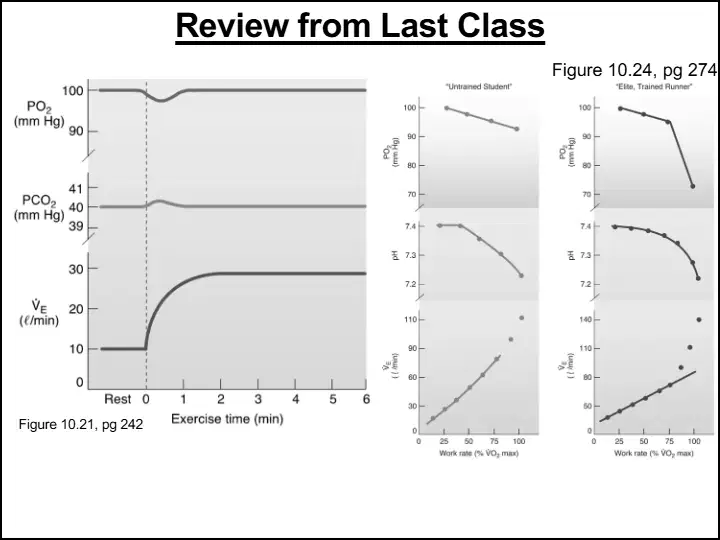
Based on the diagrams shown, what is likely being reviewed from the last class?
The effect of diet on lung capacity
The changes in respiratory gases and ventilation during exercise
The structure of the alveoli
The role of the diaphragm in breathing
What is the approximate oxygen requirement of breathing at rest and during light-to-moderate exercise?
Up to ~100 L·min⁻¹
Up to ~50 L·min⁻¹
Up to ~200 L·min⁻¹
Up to ~10 L·min⁻¹
At moderate exercise intensities, what percentage of oxygen cost is associated with breathing?
3 to 5%
10 to 15%
1 to 2%
8 to 11%
For highly trained endurance athletes with minute ventilations of greater than 150 L·min⁻¹, what can the energy cost of breathing exceed?
15%
5%
8%
3%
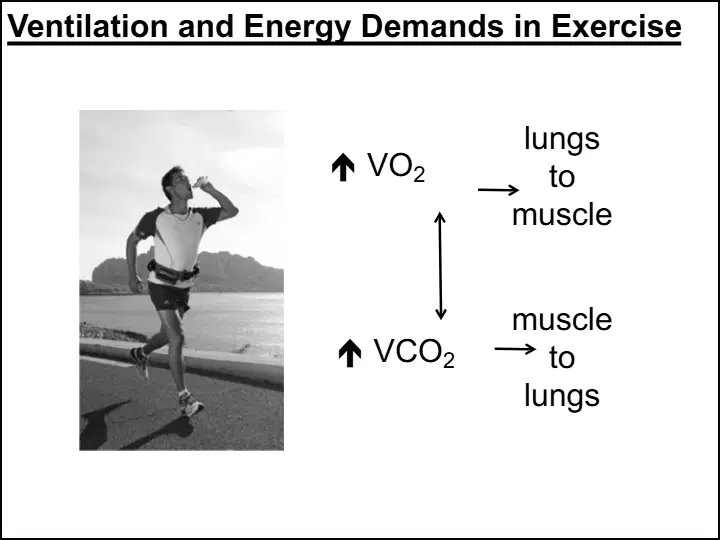
During exercise, what happens to VO₂ and VCO₂ in relation to the lungs and muscles?
VO₂ increases from lungs to muscle, VCO₂ increases from muscle to lungs
VO₂ decreases from lungs to muscle, VCO₂ increases from muscle to lungs
VO₂ increases from muscle to lungs, VCO₂ increases from lungs to muscle
VO₂ and VCO₂ both decrease from lungs to muscle
What is the oxygen cost per liter of air breathed each minute during exercise?
~1.5 mL/L
~10 mL/L
~0.5 mL/L
~5 mL/L
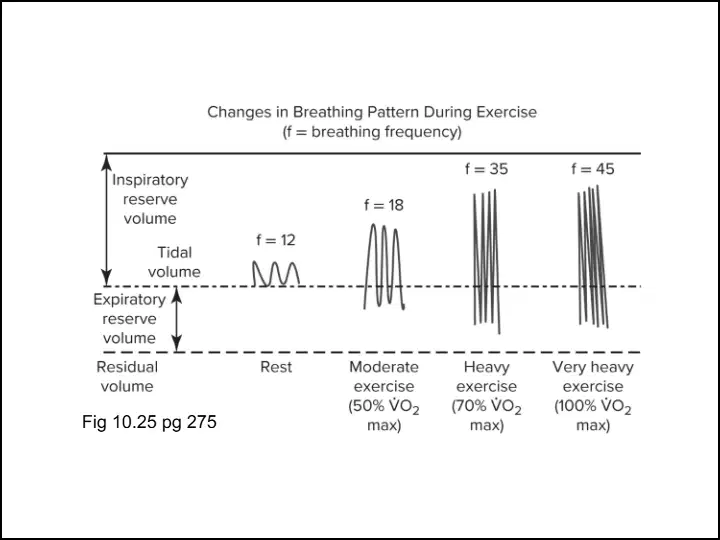
What does the variable "f" represent in the context of breathing patterns during exercise?
Breathing frequency
Heart rate
Oxygen consumption
Blood pressure
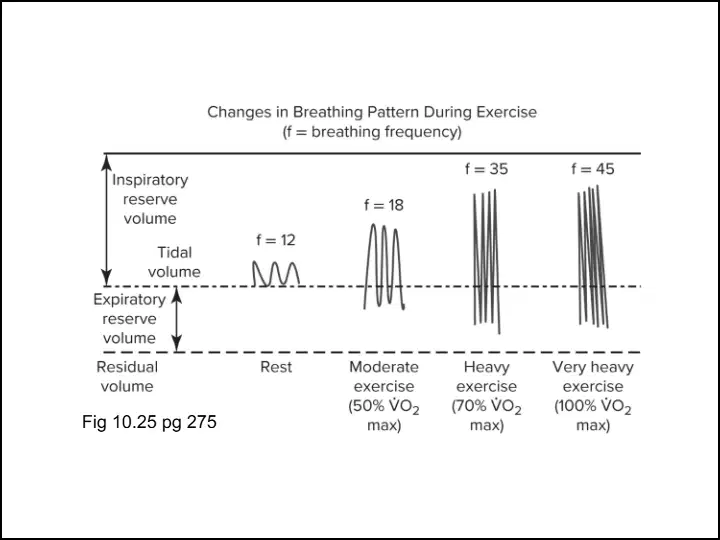
During very heavy exercise (100% VO₂ max), what is the approximate breathing frequency (f) shown in the diagram?
f = 12
f = 18
f = 35
f = 45
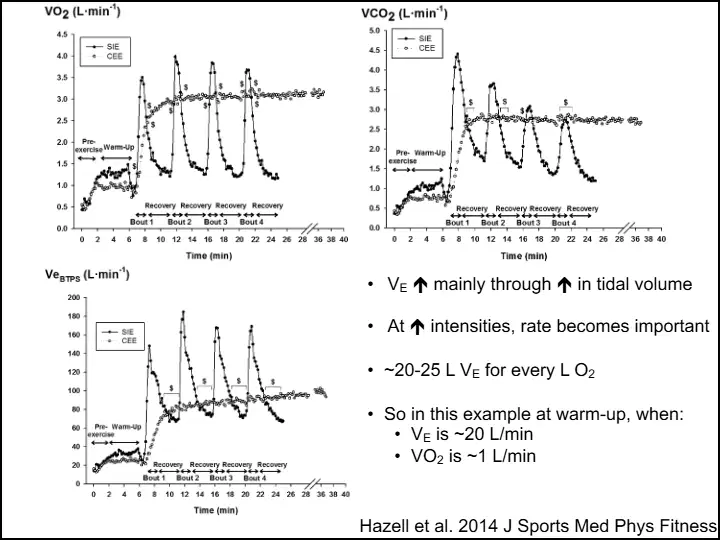
Which volume increases mainly through an increase in tidal volume during exercise, according to Hazell et al. 2014?
VO₂
VCO₂
VE
Residual volume
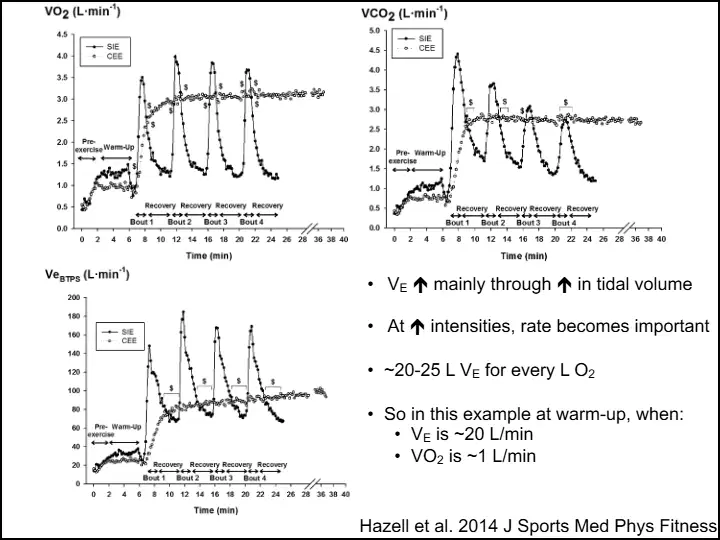
At high exercise intensities, which factor becomes more important for ventilation (VE)?
Tidal volume
Rate of breathing
Inspiratory reserve volume
Residual volume
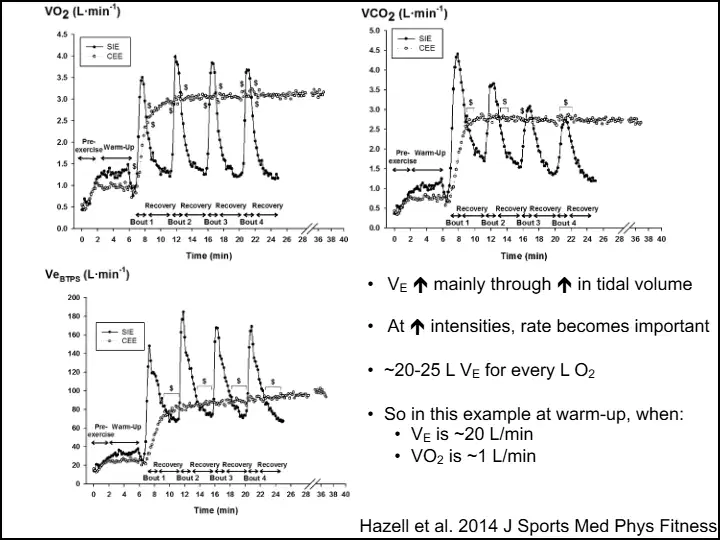
According to Hazell et al. 2014, approximately how many liters of ventilation (VE) occur for every liter of oxygen consumed (O₂) at warm-up?
5-10 L VE for every 1 L O₂
10-15 L VE for every 1 L O₂
20-25 L VE for every 1 L O₂
30-35 L VE for every 1 L O₂
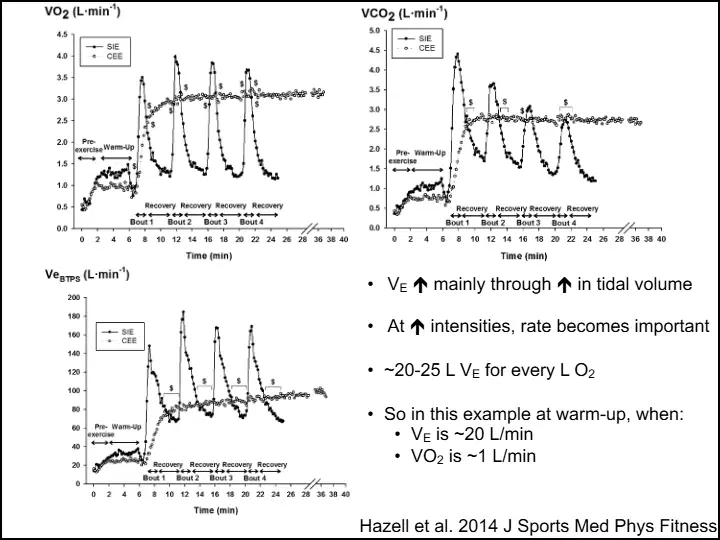
If VE is approximately 20 L/min and VO₂ is approximately 1 L/min during warm-up, what is the ratio of VE to VO₂?
5:1
10:1
20:1
25:1
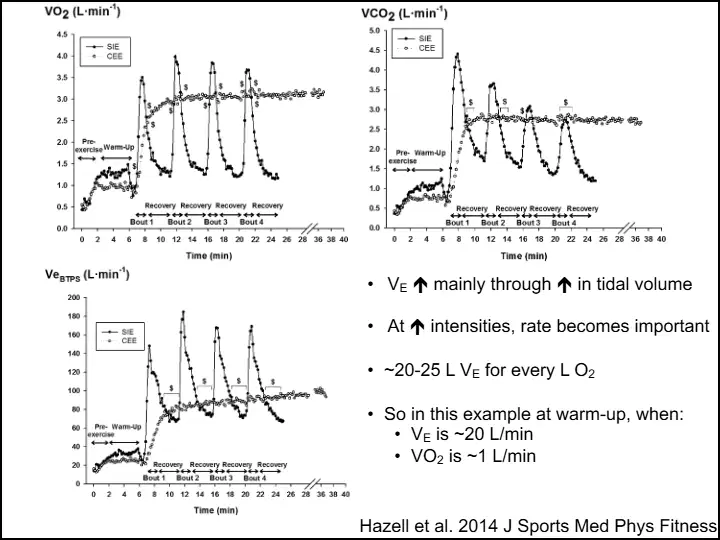
Explain why the rate of breathing becomes more important at higher exercise intensities.
Because tidal volume decreases at higher intensities
Because oxygen consumption stops at higher intensities
Because the body needs to expel more carbon dioxide quickly
Because breathing frequency compensates for limited tidal volume increase
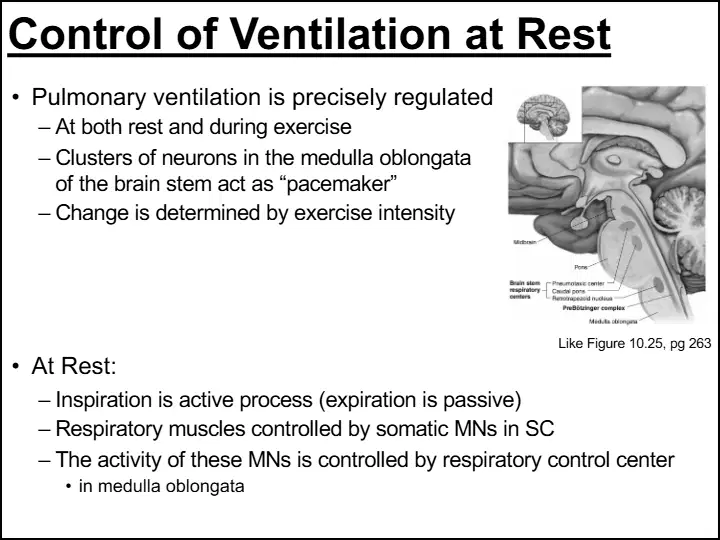
Which part of the brain stem acts as a "pacemaker" for pulmonary ventilation at rest?
Medulla oblongata
Cerebellum
Hippocampus
Thalamus
At rest, which process is considered active during ventilation?
Expiration
Inspiration
Both inspiration and expiration
Neither inspiration nor expiration
Which type of motor neurons control the respiratory muscles at rest?
Autonomic motor neurons
Somatic motor neurons
Sensory neurons
Interneurons
Where is the respiratory control center (RCC) located?
Cerebral cortex
Brain stem
Cerebellum
Spinal cord
Which of the following is NOT a distinct rhythm center involved in the initiation of breathing?
preBötzinger complex
Retrottrapezoid nucleus/parafacial respiratory group
Pontine respiratory centre
Hippocampal rhythm centre
How does the normal rhythm of breathing get regulated at rest?
Only positive feedback
Only negative feedback
Both positive and negative feedback
No feedback mechanisms involved
Explain how the interaction between the preBötzinger complex and other rhythm centers contributes to the regulation of breathing at rest.
It provides only excitatory signals to increase breathing rate.
It interacts with other centers using both positive and negative feedback to tightly regulate breathing rhythm.
It stops all respiratory activity during rest.
It only controls expiration, not inspiration.
Describe the role of the pontine respiratory centre in the control of ventilation.
It initiates inspiration only.
It controls the rate and pattern of breathing.
It is responsible for gas exchange.
It regulates blood pressure.
Which type of input to the RCC involves the motor cortex altering breathing in proportion to the amount of exercise?
Neural input
Humoral input
Chemical input
Mechanical input
What do central chemoreceptors located in the medulla detect in the cerebrospinal fluid (CSF)?
PCO₂ and H⁺ concentration
PO₂ and K⁺ concentration
Glucose and oxygen concentration
Sodium and potassium concentration
Peripheral chemoreceptors are located in which areas?
Aortic arch and common carotid artery
Medulla and spinal cord
Lungs and heart
Brainstem and cerebellum
At rest, what is the greatest respiratory stimulus?
PCO₂ in arterial plasma
PO₂ in venous blood
H⁺ in cerebrospinal fluid
K⁺ in muscle tissue
How does a small increase in PCO₂ in inspired air affect VE?
It triggers a large increase in VE
It triggers a small decrease in VE
It has no effect on VE
It triggers a large decrease in VE
If arterial PCO₂ increases by 1 mmHg, how much does VE generally increase?
2 L/min
0.5 L/min
5 L/min
10 L/min
How does acidosis affect VE?
It reflects CO₂ retention and increases VE to remove CO₂
It reflects oxygen retention and decreases VE
It reflects potassium retention and increases VE
It reflects sodium retention and decreases VE
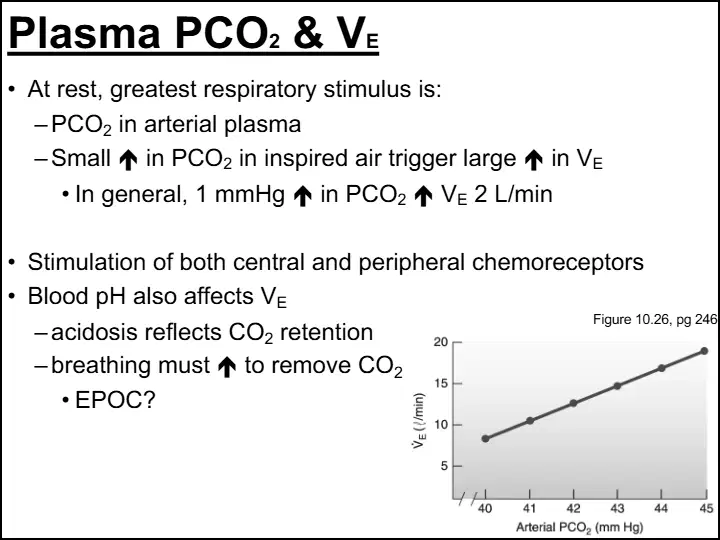
What does the graph illustrate about the relationship between arterial PCO₂ and VE?
As arterial PCO₂ increases, VE increases
As arterial PCO₂ increases, VE decreases
As arterial PCO₂ decreases, VE remains constant
As arterial PCO₂ increases, VE fluctuates randomly
At sea level, changes in PO₂ have what kind of effect on ventilation (V_E)?
Large effect
Small effect
No effect
Decreases ventilation
Which receptors are stimulated by a decrease in PO₂ due to environmental changes?
Central chemoreceptors
Peripheral chemoreceptors
Muscle mechanoreceptors
Muscle chemoreceptors
What is the primary role of carotid bodies in monitoring arterial blood?
Monitoring muscle activity
Monitoring temperature
Monitoring arterial blood as it perfuses the brain
Monitoring blood pressure
Which of the following is NOT a factor that stimulates ventilation during exercise?
Increased temperature
Increased acidity
Increased [CO₂] and [K⁺]
Decreased blood pressure
According to Table 10.2, which receptor responds to increased PCO₂ and decreased pH by increasing ventilation (V_E)?
Central chemoreceptors
Peripheral chemoreceptors (Carotid body)
Peripheral chemoreceptors (Aortic body)
All of the above
Which receptor is stimulated by muscle activity to increase ventilation (V_E)?
Central chemoreceptors
Peripheral chemoreceptors
Muscle mechanoreceptors
Muscle chemoreceptors
A student is analyzing a scenario where both pH decreases and K⁺ increases during exercise. Which receptor is most likely to be activated to increase ventilation?
Central chemoreceptors
Peripheral chemoreceptors (Carotid body)
Muscle chemoreceptors
Muscle mechanoreceptors
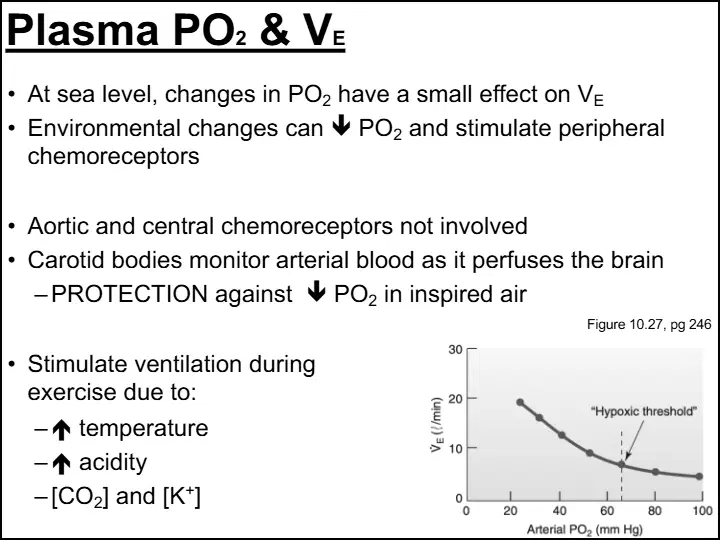
What does the "hypoxic threshold" in the graph represent?
The point where ventilation decreases as PO₂ increases
The point where ventilation increases sharply as PO₂ decreases
The point where temperature affects ventilation
The point where pH is at its highest
Which of the following best describes the cortical influence on ventilatory control during exercise?
Anticipation of exercise stimulates respiratory neurons in the medulla to initiate an abrupt increase in exercise ventilation.
Sensory input from joints, tendons, and muscles influences ventilatory adjustments during exercise.
Blood H+ stimulates carotid bodies during heavy exercise.
Catecholamines have no effect on ventilatory control.
What is the primary drive for ventilatory control during submaximal exercise?
Peripheral chemoreceptors
Higher brain centers (central command)
Increased blood potassium
Body temperature
Which of the following factors "fine tune" ventilatory control during submaximal exercise?
Catecholamines and body temperature
Humoral chemoreceptors and neural feedback from muscle
Cortical anticipation and medullary stimulation
Blood H+ and carotid bodies
During heavy exercise, what causes a linear rise in VE (ventilation)?
Decreased blood H+ levels
Increased blood H+ (from lactic acid) stimulating carotid bodies
Reduced neural feedback from muscle
Lower body temperature
Which of the following is a peripheral influence on ventilatory control during exercise?
Anticipation of exercise
Sensory input from joints, tendons, and muscles
Central command from higher brain centers
Humoral chemoreceptors
How do catecholamines affect ventilatory control during heavy exercise?
They decrease the need for ventilation.
They play an important role in increasing ventilation.
They inhibit carotid body stimulation.
They reduce body temperature.
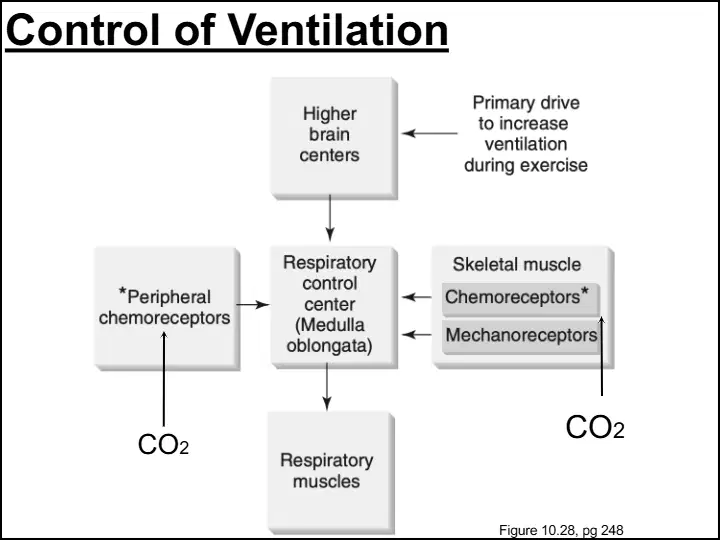
Which part of the brain is primarily responsible for controlling ventilation?
Cerebral cortex
Medulla oblongata
Cerebellum
Hypothalamus
What is the primary drive to increase ventilation during exercise?
Peripheral chemoreceptors
Higher brain centers
Skeletal muscle
Mechanoreceptors
Which phase of ventilation during exercise involves neurogenic stimuli from the cerebral cortex and feedback from active limbs stimulating the medulla?
Phase I
Phase II
Phase III
Phase IV
During which phase does minute ventilation rise exponentially to achieve a steady level related to metabolic gas exchange demands?
Phase I
Phase II
Phase III
Phase IV
How is steady-state ventilation fine-tuned during exercise?
By higher brain centers
By feedback from active limbs
Through peripheral sensory feedback mechanisms
By chemoreceptors in skeletal muscle
Explain how chemical and neural stimuli work together to regulate ventilation during exercise. (DoK Level 3)
They act independently to control ventilation.
Chemical stimuli only affect recovery, while neural stimuli affect exercise.
Combined effects of chemical and neural stimuli initiate and modulate exercise alveolar ventilation.
Only chemical stimuli are involved in ventilation regulation.
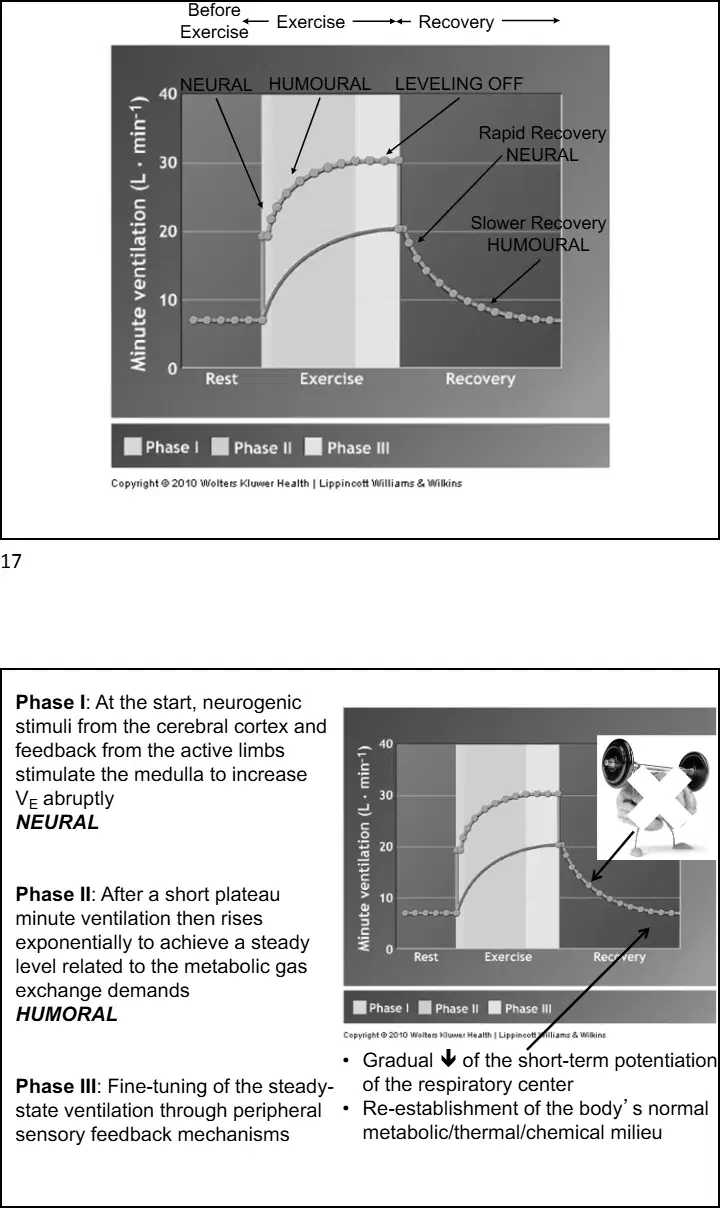
Which phase of minute ventilation during exercise is primarily influenced by neurogenic stimuli from the cerebral cortex and feedback from active limbs?
Phase I
Phase II
Phase III
Phase IV
What is the main factor responsible for the exponential rise in minute ventilation after the initial plateau during exercise?
Neural feedback
Humoral factors related to metabolic gas exchange
Peripheral sensory feedback
Thermal regulation
During which phase does fine-tuning of steady-state ventilation occur through peripheral sensory feedback mechanisms?
Phase I
Phase II
Phase III
Phase IV
What happens during the recovery phase after exercise in terms of minute ventilation?
Minute ventilation remains at its peak
Minute ventilation drops rapidly due to neural factors, then more slowly due to humoral factors
Minute ventilation increases exponentially
Minute ventilation is unaffected
Explain how the body re-establishes its normal metabolic, thermal, and chemical milieu after exercise.
By increasing neural stimulation
By gradual reduction of short-term potentiation of the respiratory center
By maintaining high minute ventilation
By stopping all feedback mechanisms
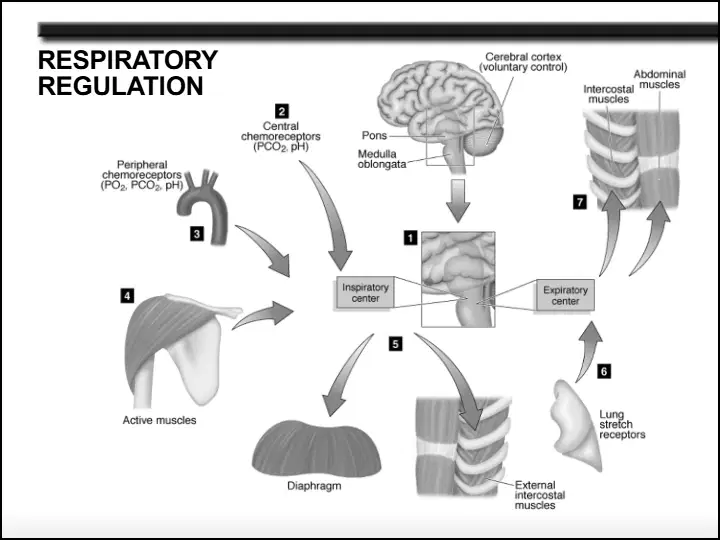
Which part of the brain is involved in voluntary control of respiration?
Cerebral cortex
Cerebellum
Hippocampus
Thalamus
What is the effect of training on lung structure and function at rest?
It increases lung structure and function
It decreases lung structure and function
There is no effect on lung structure and function at rest
It causes lung damage
Why is adaptation not required for the lung to maintain blood-gas homeostasis during normal conditions?
The lung cannot adapt to changes
The normal lung exceeds the demand for gas exchange
The lung is always in a state of hypoxemia
The lung only adapts during sleep
Which group is an exception to the general effect of training on ventilation, and what is the result?
Recreational swimmers; increased lung volume
Elite endurance athletes; failure of lung to adapt results in hypoxemia
Amateur runners; improved oxygen uptake
Weightlifters; reduced lung capacity
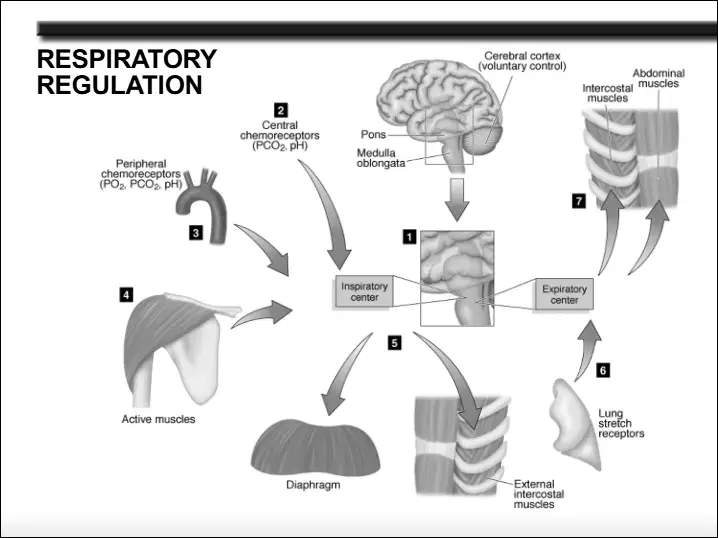
Based on the diagram, which muscle is directly involved in inspiration during respiratory regulation?
Diaphragm
Abdominal muscles
Biceps brachii
Trapezius
Explain why elite endurance athletes may experience hypoxemia during training, based on the information provided.
Their lungs adapt too quickly to training
Their lungs fail to adapt to increased training demands
They have a genetic predisposition to low oxygen levels
Their blood cannot carry enough oxygen
During low-to-moderate intensity exercise, how is the pulmonary system generally viewed in terms of limiting exercise performance?
It is seen as a major limitation
It is not seen as a limitation
It always causes hypoxemia
It limits only elite athletes
What new evidence has been found regarding the pulmonary system during high intensity exercise (>90% VO₂max)?
The pulmonary system never limits performance
Respiratory muscle fatigue can occur
Hypoxemia is not possible
Only untrained individuals are affected
What percentage of elite endurance athletes may experience hypoxemia during maximal exercise?
10–20%
25–30%
40–50%
60–70%
Which of the following best describes Maximum Voluntary Ventilation (MVV)?
The maximum amount of oxygen the body can use
The maximum amount of air a person can inhale in one breath
The ventilatory capacity measured by rapid and deep breathing for 15 seconds, extrapolated to 1 minute
The maximum heart rate during exercise
In healthy, college-aged men, what is the typical range for Maximum Voluntary Ventilation (MVV)?
40 to 80 L/min
140 to 180 L/min
200 to 250 L/min
80 to 120 L/min
Which of the following is NOT increased by training respiratory (TR) muscles?
Strength (ST)
Endurance
Functional capacity
Inspiratory muscle function
Why does ventilation during maximal exercise not maximally stress a healthy person?
Because the pulmonary system is always a limitation
Because ventilation during maximal exercise is about 25% higher than what is needed
Because hypoxemia always occurs
Because only elite athletes are affected
What does RCC most likely stand for in the context of respiratory physiology?
Renal Control Center
Respiratory Control Center
Regional Cardiac Chamber
Red Cell Count
Which two arterial blood gases are highlighted as important in the regulation of breathing?
PO₂ and PCO₂
O₂ and N₂
CO₂ and H₂O
HCO₃⁻ and Cl⁻
Which of the following is NOT listed as a take-home point in the provided material?
Role of the RCC
Arterial PO₂ and PCO₂
Structure of the alveoli
Regulation of breathing (phases)
Why might the ventilatory system be considered limiting during prolonged breath-holding?
Because it cannot increase heart rate
Because it may not adequately remove CO₂ or supply O₂
Because it regulates blood pressure
Because it controls muscle contraction
During prolonged breath-holding, what typically happens to arterial CO₂ levels?
They decrease rapidly
They remain constant
They gradually increase
They fluctuate randomly
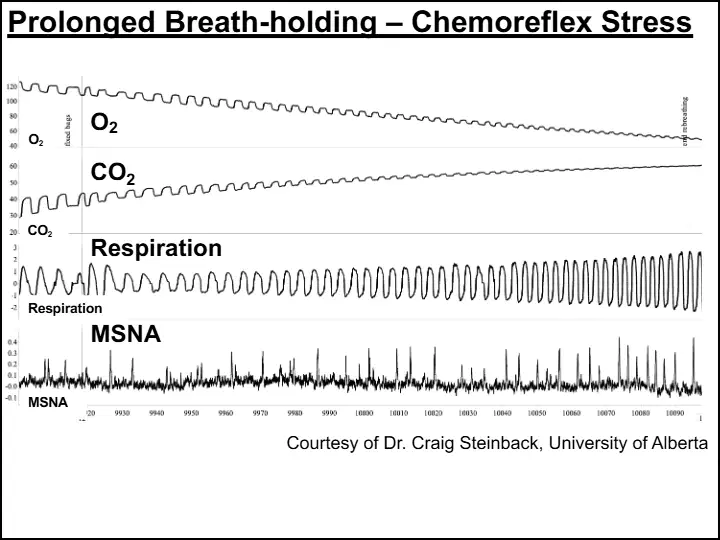
Which variable in the diagram is most directly related to chemoreflex stress during breath-holding?
O₂
CO₂
Respiration
MSNA
How many marks is the Mid-term #2 worth?
50 marks
100 marks
30 marks
20 marks
Which sections are covered in the Mid-term #2?
Muscle, CV, Respiratory
Digestive, Nervous, Endocrine
Muscle, Digestive, Respiratory
CV, Endocrine, Respiratory
If a student’s last name begins with Rae, which room should they write the Mid-term #2 in?
N-1001
BA209
CV101
N-2002
What type of questions are included in the Mid-term #2?
Only multiple choice
Only short answer
Multiple choice and short answer
Essay questions only
Why is it important for the exam questions to be spread evenly over all three sections (Muscle, CV, Respiratory)?
To ensure fair assessment of all topics
To make the exam shorter
To focus only on the most difficult section
To allow students to skip sections

