
 Worksheets
Drawing I Final Exam Review
Total questions: 98
Worksheet time: 49mins
What is drawing?
A form of visual art that makes use of only pencil to mark a two-dimensional medium
A form of visual art that makes use of any number of drawing instruments to mark a two-dimensional medium
Both A & B
None of the above
What instruments are used for drawing?
Graphite, pen, crayons, chalk, markers, charcoal
Eraser, ruler, protractors, compass
Both A & B
None of the above
Graphite are usually graded on the European Systems, “H” stands for?
Heavy
Hard
Hollow
Handy
Graphite are usually graded on the European Systems, “B” stands for?
Blend
Bland
Big
Bold
Name the types of Balance.
Symmetrical
Asymmetrical
Radial
All of the above
What are the two composition orientation?
Landscape & Portrait
Horizontal & Vertical
Both A & B
None of the above
What are the three main types of visual art?
Two-dimensional, three-dimensional & four-dimensional
Representational, abstract & non-objective
Drawing, painting & mixed media
None of the above
Define Approximate Symmetry.
When the elements are arranged equally on either side of an axis, resulting in an identical reflection of elements used.
A form of balance achieved by the use of similarly compositional units of elements on either side of an axis.
When an artwork has dissimilar sides of a design and have positioned visual weight unequally.
When the elements are arranged around a central point.
What are the basic drawing topics?
Portrait & figure
Still-life & landscape
Both A & B
None of the above
What is observational drawing?
When you are looking at what you are drawing and record what you see
Is not drawing from imagination
Is not drawing from your memory
All of the above
What is direct observational drawing?
Drawing from a photograph
Drawing from memory
Drawing from real life
None of the above
What is a viewfinder?
A small window tool that allows the artist to crop a scene
A small window tool that allows the artist to zoom in on a scene
Both A & B
None of the above
What is a grid method?
A technique that allows the artist to identify the focal point of an artwork
A technique that allows the artist to blend smoothly
A technique that allows the artist to enlarge in proportion
A technique that allows the artist to abstract an artwork
What is thumbnail sketching?
A quick and small sketch of a composition that allows the artist to brainstorm and plan
A quick and large sketch of a composition that allows the artist to brainstorm and plan
A time consuming, small sketch of a composition that allows the artist to brainstorm and plan
A time consuming, large sketch of a composition that allows the artist to brainstorm and plan
What is scratch art?
A technique of drawing where the artist uses a stylus to cut out shapes
A technique of drawing where the artist uses white color pencils on black paper
Both A & B
None of the above
What are the line value techniques?
Hatching, cross-hatching, scribbling & stippling
Horizontal, vertical, diagonal, zig-zag & curved
Both A & B
None of the above
How can lines be varied?
Length, width & texture
Direction & degree of curve
Both A & B
None of the above
What is a horizontal line?
A line that slants
A line that curves
A line that goes side to side
A line that goes straight up and down
What is a vertical line?
A line that slants
A line that curves
A line that goes side to side
A line that goes straight up and down
What is a diagonal line?
A line that slants
A line that curves
A line that goes side to side
A line that goes straight up and down
Past still-life drawings depicted ____________.
People
Fruit
Both A & B
None of the above
Still-life drawings become more __________ in the 19th and 20th century.
Realistic
Non-objective
Abstract
None of the above
What is gesture drawing?
When the artist uses lines to create texture
When the artist uses lines to outline the subject matter
When the artist uses lines to outline the subject matter without lifting the drawing tool
When the artist uses lines to outline the subject matter without looking at the drawing
What is contour drawing?
When the artist uses lines to create texture
When the artist uses lines to outline the subject matter
When the artist uses lines to outline the subject matter without lifting the drawing tool
When the artist uses lines to outline the subject matter without looking at the drawing
What is cross-contour drawing?
When the artist uses lines to create texture
When the artist uses lines to outline the subject matter without lifting the drawing tool
When the artist uses lines to define the volume of the objects by using series parallel lines
None of the above
What is sighting?
A method used to gauge relative scale of objects.
A method used to determine approximate angles of objects
Both A & B
None of the above
While using the sight method, the artist must_____________.
Use pirate eye
Lock his/her elbow
Both A & B
None of the above
What is positive space?
The space objects occupy
The space around the objects
Both A & B
None of the above
What is negative?
The space objects occupy
The space around the objects
Both A & B
None of the above
What is direct light?
Lighting in which the light goes straight from the sources
When the object is lit by scattered or bounce light
When there is no single direct light source
None of the above
What is indirect light?
When the object is lit by scattered or bounce light
When there is no single direct light source
Both A & B
None of the above
What is additive technique?
A technique in which the drawing surface receives application of art medium (layer by layer) to build an image
A technique that allows the artist to blend smoothly
A technique that allows the artist to enlarge in proportion
A technique in which the drawing surface is covered with graphite or charcoal and then erased to make the image
What is subtractive technique?
A technique in which the drawing surface receives application of art medium (layer by layer) to build an image
A technique that allows the artist to blend smoothly
A technique that allows the artist to enlarge in proportion
A technique in which the drawing surface is covered with graphite or charcoal and then erased to make the image
What is chiaroscuro?
Italian for simulated texture using value techniques
Italian for realistic drawing using value techniques
Italian for light-dark, a use of strong contrasts between light and dark
Italian for light-dark, a use of low contrast between light and dark
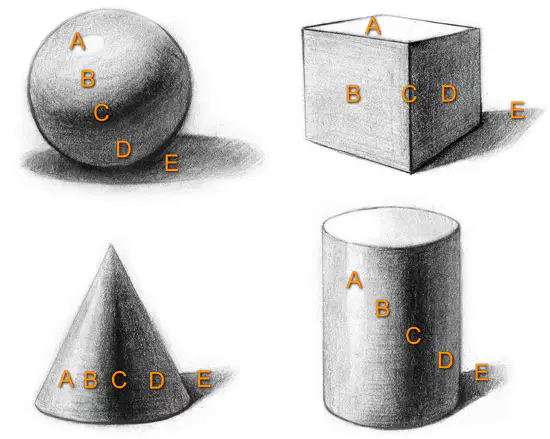
Use the image on the right to label the highlight.
A
B
C
D
E
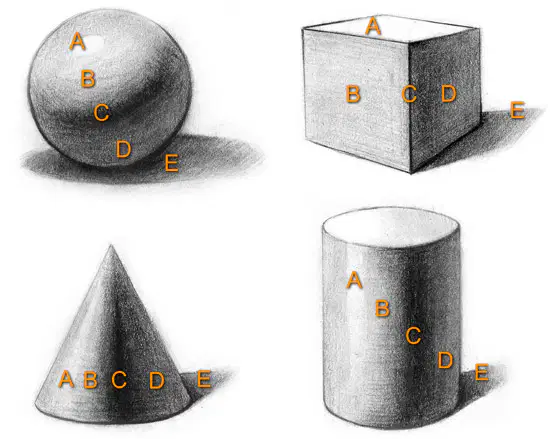
Use the image on the right to label the cast shadow.
A
B
C
D
E
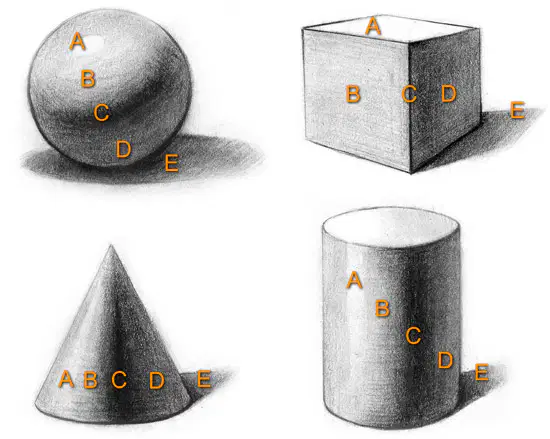
Use the image on the right to label the core shadow.
A
B
C
D
E
Use the image on the right to label the reflected light.
E (Reflected light)
A (Incident light)
B (Absorbed light)
C (Transmitted light)
Use the image on the right to label the halftone.
C (Halftone)
A (Solid)
B (Gradient)
D (Outline)
The core of a colored pencil is made out of ______________.
Graphite
Wax
Both A & B
None of the above
Lightfastness refers to ________________.
The colored pencils’ ratio of wax to pigment
The to how soft the core of the colored pencil is
The response to UVA, how susceptible to fading over time
None of the above
High pigment ratio compared to wax makes the colored pencils’ lead __________ and __________ in color.
Hard and bland
Hard and rich
Soft and bland
Soft and rich
What is gradating?
Changing values slowly/gradually
Involves layering and blending until no paper tooth shows through the colored pencil layers
Involves incising line with a sharp instrument to reveal a lower layer of a contrasting color
Involves gradual color build-ups
What is layering?
Changing values slowly/gradually
Involves layering and blending until no paper tooth shows through the colored pencil layers
Involves incising line with a sharp instrument to reveal a lower layer of a contrasting color
Involves gradual color build-ups
What is burnishing?
Changing values slowly/gradually
Involves layering and blending until no paper tooth shows through the colored pencil layers
Involves incising line with a sharp instrument to reveal a lower layer of a contrasting color
Involves gradual color build-ups
What is sgraffito?
Changing values slowly/gradually
Involves layering and blending until no paper tooth shows through the colored pencil layers
Involves incising line with a sharp instrument to reveal a lower layer of a contrasting color
Involves gradual color build-ups
What is hatching?
A line value technique with lines going in the same direction
A line value technique with lines going in different directions, intersecting
A line value technique that uses dots
A line value technique that uses circular lines
What is scribbling?
A line value technique with lines going in the same direction
A line value technique with lines going in different directions, intersecting
A line value technique that uses dots
A line value technique that uses circular lines
What is stippling?
A line value technique with lines going in the same direction
A line value technique with lines going in different directions, intersecting
A line value technique that uses dots
A line value technique that uses circular lines
What is cross-hatching?
A line value technique with lines going in the same direction
A line value technique with additional lines going in different directions, intersecting
A line value technique that uses dots
A line value technique that uses circular lines
What is linear perspective?
A technique for showing three-dimensionality using texture
A technique for showing three-dimensionality using value
A technique for showing two-dimensionality
A technique for showing distance and depth in space
What are the types of perspective drawing are there?
One-point
Two-point
Three-point
All of the above
In linear perspective, what is a vanishing point?
The meeting point where orthogonal lines meet to show depth
The meeting point that's located on the horizon line
Both A & B
None of the above
In linear perspective, what is another name for horizon line?
Converging line
Distance line
Eye-level line
None of the above
What is a picture plane?
Is the plane used to record/capture the subject matter
Changes when the artist changes perspective
Both A & B
None of the above
What is bird’s eye view?
A linear perspective technique with three vanishing points looking up
A linear perspective technique with three vanishing points looking down
A linear perspective technique with three vanishing points looking to the left
A linear perspective technique with three vanishing points looking to the right
What is ant’s eye view?
A linear perspective technique with three vanishing points looking up
A linear perspective technique with three vanishing points looking down
A linear perspective technique with three vanishing points looking to the left
A linear perspective technique with three vanishing points looking to the right
The drawing below was drawn using _______ point perspective.
One
Two
Three
None of the above
The drawing below was drawn using _______ point perspective.
One
Two
Three
None of the above
What is figure drawing?
A drawing of the plant form
A drawing of cityscape, seascape, etc.
A drawing of human form
None of the above
What is proportion?
A principle of art that describes the size, location or amount of one element to another
Parts and whole relationship
Both A & B
None of the above
The adult body is approximately ____________ heads tall.
8
7 ½
7
None of the above
What is foreshortening?
Refers to the technique of depicting an object or human body in a picture so as to produce an illusion of projection or extension in space
A tool for composition the artist divides any composition into thirds, vertically and horizontally, then place the key elements either along these lines or at the junctions
Used by artists to enlarge in proportion
None of the above
What is the grid method?
Refers to the technique of depicting an object or human body in a picture so as to produce an illusion of projection or extension in space
A tool for composition the artist divides any composition into thirds, vertically and horizontally, then place the key elements either along these lines or at the junctions
Used by artists to enlarge in proportion
None of the above
What is the rule of thirds?
Refers to the technique of depicting an object or human body in a picture so as to produce an illusion of projection or extension in space
A tool for composition the artist divides any composition into thirds, vertically and horizontally, then place the key elements either along these lines or at the junctions
Used by artists to enlarge in proportion
None of the above
What is Facial Proportions?
Refers to the relationship in size and placement between facial features.
Refers to the distortion of size and placement of facial features.
Both A & B
None of the above
Where is the eye-level line located on a face?
Halfway in between the tip of the nose and the tip of the chin.
Halfway in between the top of the skull and the tip of the chin.
Halfway in between the jawline and the tip of the chin.
Halfway in between the top of the skull and the tip of the nose.
On the eye-level line, how many eyes can fit across?
4 eyes across
5 eyes across
6 eyes across
7 eyes across
Where is the tip of the nose located?
Halfway in between the top of the skull and the tipoff the chin.
Halfway in between the eye-level line and the tip of the chin.
Halfway in between the jawline and the tip of the chin.
Halfway in between the top of the skull and the eye-level line.
How wide is the width of nose?
The width of an eye
The width of 2 eyes
The width of 3 eyes
None of the above
Where is the jaw line located?
Halfway in between the tip of the nose and the tip of the chin.
Halfway in between the top of the skull and the tip of the chin.
Halfway in between top of the skull and the tip of the nose.
None of the above
How wide should the lips be?
As wide as the width of the nose.
As wide as the distance between the tails of the left and right eye.
As wide as the distance between the central points of the left and right eye.
None of the above
The bottom lip should be located where?
Above the jaw line
Below the jaw line
Both A & B
None of the above
The top of the ears should touch the ____________ line, meanwhile the bottoms touch the __________ line.
Hair, tip of nose
Eyebrow, tip of nose
Eye-level, jaw
Eye-level, tip of nose
The width of the neck should be as wide as the ____________ line.
Eye-level
Hair
Jaw
None of the above
The shoulders should be the width of ____________ across.
One head
Two heads
Three heads
Four heads
None of the above
The hairline should be located halfway in between the _________ line and the _________ line.
Top of skull, eye-level
Top of skull, chin
Top of skull, tip of nose
None of the above
The placement of eyebrows should be located in between the _________ line and the _________ line.
Top of skull, eye-level
Hair, eye-level
Eye-level, tip of nose
None of the above
Why are the seven Elements of Art important to the artist?
They help the artist with choosing a medium
The Elements of Art are the building blocks of creating an artwork
The Elements of Art measure creativity
They determine the style of an artwork
A continuous mark made on a surface by a moving tool is a
Shape
Value
Line
Hue
What is an enclosed area that has only length and width?
A form
A gesture drawing
A shape
A still-life
How many dimensions does a form have?
2
4
5
3
Some ways that an artist can create the illusion of space is
Overlapping
Size
Placement
All of the above
In art, what is color?
Absorbed light
The absence of light
Reflected light
Star light
The three properties of color are
Monochromatic, analogous, and complementary
Black, gray, and white
Primary, secondary, and tertiary
Hue, value, and intensity
Intensity refers to
How light or dark a color is
The texture of a color
The name of a color
How bright or dull a color is
A color scheme is
The colors on the color wheel
A prism broken into a rainbow
Additive and subtractive colors
A plan for organizing colors
What is a simulated texture?
A texture that doesn’t look real, but is made-up by the artist
A texture that is drawn or painted to look like a real texture
A texture that you can really touch, and it feels the same as it looks
All of the above
There are two categories of texture. What are they?
Actual and visual
Shiny and dull
Rough and smooth
Soft and hard
What is the “Principles of Design?”
Describe the ways that artists use and arrange the elements of art.
The rules/guidelines an artist follows to create an effective composition.
Both A & B
None of the above
What is Unity?
Describes how rough or smooth an artwork appears.
Measures how well each elements of a design works together.
How light or how dark the elements of art appear on the artwork.
None of the above
What is Balance?
The visual harmony of the elements used within a work of art.
The visual opposition of the elements of art being used within an artwork.
The distribution of the visual weight of the art elements within an artwork.
None of the above
Define Pattern.
The repetition of the art elements, regular arrangement of repeated same elements.
Refers to the arrangement of opposite elements.
Both A & B
None of the above
Define Contrast.
The repetition of the art elements, regular arrangement of repeated same elements.
Refers to the arrangement of opposite elements.
Both A & B
None of the above
Define Emphasis.
Refers to an area in the composition that has the most significance, an area that the artist wants to draw attention to as the most important aspect.
Refers to an area or areas within a composition that plays a supporting role.
Is defined as an area or object within the artwork that draws attention.
None of the above
What is Variety?
It is achieved when the art elements are combined in various ways to increase visual interest.
Refers to a way of utilizing the art elements to produce the look and feel of structured movement with a visual tempo or beat.
Is the process of printing multiple copies of one design/artwork.
The design principle that uses some of the elements of art to produce the look of action or to cause the viewer’s eye to sweep over the artwork in a certain manner.
What is Rhythm?
It is achieved when the art elements are combined in various ways to increase visual interest.
Refers to a way of utilizing the art elements to produce the look and feel of structured movement with a visual tempo or beat.
Is the process of printing multiple copies of one design/artwork.
The design principle that uses some of the elements of art to produce the look of action or to cause the viewer’s eye to sweep over the artwork in a certain manner.
What is Movement?
It is achieved when the art elements are combined in various ways to increase visual interest.
Refers to a way of utilizing the art elements to produce the look and feel of structured movement with a visual tempo or beat.
Is the process of printing multiple copies of one design/artwork.
The design principle that uses some of the elements of art to produce the look of action or to cause the viewer’s eye to sweep over the artwork in a certain manner.

