
 Worksheets
Social Studies - 1st Semester Final
Total questions: 69
Worksheet time: 38mins
What is the meaning of the term 'chronology'?
The arrangement of events or dates in the order of their occurrence.
The study of ancient languages.
The measurement of physical quantities.
The classification of living organisms.
What does BCE or BC stand for?
Before Common Era or Before Christ.
Before Current Era or Before Calendar.
Before Civil Era or Before Century.
Before Christian Era or Before Civilization.
What does CE or AD stand for?
Common Era or Anno Domini.
Central Era or After Death.
Current Era or Ancient Date.
Civil Era or Annual Day.
What is a bias?
A prejudice in favor of or against one thing, person, or group compared with another.
A scientific law that explains natural phenomena.
A mathematical formula used for calculations.
A type of physical force between objects.
What are primary sources?
Original materials from the time period being studied.
Summaries written by historians.
Textbooks covering historical events.
Biographies of famous people.
What are secondary sources?
Documents or recordings that relate or discuss information originally presented elsewhere.
Original manuscripts or artifacts created at the time of the event.
Firsthand accounts or eyewitness testimonies.
Primary data collected directly from experiments.
What is a decade?
A period of ten years.
A period of five years.
A period of one hundred years.
A period of one year.
What is a century?
A period of one hundred years.
A period of fifty years.
A period of ten years.
A period of one thousand years.
What is a millennium?
A period of one thousand years.
A period of one hundred years.
A period of ten years.
A period of five hundred years.
What is an era?
A long and distinct period of history.
A type of animal found in Africa.
A small unit of currency.
A type of weather phenomenon.
What is a period in history?
A length or portion of time.
A type of government.
A famous historical figure.
A specific location.
What is the Julian Calendar?
A calendar introduced by Julius Caesar in 45 BC.
A calendar introduced by Pope Gregory XIII in 1582.
A calendar used exclusively in ancient Egypt.
A calendar based on lunar cycles only.
What is the Gregorian Calendar?
The calendar currently used in most of the world, introduced by Pope Gregory XIII in 1582.
A lunar calendar used in ancient Egypt.
A calendar system developed by Julius Caesar in 46 BC.
A calendar based on the cycles of the moon used in Islamic countries.
Who is a historian?
A person who studies and writes about the past.
A person who predicts the future.
A person who creates fictional stories.
A person who studies plants.
What is prehistory?
The period of time before written records.
The period after the invention of the wheel.
The time when humans first built cities.
The era of modern technology.
Who is an archaeologist?
A person who studies human history through the excavation of sites and the analysis of artifacts and other physical remains.
A person who studies stars and planets.
A person who writes novels and stories.
A person who treats sick animals.
Who are nomads?
People who move from place to place in search of food, water, or pasture.
People who live permanently in one place.
People who only travel for leisure.
People who work in offices.
What does it mean to migrate?
To move from one region or habitat to another.
To stay in the same place forever.
To build a new home in the same location.
To change color with the seasons.
What is an artifact?
An object made by a human being, typically of cultural or historical interest.
A natural rock formation found in the wild.
A type of weather phenomenon.
A species of animal discovered recently.
What is a fossil?
The remains or impression of a prehistoric organism preserved in petrified form or as a mold or cast in rock.
A type of mineral found in caves.
A modern animal living today.
A tool used by archaeologists to dig.
What is the Fertile Crescent?
A region in the Middle East known for its rich soils and the early development of agriculture.
A mountain range in South America famous for its ancient ruins.
A desert in Africa known for its vast sand dunes.
An island in the Pacific renowned for its volcanic activity.
What are city-states?
A city that with its surrounding territory forms an independent state.
A city that is part of a larger country.
A city that is governed by multiple states.
A city that is only a capital city.
What is a ziggurat?
A rectangular stepped tower, sometimes surmounted by a temple.
A circular amphitheater used for gladiator games.
A type of ancient Egyptian pyramid.
A large stone statue of a mythical creature.
What is an empire?
An extensive group of states or countries under a single supreme authority.
A small village governed by local elders.
A democratic nation with elected representatives.
A city-state ruled by a mayor.
What is cuneiform?
A system of writing first developed by the ancient Sumerians of Mesopotamia.
An ancient form of pottery used in Egypt.
A type of musical instrument from Greece.
A traditional dance from India.
What is polytheism?
The belief in or worship of more than one god.
The belief in only one god.
The rejection of all religious beliefs.
The worship of nature spirits.
What is silt?
Fine sand, clay, or other material carried by running water and deposited as a sediment.
A type of volcanic rock found near mountains.
A large body of salt water that covers most of the earth.
A hard mineral used in construction.
What is irrigation?
The supply of water to land or crops to help growth.
The process of planting seeds in dry soil.
The method of harvesting crops using machines.
The technique of adding fertilizers to soil.
One thing history has given us is:
Knowledge of the past
Unlimited resources
Perfect predictions
Instant solutions
What does GRAPES stand for in the context of civilization?
Geography, Religion, Achievements, Politics, Economics, Social Structure.
Government, Resources, Agriculture, People, Education, Science.
Growth, Religion, Art, Politics, Economy, Society.
Geology, Rights, Architecture, Power, Environment, Security.
Why did early humans stop living as nomads?
They began to farm and settle in one place.
They discovered fire and needed to stay near it.
They started building boats for travel.
They wanted to avoid wild animals by staying in caves.
How did Mesopotamia change the nomadic way of life?
By developing agriculture and permanent settlements.
By encouraging more frequent migrations.
By promoting hunting and gathering.
By increasing reliance on trade routes.

A fossil is a...
primary source
secondary source

An autobiography (book written by the person about themselves) would be a...
Primary Source
Secondary Source

A history textbook is a:
Primary Source
Secondary Source

The movie based on true events about Bethany Hamilton is a:
Primary Source
Secondary Source
Why is Mesopotamia referred to as the fertile crescent?
It has nutrient rich soil that is good for farming
It has mines of gold
It is shaped like a rectangle
Their chief export is crescent rolls
What was the form of writing invented by the people of Mesopotamia?
Pictographs
Cave paintings
Cueniform
Hieroglyphics
What invention helped farming the most?
Wheel
Compass
Ziggurats
Irrigation Canals
Hammurabi's Code had the SAME consequences for men of DIFFERENT social classes.
Ture
False
Civilization in Mesopotamia developed between which two rivers?
the Persian Gulf and the Mediterranean
the Tigris and the Persian Gulf
the Persian Gulf and the Euphrates
the Euphrates and the Tigris

Why were ziggurats important to the Sumerians?
They were built as temples to honor the gods and goddesses.
They protected the city from invaders.
They were built as tombs for the kings.
Scrolls that documented Mesopotamian history were encased in ziggurats.
When people bring water from a river to their crops using channels it is called....
A levee
A dike
Irrigation
A dam system
The Tigris & Euphrates rivers were in the center of Mesopotamia. Is this:
Geography
Religion
Achievements
Politics
The people of Mesopotamia believed in 7 gods. Is this:
Geography
Social Structure
Politics
Religion
Writing was invented in Mesopotamia.
Social Structure
Politics
Achievements
Geography
A king was in charge of each city-state. Is this:
Achievements
Geography
Politics
Economics
City-states in Mesopotamia had different jobs like farmers, merchants, priests, and potters. Is this:
Geography
Economics
Religion
Politics
Kings and priests had the most power in Mesopotamia. Is this:
Social Structure
Economics
Geography
Achievements

The name Homo Habilis Means:
Upright Man
Handy Man
Wise Man
Artist Man
Which type of map shows natural features like mountains and rivers?
Road Map
Political Map
Physical Map
Climate Map
Which type of map shows borders between countries, states, or cities?
Physical Map
Road Map
Political Map
Topographic Map
What is one feature of a physical map?
Shows roads
Shows capital cities
Uses colors to represent landforms and elevation
Shows weather patterns
Which map type uses "invisible lines" to divide land?
Physical Map
Road Map
Political Map
Topographic Map
Which map provides a detailed picture of land showing the shape of the land, including hills and valleys?
Climate Map
Topographic Map
Resource Map
Economic Map
Which type of map would you use to find information about jobs or industries in an area?
Climate Map
Topographic Map
Resource Map
Economic Map
What information is typically shown on a topographic map?
Climate zones
Economic activities
Elevation, latitude, and longitude
Natural resources
Which map would you use to understand the weather patterns of a region?
Economic Map
Resource Map
Climate Map
Topographic Map
What kind of map would show the distribution of coal and oil in a region?
Climate Map
Topographic Map
Resource Map
Economic Map

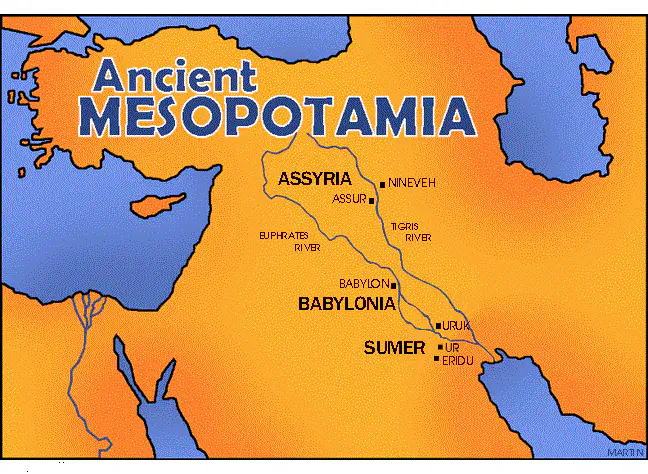
How did Mesopotamia change the nomadic way of life?
Don't forget to restate the question: Mesopotamia changed the nomadic way of life by...

