
 Worksheets
Untitled Quiz
Total questions: 51
Worksheet time: 26mins
What is the main application of durian peel (Durio zibethinus) discussed in the article?
Food ingredient
Adsorbent in purification
Fertilizer
Animal feed
Fill in the blank: Durian peel is rich in ________-lignin, making it effective as an adsorbent.
cellulose
hemicellulose
pectin
chitin
Which chemical is used to activate durian peel for use as an adsorbent in the purification process?
NaOH
HCl
KOH
CaCO3
Fill in the blank: The highest glycerol purity obtained in the study was ______%.
96.26%
85.40%
90.15%
92.80%
The adsorption process used a magnetic stirrer at a speed of 250 rpm for 2 hours.
True
False
Fill in the blank: The composition of durian fruit consists of 20–35% flesh, 5–15% seeds, and ______% peel.
60–75%
40–55%
10–25%
80–95%
Which of the following is NOT mentioned as a material that can be used as an adsorbent?
Sunflower stem-pith
Banana stem
Lemongrass leaf
Rice husk
What is the main by-product of the transesterification process in biodiesel production?
Glycerol
Methanol
Ethanol
Water
Which of the following is NOT typically found in crude glycerol?
Fatty acids
Methanol
Sodium chloride
Glycerol
What is the purpose of using acid, usually phosphoric acid, in the first step of glycerol purification?
To help separate the waste catalyst from salts and soaps that are insoluble in glycerol.
To neutralize the glycerol and make it edible.
To increase the viscosity of glycerol for industrial use.
To add fragrance to the purified glycerol.
Name one disadvantage of membrane filtration in glycerol purification.
It requires expensive membrane maintenance and can cause fouling.
It always increases the purity of glycerol without any drawbacks.
It eliminates the need for any further purification steps.
It is the cheapest method available for glycerol purification.
What is the main research focus of the study described in the article?
The use of waste-based natural materials, namely durian peel, as an adsorbent in the process of acidified crude glycerol purification.
The development of synthetic polymers for water purification.
The application of nanotechnology in renewable energy production.
The study of enzymatic reactions in biodiesel synthesis.
Which chemical was NOT used in the preparation of crude glycerol in the study?
Hydrochloric acid
Sodium hydroxide
Sulfuric acid
Nitric acid
What is the temperature used for drying durian peel before carbonization?
105°C
60°C
150°C
200°C
Calculate the Ash Yield (%) using the formula provided: Ash Yield (%) = (Final weight / Initial weight) x 100%. If the final weight is 2 g and the initial weight is 5 g, what is the Ash Yield (%)?
40%
25%
60%
10%
Calculate the Glycerol Content (%) using the formula: Glycerol Content (%) = ((T1 - T2) x N x 9.209) / W. If T1 = 10 mL, T2 = 2 mL, N = 0.05, and W = 0.5 g, what is the Glycerol Content (%)?
7.3672%
4.6045%
9.2090%
2.3000%
Which instrument was used to analyze the chemical composition of crude and purified glycerol?
Gas chromatography (GC)
Ultraviolet-visible spectrophotometer (UV-Vis)
Centrifuge
pH meter
What is the purpose of using KOH as an activator in the carbonization process of durian peel?
To react with the carbon adsorbent, leading to the formation of pores and the development of a highly porous structure.
To enhance the color of the carbon adsorbent for better visual identification.
To neutralize acidic compounds present in the durian peel before carbonization.
To increase the mass of the final carbon product by adding potassium ions.
The surface area of activated carbon produced from durian peel is usually characterized by a regular and smooth particle shape.
True
False
Which of the following elements were mainly detected in the chemical analysis of the activated carbon?
A) Al, Ca, Mg
B) Fe, Zn, Cu
C) Na, K, Cl
D) Si, P, S
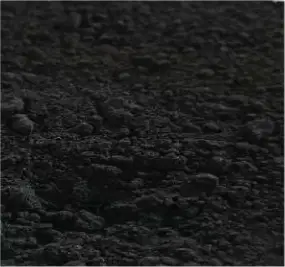
Which image represents the activated carbon?
(a) durian peel
(b) activated carbon produced from durian peel
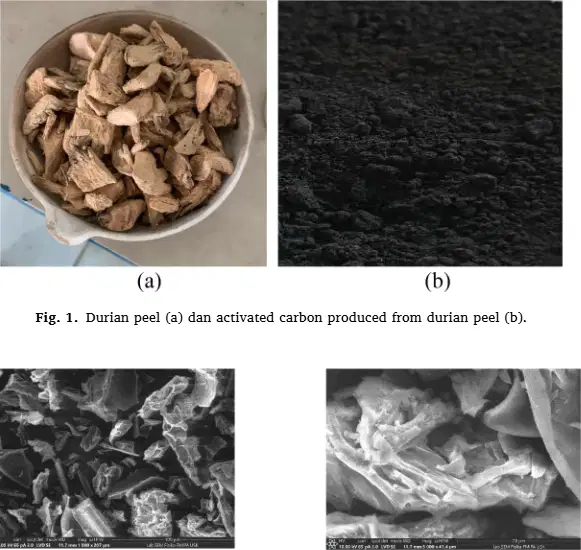
According to Fig. 2, what is the magnification used in the SEM test result shown in image (a)?
1000x magnification
500x magnification
2000x magnification
5000x magnification
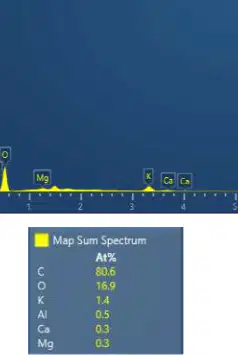
According to the EDX analysis in Fig. 2 (d), what is the percentage composition of Carbon (C) in the activated carbon?
80.6%
65.2%
45.8%
92.1%
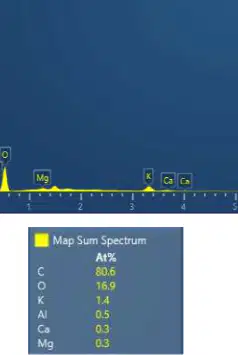
Which element has the second highest percentage in the EDX analysis of activated carbon from durian peel?
O
K
Al
Ca
Fill in the blank: The chemical equation for the activation process is 4KOH + C → K2CO3 + K2O + 2H2. The product gases are ________.
H2
CO2
O2
N2
Which of the following is a product in the reaction: K2CO3 + 2C → 2K + 3CO?
K2CO3
K
CO2
H2
In the reaction K2CO3 → K2O + CO2, what is the gaseous product formed?
CO2
K2O
K2CO3
O2
In the reaction K2O + C → 2K + CO, what are the products?
2K and CO
K2CO3 and CO2
K2O and CO2
K and CO2
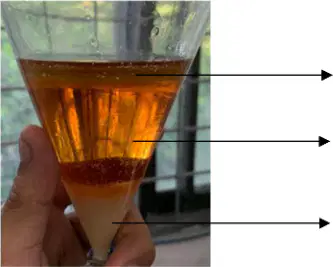
In the acidification of crude glycerol at a mole ratio of acid to crude glycerol of 1:1, what are the three main layers formed after separation based on density?
Fatty acid, Glycerol, Salt Precipitates
Glycerol, Water, Salt Precipitates
Fatty acid, Water, Glycerol
Salt Precipitates, Water, Glycerol
Fill in the blank: According to Eq. (8), the reaction of RCOOK with H3PO4 produces ______, KH2PO4, and a precipitate.
RCOOH
CO2
H2O
K2SO4
Fill in the blank: According to Eq. (9), the reaction of RCOONa with H3PO4 produces ______, NaH2PO4 (precipitate), and H2O.
RCOOH
NaCl
CO2
Na2SO4
Fill in the blank: According to Eq. (10), the reaction of NaOH with H3PO4 produces ______ and H2O.
NaH2PO4
Na3PO4
Na2HPO4
NaCl
According to the text, what is the main purpose of using activated carbon as an adsorbent in the purification of crude glycerol?
To increase the pH
To enhance the adsorption of impurities
To neutralize acids
To increase the temperature
According to Table 1, what is the glycerol content (%) obtained with a phosphoric acid to crude glycerol mole ratio of 1:1?
96.26
85.40
78.15
90.50
According to Table 1, what is the density (g/cm³) of glycerol obtained with a phosphoric acid to crude glycerol mole ratio of 2:1?
1.259
1.100
1.350
1.180
According to Table 1, what is the maximum allowed water content (%) in the glycerol standard BS 26221:1979?
<10 %
<5 %
<15 %
<20 %
According to Table 1, which acidification mole ratio resulted in the lowest MONG (%) value?
1:1
2:1
1:2
3:1
According to Table 1, what is the ash content (%) for the acidification mole ratio of 2.5:1?
4.00
2.50
5.25
3.10
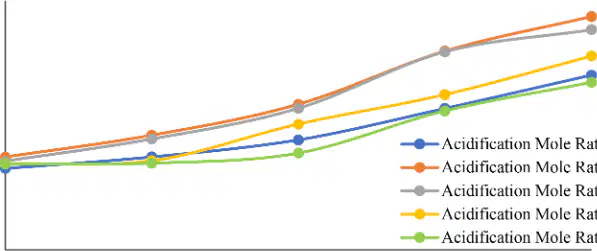
Based on Fig. 4, which acidification mole ratio resulted in the highest glycerol purity at 25% adsorbent mass?
Acidification Mole Ratio 1:1
Acidification Mole Ratio 2:1
Acidification Mole Ratio 1:2
Acidification Mole Ratio 3:1
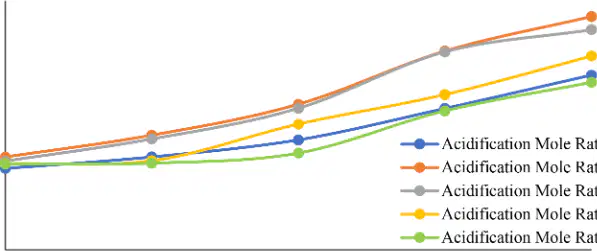
Based on Fig. 4, as the adsorbent mass increases, what happens to the glycerol purity (%) for all acidification mole ratios?
Glycerol purity increases.
Glycerol purity decreases.
Glycerol purity remains constant.
Glycerol purity fluctuates randomly.
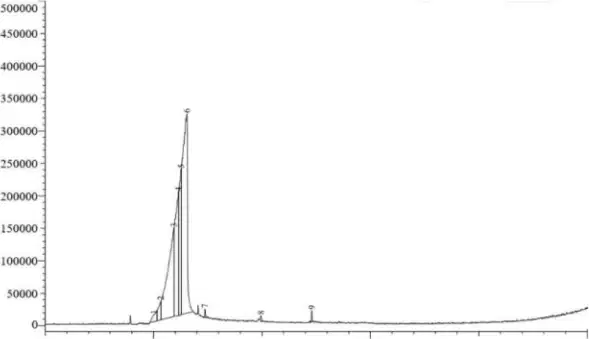
What is the approximate retention time of the main peak?
Around 10 minutes
Around 2 minutes
Around 25 minutes
Around 50 minutes
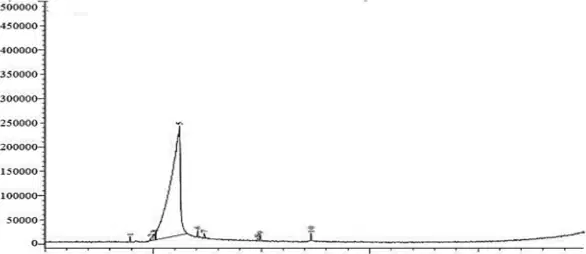
How does the main peak compare to that in Fig. 5?
The main peak is sharper and more defined in Fig. 6 compared to Fig. 5.
The main peak is broader and less defined in Fig. 6 compared to Fig. 5.
The main peak is absent in Fig. 6.
The main peak in Fig. 6 is identical to that in Fig. 5.
According to Table 2, what is the area (%) of Glycerol in crude glycerol before purification?
17.60
40.61
96.26
2.14
According to Table 2, what is the area (%) of Glycerol in glycerol after purification?
0.39
96.26
0.29
0.51
Fill in the blank: The best results for glycerol purification are obtained at an acid and glycerol ratio (n/n) of 1:1 with adsorbent ratio (w/wt) of 25%, which produced glycerol with a purity of ________%.
96.26
89.50
92.10
85.75
According to the conclusion, what type of adsorbent was used in this study for the purification of crude glycerol?
Activated carbon durian peel adsorbent
Silica gel adsorbent
Zeolite adsorbent
Alumina adsorbent
Which of the following is NOT a compound identified in crude glycerol before purification according to Table 2?
Glycerol
Cyclohexanone
2-Propanol
4-Phenylbutyric acid
The glycerol content after purification was the same as the calculated value, reaching 96.26%.
True
False
Who is the author of the paper titled 'Insight into KOH activation mechanism during biomass pyrolysis: chemical reactions between O-containing groups and KOH'?
Chen, W., Gong, M., Li, K., Xia, M., Chen, Z., Xiao, H., Fang, Y., Chen, Y., Yang, H., Chen, H.
Wang, L., Zhang, Q., Liu, J., Sun, X., Zhao, F.
Li, S., Huang, T., Zhou, Y., Wu, D., Xu, P.
Zhao, Y., Lin, M., Guo, X., He, J., Feng, L.
In which year was the paper 'Preparation and high surface area activated carbon from walnut shells by microwave-induced KOH activation' published?
2015
2012
2017
2019
What is the main focus of the paper by Dhabhai, B., Ahmadijokani, F., Dalai, A.K., Reaney, M., 2016?
Purification of crude glycerol derived from biodiesel production processes: experimental studies and techno-economic analyses.
Development of novel catalysts for hydrogen production from water splitting.
Optimization of enzymatic transesterification for biodiesel synthesis.
Assessment of environmental impacts of large-scale algae cultivation.

