
 Worksheets
Science Semester Exam Review
Total questions: 40
Worksheet time: 32mins
H2SO4
Carbon is considered an element, while carbon dioxide is considered a compound. This is because carbon dioxide is –
a gas at room temperature.
made of two different elements.
given off by green plants.
useful to human beings.
Which of the following is NOT an example of chemical change?
sour milk
burning wood
breaking a pencil
rust
Which of the following is a sign that a chemical reaction has occurred?
change in shape
melting
formation of a gas
dissolving
You can make a solution more concentrated by adding more __________.
solution
Why does the rate of dissolving increase as the temperature increases?
The solute molecules move faster at higher temperatures
The solute particles become smaller at higher temperatures
The solvent molecules become slower at higher temperatures
What is the effect of agitation on the rate of dissolving?
What is the effect of agitation on the rate of dissolving?
It decreases the rate of dissolving
It has no effect on the rate of dissolving
It increases the rate of dissolving
It changes the color of the solute
How does heat move?
from a warmer to a cooler object
from a cooler to a warmer object
toward a hot object
away from a cold object
How is energy from the Sun transferred?
by radiation
by conduction
by convection
by the force of gravity
__________ is the transfer of heat by the movement of a fluid.
Conduction
Convection
Radiation
When you heat up an object, the particles in the object move _________.
faster
the same speed
slower
All of the following are examples of convection currents, excerpt:
Warm air rising in a house
Cold water sinking to the bottom of the lake
Water flowing through pipes
Steam from hot soup rising into the air


than in hot things.
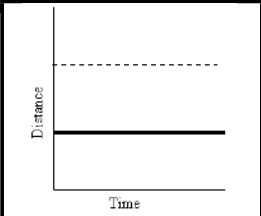

Describe the motion in the graph:
Constant Speed (positive slope)
Stopped (at rest)
Acceleration (increasing speed)
Return Home (negative slope)


Segment A-B The bus is _________________.
at rest
returning (to original position)
moving forward
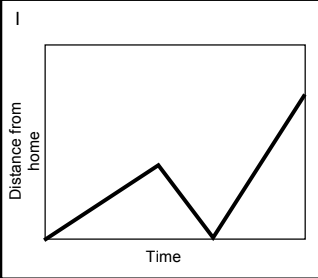
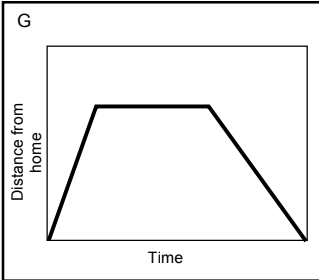
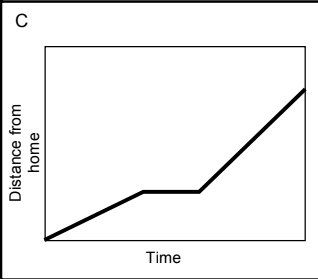
Susie went to the store, when she got there she realized that she forgot her wallet and returned home.
Which graph matches this motion?
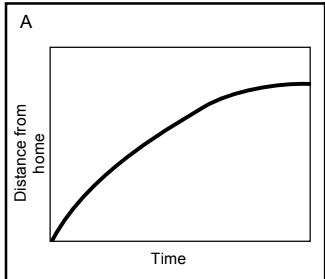
Gravitational force differs based on two things.
It increases with increasing ___________.
It decreases with increasing __________ .
mass
distance
distance
mass
orbit
displacement
displacement
orbit
What is the definition of Gravity?
the force that resists the sliding motion of two surfaces that are touching
the force of attraction that pulls objects towards each other because of their masses
the speed and the direction of a moving object
the force that pushes perpendicular to the object's surface
Which planet is known as the red planet and is composed of rock and has a thin atmosphere of gas?
Saturn
Mars
Neptune
Jupiter
Which is not true of Terrestrial planets?
They are closest to the sun
They are smaller planets
They have thin atmospheres
They do not rotate on their axis
What is the largest and most massive object in our solar system?
Mars
Venus
Sun
Earth
Which characteristic of earth is most responsible for its ability to support life?
carbon dioxide present in the atmosphere
earth is terrestrial
proximity to the sun
presence of ice
What is the most abundant gas on Earth?
nitrogen
oxygen
carbon dioxide
neon
Which of the following statements best describes the characteristics of the terrestrial planets?
small, dense, rocky surfaces
large, planetary rings; many moons
rocky cores; close to sun; surface craters
made up of hydrogen and helium; small; close to sun
This planet is mostly covered by liquid water.
Mars
Venus
Earth
Mercury

