
 Worksheets
Biology and Ecology Review Worksheet
Total questions: 61
Worksheet time: 31mins
Define Biology.
Study of the living world
Study of rocks and minerals
Study of chemical reactions only
Study of celestial bodies
Define Manipulated Variable.
The variable the scientist changes (independent variable)
The variable that responds (dependent variable)
A constant that never changes
The control group used for comparison
Define Responding Variable.
The variable that changes because of the independent variable (dependent variable)
The variable the scientist manipulates
A constant that does not change
The control used to compare results
Define Control.
A setup that does not include the independent variable and is used to compare results
The variable being measured
The variable the scientist changes
A random trial with no constants
Define biotic factor. Give an example.
A living factor such as plants or animals
A nonliving factor such as sunlight
A chemical process in rocks
A human-made structure
Define abiotic factor. Give an example.
A nonliving factor such as temperature, sunlight, or water
A living factor such as plants
A behavior within a population
A type of consumer in a food web
List the levels of organization in order of complexity (largest to smallest).
Biosphere, biome, ecosystem, community, population, species
Species, population, community, ecosystem, biome, biosphere
Biome, biosphere, ecosystem, community, species, population
Ecosystem, biome, biosphere, community, species, population
Where does most of the energy on Earth come from?
The Sun
The Moon
Earth’s core
Ocean tides
Define autotroph/producer and give an example.
An organism that produces its own food (for example, a plant)
An organism that only eats other consumers
An organism that decomposes dead matter
An organism that migrates seasonally
If a disease killed many grasshoppers in this food web, predict what would happen.
The frog population may decrease because grasshoppers are its primary food source
The frog population will increase immediately
No change would occur in frog populations
All producers would die out
What percentage of energy transfers to each level in a food chain or food web?
10%
5%
25%
50%
If the bottom level in a food chain is 5000 units of energy, what would the energy at the 4th level be using the 10% rule?
5
50
500
0.5
Define invasive species.
A non-native species that causes ecological problems
A native species that supports biodiversity
A species introduced that always improves habitats
A rare species with no impact
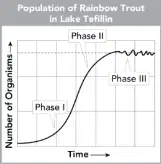
What is carrying capacity, and when does carrying capacity occur in the provided population-over-time graph?
It is the maximum number of individuals an environment can support; it occurs where the graph levels off
It is the minimum number of individuals needed for survival; it occurs at the graph’s starting point
It is the average population size; it occurs at the steepest increase
It is the total number of births; it occurs where the graph declines
Define limiting factors.
Factors that decrease the growth of a population
Factors that always increase population size
Traits inherited from parents
Only weather-related events
List examples of limiting factors.
Predation
Emigration (individuals leaving an area)
Competition
Natural disasters
Human activity
Describe the predator–prey relationship.
If the predator population increases, the prey population decreases and vice versa
If predators increase, prey always increase as well
Predator and prey populations never affect each other
Prey populations control predator populations only by increasing births
Which scenario best explains a trophic cascade? Choose the example that matches the definition.
Removal of a top predator causes herbivore populations to increase and plant populations to decrease, altering the entire ecosystem
Introduction of a new plant increases soil nutrients without changing animal populations
Seasonal migration of birds temporarily changes local food webs but returns to normal
A drought reduces water availability but predators, herbivores, and plants keep the same relative numbers
Which statement about biodiversity and ecosystem stability is correct?
Biodiversity is the different types of organisms in an ecosystem, and greater diversity makes the ecosystem more stable
Biodiversity is the total amount of sunlight in an ecosystem, and more sunlight makes it unstable
Biodiversity refers only to the number of predators, and more predators always destabilize ecosystems
Biodiversity is the variety of habitats, and more variety always decreases stability
Select all processes that release carbon dioxide into the atmosphere.
Respiration
Photosynthesis
Decomposition
Volcanic eruptions
Burning of fossil fuels
Too much carbon dioxide in the atmosphere causes which effect, and what can it lead to?
Greenhouse effect, which may cause global warming
Ozone formation, which may cause acid rain
Coriolis effect, which may cause stronger winds
Albedo increase, which may cause cooling
Organisms need nitrogen primarily to make what?
Proteins
Carbohydrates
Lipids
Minerals
Which organisms can directly use atmospheric nitrogen gas?
Bacteria
Animals
Most plants
Fungi
What is nitrogen fixation?
The process of bacteria converting nitrogen gas into nitrogen compounds
Plants absorbing nitrates from soil to build sugars
Animals breaking down proteins to release ammonia
Lightning converting carbon dioxide into ammonium
Which biogeochemical cycle does not pass through the atmosphere as a gas?
Phosphorus cycle
Nitrogen cycle
Carbon cycle
Water cycle
Which option correctly lists characteristics of a prokaryotic cell and provides one example?
No nucleus and no membrane-bound organelles; example: bacterium
Nucleus and membrane-bound organelles; example: plant cell
Nucleus but no membrane-bound organelles; example: animal cell
No nucleus but membrane-bound organelles; example: fungus cell
Which option correctly lists characteristics of a eukaryotic cell and provides two examples?
Nucleus and membrane-bound organelles; examples: plants and animals
No nucleus and no membrane-bound organelles; examples: bacteria and archaea
No nucleus but membrane-bound organelles; examples: bacteria and plants
Nucleus only; examples: viruses and bacteria
What is the main function of the cell membrane?
Regulates what enters and leaves the cell
Produces most of the cell’s ATP
Contains the cell’s DNA
Carries out photosynthesis as its primary role
What is the primary function of the nucleus?
Controls the cell and contains the DNA
Synthesizes proteins directly
Regulates what enters and leaves the cell
Stores pigments for photosynthesis
Which statement correctly defines passive transport?
Moves molecules from an area of high concentration to an area of low concentration without using energy
Moves molecules from low concentration to high concentration using ATP
Transports large particles by endocytosis and exocytosis using energy
Moves water only and requires energy
Define active transport.
Movement of molecules from high to low concentration without energy
Movement of molecules from low to high concentration using energy
Diffusion of water across a semi‑permeable membrane
Bulk movement of water into a cell only
The movement of particles from a high concentration to a low concentration to reach equilibrium is called what?
Osmosis
Active transport
Diffusion
Endocytosis
Osmosis is the diffusion of what?
Proteins
Water
Ions
Gases
What does an isotonic solution have relative to the cell?
Higher concentration of molecules than the cell
Lower concentration of molecules than the cell
The same concentration of molecules as the cell
Only water molecules present
What characterizes a hypertonic solution relative to the cell?
A high concentration of molecules
A low concentration of molecules
The same concentration of molecules
No solutes present
What characterizes a hypotonic solution relative to the cell?
A high concentration of molecules
A low concentration of molecules
The same concentration of molecules
No water present
A type of passive transport that moves particles across a protein channel to reach equilibrium is called what?
Facilitated diffusion
Active transport
Endocytosis
Exocytosis
When particles or molecules are even throughout a space, the cell has reached what?
Homeostasis
Equilibrium
Turgor pressure
Plasmolysis

Look at the diagram showing a cell in a solution labeled 10% salt. Identify the tonicity of the solution relative to the cell and the direction of water flow.
Hypotonic; water into the cell
Isotonic; no net water movement
Hypertonic; water out of the cell
Hypertonic; water into the cell
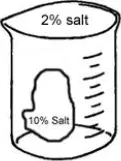
Look at the diagram showing a cell in a solution labeled 2% salt. Identify the tonicity of the solution relative to the cell and the direction of water flow.
Hypotonic; water into the cell
Isotonic; no net water movement
Hypertonic; water out of the cell
Hypertonic; water into the cell
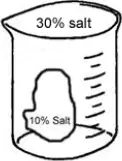
Look at the diagram showing a cell in a solution labeled 30% salt. Identify the tonicity of the solution relative to the cell and the direction of water flow.
Hypotonic; water into the cell
Isotonic; no net water movement
Hypertonic; water out of the cell
Hypotonic; water out of the cell
Type of active transport that releases large amounts of materials from the cell.
Endocytosis
Exocytosis
Facilitated diffusion
Osmosis

In the membrane diagram with labels A and B, identify the structure marked A.
Phospholipids
Protein channel
Cholesterol
Carbohydrate chain
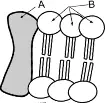
In the membrane diagram with labels A and B, identify the structure marked B.
Phospholipids
Protein channel
Cholesterol
Carbohydrate chain
Write the equation for photosynthesis. Choose the correct balanced equation.
CO2+H2O+sunlight→C6H12O6+O2
O2+C6H12O6→CO2+H2O+energy
N2+H2→NH3
CO2+H2O→H2CO3
Where does photosynthesis occur?
Mitochondria
Cytoplasm
Chloroplast
Ribosome
Write the equation for cellular respiration. Choose the correct balanced equation.
CO2+H2O+sunlight→C6H12O6+O2
C6H12O6+O2→CO2+H2O+energy
N2+H2→NH3
H2O→H2+O2
Where does cellular respiration happen in the cell?
Chloroplast
Mitochondria
Golgi apparatus
Endoplasmic reticulum
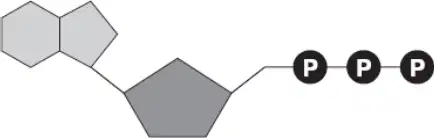
In the ATP diagram, where does ATP break to release energy?
Between adenine and ribose
Between ribose and the first phosphate
Between the second and third phosphate
Between adenine and the second phosphate
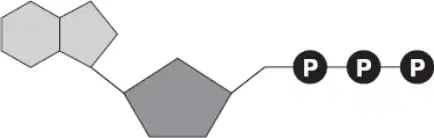
After ATP releases energy by breaking a phosphate bond, what is the molecule called?
AMP
ADP
ATP
NADH

Why is the molecule called ADP after ATP releases energy?
It has one phosphate group
It has two phosphate groups instead of three
It has an extra ribose
It has no adenine
What is the purpose of mitosis?
Growth and tissue repair
Producing sex cells for reproduction
Reducing chromosome number by half
Creating genetic diversity
How many cells are produced at the end of mitosis, and how alike are they?
Two identical cells
Two genetically different cells
Four identical cells
Four genetically different cells
Which statement best defines haploid cells and gives two examples?
Cells with one set of chromosomes; examples: sperm and egg
Cells with two sets of chromosomes; examples: liver and skin cells
Cells with one set of chromosomes; examples: liver and skin cells
Cells with two sets of chromosomes; examples: sperm and egg
How many times does cell division occur during meiosis?
Once
Twice
Three times
Four times
How many cells are created in meiosis, and how alike are they?
Two identical cells
Two genetically different cells
Four identical cells
Four genetically different cells
How does the chromosome number change during meiosis?
It doubles
It stays the same
It is halved
It increases by one
Why must the chromosome number be half in cells produced by meiosis?
To ensure sex cells combine to form a diploid zygote with the correct chromosome number
To speed up cell division and growth
To prevent chromosomes from replicating during fertilization
To make daughter cells identical to the parent cell
Select the pair that correctly completes the statement: A sperm cell is a ______ and is ______.
gamete; haploid
gamete; diploid
zygote; haploid
zygote; diploid
If the diploid number in a liver cell is 52, how many chromosomes are in the egg of this organism?
13
26
52
104
Select the pair that correctly completes the statement: When a sperm cell and an ovum merge during fertilization, they give rise to a ______, which is ______.
zygote; diploid
zygote; haploid
gamete; diploid
gamete; haploid

