
 Worksheets
Investigation 2: Experience 3: Periodic Trends
Total questions: 21
Worksheet time: 12mins
Choose the correct answer: From left to right across a period for main‑group elements, the effective nuclear charge __
increases.
decreases.
remains the same.
increases and then decreases.
Based on their relative positions on the periodic table, which of these atoms has the highest first ionization energy?
Br
Cl
F
I
Would you expect the shielding effect to be greater in bromine than in chlorine?
No, because they are both in the same period
Yes, because bromine has a lower atomic number
Yes, because there are more filled energy levels in bromine
No, because chlorine loses an electron more easily than bromine
What is the correct order of the following elements based on their atomic radius?
-The order should be from smallest to largest radius.
[barium Ba - beryllium Be - hydrogen H - potassium K]
barium; beryllium; hydrogen; potassium
potassium; beryllium; hydrogen; barium
hydrogen; beryllium; potassium; barium
beryllium; potassium; barium; hydrogen
Na is __________ Na+
the same size as
smaller than
larger than
none of the above
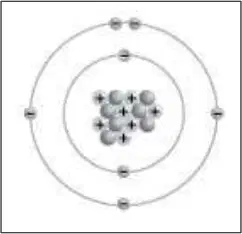
Which of the following elements has the same number of electrons in the outer shell and similar chemical characteristics as the atom shown?
Li
Fe
As
O
Choose the correct answer: Which answer correctly lists the element with the smallest electron affinity first and the element with the greatest electron affinity last?
oxygen → fluorine → calcium → magnesium → rubidium
fluorine → oxygen → magnesium → calcium → rubidium
rubidium → magnesium → calcium → fluorine → oxygen
rubidium → calcium → magnesium → oxygen → fluorine
Choose the correct answer: Which of the following elements is found in group 2, period 3 of the periodic table?
Boron
Calcium
Aluminum
Magnesium
Choose the correct answer: Based on their location in the periodic table, which two elements are expected to show similar properties?
carbon and silicon
lithium and fluorine
calcium and oxygen
aluminum and sulphur
Choose the correct answer: Cations are always ________ than the parent atom and anions are always ________ than the parent atom.
smaller; smaller
larger; smaller
smaller; larger
larger; larger
Choose the correct answer: Lithium is in Group 1A, Period 2 of the periodic table. Which statement describes the charge of the ion it typically forms?
It forms a cation with +2 charge.
It forms a cation with a +1 charge.
It forms an anion with a +1 charge.
It forms an anion with a −1 charge.
Choose the correct answer: The elements K, Ca, Se, Kr, and Ga all appear in Period 4 of the Periodic Table. Which arrangement, from left to right, orders them with respect to their atomic size, from largest to smallest?
K; Ca; Se; Kr; Ga
Ca; Ga; K; Kr; Se
K; Kr; Se; Ca; Ga
K; Ca; Ga; Se; Kr
Choose the correct answer: Based on their definitions, electron affinity could be considered the opposite of __
shielding effect
ionization energy
nonmetallic character
effective nuclear charge
Choose the correct answer: ________ is one‑half the distance between the nuclei of two atoms of the same element.
Atomic radius
Atomic emission
Atomic size
Ionic size
Choose the correct answer: ________ is the largest atom, has an atomic radius of about 260 picometer.
Sodium
Fluorine
Hydrogen
Francium
Choose the correct answer: An atom that loses one or more electrons to form an ion with a net positive charge is called ________ While an atom that gains one or more electrons to form an ion with a net negative charge is called ________.
anion, cation
cation, cation
anion, anion
cation, anion
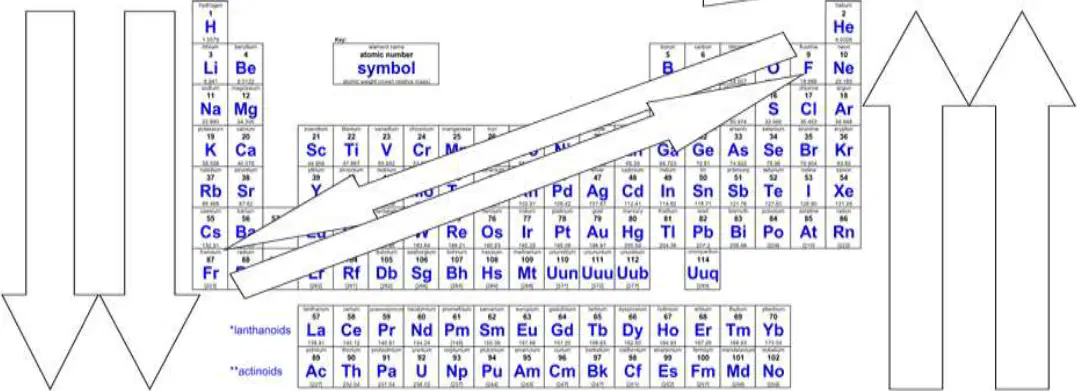
Instructions: Fill in the arrows in the periodic table diagram with the listed trends. Which direction on the periodic table corresponds to increasing atomic radius?
toward the top right
toward the bottom left
uniform in all directions
toward the top left
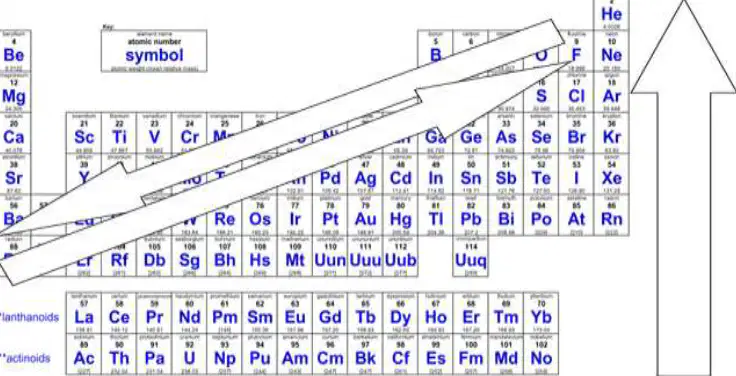
Instructions: Fill in the arrows in the periodic table diagram with the listed trends. Which direction on the periodic table corresponds to decreasing atomic radius?
toward the bottom left
toward the top right
toward the middle of the table
toward the bottom right
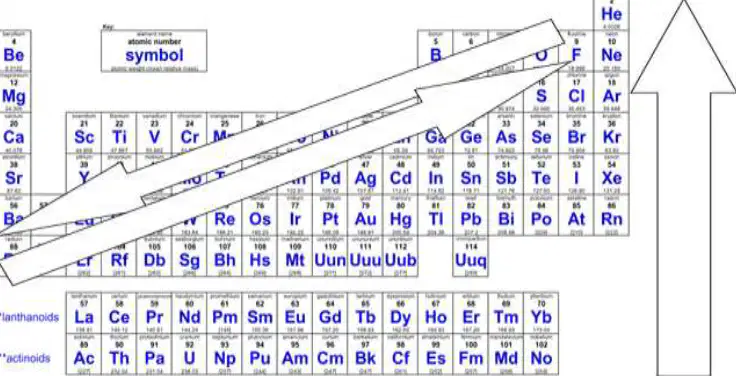
Instructions: Fill in the arrows in the periodic table diagram with the listed trends. Which direction on the periodic table corresponds to increasing nonmetallic character?
toward the top right
toward the bottom left
toward the middle of the table
uniform in all directions
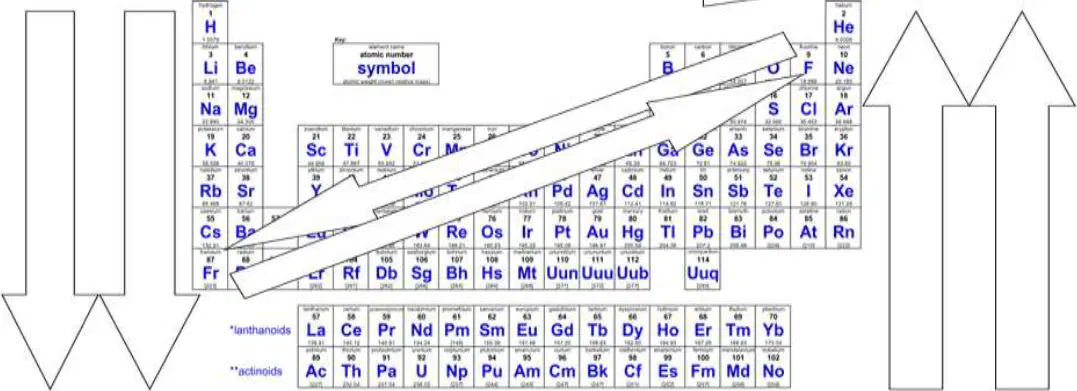
Instructions: Fill in the arrows in the periodic table diagram with the listed trends. Based on standard periodic trends, select all directions on the periodic table that correspond to increasing reactivity.
toward the bottom left (metals)
toward the top right (nonmetals)
toward the top left
toward the bottom right
Choose the correct answer: Which of the following statements is true regarding the trend of ionization energy across a period?
It decreases from left to right.
It increases from left to right.
It remains constant across the period.
It varies randomly across the period.

