
 Worksheets
Apply What You Have Learned
Total questions: 35
Worksheet time: 18mins
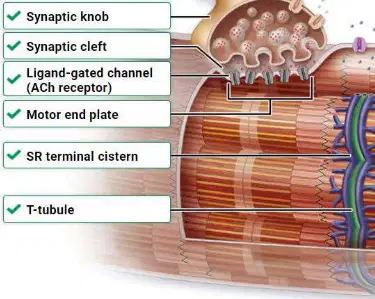
Botulinum neurotoxin blocks exocytosis of acetylcholine at the neuromuscular junction. Which immediate event is prevented at the motor end plate?
Opening of ligand-gated sodium channels
Formation of an end-plate potential
Release of calcium from terminal cisternae
Propagation of an action potential along sarcolemma
During crossbridge cycling, ATP becomes unavailable while sarcoplasmic calcium remains high. Select all outcomes that would occur.
Acetylcholine release increases at synaptic knob
Crossbridge cycling halts in rigor state
Muscle fiber enters sustained contraction
Myosin heads detach from actin filaments
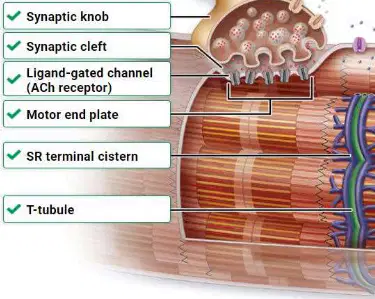
In the diagram, which structure is the specialized postsynaptic region of the muscle fiber that contains nicotinic ACh receptors?
Synaptic knob
Motor end plate
Synaptic cleft
Sarcolemma
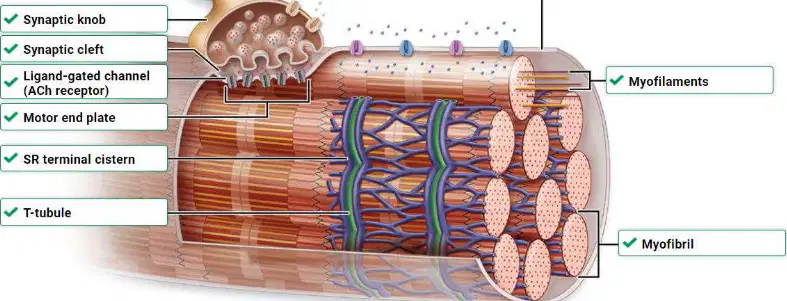
Which pair of structures forms a triad critical for excitation–contraction coupling in skeletal muscle?
Two T-tubules and one terminal cistern
One motor end plate and one myofibril
One T-tubule and one synaptic knob
Two synaptic clefts and one sarcolemma
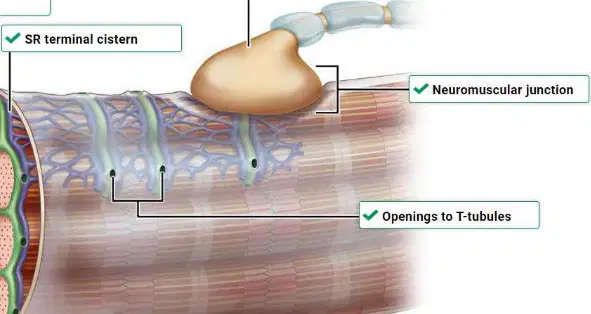
Which statement best explains why action potentials travel deep into the muscle fiber?
T-tubules conduct the signal inward
Myofibrils propagate the impulse outward
Synaptic cleft carries current longitudinally
SR terminal cistern generates extracellular voltage
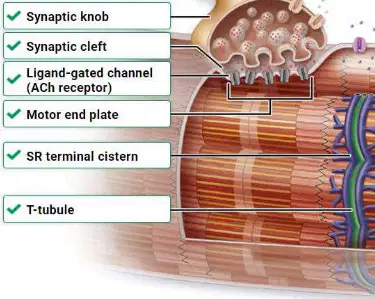
Select all structures that are part of the neuromuscular junction, not the sarcoplasmic reticulum.
Motor end plate
Synaptic knob
Synaptic cleft
T-tubule
SR terminal cistern

Which structure directly encloses the muscle fiber and is continuous with the motor end plate region?
Z disc
Myofibril
M line
Sarcolemma

Which correctly matches structure to primary function?
Synaptic cleft — stores Ca2+
SR terminal cistern — releases Ca2+
Myofibril — secretes ACh
T-tubule — degrades ACh
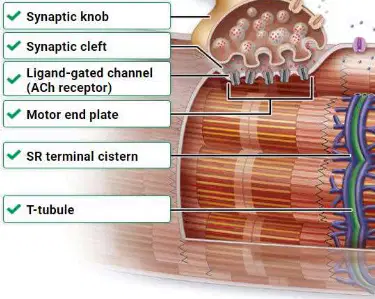
A toxin blocks ACh release from the synaptic knob. Which immediate event fails to occur at the muscle fiber?
Myofibril shortening by sliding
Opening of SR ryanodine channels
Depolarization of the motor end plate
Crossbridge formation on actin
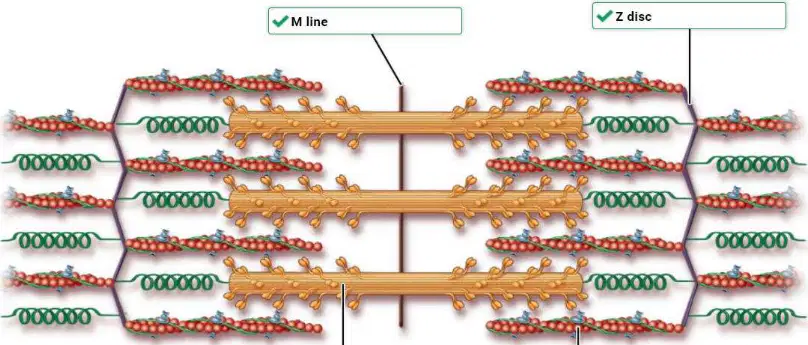
In the sarcomere diagram, which structure anchors the thin filaments at the boundary of each sarcomere?
Z disc at the edge
M line in the center
H zone in the middle
T-tubule alongside
SR terminal cistern

Which statement best describes the spatial relationship between thick and thin filaments around the M line?
Thin filaments cross the M line
Thick filaments center on M line
Z discs lie at the M line
T-tubules overlap the M line
SR cistern forms the M line
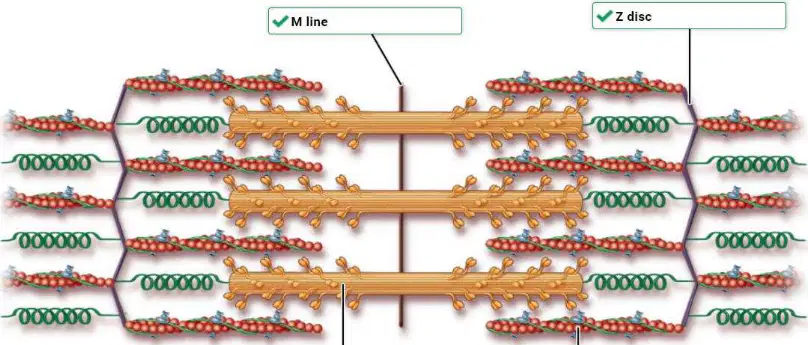
Select all components that directly define sarcomere boundaries and central alignment.
Thin filament as boundary
Thick filament as boundary
H zone as boundary
Z disc as boundary
M line as central alignment
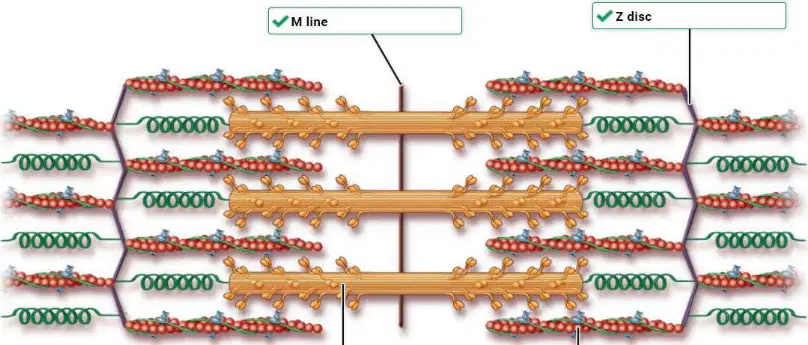
In the diagram, where do thin filaments extend from and toward?
From T-tubules toward SR cistern
From synaptic knob toward junction
From Z discs toward M line
From myofibrils toward sarcolemma
From M line toward Z discs
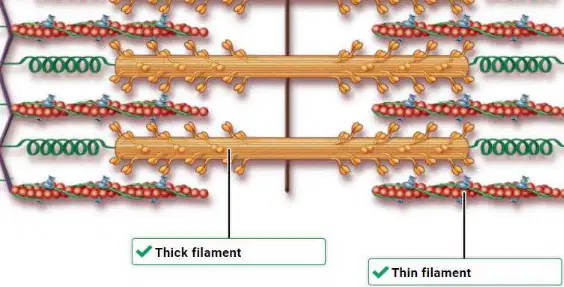
Which combination is correctly matched to filament type and associated position?
Thick filament—centered at M line
Thin filament—forms T-tubules
Thick filament—forms Z disc
Thick filament—anchored at Z disc
Thin filament—centered at M line
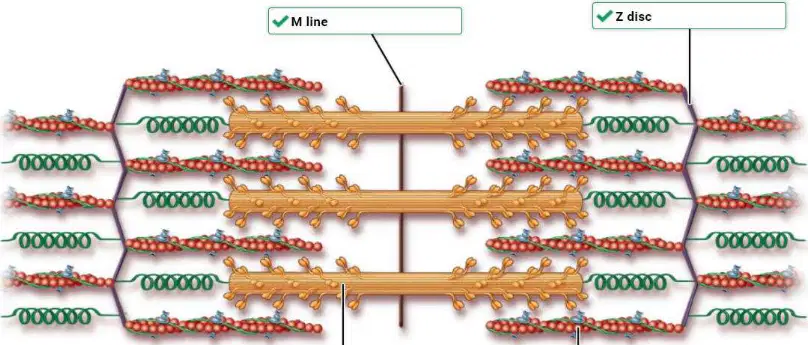
Which structures are explicitly labeled in the filament arrangement diagram?
Thick filament
Z disc
M line
Neuromuscular junction
Thin filament
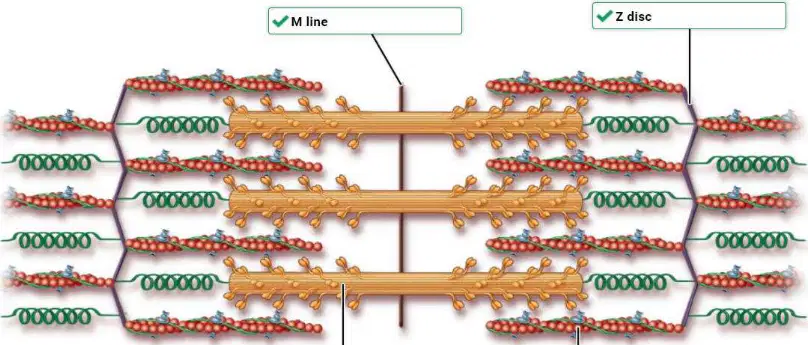
What best defines a sarcomere in the illustrated myofibril?
Region from Z disc to T-tubule
Region surrounding the neuromuscular junction
Region across the H zone only
Region between two Z discs
Region between two M lines
Which event directly triggers exocytosis of acetylcholine at the synaptic knob?
Sodium influx through ligand-gated channels
Arrival of end-plate potential at sarcolemma
Opening of voltage-gated calcium channels
Binding of ACh to nicotinic receptors
At the neuromuscular junction, what immediately follows ACh binding to its receptor on the motor end plate?
Sodium enters the muscle fiber
Calcium released from the SR
Tropomyosin shifts on actin
Myosin detaches from actin
Which pathway correctly traces the action potential after threshold at the end plate?
Triad to SR to axon terminal
SR to sarcolemma to T-tubule
Sarcolemma to T-tubule to triad
Myofibril to SR to sarcolemma
Voltage-sensitive receptors at the triad primarily cause which event?
Opening of calcium channels in SR
Exocytosis of synaptic vesicles
Release of ACh into synaptic cleft
Hydrolysis of ATP on myosin
What is the immediate role of Ca2+ released into the sarcoplasm during excitation–contraction coupling?
Depolarize the sarcolemma membrane
Activate ATP synthase in mitochondria
Attach directly to myosin heads
Bind troponin to expose actin sites
Which statement best describes the sarcomere?
Organized array of thin and thick filaments
Network of T-tubules around myofibrils
Region containing only thick filaments
Space between the SR and sarcolemma
Which proteins regulate access to myosin-binding sites on actin?
Actinin and nebulin
Troponin and tropomyosin
Myomesin and desmin
Dystrophin and titin
When calcium binds troponin, what is the immediate structural consequence on thin filaments?
Tropomyosin shifts to uncover sites
Actin polymerizes into thicker strands
Z discs move toward the M-line
Myosin heads detach from actin
Which sequence correctly outlines crossbridge cycling for one cycle?
ATP hydrolysis re-cocks myosin
ATP binds, myosin releases actin
Power stroke pulls actin inward
Myosin binds actin at exposed site
What event constitutes the power stroke in skeletal muscle?
Release of calcium from SR
Detachment of myosin from actin
Binding of ATP to myosin head
Pivot of myosin pulling actin
Which conditions must persist for crossbridge cycling to continue?
Cytosolic calcium remains elevated
Sarcolemma remains hyperpolarized
ACh continues in synaptic cleft
Adequate ATP is available
During repeated cycles, what happens to thin filaments relative to the sarcomere?
Detach from the thick filaments
Move toward the Z discs
Lengthen beyond resting state
Slide toward the center
What immediate cellular change results from sodium influx at the end plate?
Localized depolarization called EPP
Repolarization of the axon terminal
Generation of the power stroke
Opening of SR calcium channels
Which step initiates skeletal muscle contraction at the cellular level?
Myosin hydrolyzes ATP
Motor neuron releases ACh
Z discs fuse at M-line
Actin binds troponin
Which structural elements stabilize the sarcomere’s filament arrangement?
M-line and Z discs
T-tubules and SR
Dendrites and myelin
Sarcolemma and triad
What best explains unison response of all myofibrils within a fiber?
High mitochondrial density
Continuous actin filaments
Multiple axon terminals
T-tubule and SR network
Which event immediately precedes ACh diffusion across the synaptic cleft?
Troponin conformational change
Myosin detachment from actin
Opening of ligand-gated Na+ channels
Ca2+ binding synaptic vesicle proteins
Which receptor type is located on the motor end plate binding ACh?
Ligand-gated ion channel receptor
Mechanosensitive stretch receptor
Voltage-gated calcium receptor
G-protein-coupled muscarinic receptor
What is the ultimate result of coordinated sarcomere shortening across a muscle fiber?
Shortening of the entire muscle
Increase in SR membrane area
Expansion of extracellular matrix
Loss of end-plate potential

