
 Worksheets
Biology 1 - Semester 1 Review
Total questions: 66
Worksheet time: 33mins
Name
Class
Date
1.
All living things are made of one or more ____.
a)
cells
b)
organs
c)
parts
d)
adaptations
2.
Which is an example of the human body maintaining homeostasis?
a)
sprinting across the street to avoid oncoming traffic
b)
producing sweat to reduce body temperature
c)
digesting foods into nutrients
d)
creating thoughts to solve a difficult problem
3.
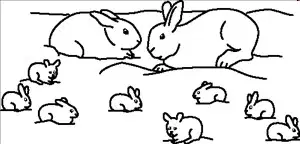
Which of the following results from quantitative analysis of the following figure?
a)
The babies are cold.
b)
There are 8 offspring.
c)
These are the first offspring these rabbits have had.
d)
There isn’t enough food.
4.
A researcher is interested in the effects of nitrate and phosphate on plant growth and sets up an experiment in which groups of five plants are given 1, 2, and 3 grams of nitrate and 1, 2, and 3 grams of phosphate in all combinations over a period of one month. The researcher measures plant height and weight at the end of the experiment. What is missing in this experimental design?
a)
an independent variable
b)
a dependent variable
c)
an experimental group
d)
a control group
5.
The results of an experiment show that as temperature increases, enzyme activity decreases. Which graph correctly displays these findings?
a)
Option 1
b)
Option 2
c)
Option 3
d)
Option 4
6.
Which of the following statements about a controlled experiment is true?
a)
All variables must be kept the exact same.
b)
Only one variable can be changed at a time.
c)
Everything can be studied by setting up a controlled experiment.
d)
Controlled experiments cannot be performed on living things.
7.
Which of the following is not a characteristic of life?
a)
requires energy
b)
can move from one place to another
c)
responds to a stimulus
d)
has the ability to reproduce
8.
All living things have a genetic code, which is contained in ___.
a)
DNA
b)
ATP
c)
sugar compounds
d)
photosynthesis
9.
The combination of chemical reactions through which an organism builds up or breaks down materials is known as
a)
homeostasis
b)
metabolism
c)
adaptation
d)
response
10.
A characteristic of life that involves a whole species rather than a single organism is ____.
a)
evolution
b)
responsiveness
c)
homeostasis
d)
growth and development
11.
A biologist gives a new kind of food to a group of dogs and compares the weight gain of these dogs over time to a group of similar dogs that do not receive the new food. Which is the independent variable?
a)
The type of food given to the dogs
b)
How much weight the dogs gained
c)
The group of dogs who got the new food
d)
The group of dogs who did not get the new food
12.
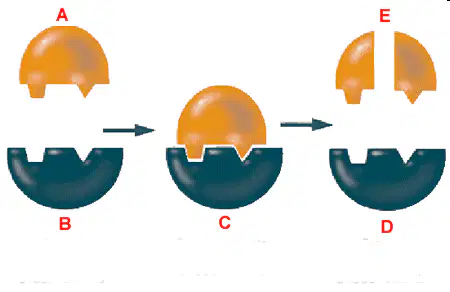
A substrate binds to an enzyme at a region known as the
a)
reactant
b)
product
c)
active site
d)
catalyst
13.
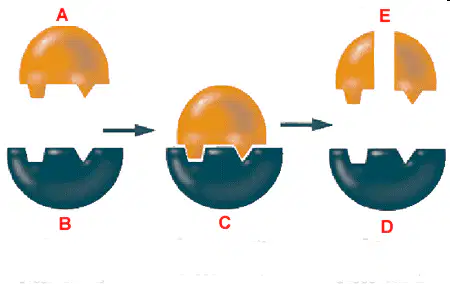
Using the image below, “A” is the ____, and “B” is the ____.
a)
enzyme, substrate
b)
substrate, enzyme
c)
product, reactant
d)
reactant, product
14.
Most enzymes are
a)
proteins
b)
carbohydrates
c)
nucleic acids
d)
lipids
15.
Which statement is false about macromolecules?
a)
Lipids are made of glycerol and fatty acids.
b)
Nucleic acids are made of nucleotides.
c)
Proteins are made of amino acids.
d)
Simple sugars are made of polysaccharides.
16.
What macromolecule is nonpolar and made of fatty acids & glycerol?
a)
carbohydrates
b)
lipids
c)
proteins
d)
nucleic acids
17.
A property of water that causes water molecules to be attracted to other surfaces (like water on glass) is called _____.
a)
cohesion
b)
adhesion
c)
surface tension
d)
capillary action
18.
The group of macromolecules that stores and transmits genetic information are ____.
a)
nucleic acids
b)
proteins
c)
lipids
d)
carbohydrates
19.
The monomer of proteins is the
a)
monosaccharide
b)
amino acid
c)
glycerol and fatty acid
d)
nucleotide
20.
The name of an enzyme usually ends with
a)
-yme.
b)
-ase.
c)
-ose.
d)
-enz
21.
A covalent bond is formed as the result of
a)
transferring protons.
b)
transferring electrons.
c)
sharing electrons.
d)
sharing protons.
22.
A property of water that causes water molecules to be attracted to other water molecules is called ______.
a)
cohesion
b)
adhesion
c)
suspension
d)
polarity
23.
Identify the product(s) in the chemical reaction, CO2 + H2O ----> H2CO3.
a)
CO2 and H2O
b)
H2CO3
c)
CO2, H2O, and H2CO3
d)
H2O
24.
In a water molecule, shared electrons spend more time around the oxygen atom than the hydrogen atoms. As a result, the oxygen atom is
a)
slightly negative.
b)
slightly positive.
c)
neutral.
d)
stable.
25.
The monomer of nucleic acids is called a _____.
a)
nucleotide
b)
amino acid
c)
monosaccharide
d)
lipid
26.
An example of a nucleic acid is
a)
DNA
b)
protein chains
c)
glucose
d)
polysaccharides
27.
Carbohydrates and lipids are sources of ______.
a)
energy
b)
protein
c)
water
d)
life
28.
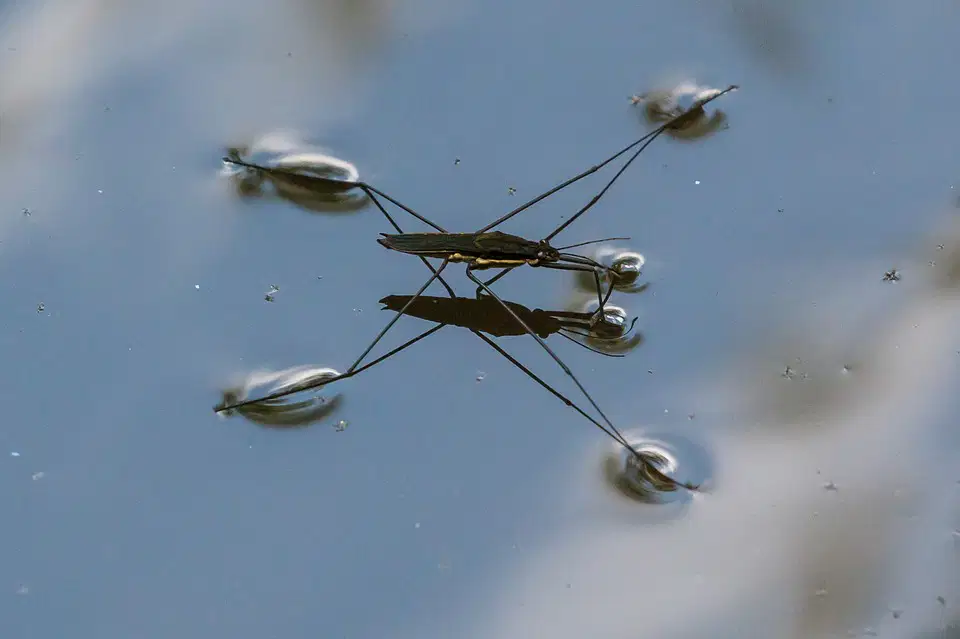
What property of water allows for this insect to stay on top of the water without breaking the surface?
a)
capillary action
b)
surface tension
c)
heat capacity
d)
hydrogen bonding
29.

The property of water that in part allows a mosquito to take in blood through a tube against the pull of gravity is called
a)
surface tension
b)
capillary action
c)
xylem
d)
an allergic reaction
30.
The outside layer that surrounds all cells is the
a)
cell membrane
b)
cell wall
c)
cytoplasm
d)
channel protein
31.
In eukaryotic cells, this structure contains DNA that controls the cell's activities
a)
cytoplasm
b)
nucleolus
c)
mitochondria
d)
nucleus
32.
Particles that move across the cell membrane by passive transport move
a)
away from equilibrium.
b)
from high concentrations to low concentrations.
c)
from low concentrations to high concentrations.
d)
by using cellular energy
33.
This organelle's job is to get energy (ATP) from food molecules that the cell can use.
a)
mitochondria
b)
ribosomes
c)
chloroplast
d)
nucleus
34.
Usually found in plant cells, which organelle is used to capture sunlight to make glucose?
a)
chloroplast
b)
endoplasmic reticulum
c)
cell wall
d)
vacuole
35.
Which organelle will dispose of old, worn-out cell parts, food particles, and harmful materials?
a)
lysosome
b)
mitochondria
c)
ribosome
d)
smooth endoplasmic reticulum
36.
Which organelle modifies, sorts, and packages materials for storage or release from the cell?
a)
vacuole
b)
lysosome
c)
mitochondria
d)
Golgi apparatus
37.

This diagram represents a cell in a hypertonic solution. Why is more water moving out of the cell?
a)
The amount of solute is higher in the solution than in the cell.
b)
The amount of solute is higher in the cell than in the solution.
c)
The amount of solute is in equal concentrations in and out of the cell.
d)
The concentration of water outside of the cell is too high.
38.
A(n) _____ solution means that there is low solute concentration outside of the cell.
a)
hypertonic
b)
hypotonic
c)
isotonic
d)
osmotic
39.
During diffusion, when the concentration of molecules on both sides of a membrane are equal, the molecules will
a)
move across the membrane to the outside of the cell.
b)
stop moving across the membrane.
c)
continue to move across the membrane equally in both directions.
d)
move across the membrane to the inside of the cell.
40.
The diffusion of water across a cell membrane is called ____.
a)
osmosis
b)
active transport
c)
aquaporin
d)
endocytosis
41.
Which of the following is not part of the cell theory?
a)
All cells come from preexisting cells.
b)
All living things are made of cells.
c)
Cells are the basic unit of structure of living things.
d)
All cells have a nucleus.
42.
Which of the following is a function of the cell membrane?
a)
breaks down lipids, carbohydrates, and proteins from foods
b)
stores water, salt, proteins, and carbohydrates
c)
keeps the cell wall in place
d)
controls the movement of materials into and out of the cell
43.
What is true of active transport?
a)
Molecules move from high concentration to low concentration.
b)
Active transport requires energy.
c)
No energy is required for active transport to happen.
d)
Osmosis is a type of active transport.
44.
Cells communicate with other cells by
a)
teleporting
b)
chemical signals
c)
making polymers
d)
osmosis
45.
What part of the plant is most responsible for photosynthesis?
a)
leaf
b)
stem
c)
flower
d)
roots
46.
What is the main pigment used for photosynthesis?
a)
chlorophyll
b)
carotenoids
c)
xanthophyll
d)
wavelengths
47.
Energy is released from ATP when
a)
a phosphate group is added.
b)
adenine binds to ribose.
c)
ATP is exposed to sunlight.
d)
a phosphate group is removed.
48.
Most plants appear green because chlorophyll
a)
absorbs green light well
b)
absorbs violet light well
c)
does not absorb green light
d)
does not absorb violet light
49.

Which chemical shown in the image below is an electron carrier molecule?
a)
ATP
b)
stroma
c)
NADPH
d)
H2O
50.
Which of the following statements about ATP is true?
a)
ATP is a molecule made of adenosine, ribose sugar, and three phosphates.
b)
ATP has less energy than ADP.
c)
ATP is a carbohydrate.
d)
ATP has more energy than glucose.
51.
Organisms that are autotrophs
a)
make their own food through processes like photosynthesis.
b)
must eat other living things for energy.
52.
Organisms that are heterotrophs
a)
make their own food through processes like photosynthesis.
b)
must eat other living things for energy.
53.
How do organisms get the energy they need?
a)
by burning food molecules and releasing their energy as heat
b)
by breathing oxygen into the lungs and combining it with carbon dioxide
c)
by breaking down food molecules gradually and capturing their chemical energy
d)
by using the sun’s energy to break down food molecules and form chemicals
54.
Aerobic processes
a)
require oxygen
b)
do not require oxygen
55.
Anaerobic processes
a)
require oxygen
b)
do not require oxygen
56.
Which of the following is the correct sequence of events in aerobic cellular respiration?
a)
glycolysis ---> electron transport ---> Krebs cycle
b)
Krebs cycle ---> electron transport ---> glycolysis
c)
glycolysis ---> Krebs cycle ---> electron transport
d)
Krebs cycle ---> glycolysis ---> electron transport
57.

What are the reactants in the equation for cellular respiration?
a)
oxygen and lactic acid
b)
carbon dioxide and water
c)
glucose and oxygen
d)
water and glucose
58.
The Krebs cycle and electron transport chain are aerobic processes because it requires
a)
light.
b)
exercise.
c)
oxygen.
d)
glucose.
59.
Photosynthesis is to chloroplasts as cellular respiration is to
a)
chloroplasts
b)
cytoplasm
c)
mitochondria
d)
nuclei
60.
Which of the following is one of the ways that cellular respiration and photosynthesis are opposite processes?
a)
Photosynthesis releases energy, and cellular respiration stores energy.
b)
Photosynthesis removes carbon dioxide from the atmosphere, and cellular respiration puts it back.
c)
Photosynthesis removes oxygen from the atmosphere, and cellular respiration puts it back.
d)
Photosynthesis consumes glucose, and cellular respiration produces glucose.
61.
The starting molecule for glycolysis is
a)
ADP.
b)
pyruvic acid.
c)
citric acid.
d)
glucose.
62.
Muscle cells, which need a lot of ATP, would be expected to have a lot of ___, the organelles involved in aerobic cellular respiration.
a)
mitochondria
b)
chloroplasts
c)
cytoplasm
d)
DNA
63.
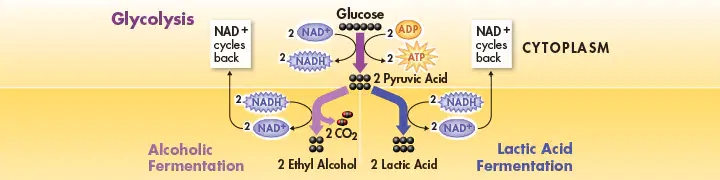
The two main types of fermentation are called
a)
alcoholic and aerobic.
b)
aerobic and anaerobic.
c)
alcoholic and lactic acid.
d)
lactic acid and anaerobic.
64.
Fermentation takes place in what part of the cell?
a)
cytoplasm
b)
mitochondria
c)
cell membrane
d)
Golgi apparatus
65.
Bread is made in part due to
a)
lactic acid fermentation
b)
glycolysis
c)
alcoholic fermentation
d)
the Krebs cycle
66.
During fermentation
a)
NAD+ is regenerated, allowing glycolysis to continue.
b)
glucose is split into 3 pyruvic acid molecules.
c)
oxygen is required.
d)
carbon dioxide is produced.
100 %

