
Font size
 Worksheets
Contextualizing Renaissance and Discovery
Total questions: 84
Worksheet time: 42mins
A major environmental factor contributing to harvest failures in the 14th century was:
Political instability confusing succession
Avignon Papacy separating church and state
Climate change altering weather patterns
Urbanization increasing trade networks

Which development reflects social unrest among lower classes reacting to economic hardship?
Agricultural decline due to new machinery
Black Death introducing modern medical cures
Peasant uprisings challenging feudal obligations
Great Schism creating competing pontiffs
Which crisis undermined centralized religious authority by creating rival claimants to leadership?
Climate change stabilizing growing seasons
Hundred Years’ War consolidating papal power
The Great Schism splitting church allegiance
Agricultural decline raising technology use
Which economic shift most directly created opportunities for Renaissance development after the Black Death?
Return to subsistence agriculture in rural villages
Strict wage controls imposed by medieval guilds
Diversified economies with greater urban prosperity
Elimination of trade between Italian and northern cities
What role did universities play in the economic context of the Renaissance?
Centers of scholastic theology only
Hubs of humanist learning and innovation
Outposts for military recruitment campaigns
Warehouses for merchant guild inventories

Which group most often became patrons of Renaissance art, architecture, and music?
Peasant farmers in isolated villages
Wealthy urban elites and ruling monarchs
Traveling monks and mendicant orders
Foreign mercenaries from the Hundred Years’ War

Frequent warfare in the late Middle Ages contributed to which political development?
Permanent truce among European kingdoms
Growth of modern centralized nation-states
Fragmentation into smaller feudal fiefs
Decline of royal patronage for the arts
After the unification of Castile and Aragon and expulsion of Muslims, the Spanish monarchy emerged as:
One of the weakest in Western Europe
A decentralized alliance of city-states
A vassal realm of the Holy Roman Empire
One of the strongest powers in Europe

Which religious factor weakened the prestige of the papacy during the late Middle Ages?
Council of Trent reforms in 1545
Diet of Worms condemnation in 1521
Western Schism with rival popes
Edict of Nantes toleration in 1598
The diminished authority of the church in the 14th–15th centuries led to:
Uniform acceptance of papal supremacy across Europe
Royal bans on patronage of arts and music
New religious movements that anticipated Reformation
Abolition of universities and humanist learning
Which city became the primary center of the Italian Renaissance due to wealth and patronage?
Rome, seat of the papacy
Florence, a banking hub
Milan, a ducal stronghold
Venice, a maritime republic
What does the term Renaissance most directly mean in historical context?
Rebirth of classical culture
Rise of national monarchies
Decline of medieval power
Spread of feudal structures
Which factor best explains why Florence could finance art and learning?
Wealth from merchants and bankers
Silver mines in the Alps
Control of Mediterranean trade
Tribute from conquered cities
Which family’s patronage most significantly advanced arts and scholarship in Florence?
Medici of Florence
Borgia of Rome
Sforza of Milan
Gonzaga of Mantua
Which Medici leader earned the epithet “The Magnificent” for cultural patronage?
Lorenzo de’ Medici
Piero de’ Medici
Giovanni de’ Medici
Cosimo de’ Medici
Humanists in Italy promoted which intellectual approach to ancient texts?
Scholastic disputation
New philological methods
Astrological interpretation
Mystical allegory only
Which individuals are associated with the revival of Greek and Roman literature during the Renaissance?
Leonardo Bruni and Leon Battista Alberti
Charlemagne and Alcuin
Thomas Aquinas and Abelard
Giotto and Cimabue
In Renaissance thought, what did virtu signify for a ‘Renaissance Man’?
Strict religious obedience
Display of humanistic virtues
Service to feudal lords
Mastery of military tactics
Which development reflects growing recognition of individual achievement among artists?
Collective fresco commissions
Anonymous workshop manuals
Portraits and autobiographies
Guild bans on signatures
How did the Medici support cultural growth in Florence?
Built fortifications
Imposed sumptuary laws
Financed libraries and churches
Expanded grain storage
Which shift best characterizes humanists compared to scholastic medieval scholars?
From individual excellence to humility
From civic service to cloister life
From vernacular to Latin-only use
From theology to liberal arts study
Which outcome humanists aimed for through humanities education?
Expanded papal authority
Increased monastic vows
Greater civic responsibility
Stronger feudal bonds
What does calling the Renaissance more secular imply about its orientation?
Less religious and more individualistic
More doctrinal and church-centered
Focused on divine revelation alone
Dominated by monastic scholarship
Who labeled the earlier era the “Dark Ages” and studied classical works to understand human nature?
Lorenzo Valla alone
Petrarch before 1450
Marsilio Ficino later
Pico della Mirandola
Which scholar exposed the Donation of Constantine as a forgery, undermining church influence?
Lorenzo Valla in Declamatio
Guicciardini with histories
Pico with Oration text
Ficino revising Plato
Which thinker revised Plato’s ideas from a Renaissance perspective?
Niccolò Machiavelli
Francesco Guicciardini
Baldassare Castiglione
Marsilio Ficino of Florence
Which work most directly celebrates human potential and dignity?
Storia d’Italia chronicle
The Courtier on etiquette
The Prince on statecraft
Oration on the Dignity of Man
Which claim reflects Machiavelli’s guidance for leadership in a divided Italy?
Religious authority guides rulers
Ends always justify the means
Mercy over power in politics
Human nature purely benevolent
Which description matches the ideals in Castiglione’s The Courtier for upper-class men?
Scholastic, dogmatic, and rigid
Ascetic, secluded, and silent
Polite, charming, and witty
Militant, severe, and feared
Which author composed Storia d’Italia covering Italian states from 1494 to 1534?
Lorenzo Valla
Marsilio Ficino
Pico della Mirandola
Francesco Guicciardini
What visual technique did Renaissance artists use to create depth on a flat surface?
Foreshortening in anatomy
Linear perspective systems
Sfumato glazing layers
Atmospheric distance blur

Chiaroscuro primarily involves which artistic approach?
Blend of light and shade
Mathematical proportion
Precise linear outlines
Contrasting color harmonies
Renaissance art remained partly connected to Christianity because
All subjects required biblical approval
Artists feared blasphemy laws
The Catholic Church patronized works
The papacy banned secular paintings
Who engineered the iconic dome that became a symbol of Florence’s ingenuity?
Donatello of Padua
Filippo Brunelleschi
Leon Battista Alberti
Giorgio Vasari
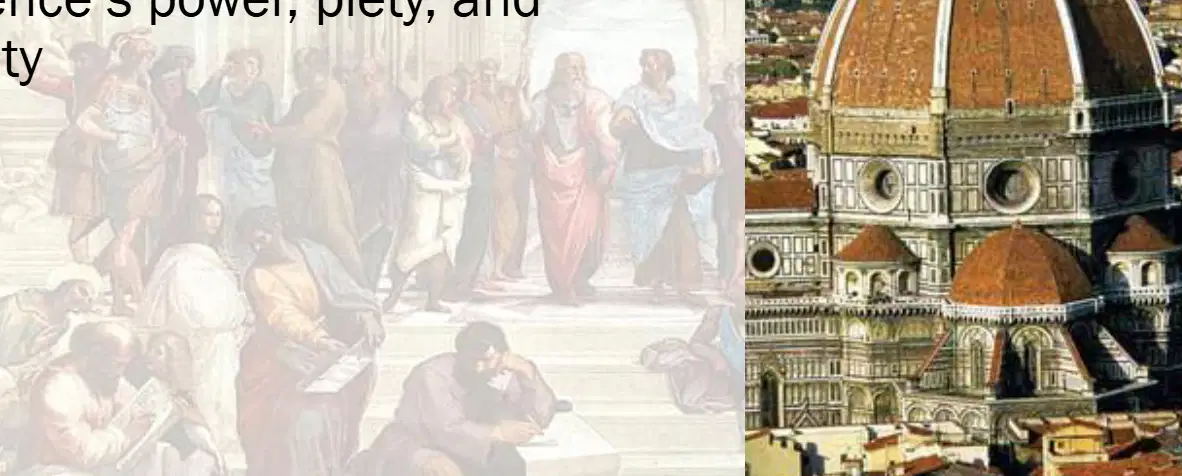
The Dome of Florence served as a symbol of the city’s
Military conquest of Rome
Power, piety, and ingenuity
Trade deficits and scarcity
Isolation from Europe
Michelangelo’s statue David exhibits a classical pose characterized by
Forward lean with wide stance
Raised arms and bent knees
Relaxed left leg, stiff right
Balanced weight on both feet
In civic symbolism, David can metaphorically represent
The Medici exile from Pisa
Rome’s triumph over Florence
Florence’s victory over Milan
Florence’s defeat by Venice
Which foundational method became central to European art for roughly five centuries?
Contrapposto body alignment
Perspective construction rules
Fresco plaster techniques
Chiaroscuro shading practice
Why did patrons in the Renaissance invest in artworks?
To replace church architecture
To codify guild regulations
To project power and wealth
To evade civic taxes
In Raphael’s School of Athens, which pair is depicted at the architectural center as leading figures among ancient philosophers?
Plato and Aristotle
Heraclitus and Democritus
Socrates and Pythagoras
Epicurus and Zeno
Which visual qualities are emphasized by the composition of the School of Athens?
Mysticism, abstraction, minimalism
Emotion, drama, chiaroscuro
Chaos, spontaneity, asymmetry
Order, unity, symmetry
Michelangelo’s Sistine Chapel ceiling is best described as combining which elements?
Baroque theatrics and Counter-Reformation themes
Classical human form and Christian narratives
Medieval iconography and Gothic architecture
Byzantine mosaics and Romanesque reliefs
What did Northern Humanists aim to retain while studying classical learning?
Military chivalry and knighthood
Monastic isolation and asceticism
Feudal obligations and serfdom
Christian values like piety and love

Which statement best defines Christian Humanism during the Northern Renaissance?
Prioritizing royal power over theology
Applying Renaissance ideas to Christian themes
Rejecting scripture in favor of pagan texts
Replacing churches with secular academies
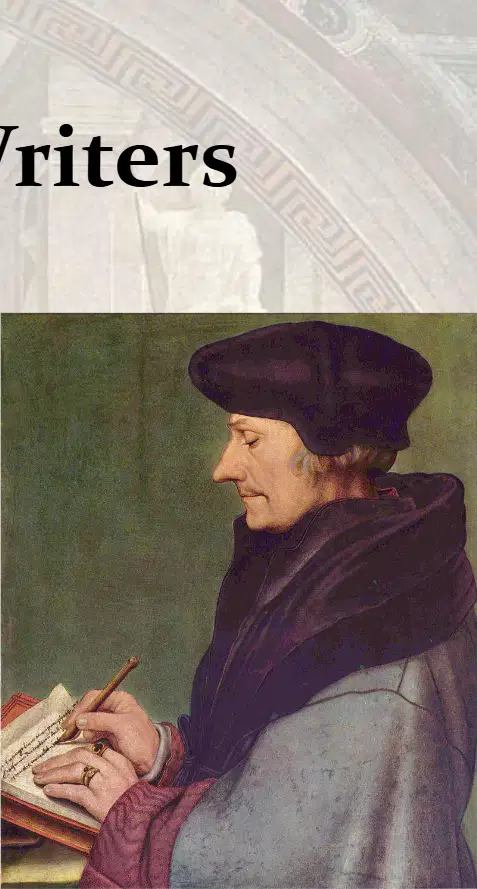
Who was called the “Prince of the Humanists” and authored The Praise of Folly?
Pico della Mirandola of Modena
Niccolò Machiavelli of Florence
Desiderius Erasmus of Rotterdam
Francis Bacon of London
Erasmus’s writings most often targeted which problem?
Greedy and hypocritical church leaders
Illiteracy among rural peasants
Decline of urban guild craftsmanship
Overtaxation by secular monarchs
The phrase “Erasmus laid the egg that Luther hatched” suggests what relationship?
Erasmus created Protestantism single‑handedly
Luther directly tutored Erasmus in doctrine
Medieval theology fully rejected humanism
Humanist critiques paved the way for reform
How did Northern Renaissance writers use learning differently than many Italian counterparts?
Employed learning to pursue religious reform
Focused chiefly on courtly aesthetics
Reinforced medieval scholastic disputation
Avoided political or moral commentary
Which outcome aligns with Christian Humanist reform goals?
Restoring crusading orders’ dominance
Strengthening papal temporal armies
Expanding indulgence sales revenues
Cleaner institutions and moral leadership
If a Northern Humanist advised a ruler, which policy would best reflect their ideals?
Ban vernacular scripture translations
Support schools teaching virtue and charity
Reward wealth accumulation by clergy
Mandate noble-only classical education
Which feature best characterizes Northern Renaissance art as described?
Idealized figures and heroic myths
Naturalism and everyday life portrayal
Classical architecture and linear perspective
Abstract forms and emotional color
Which painting by Rembrandt depicts a professor leading a study on human anatomy?
Anatomy Lesson of Dr. Jan Deijman
Self-Portrait with two circles
Night Watch in Amsterdam hall
The Storm on the Sea of Galilee
Pieter Bruegel the Elder’s Battle Between Carnival and Lent primarily depicts what?
A merchant voyage to the East
A royal coronation in Vienna
A mythic duel of Roman gods
A common celebration in Southern Netherlands
Identify the main impact of the printing press on the spread of Renaissance works.
Limited literacy to clergy
Increased costs of manuscripts
Enabled works to spread quickly
Restricted circulation by guild rules
In 1456, which text was published using movable type?
Decameron second printing
King James Bible translation
Mazarine Bible edition
Luther’s Ninety-Five Theses
Why did authorities find it harder to suppress dissenting ideas after the printing press emerged?
Books became fragile and rare
Monasteries controlled distribution
Ideas spread faster through print
Censorship laws were abolished
Which statement compares the printing press to a modern technology in terms of idea dissemination?
It mirrored radio broadcasts at night
It resembled telegraph lines in cities
It worked like the internet for spreading ideas
It functioned like postal services today
What was a key military change under New Monarchs?
Militia raised by the Church
Creation of professional standing armies
Mercenary bands hired by nobles
Feudal levies from vassals
How did the relationship with the Church change under New Monarchs?
Clergy replaced royal bureaucrats entirely
Top‑down reforms reduced Church power
Church gained increased temporal authority
Kings remained subordinate to the pope
Which administrative development supported centralized power for New Monarchs?
Guild councils of artisans
Decentralized feudal courts
Regional assemblies led by bishops
Centralized bureaucracy of middle‑class officials
Who initiated French recovery after the Hundred Years’ War by strengthening royal finances and the army?
Charles VII of France
Henry II of Navarre
Francis I of Angoulême
Louis XII of Brittany
Louis XI is often associated with consolidating power by curbing noble independence. Which policy aligns with that goal?
Developing royal bureaucracy and taxation
Empowering provincial estates over the crown
Expanding feudal immunities for vassals
Transferring judicial power to noble courts
What was the Concordat of Bologna (1516) under Francis I primarily about?
Allowing French king to appoint high Church officials
Granting French nobles control of bishoprics
Abolishing royal authority in ecclesiastical courts
Recognizing papal taxation over French subjects
Why did New Monarchs favor middle‑class officials in administration?
They were cheaper than clergy and nobles
They were loyal to local lords over the crown
They strengthened feudal fragmentation
They supported centralized royal authority
Which fiscal measure under Charles VII became a primary source of royal income for centuries?
Sale of offices and court patronage
Monopoly on grain trade and mills
Land tax taille and salt tax gabelle
Abolition of feudal dues and tariffs
What military reform is attributed to Charles VII after the Hundred Years War?
Creation of a permanent royal army
Hiring mercenaries for short campaigns
Delegating warfare to local nobles
Forming naval fleets to patrol coasts
Louis XI’s economic strategy most directly aimed to do what?
Control markets by banning guilds
Expand economy by promoting industries
Replace taxes with church tithes
Finance crusades through indulgences
Which industry is specifically linked to Louis XI’s economic policy?
Wool spinning and cloth dying
Silk weaving and luxury textiles
Iron smelting and cannon casting
Wine production and grape cultivation
Francis I secured administrative control over the French Church through which agreement?
Peace of Augsburg of 1555
Edict of Nantes of 1598
Concordat of Bologna of 1516
Treaty of Tordesillas of 1494
Under the Concordat of Bologna, what authority did the French king gain?
Control to rewrite canon law statutes
Ability to appoint parish priests directly
Right to levy papal taxes independently
Power to nominate bishops and abbots
Who was the first French monarch to be addressed as “Your Majesty”?
Charles VII during postwar reforms
Louis XI during economic expansion
Francis I in the early sixteenth century
Henry II after consolidating authority
Which outcome best reflects Charles VII’s success against foreign enemies?
Defeated Burgundian dukes decisively
Ridded France of English invaders
Annexed Navarre and Aragonese lands
Drove Habsburgs from northern Italy
How did Louis XI strengthen royal military capacity compared to his predecessor?
Expanded the existing royal army
Focused solely on fortification building
Reduced cavalry in favor of infantry
Shifted defense to private militias
Which policy combination most illustrates Francis I’s royal authority over religion and titles?
Edict of Nantes and military levies
Guild suppression and naval construction
Being called Your Majesty and the Concordat
Salt tax gabelle and land tax taille
Which dynasty did Henry VII and Henry VIII belong to in England?
Stuart house preceding James I
Tudor dynasty established by Henry VII
Yorkist line after Wars of the Roses
Plantagenet dynasty of medieval England
What was the primary purpose of Henry VII’s Star Chamber?
Register trade guilds and wool tariffs
Issue royal proclamations to counties
Tax clergy to fund the merchant marine
Try prominent nobles outside common law
Which feature best characterized procedures in the Star Chamber under Henry VII?
Jury deliberations from local shires
Right to appeal verdicts to Parliament
Public trials with sworn witnesses
No appeals, no juries, no witnesses
How did Henry VII extend royal authority across localities?
By appointing bishops as sheriffs
Using standing armies in each shire
By creating regional privy councils
Through Justices of the Peace network
Which economic policy is most associated with Henry VII?
Imposing navigation acts on Dutch traders
Opening silver mines in Northumbria
Expanding the wool industry and merchant marine
Colonizing Ireland to secure raw materials
Henry VIII’s major religious change in England resulted in what institution?
Roman Catholic Church with English rites
Presbyterian Church governed by elders
Anglican Church led by the monarch
Puritan Congregationalist national church
What action by Henry VIII most directly weakened monastic influence?
Restoring papal authority over bishops
Adopting Lutheran Augsburg Confession
Dissolution of the Monasteries nationwide
Issuing the Six Articles of Religion
Which statement compares the aims of Henry VII and Henry VIII most accurately?
Henry VII consolidated power; Henry VIII reformed religion
Both sought parliamentary sovereignty first
Both relied on juries and appeals for justice
Henry VII pursued empire; Henry VIII promoted trade only
Why did the Star Chamber help Tudor centralization?
It guaranteed local jury independence
It expanded feudal courts for magnates
It increased appeals to ecclesiastical courts
It curtailed noble resistance to royal justice
What immediate political effect followed Henry VIII’s creation of the Anglican Church?
Ended the Star Chamber’s jurisdiction permanently
Transferred ecclesiastical authority to the crown
Strengthened papal supremacy over England
Restored monastic lands to religious orders

