
 Worksheets
Midterm Review 7th Grade
Total questions: 100
Worksheet time: 2hrs 40mins
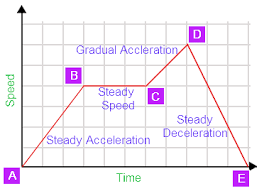
At what point is the speed the greatest?
C-D
B-C
A-B
D-E

Two people walk across a parking lot. Their paths are shown in the image. Who traveled with a larger displacement?
Person A
Person B
They both had the same displacement.
Steve runs 20 m North in 4 seconds. What is his velocity
5 m/s
4 m/s south
5 m/s south
5 m/s north
A runner runs 2 laps around a track with a circumference of 400 m in 100 seconds. What is their average velocity?
80 m/s
0
40 m/s
60 m/s

A 20 kg object needs how big of a net force to keep moving at a constant velocity?
0 N
20 N
200 N
2 N
If an astronaut has a mass of 88 kg on the Earth, her mass up in orbit on the International Space Station would be:
88 kg
0 kg
44 kg
You can't tell because she would be weightless.
An astronaut kicks a soccer ball in outer space at a location far from significant influences of gravity and air resistance. The soccer ball will _________.
continue in motion with the same speed and direction
eventually stop as its inertia slowly becomes used up
eventually stop since all objects ultimately "lose their steam"
either a, b, or c -- depending on whether the astronaut continues to kick it
Why does an 18-wheeler truck have more inertia than a bicycle?
it has more mass
it has more volume
it is not as aerodynamic
it has more space
An object's tendency to resist (not) change its state of motion.
gravity
force
inertia
friction
Which of the following has no acceleration?
A motorcycle speeding up
A school bus coming to a stop at a stop sign
A mini van going a constant speed
The moon in orbit around Earth
What is the difference between speed and velocity?
There is no difference.
Speed is calculated in a different way.
Velocity is speed with a given direction.
Both have the same units.
A hockey puck sliding on ice eventually comes to a stop. Describe the forces involved.
unbalanced
balanced
Fnet = 0
None of these

Which is faster?
walking
skating
biking

Describe the motion in the graph:
Constant Speed (positive slope)
Stopped (at rest)
Acceleration (increasing speed)
Return Home (negative slope)
Match the description to the graph:
"The car is slowing down."


A measure of the average kinetic energy of the individual particles in an object is called
thermal energy
conduction
convection
temperature
What is temperature?
The sum of kinetic and potential energy of the particles in an object
The transfer of energy from one object to another
The measure of the average kinetic energy of particles in an object
The thermal energy that is moving or is capable of moving
What is thermal energy?
The sum of kinetic and potential energy of the particles in an object
The transfer of energy from one object to another
The measure of the average kinetic energy of particles in an object
The thermal energy that is moving or is capable of moving
Thermal expansion occurs because:
Particles slow down and come closer together when heated
Particles speed up and spread apart when heated
Particles change from solid to liquid
Particles are destroyed by heat
True or False:
Thermal expansion occurs in all 3 states of matter (solid, liquid, gas)
True
False
Many objects, such as train tracks and road joints, are specifically designed to allow extra space for (a)

The movement of thermal energy from a region of (a) temperature to a region of (b) temperature is called heat.

Convection currents can be observed in ...
liquids
gases
solids
superconductors
Heated air moves from baseboard heaters to the rest of a room in a process called
conduction
convection
radiation
insulation
Convert 110 ℉ to ℃.
33
23
53
43
The temperature at which particles stop moving is
0 oC
32 oF
0 K
0 oF
Convert 125 °C = ? °F
(Round to the nearest tenth).
(a)
A snowball is made up of frozen water, which means its temperature is at or below 0°C. A person's hand is usually at normal body temperature, about 37°C.
A person holds a snowball in his hand. Which photo shows the direction of thermal energy transfer?


During summer the ground temperature is 50°C. If you place a piece of ice that has a temperature of –6°C.
Which statement best explains what happens?
Heat transfers coldness from the ice to the ground.
Thermal energy transfers heat from the ground to the ice.
Thermal energy transfers coldness from the ground to the ice.
Heat transfers thermal energy from the ground to the ice.
The transfer of thermal energy between objects
Kinetic energy
Temperature
Heat
Potential energy
If it is very cold outside and you start feeling cold, what happened?
The cold is going into your body and making you cold
You are losing thermal energy (heat) from your body to the cold environment

When you put ice into a drink what happens?
The ice puts cold into the drink
The heat leaves the drink and goes into the ice
nothing
Which process transfers thermal energy through waves?
Radiation
Conduction
Convection
Circulating
How is thermal energy different from temperature?
Thermal energy is the total energy due to motion of particles, while temperature is the average kinetic energy of atoms.
Thermal energy is the same as temperature.
Thermal energy is only found in solids, while temperature is only in gases.
Thermal energy measures compactness, while temperature measures volume.
What is a substance that is dissolved in another substance?
Solution
Solvent
Solute
Compound
What is the term for a mixture in which one substance is evenly distributed within another?
Suspension
Colloid
Solution
Emulsion
Which of the following is a characteristic of a solvent?
It is always a liquid.
It dissolves other substances.
It is always a solid.
It cannot be separated.
In a saltwater solution, what is the role of water?
Solute
Solvent
Solution
Compound
The smaller the particle size, the faster the rate of dissolution (rate of dissolving).
True
False
Which combination would dissolve a solid solute the fastest?
High temperature, no stirring
No heat, no stirring
Sugar cube, no heat
High temperature, stirring
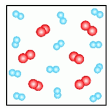

What type of substance is being modeled here?
Element
Compound
Homogeneous Mixture
Heterogeneous Mixture

Which diagram(s) are modeling pure substances?
1 only
1, 3, and 4
2 only
1 and 4

Which model represents a compound?
Model 1
Model 2
Model 3
Model 4
Which element makes up most of Earth’s atmosphere?
Hydrogen
Carbon
Oxygen
Nitrogen
How are elements and compounds different?
A compound is represented by a chemical formula, and elements are represented by a chemical symbol.
Compounds are represented by chemical symbols of one letter, and elements are represented by symbols of two letters.
Elements are pure substances, and compounds are not.
Elements are always larger units of matter, and compounds are smaller.
How many elements are in the compound Fe2O3?
0
1
2
3
Water is made up of hydrogen and oxygen, two elements that were chemically combined. This makes water a(n)
atom
compound
element
mixture
__ is a pure substance containing two or more kinds of atoms.
Element
compound
mixture
solution
The smallest particle of an element; the smallest unit of matter.
atom
element
compound
mixture

Is this an example of a physical or chemical change?
Physical
Chemical

Is this an example of a physical or chemical change?
Physical
Chemical
Which lab experiments below describe a situation where a chemical change has occurred? Check all that apply.
After adding zinc (Zn) to hydrochloric acid (HCl), a student observes bubbles forming in the solution and a thermometer registers a 10° change in temperature.
A student uses a mortar and pestle (a grinding stone) to break up large pieces of ammonium thiocyanate ( NH4SCN ) into smaller pieces.
After combining Unknown A (a solid, white crystal) with Unknown B (a clear, odorless liquid), there is a strong smell produced and a thermometer registers a 15° change in temperature.
A student dissolves sugar ( C6H6O6 ) into water ( H2O ). The sugar crystals seem to disappear.
Physical property
Color
Physical property
Melts at 145 °C
Physical property
Good conductor of heat
Chemical property
Burns easily (flammable)
Chemical property
Reacts violently with chlorine
Chemical change
Burning gasoline
Chemical change
Milk sours
Chemical change
Digesting food
Physical change
Dissolving sugar in water
Physical change
Ethyl alcohol evaporates
Chemical Properties are characteristics that are observed or measured without changing matter.
True
False
Which is a sign of a chemical reaction and or an example of a physical change?
change in color
ice melting
flammability
density
Which is an example of a physical change?
change in odor
ice melting
flammability
density
Which is and example of a chemical property?
change in odor
ice melting
flammability
density
Which is and example of a physical property?
change in odor
ice melting
flammability
density

