
 Worksheets
Quiz on Shunt DC Motor
Total questions: 9
Worksheet time: 5mins
Which windings in the electrical diagram are responsible for excitation in the shunt DC motor?
Auxiliary poles winding (D1, D2)
Additional windings (A, B1, A2, B2)
Excitation winding (E1, E2)
Field rheostat (Rc)
What does the term "armature reaction" refer to in the context of a shunt DC motor?
The interaction between the field and armature currents.
The loss of energy due to mechanical friction.
The stabilization of the magnetic field by auxiliary poles.
The adjustment of the start-up current.
Which component in the electrical diagram is directly responsible for controlling the motor's start-up current?
Field rheostat (Rc)
Start-up rheostat (Rp)
Excitation winding (E1, E2)
Auxiliary poles winding (D1, D2)
What is the significance of additional windings (A, B1, A2, B2) in the shunt DC motor?
They provide excitation to the motor.
They compensate for the armature reaction.
They control the start-up current.
They adjust the field current.
What type of losses are primarily encountered at no-load in a motor?
Mechanical and magnetic losses
Electrical and thermal losses
Frictional and windage losses
Core and stray losses
What does the iron loss in a motor depend on?
Motor speed and excitation flux
Load and excitation current
Magnetic flux and load
Motor speed and load
If the excitation current (Ie) is increased, what will happen to the no-load e.m.f. of the motor?
It will decrease
It will remain constant
It will increase
It will fluctuate
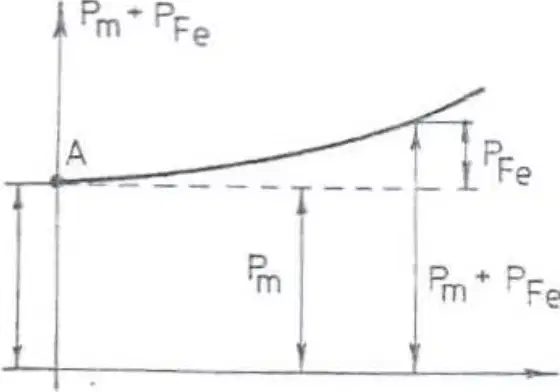
What does the excitation flux represent at point A in the diagram?
The total losses
The iron losses ($P_{Fe}$)
The mechanical losses ($P_{m}$)
Zero value
What is the purpose of using the formulas provided in the learning material?
To calculate the excitation flux
To complete the table and analyze losses
To determine the resistance values
To measure the current flow

