
 Worksheets
Physics: Unit 8 - Electricity and Magnetism
Total questions: 55
Worksheet time: 55mins
What does it mean when the electric field lines are close together?
The field is positive
The field is negative
The field is strong
The field is weak
When a glass rod is rubbed with silk and becomes positively charged, what happens to the electrons?
They are removed from the rod.
They are added to the rod.
What is the process of charging a conductor by bringing it near another charged object and grounding it called?
induction
polarization
neutralization
conduction
Which of the following is a good conductor?
Copper
Glass
Rubber
Wool
Assume a rubber rod is rubbed against rabbit fur and gains 5 electrons. Which of the following statements is true?
The fur lost 5 electrons.
The fur gained 5 electrons.
The fur gained 5 protons.
The fur lost 2 electrons.
The distance between two charges is r, and the force between them is F. What will the force be between them if the distance is tripled?
3F
9F
F/3
F/9
What is the magnitude of the electric field intensity at a point where a proton experiences an electrostatic force of 2.30 × 10⁻²⁵ newtons?
1.44 × 10⁻⁶ N/C
3.68 × 10⁶ N/C
1.44 × 1044 N/C
3.68 × 10-44 N/C

QA and QB are two charges creating an electric field. Based on the electric field lines shown, we can conclude:
QA and QB are both positive.
QA and QB are both negative.
QA is positive and QB is negative.
QA is negative and QB is positive.

Two point charges, initially 4 cm apart, are moved to a distance of 12 cm apart. By what factor does the electric force between them change?
8
1/3
1/9
9


Three resistors with values of 4.0 Ω, 6.0 Ω, and 10.0 Ω are connected in parallel. What is the equivalent resistance?
20.0 Ω
7.3 Ω
6.0 Ω
1.9 Ω


In an electric circuit, charges:
flow in a closed loop.
receive energy from an external source.
flow from higher potential to lower potential.
do all of these.

Compared to thin wires, the electrical resistance of thick wires is:
greater
less
the same

The current from a battery is:
AC
DC

As the number of resistors in a parallel circuit increases, what happens to the equivalent resistance and the total current in the circuit?
The equivalent resistance and total current decrease.
The equivalent resistance and total current increase.
The equivalent resistance increases and the total current decreases.
The equivalent resistance decreases and the total current increases.
What is the effect on the current in a simple circuit if both the voltage and the resistance are doubled?
1/2 I
I
2 I
4 I


A 20.0 Ω and a 40.0 Ω resistor are connected in series across a battery. If the current is 2.00 A, what is the voltage of the battery?
30.0 V
60.0 V
80.0 V
120 V

Three resistors of 4.0 Ω, 8.0 Ω, and 10.0 Ω are connected in series across an 11 V battery. What is the potential difference across the 4.0 Ω resistor?
2.0 V
4.0 V
5.0 V
11 V

Identify the following as a characteristic of either a series circuit or a parallel circuit:
Type of circuit used for wiring in buildings.
Series circuit
Parallel circuit

Identify the following as a characteristic of either a series circuit or a parallel circuit:
When one light bulb burns out, the others remain lit.
Series circuit
Parallel circuit
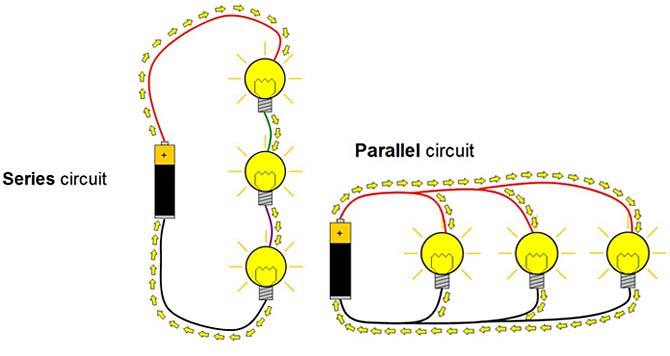
Identify the following as a characteristic of either a series circuit or a parallel circuit:
When one light bulb burns out, all of the bulbs go out.
Series circuit
Parallel circuit

Identify the following as a characteristic of either a series circuit or a parallel circuit:
The current remains the same throughout the entire circuit.
Series circuit
Parallel circuit

How does the brightness of each identical light bulb compare?
A is the brightest.
B is the brightest.
C is the brightest.
All have equal brightness.

What will happen if bulb A is removed?
Bulbs B and C will go out.
Bulb B will go out.
Bulb C will go out.
Bulbs B and C will stay lit.

What will happen if bulb C is unscrewed?
Bulbs A and B will go out.
Bulb B will go out.
Bulb A will go out.
Bulbs A and B will stay lit.

Which light bulb has the highest voltage across it?
Bulb A
Bulb B
Bulb C
All bulbs have equal voltage
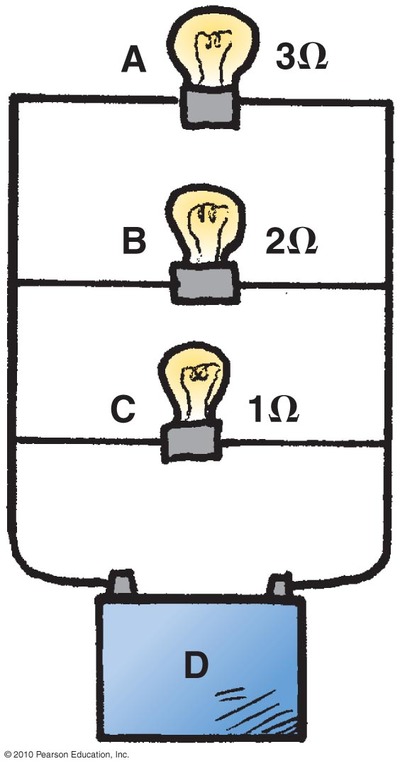
Which bulb has the greatest current flowing through it?
Bulb A
Bulb B
Bulb C
All bulbs have the same current
The magnetic pole that points toward the geographic north is the magnet's
south pole
north pole
east pole
west pole
As an electron moves, it creates or induces a
resistance
voltage
proton
magnetic field
TRUE OR FALSE
A magnet can have only a north pole, just as a charge can be only positive.
TRUE
FALSE
A device that increases or decreases the voltage of alternating current.
electric motor
magnet
transformer
electric generator
A device that converts electrical energy into mechanical energy.
electric motor
solenoid
electric generator
transformer
A device that converts mechanical energy into electrical energy.
electric motor
solenoid
electric generator
transformer
The attraction or repulsion caused by the interaction of two magnetic fields.
electric force
magnetic force
electric generator
electric motor
A coil of wire with a soft iron core that becomes a magnet when an electric current flows through the coil is called a(n)
ferromagnet
electromagnet
permanent magnet
temporary magnet
Increasing the number of loops per meter in the coils of a solenoid is one way to:
increase the wire's electric current.
decrease the wire's electric current.
strengthen the solenoid's magnetic field.
weaken the solenoid's magnetic field.
How does a galvanometer utilize the relationship between electric current and magnetic fields?
Galvanometers generate electric current.
Galvanometers change AC to DC.
Galvanometers use magnets to measure current.
Galvanometers use magnets to convert current into other forms of energy.
Four coils of wire are being used as electromagnets. They are all the same size and made of the same material, but each has a different number of loops. Which coil will produce the strongest magnetic field when the same amount of current passes through each coil?
15 loops
25 loops
35 loops
45 loops
Which of the following options can be used to generate electricity?
Move the circuit loop into and out of a magnetic field.
Change the magnetic field strength around the circuit loop.
Change the orientation of the circuit loop with respect to the magnetic field.
All of the above.
The lines of the magnetic field around a current-carrying wire
point away from the wire.
point toward the wire.
form concentric circles around the wire.
are parallel to the wire.
Which of the following modifications to a solenoid would most likely decrease the strength of its magnetic field?
Removing its iron core and increasing the number of coils
Increasing the current and reducing the number of coils
Reducing the number of coils and inserting an iron core
Decreasing the current and reducing the number of coils
Where is the magnitude of the magnetic field around a permanent magnet greatest?
The magnitude is greatest close to the poles.
The magnitude is greater at the north pole than at the south pole.
The magnitude is equal at all points in the field.
The magnitude is greatest halfway between the poles.
Why do power companies transmit electricity using AC power instead of DC power?
More devices run on AC power
AC power is cheaper to generate
AC power can travel over longer distances
AC power is better for the environment
Which of the following statements about a transformer is true?
Works with both DC and AC power
Changes voltage and current
Changes voltage but not current
Increases electrical power
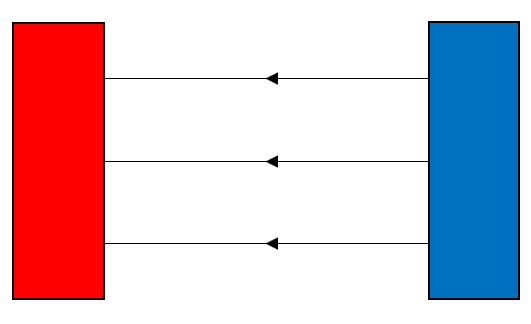
What type of pole is the red pole shown in the diagram?
north
east
west


What is the direction of the current through the circular coil if the magnetic field at the center is as shown?
clockwise
counterclockwise

What is the direction of the magnetic force on a POSITIVE moving particle in the magnetic field?
right
left
up
down

All of the following would increase the current induced by the magnet except:
move the magnet faster
add more coils to the wire
reverse the magnet direction
use a stronger magnet
In a step-down transformer:
Both current and voltage decrease.
Both current and voltage increase.
Voltage decreases, current increases.
Voltage increases, current decreases.
Primary winding: 400 turns
Secondary winding: 200 turns
If there are 240V and 8A on the primary, the secondary will have...
240V at 4A
120V at 4A
240V at 16A
120V at 16A

