
 Worksheets
PMA_Review 1
Total questions: 18
Worksheet time: 9mins
What is Accessibility Hierarchy about?
A list of vocabulary items arranged by frequency of use in English.
A universal sequence predicting the order in which learners acquire different types of relative clauses.
A ranking of language skills (listening, speaking, reading, writing) based on difficulty.
A method for teaching grammar through activities of hierarchy.
The Noun Phrase Accessibility Hierarchy indicates that the easiest relative clause construction is the subject of the relative clause.
True
False
The following relative clause types are listed in a random order. Rearrange them according to the Accessibility Hierarchy from easiest to hardest:
Subject → Direct Object → Indirect Object → Object of Preposition → Genitive → Object of Comparison
Subject → Indirect Object → Direct Object → Object of Comparison → Object of Preposition → Genitive
Genitive → Object of Comparison → Object of Preposition → Indirect Object → Direct Object → Subject
Direct Object → Subject → Indirect Object → Object of Preposition → Genitive → Object of Comparison
What does the Acculturation Model claim in second language acquisition?
Learners acquire a second language faster if they memorize vocabulary lists.
The success of L2 acquisition depends on learners’ full adaptation to the target language culture.
Language acquisition occurs independently of cultural adaptation.
Grammar instruction is the primary factor in successful language learning.
According to the Acculturation Model, ________ and ________ have effects on the success of L2 learners’ acquisition
Contextual + Psychological
Psychological + Social
Social + Mental
Mental + Linguistic
Anxiety, Motivation, and Ego are some popular psychological distance factors.
True
False
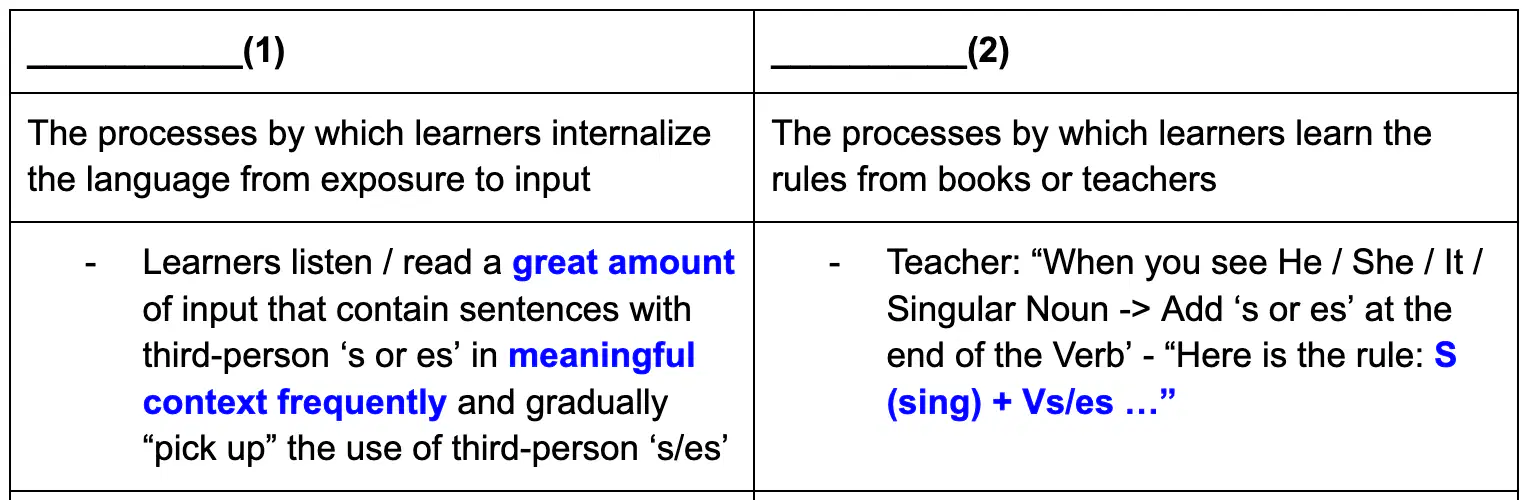
Look at the table and fill in the blanks
Acquisition/Learning
Learning/Acquisition
Acquisition/Immersion
Immersion/Learning
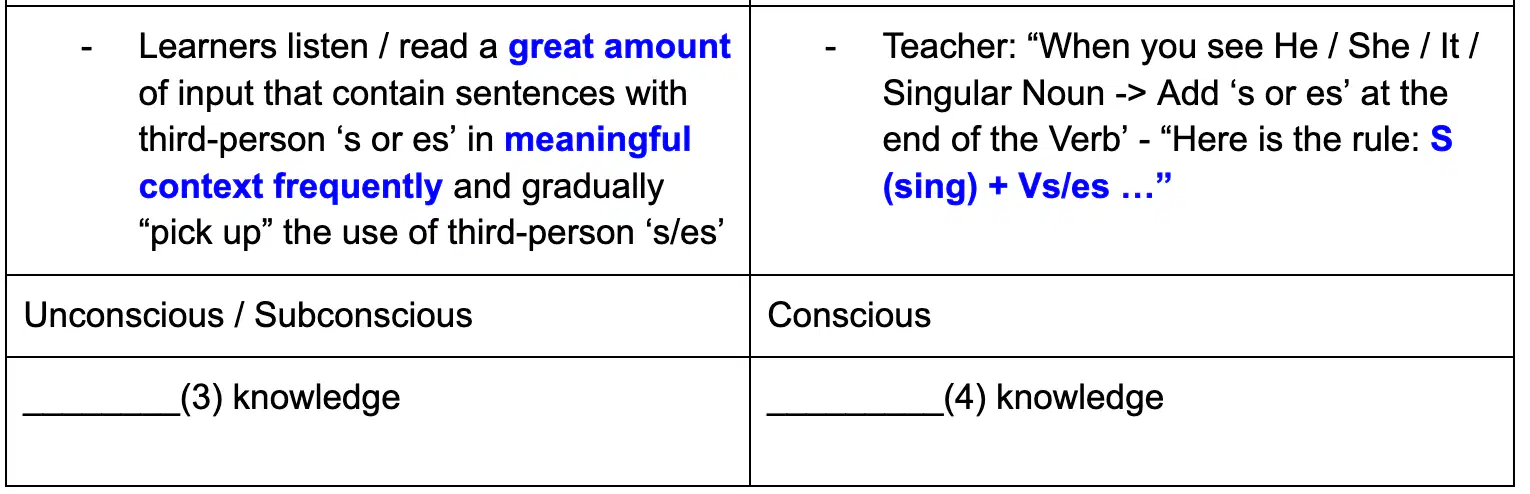
Look at the information from the table and fill in the blanks
Declarative/Implicit
Explicit/Procedural
Implicit/Explicit
Implicit/Metalinguistic
According to S. Krashen, learning rules and practicing using these rules sufficiently can help learners acquire a language.
True
False
Learning provides learners with learned system which allows learners to:
communicate naturally
monitor the output
take advantage of the input
accelerate the learning process
According to the core application of behaviorism in language learning, how is language primarily viewed?
A system of innate rules that learners discover naturally.
A set of patterns or habits formed through repetition and reinforcement.
A creative process of generating novel sentences using universal grammar.
A collection of vocabulary memorized for communication purposes.
Behaviorist believe that as long as an organism interacts with its environment, its behavior is conditioned
True
False
In the L2 context, learners were to be trained to repress L1 habits and acquire good L2 habits. Behaviors were modified over time when learners were ________ for responding correctly.
reinforced
penalized
ignored
graded
________ were a sign of failure that should be corrected immediately.
Errors
Hypotheses
Strategies
Styles
Pedagogical and practical implications of behaviorism resulted in ALM — Audio-lingual method which was a teaching method heavily relied on ________
drills
translation
free writing
silent reading
What does the Critical Period Hypothesis (CPH) suggest in second language acquisition?
Language acquisition can occur at any age without limitations.
There is a specific time during which language acquisition is most effective, and after this period, full acquisition becomes unlikely.
Language learning depends on motivation and exposure, not age.
Children learn languages faster than adults because they have better mental capacity and “care-free” than adult learners
According to the weak version of CPH, if children fail to learn their first language by puberty they will not be able to learn it afterwards
True
False
Fill in the blanks: Until about the age of _________, children can still acquire a language, but without a native-like _________ . Choose the option that best completes both blanks.
puberty; competence
puberty; proficiency
18; accent
adolescence; fluency

